CO2 Gas Sensor Market Size, Share Demand Report By Technology (NDIR Sensors, Electrochemical Sensors, MEMS Sensors, Solid-State Sensors), By Application (HVAC Systems, Industrial Safety Monitoring, Environmental Monitoring, Automotive, Healthcare), By End-Use (Residential, Commercial Buildings, Industrial, Healthcare, Transportation), By Region & Segment Forecasts, 2026–2034
USD 3950
Market Overview
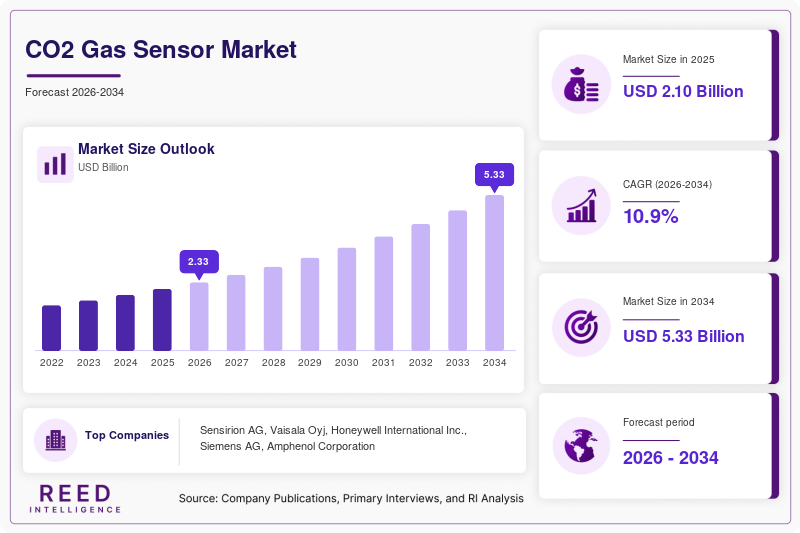
The global CO2 Gas Sensor Market size was valued at approximately USD 2.1 billion in 2026 and is projected to reach USD 4.8 billion by 2034, expanding at a compound annual growth rate (CAGR) of 10.9% during the forecast period of 2026–2034. The market continues to gain traction due to rising awareness regarding indoor air quality and environmental monitoring. Governments and regulatory bodies across developed and developing economies are implementing stricter air quality standards, which has increased the adoption of CO2 gas sensors in residential, commercial, and industrial applications.
A key global factor supporting market growth is the increasing deployment of smart building technologies. Modern infrastructure increasingly integrates HVAC systems with real-time monitoring capabilities, where CO2 sensors play a critical role in maintaining optimal ventilation and energy efficiency. This trend is particularly visible in urban regions, where concerns related to pollution and occupant health are shaping construction and facility management strategies.
Key Highlights
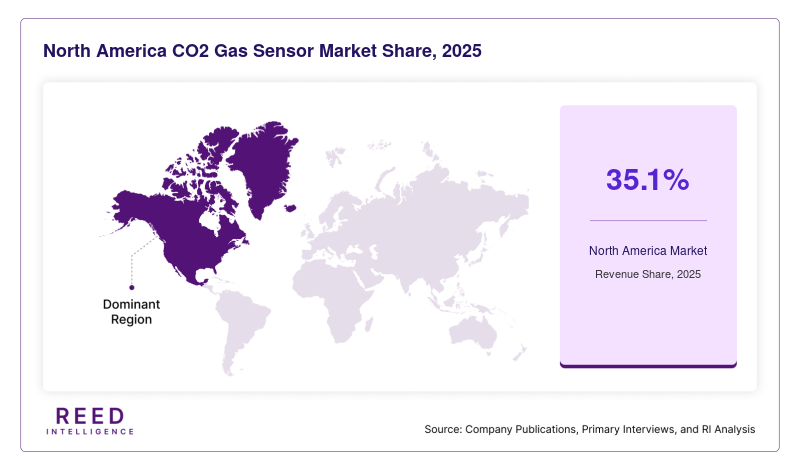
- North America dominated the market with a 35.1% share in 2025.
- Asia Pacific is expected to grow at the fastest CAGR of 12.3% during 2026–2034.
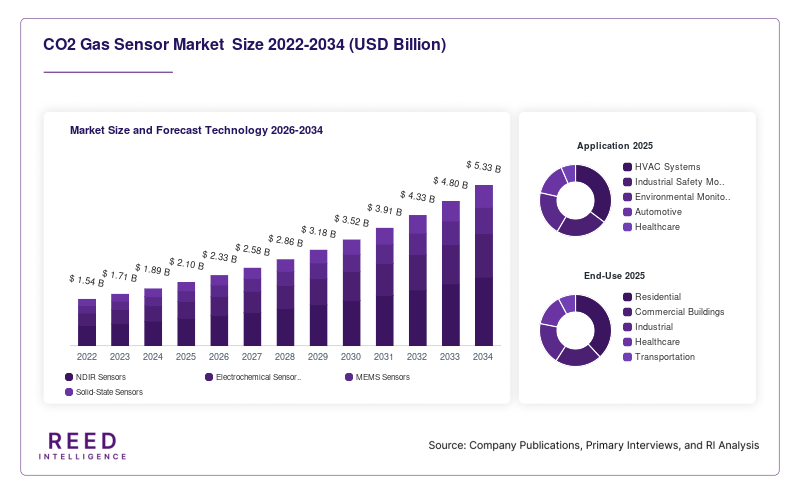
- By technology, NDIR sensors accounted for the largest share of 42.6%, while MEMS-based sensors are projected to grow at a CAGR of 13.1%.
- By application, HVAC systems led with a 39.8% share, whereas industrial safety monitoring is expected to expand at a CAGR of 12.6%.
- The United States remained the dominant country, with market values of USD 620 million in 2024 and USD 680 million in 2025.
Market Trends
Increasing Integration of IoT and Smart Monitoring Systems
The integration of Internet of Things (IoT) technologies into CO2 gas sensors is transforming the market landscape. Modern sensors are increasingly embedded with wireless connectivity features such as Wi-Fi, Bluetooth, and LoRa, enabling real-time data transmission and remote monitoring. This capability allows facility managers and industrial operators to track air quality continuously and make data-driven decisions. Smart buildings, in particular, rely heavily on such systems to optimize ventilation and energy consumption, creating a strong demand for connected CO2 sensors.
Additionally, IoT-enabled sensors support predictive maintenance by identifying patterns in air quality fluctuations. This reduces operational downtime and improves system efficiency. The adoption of cloud-based platforms further enhances scalability, enabling centralized monitoring across multiple locations. As industries continue to digitize operations, the demand for smart CO2 sensing solutions is expected to expand steadily, reinforcing this trend across commercial and industrial sectors.
Rising Demand for Indoor Air Quality Monitoring
Indoor air quality monitoring has emerged as a significant trend in the CO2 gas sensor market. Increasing awareness about the health impacts of poor air quality has driven demand in residential, commercial, and institutional settings. Elevated CO2 levels can affect cognitive performance, productivity, and overall well-being, prompting organizations to adopt monitoring systems in offices, schools, and healthcare facilities.
Post-pandemic emphasis on ventilation has further accelerated this trend. Governments and building standards now recommend maintaining optimal CO2 levels to reduce airborne risks, increasing the adoption of sensor-based solutions. The hospitality and retail sectors are also incorporating air quality monitoring to enhance customer experience. As urban populations continue to grow, the need for effective indoor air management solutions is expected to sustain long-term demand for CO2 gas sensors globally.
Market Drivers
Expansion of Smart Building Infrastructure
The rapid expansion of smart building infrastructure is a major driver of the CO2 gas sensor market. Modern buildings are designed to be energy-efficient and environmentally sustainable, requiring advanced monitoring systems to regulate air quality and ventilation. CO2 sensors are integral components of HVAC systems, enabling automated adjustments based on occupancy and air quality levels.
This integration not only improves occupant comfort but also reduces energy consumption, aligning with global sustainability goals. Governments are promoting green building certifications and energy-efficient construction practices, further supporting the adoption of such technologies. The commercial real estate sector, including offices and shopping complexes, is particularly driving demand. As smart city initiatives continue to gain momentum worldwide, the deployment of CO2 sensors is expected to increase significantly, reinforcing market growth over the forecast period.
Growing Industrial Safety and Environmental Regulations
Industrial safety regulations and environmental policies are also contributing to market growth. Industries such as oil and gas, chemicals, and manufacturing require continuous monitoring of gas concentrations to ensure worker safety and regulatory compliance. CO2 sensors are widely used to detect leaks and maintain safe working conditions in confined spaces.
Regulatory authorities across regions are enforcing stricter emission standards and workplace safety norms. This has compelled industries to invest in advanced monitoring systems, including high-precision CO2 sensors. Additionally, environmental monitoring initiatives aimed at reducing carbon emissions are driving the adoption of these sensors in outdoor and industrial applications. The increasing focus on sustainability and regulatory compliance is expected to remain a strong driver for the market.
Market Restraint
High Cost and Calibration Requirements
One of the primary restraints in the CO2 gas sensor market is the relatively high cost associated with advanced sensor technologies and their maintenance. High-precision sensors, particularly those based on non-dispersive infrared (NDIR) technology, involve complex manufacturing processes, leading to higher initial costs. This can limit adoption among small and medium-sized enterprises, especially in price-sensitive markets.
In addition to cost, regular calibration and maintenance requirements pose challenges. Sensors must be periodically calibrated to ensure accuracy, which increases operational expenses and requires technical expertise. In industrial settings, where multiple sensors are deployed, maintenance can become resource-intensive. This factor can deter end-users from adopting high-end solutions, particularly in developing regions.
Furthermore, the availability of low-cost alternatives with limited accuracy can create market fragmentation. While these alternatives may be sufficient for basic applications, they may not meet stringent regulatory standards, limiting their usage in critical environments. Addressing these challenges through cost optimization and technological innovation remains essential for sustained market growth.
Market Opportunities
Growth in Automotive Air Quality Monitoring
The automotive sector presents a significant opportunity for the CO2 gas sensor market. Modern vehicles, particularly electric and autonomous models, are increasingly incorporating advanced cabin air quality monitoring systems. CO2 sensors help maintain optimal air conditions within vehicles, enhancing passenger comfort and safety.
As consumer preferences shift toward premium features and improved in-cabin experiences, automakers are integrating sensors into climate control systems. This trend is particularly strong in electric vehicles, where energy efficiency and passenger comfort are key considerations. Additionally, regulatory standards for in-vehicle air quality are becoming more stringent, further supporting adoption. The continuous evolution of automotive technologies is expected to create long-term growth opportunities for sensor manufacturers.
Emerging Demand in Healthcare and Smart Wearables
The healthcare sector and smart wearable devices are emerging as promising application areas for CO2 gas sensors. In medical environments, these sensors are used for patient monitoring, respiratory analysis, and ventilation systems. The increasing focus on remote healthcare and telemedicine is driving the adoption of compact and portable sensing devices.
Wearable technology is also gaining traction, with sensors being integrated into devices for personal health monitoring. These applications require miniaturized sensors with high accuracy and low power consumption, creating opportunities for innovation. As healthcare systems continue to evolve and digital health technologies expand, the demand for advanced CO2 sensing solutions is expected to grow, opening new revenue streams for market participants.
Segmental Analysis
By Technology
NDIR (Non-Dispersive Infrared) sensors dominated the CO2 gas sensor market in 2024, accounting for approximately 42.6% of the total share. These sensors are widely preferred due to their high accuracy, stability, and long operational life. They are commonly used in HVAC systems, industrial monitoring, and environmental applications where precise measurements are critical. The ability of NDIR sensors to provide reliable performance under varying environmental conditions makes them suitable for both indoor and outdoor applications.
Additionally, advancements in NDIR technology have improved sensor efficiency and reduced power consumption. Manufacturers are focusing on developing compact and cost-effective NDIR sensors to expand their application scope. The increasing demand for high-performance sensing solutions in critical environments is expected to sustain the dominance of this segment over the forecast period.
MEMS-based sensors are projected to be the fastest-growing subsegment, with a CAGR of 13.1% during the forecast period. These sensors offer advantages such as miniaturization, low power consumption, and integration capabilities with electronic devices. Their compact size makes them ideal for portable and wearable applications, including smart devices and healthcare monitoring systems.
The growing demand for IoT-enabled devices is a key factor driving the adoption of MEMS-based sensors. Their ability to be integrated into smart systems enhances their utility in various applications. As technology continues to evolve, MEMS sensors are expected to gain significant traction, contributing to overall market growth.
By Application
HVAC systems accounted for the largest share of the CO2 gas sensor market in 2024, with approximately 39.8%. These systems rely on CO2 sensors to maintain optimal indoor air quality and energy efficiency. By monitoring CO2 levels, HVAC systems can adjust ventilation rates based on occupancy, reducing energy consumption and improving comfort.
The increasing adoption of smart building technologies has further strengthened the demand for CO2 sensors in HVAC applications. Commercial buildings, including offices and shopping malls, are incorporating advanced monitoring systems to enhance operational efficiency. The integration of sensors with building management systems is expected to drive continued growth in this segment.
Industrial safety monitoring is expected to be the fastest-growing application segment, with a CAGR of 12.6%. Industries such as oil and gas, chemicals, and manufacturing require continuous monitoring of gas levels to ensure worker safety. CO2 sensors play a critical role in detecting leaks and maintaining safe working environments.
The implementation of stringent safety regulations is a major factor driving growth in this segment. Companies are investing in advanced monitoring systems to comply with regulatory standards and prevent accidents. As industrial activities continue to expand, the demand for CO2 sensors in safety applications is expected to increase significantly.
By End-Use
Commercial buildings dominated the market in 2024, accounting for a significant share due to the widespread adoption of CO2 sensors in offices, retail spaces, and hospitality establishments. These environments require continuous monitoring of air quality to ensure occupant comfort and compliance with health standards. The integration of sensors into building management systems enhances operational efficiency and reduces energy consumption.
The growing emphasis on sustainability and energy efficiency is driving the adoption of CO2 sensors in commercial buildings. Green building certifications and environmental regulations are encouraging the use of advanced monitoring systems. This trend is expected to continue, supporting the dominance of this segment.
Healthcare is anticipated to be the fastest-growing end-use segment, with a CAGR of 12.9%. CO2 sensors are increasingly used in medical applications, including respiratory monitoring and ventilation systems. The rise of telemedicine and remote patient monitoring is driving demand for portable and accurate sensing devices.
Technological advancements in healthcare devices are enabling the integration of sensors into compact and wearable solutions. This enhances patient care and improves diagnostic capabilities. As healthcare systems continue to evolve, the demand for CO2 sensors in this sector is expected to grow rapidly.
Regional Analysis
North America
North America accounted for approximately 35.1% of the global CO2 gas sensor market share in 2025 and is expected to grow at a CAGR of 9.8% during the forecast period. The region benefits from advanced technological infrastructure and widespread adoption of smart building systems. Strong regulatory frameworks related to air quality and workplace safety further support market growth. The presence of established market players and continuous investment in research and development contribute to the region’s leadership position.
The United States dominates the regional market due to its robust industrial base and high adoption of smart technologies. A unique growth factor in the country is the increasing implementation of green building standards and energy-efficient systems. These initiatives require continuous monitoring of indoor air quality, driving demand for CO2 sensors across commercial and residential sectors.
Europe
Europe held a significant share of the market in 2025 and is projected to expand at a CAGR of 10.2% during the forecast period. The region’s focus on environmental sustainability and carbon emission reduction has driven the adoption of advanced sensing technologies. Regulatory policies aimed at improving indoor and outdoor air quality are key factors supporting market growth.
Germany leads the European market due to its strong manufacturing sector and emphasis on industrial safety. A unique growth factor in the country is the integration of CO2 sensors in industrial automation systems. This trend enhances operational efficiency and ensures compliance with stringent safety regulations, boosting demand for advanced sensing solutions.
Asia Pacific
Asia Pacific is expected to register the fastest CAGR of 12.3% during the forecast period, driven by rapid urbanization and industrialization. The region’s expanding construction sector and increasing adoption of smart city initiatives are key growth drivers. Rising awareness about air pollution and its health impacts is also contributing to market expansion.
China dominates the regional market due to its large population and extensive industrial activities. A unique growth factor is the government’s focus on environmental monitoring and pollution control. Investments in smart infrastructure and clean energy projects are driving the adoption of CO2 sensors across various applications, including industrial and residential sectors.
Middle East & Africa
The Middle East & Africa region is witnessing steady growth in the CO2 gas sensor market, with a projected CAGR of 8.7%. Increasing investments in infrastructure development and industrial projects are driving demand for air quality monitoring solutions. The region’s harsh climatic conditions also necessitate efficient HVAC systems, further supporting market growth.
Saudi Arabia is a key market in the region, driven by large-scale construction and smart city projects. A unique growth factor is the country’s focus on sustainable urban development under its national vision initiatives. This has led to increased adoption of advanced monitoring technologies, including CO2 sensors, in commercial and residential buildings.
Latin America
Latin America accounted for a moderate share of the global market in 2025 and is expected to grow at a CAGR of 9.1%. The region’s growth is supported by increasing awareness about environmental issues and gradual adoption of smart technologies. Industrial expansion and urbanization are also contributing to the demand for CO2 sensors.
Brazil leads the regional market due to its growing industrial sector and urban population. A unique growth factor is the increasing implementation of environmental monitoring programs aimed at reducing pollution levels. These initiatives are encouraging the adoption of CO2 sensing technologies in both industrial and urban applications, supporting market growth.
Competitive Landscape
The CO2 gas sensor market is moderately competitive, with several global and regional players focusing on product innovation and strategic partnerships. Leading companies are investing in research and development to enhance sensor accuracy, reduce costs, and expand application areas. The market is characterized by continuous technological advancements and increasing competition among key players.
Sensirion AG is considered a leading player in the market due to its strong portfolio of high-precision sensors and consistent innovation. The company recently introduced a new generation of compact CO2 sensors designed for smart building applications, enhancing energy efficiency and performance.
Other major companies are also focusing on expanding their product offerings and geographic presence. Strategic collaborations with technology providers and end-users are helping companies strengthen their market position. The increasing demand for advanced sensing solutions is expected to intensify competition in the coming years.
Key Players
- Sensirion AG
- Vaisala Oyj
- Honeywell International Inc.
- Siemens AG
- Amphenol Corporation
- Figaro Engineering Inc.
- Gas Sensing Solutions Ltd.
- Senseair AB
- Telaire (Amphenol Advanced Sensors)
- Cubic Sensor and Instrument Co., Ltd.
- ELT Sensor Corp.
- Dynament Ltd.
- Edinburgh Sensors Ltd.
- Trane Technologies plc
- Johnson Controls International plc
Recent Developments
- Sensirion AG launched a compact CO2 sensor module designed for smart HVAC systems, improving energy efficiency and indoor air quality monitoring.
- Honeywell International Inc. expanded its gas detection portfolio with advanced IoT-enabled CO2 sensors for industrial safety applications.
- Vaisala Oyj introduced a new series of high-accuracy CO2 sensors for environmental monitoring and research applications, enhancing measurement precision.
CO2 Gas Sensor Market Segments
Technology
- NDIR Sensors
- Electrochemical Sensors
- MEMS Sensors
- Solid-State Sensors
Application
- HVAC Systems
- Industrial Safety Monitoring
- Environmental Monitoring
- Automotive
- Healthcare
End-Use
- Residential
- Commercial Buildings
- Industrial
- Healthcare
- Transportation
By Region
- North America
- Europe
- APAC
- Middle East and Africa
- LATAM