Co2 Lasers Market Size, Share & Demand Report By Type (Continuous Wave CO₂ Lasers, Pulsed CO₂ Lasers), By Application (Material Processing, Medical Procedures, Marking & Engraving, Others), By End-Use Industry (Industrial Manufacturing, Healthcare, Electronics, Automotive, Others), By Region & Segment Forecasts, 2025–2034
USD 3950
Market Overview
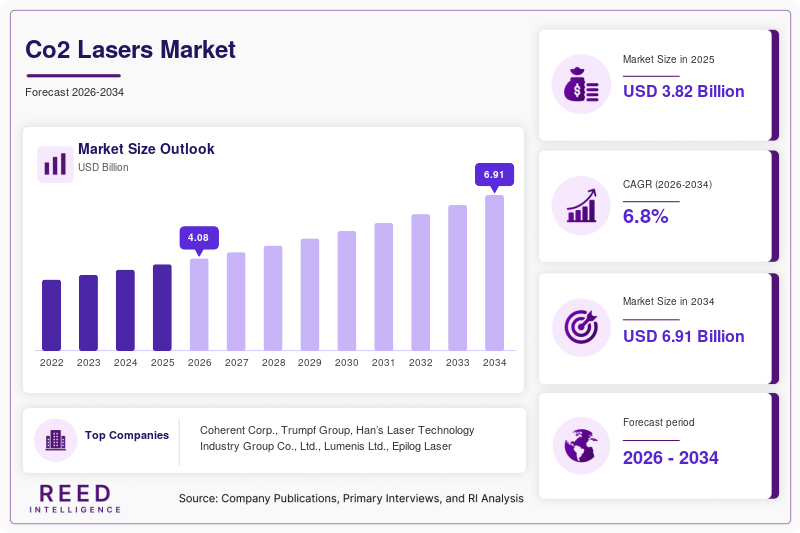
The global Co2 Lasers Market size was valued at USD 3.82 billion in 2025 and is projected to reach USD 6.94 billion by 2033, expanding at a CAGR of 6.8% from 2025 to 2034. The market growth is being supported by the increasing integration of precision laser systems across manufacturing, healthcare, electronics, and material processing industries. CO₂ laser technology remains widely adopted due to its ability to efficiently cut, engrave, and process non-metallic materials such as plastics, glass, textiles, wood, and ceramics. As industrial production shifts toward automation and digital manufacturing processes, CO₂ laser systems continue to gain relevance in production lines that demand high accuracy and repeatability.
One key global factor supporting the expansion of the Co2 Lasers Market is the growing adoption of laser-based manufacturing technologies in Industry 4.0 environments. Advanced production facilities are increasingly incorporating automated laser solutions to improve productivity, reduce material waste, and maintain consistent product quality. In sectors such as electronics fabrication, packaging, and automotive component manufacturing, CO₂ lasers offer reliable performance and cost efficiency for high-volume operations. Furthermore, medical and cosmetic procedures such as dermatological resurfacing and minimally invasive surgery are also contributing to the rising adoption of CO₂ laser systems.
Increasing research investments in laser technology and the development of compact and energy-efficient systems are also strengthening the market outlook. Manufacturers are focusing on innovations that enhance beam quality, operational lifespan, and system integration with digital manufacturing platforms.
Key Highlights
- Asia Pacific dominated the market with 41% share in 2025, while the region is expected to remain the fastest growing with a CAGR of 7.9%.
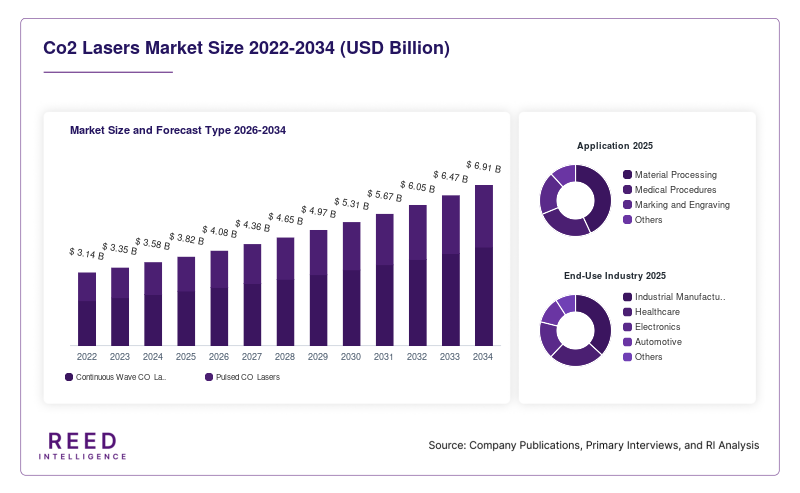
- Continuous Wave (CW) CO₂ lasers led the Type segment with 58% share, while Pulsed CO₂ lasers will grow at a CAGR of 7.5% during the forecast period.
- Material Processing was the leading Application segment with 46% share, while Medical applications are projected to grow at a CAGR of 7.2%.
- Industrial manufacturing dominated the End-Use segment with 52% share, whereas healthcare end-use will expand at a CAGR of 7.3%.
- The United States accounted for USD 0.96 billion in 2025 and is projected to reach USD 1.02 billion in 2026.
Market Trends
Integration of CO₂ Laser Systems in Automated Manufacturing
Manufacturers are increasingly integrating CO₂ laser technology with automated production lines and robotic systems. Automated laser cutting and engraving equipment allows industries to enhance productivity while reducing manual intervention in precision manufacturing processes. Industries such as electronics assembly, packaging, textiles, and automotive component production are adopting advanced laser platforms that integrate sensors, machine vision, and digital monitoring systems. These integrated solutions help maintain consistent cutting quality and minimize operational downtime.
Another aspect of this trend involves the use of intelligent control software and connectivity features. Laser machines equipped with digital interfaces enable real-time performance monitoring, remote diagnostics, and predictive maintenance. Such features are becoming important in smart factories where operational efficiency and production traceability are essential.
Rising Use of CO₂ Lasers in Medical and Cosmetic Procedures
The adoption of CO₂ laser systems in dermatology and cosmetic surgery has emerged as another significant trend in the Co2 Lasers Market. These systems are widely used for skin resurfacing, scar treatment, wrinkle reduction, and other minimally invasive procedures. Medical professionals prefer CO₂ lasers due to their ability to deliver controlled thermal energy with precision, which supports targeted tissue treatment and faster recovery times.
Additionally, advancements in fractional CO₂ laser technologies are enabling safer and more effective procedures. Medical device manufacturers are focusing on compact and portable laser systems designed specifically for clinics and outpatient facilities. This trend is expected to strengthen demand across aesthetic medicine and dermatological treatment segments.
Market Drivers
Increasing Demand for Precision Material Processing
The growing requirement for precise material processing across multiple industrial sectors is a major driver of the Co2 Lasers Market. Industries such as electronics, packaging, automotive, and aerospace require high-accuracy cutting and engraving solutions that can process a variety of materials without mechanical contact. CO₂ lasers provide clean edges, minimal thermal distortion, and consistent repeatability, making them suitable for high-volume manufacturing environments.
The ability of CO₂ lasers to process organic and non-metallic materials efficiently has increased their adoption in industries producing packaging materials, textiles, plastics, and rubber components. As manufacturing processes become more sophisticated, the demand for laser-based machining technologies continues to expand.
Expansion of Laser Applications in Healthcare
The healthcare sector has increasingly adopted laser technology for therapeutic and cosmetic treatments. CO₂ lasers are used in dermatology, gynecology, dental procedures, and surgical applications where precise tissue removal is required. These systems provide controlled penetration depth and minimal damage to surrounding tissue, which improves patient outcomes and reduces recovery times.
Medical practitioners are also adopting laser-based solutions due to their ability to perform minimally invasive procedures in outpatient settings. As healthcare infrastructure expands and aesthetic treatments gain popularity globally, the demand for CO₂ laser systems is expected to increase steadily.
Market Restraint
High Initial Cost of Laser Systems
A major challenge affecting the Co2 Lasers Market is the relatively high cost associated with acquiring and maintaining advanced laser systems. Industrial-grade CO₂ laser equipment often requires significant capital investment, including expenses related to system installation, cooling systems, and specialized training for operators. Small and medium-sized enterprises may find it difficult to adopt such technologies due to budget limitations.
Additionally, maintenance requirements such as periodic replacement of laser tubes, optical components, and calibration procedures can increase operational costs over time. These financial barriers may slow the adoption rate of CO₂ laser systems in cost-sensitive industries and developing economies.
Market Opportunities
Growing Demand from Electronics Manufacturing
The increasing production of consumer electronics and semiconductor components presents a notable opportunity for the Co2 Lasers Market. Electronics manufacturers require precise cutting and marking solutions for materials such as flexible circuits, polymers, and composite substrates. CO₂ laser systems provide high-precision processing without causing mechanical stress on delicate components.
As the global electronics industry continues to expand with rising demand for smartphones, wearable devices, and advanced electronic components, laser-based manufacturing solutions are expected to experience increased adoption.
Development of Compact and Energy-Efficient Laser Systems
Technological advancements are enabling the development of smaller, more energy-efficient CO₂ laser systems designed for diverse industrial and medical applications. Compact laser units are particularly beneficial for small manufacturing workshops, research laboratories, and medical clinics with limited space.
Manufacturers are focusing on improving beam stability, reducing power consumption, and extending system lifespan. These innovations are expected to expand the accessibility of CO₂ laser technology across new user segments, thereby creating additional growth opportunities for the market.
Segmental Analysis
By Type
Continuous Wave (CW) CO₂ lasers represented the dominant subsegment with 58% share in 2025. These laser systems are widely used in industrial processing applications due to their ability to deliver continuous and stable laser output. Industries such as packaging, plastics manufacturing, and textile processing frequently use CW CO₂ lasers for cutting and engraving operations that require consistent energy delivery. Their operational reliability and compatibility with automated manufacturing lines have supported their leading market position.
The Pulsed CO₂ laser subsegment will grow at a CAGR of 7.5% during the forecast period. Pulsed laser systems will gain traction due to their ability to provide controlled bursts of laser energy, which improves precision when processing delicate materials. These systems will increasingly be used in electronics manufacturing and medical applications where high accuracy and reduced heat-affected zones are essential. The ability to adjust pulse duration and frequency will support their adoption in specialized manufacturing environments.
By Application
Material processing dominated the Application segment with 46% share in 2025. CO₂ lasers are widely used for cutting, engraving, drilling, and marking materials such as plastics, rubber, wood, glass, and textiles. Industrial facilities rely on these systems to achieve precise machining with minimal mechanical wear. The ability to process various non-metallic materials efficiently has supported the strong demand for CO₂ lasers in industrial material processing.
Medical applications will emerge as the fastest-growing subsegment with a projected CAGR of 7.2%. The demand will increase as healthcare providers adopt advanced laser technologies for dermatological procedures, surgical treatments, and cosmetic therapies. Medical professionals will continue to prefer CO₂ lasers due to their precision and ability to minimize tissue damage during procedures.
By End-Use Industry
Industrial manufacturing held the largest share of 52% in 2025 within the End-Use segment. Manufacturing industries use CO₂ lasers extensively for production processes involving cutting, engraving, and marking. These industries require reliable and efficient equipment capable of handling high production volumes while maintaining consistent quality standards.
The healthcare industry will grow at a CAGR of 7.3% during the forecast period. The rising number of cosmetic and dermatological procedures will contribute to the demand for CO₂ laser systems in clinics and medical centers. Healthcare providers will increasingly adopt laser technologies to perform minimally invasive treatments that require precision and controlled energy delivery.
Regional Analysis
North America
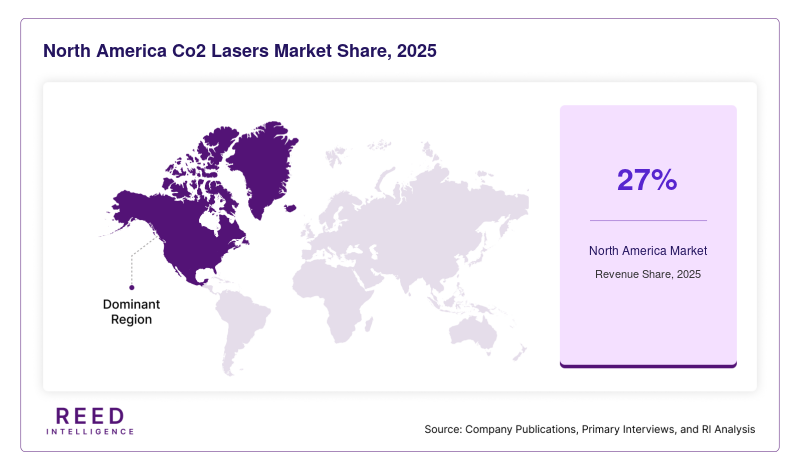
North America accounted for 27% of the global Co2 Lasers Market share in 2025. The regional market will grow at a CAGR of 6.3% from 2025 to 2034. The region has an established industrial manufacturing base and a strong presence of advanced technology providers. Laser-based production technologies are widely adopted across sectors such as electronics manufacturing, automotive component fabrication, and medical device production.
The United States represented the dominant country within the region. A key growth factor in the country is the strong presence of research institutions and industrial technology companies focusing on laser system innovation. These organizations are actively developing advanced laser solutions with improved efficiency and performance capabilities. Continuous collaboration between research laboratories and industrial manufacturers has supported the commercialization of new CO₂ laser technologies, strengthening the market outlook in the country.
Europe
Europe held 24% of the global Co2 Lasers Market share in 2025 and will expand at a CAGR of 6.1% during the forecast period. The region has a long-standing industrial equipment manufacturing sector and a strong emphasis on high-precision engineering. CO₂ laser systems are commonly used in industries such as automotive component production, aerospace manufacturing, and industrial machinery fabrication.
Germany dominated the regional market due to its advanced industrial infrastructure and strong engineering capabilities. The country hosts numerous manufacturers specializing in precision machinery and laser-based production technologies. German manufacturing companies emphasize high-quality industrial automation and efficient production processes, which has increased the use of CO₂ laser equipment in manufacturing plants.
Asia Pacific
Asia Pacific accounted for 41% of the global Co2 Lasers Market share in 2025 and will grow at the fastest CAGR of 7.9% from 2025 to 2034. Rapid industrialization, expanding electronics manufacturing, and increasing adoption of automated production systems are contributing to market growth in the region. Many global electronics and consumer goods manufacturers operate large production facilities in Asia Pacific.
China dominated the regional market due to its large-scale manufacturing industry. The country has become a major hub for electronics, packaging materials, and textile production. These industries frequently use CO₂ laser systems for cutting, engraving, and marking applications. Continuous investments in industrial modernization and advanced manufacturing technologies are further strengthening the adoption of laser-based production equipment in the country.
Middle East & Africa
The Middle East & Africa represented 5% of the global Co2 Lasers Market share in 2025 and will expand at a CAGR of 6.0% through 2034. The market growth in the region is supported by the gradual diversification of industrial sectors and increasing adoption of advanced manufacturing technologies.
The United Arab Emirates emerged as the dominant country within the region. A key growth factor is the country’s focus on developing high-technology manufacturing industries and innovation-driven industrial clusters. Government initiatives aimed at strengthening advanced manufacturing and industrial automation are supporting the adoption of laser technologies in sectors such as electronics assembly and specialized manufacturing.
Latin America
Latin America accounted for 3% of the global Co2 Lasers Market share in 2025 and will grow at a CAGR of 5.8% during the forecast period. The regional market is gradually expanding as industrial sectors adopt modern manufacturing technologies. CO₂ laser equipment is increasingly used in packaging, plastics processing, and textile industries within the region.
Brazil dominated the Latin American market due to its diversified industrial base. The country has established manufacturing industries producing automotive components, consumer products, and packaging materials. These industries require reliable and precise cutting and engraving solutions, which has supported the gradual adoption of CO₂ laser systems in industrial production facilities.
Competitive Landscape
The Co2 Lasers Market features several established manufacturers that focus on product innovation, system integration, and global distribution networks. Companies are investing in research and development to enhance laser performance, improve energy efficiency, and expand application capabilities.
Coherent Corp. remains a leading player in the market due to its extensive portfolio of industrial and medical laser systems. The company has recently introduced upgraded CO₂ laser platforms designed for high-precision material processing in automated manufacturing environments.
Other major companies are strengthening their market presence by expanding regional sales networks and developing specialized laser solutions tailored to industry-specific requirements.
Key Players
- Coherent Corp.
- Trumpf Group
- Han’s Laser Technology Industry Group Co., Ltd.
- Lumenis Ltd.
- Epilog Laser
- Universal Laser Systems Inc.
- Trotec Laser GmbH
- El.En. S.p.A.
- Rofin-Sinar Technologies
- LaserStar Technologies Corporation
- Gravotech Group
- Kern Laser Systems
- SEI Laser
- Boss Laser LLC
- Vytek Laser Systems
Recent Developments
- Several manufacturers introduced compact CO₂ laser systems designed for small manufacturing facilities and laboratories.
- Industrial equipment providers expanded automation-compatible laser platforms to support smart factory environments.
- Medical device companies developed fractional CO₂ laser systems aimed at dermatology and cosmetic treatment applications.
- Laser technology companies increased research investments in beam stability and energy efficiency to improve system performance.
Co2 Lasers Market Segments
Type
- Continuous Wave CO₂ Lasers
- Pulsed CO₂ Lasers
Application
- Material Processing
- Medical Procedures
- Marking and Engraving
- Others
End-Use Industry
- Industrial Manufacturing
- Healthcare
- Electronics
- Automotive
- Others
By Region
- North America
- Europe
- APAC
- Middle East and Africa
- LATAM