Coffee Crystal Market Size, Share, Demand Report By Product Type (Freeze-Dried Coffee Crystals, Spray-Dried Coffee Crystals, Flavored Coffee Crystals, Organic Coffee Crystals), By Distribution Channel (Supermarkets and Hypermarkets, Convenience Stores, Online Retail, Specialty Stores, Foodservice Distribution), By End Use (Household Consumption, Foodservice Applications, Corporate Offices, Hospitality Sector, Institutional Use), By Region & Segment Forecasts, 2026–2034
USD 3950
Market Overview
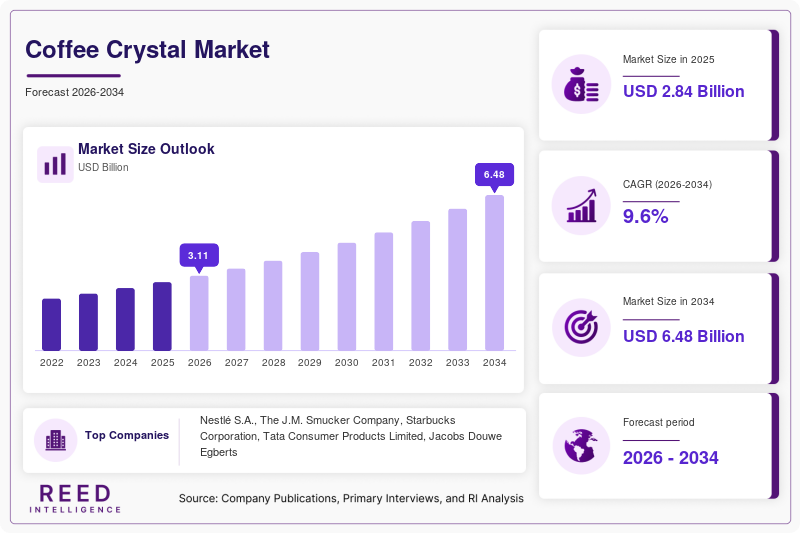
The global Coffee Crystal Market size was valued at USD 2.84 billion in 2026 and is projected to reach USD 5.91 billion by 2034, expanding at a CAGR of 9.6% during the forecast period. The market continues to gain momentum due to the rising demand for convenient coffee products across developed and emerging economies. Coffee crystals, commonly used in instant coffee formulations, are witnessing broader adoption in retail, hospitality, foodservice, and vending applications because they provide longer shelf life, simplified preparation, and stable flavor retention. The increasing urban population, changing consumer routines, and growth of ready-to-drink beverage culture are also contributing to market expansion.
One of the major global factors supporting market growth is the rapid shift toward convenience-based food and beverage consumption. Consumers with busy lifestyles increasingly prefer products that reduce preparation time while maintaining quality and taste consistency. Coffee crystals align with this preference by offering quick dissolvability, portability, and compatibility with cold and hot beverages. Manufacturers are also investing in premium freeze-dried coffee crystals, flavored variants, and sustainable sourcing strategies to attract younger consumers. In addition, expansion of e-commerce channels and private-label coffee products has improved product accessibility across multiple price categories.
Key Highlights
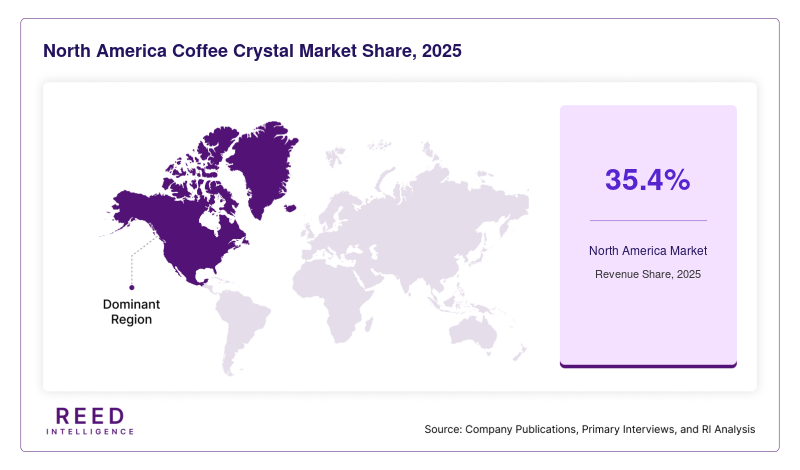
- North America dominated the market with a 35.4% share in 2025, while Asia Pacific is expected to grow at the fastest CAGR of 11.4% during 2026–2034.
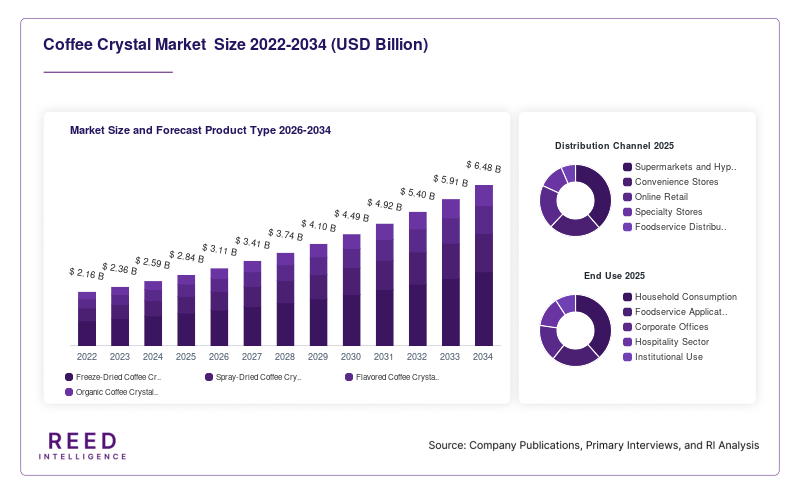
- By product type, freeze-dried coffee crystals accounted for the largest share of 46.8%, while flavored coffee crystals are projected to grow at a CAGR of 12.1%.
- By distribution channel, supermarkets and hypermarkets led with a 39.6% share, whereas online retail is expected to expand at a CAGR of 13.3%.
- By end use, household consumption accounted for the highest share of 51.2%, while foodservice applications are projected to grow at a CAGR of 11.7%.
- The United States remained the dominant country, with market values of USD 620 million in 2024 and USD 688 million in 2025.
Market Trends
Premiumization of Instant Coffee Products
The Coffee Crystal Market is experiencing a gradual shift toward premium and specialty product categories. Consumers are increasingly seeking products that offer café-style flavor, aroma retention, and high-quality bean sourcing within instant coffee formats. This demand has encouraged manufacturers to launch freeze-dried coffee crystals derived from single-origin beans, arabica blends, and sustainably sourced coffee varieties. Premium coffee crystal products are gaining traction among working professionals and younger consumers who value convenience without compromising taste quality. Companies are also investing in improved drying technologies that preserve flavor compounds and enhance product texture.
In addition, premium coffee crystal products are being marketed with clean-label ingredients, reduced sugar content, and functional health positioning. The inclusion of adaptogens, vitamins, collagen, and plant-based additives is becoming more common in premium formulations. Retailers are expanding shelf space for gourmet instant coffee products, while online platforms are helping brands reach niche consumer groups. The trend is expected to strengthen as consumers become more willing to pay higher prices for convenience products with enhanced quality and transparency.
Expansion of Digital and Subscription-Based Retail Channels
The growth of digital retail infrastructure has significantly influenced purchasing behavior in the Coffee Crystal Market. Consumers increasingly prefer online platforms due to broader product variety, flexible pricing, and direct-to-consumer delivery models. Subscription-based coffee services are also gaining popularity because they provide recurring access to customized coffee crystal products. This trend is particularly visible among younger urban consumers who prioritize convenience and personalized purchasing experiences.
Manufacturers are strengthening their digital presence through e-commerce partnerships, mobile applications, and social media marketing campaigns. Data-driven consumer insights are helping companies introduce targeted flavors, package sizes, and seasonal offerings. Online platforms are also improving accessibility in emerging economies where modern retail penetration remains limited. The rise of digital grocery platforms and cross-border e-commerce has created additional opportunities for small and medium coffee brands to compete with established multinational companies. As internet penetration and digital payment adoption continue to increase globally, online sales channels are expected to contribute significantly to future market growth.
Market Drivers
Rising Demand for Convenient Beverage Solutions
The increasing preference for convenience-focused beverages is one of the primary growth drivers for the Coffee Crystal Market. Consumers across urban areas are adopting products that require minimal preparation while delivering consistent flavor and caffeine content. Coffee crystals provide rapid solubility and can be used in both hot and cold beverages, making them suitable for office workers, students, and travelers. The expansion of remote work culture and fast-paced lifestyles has further accelerated the demand for instant coffee formats.
Foodservice operators and vending machine suppliers are also adopting coffee crystals because they reduce preparation complexity and operational costs. In comparison to traditional brewed coffee, coffee crystals require less equipment and lower maintenance expenses. Manufacturers are responding to changing consumer expectations by offering portion-controlled packaging, flavored variants, and sugar-free formulations. Growing retail availability across supermarkets, convenience stores, and digital channels is also improving market penetration. The combination of affordability, convenience, and long shelf stability continues to strengthen product demand globally.
Increasing Consumption of Coffee-Based Functional Products
The growing popularity of functional beverages is contributing to the expansion of the Coffee Crystal Market. Consumers are increasingly associating coffee products with energy enhancement, cognitive support, and productivity benefits. As a result, manufacturers are incorporating nutritional ingredients such as protein, probiotics, herbal extracts, and vitamins into coffee crystal formulations. This strategy has enabled companies to attract health-conscious consumers seeking multifunctional beverage products.
The fitness and wellness industry has also increased demand for coffee crystals in meal replacement shakes, protein drinks, and nutritional supplements. In several markets, ready-to-mix coffee products are being promoted as healthier alternatives to carbonated beverages and sugary energy drinks. Younger consumers are showing interest in low-calorie and plant-based formulations that combine convenience with wellness positioning. Product innovation supported by marketing campaigns focused on energy and productivity is expected to strengthen consumer engagement. The growing intersection between functional nutrition and beverage convenience will continue to create favorable conditions for market expansion.
Market Restraint
Volatility in Coffee Bean Prices and Supply Chain Disruptions
Price fluctuations in raw coffee beans remain a major restraint affecting the Coffee Crystal Market. Coffee production is highly dependent on climatic conditions, labor availability, transportation infrastructure, and geopolitical stability in major producing countries. Unpredictable weather events such as droughts, excessive rainfall, and temperature changes can reduce crop yields and influence global coffee prices. These fluctuations directly impact manufacturing costs for coffee crystal producers and create pricing challenges across retail and foodservice channels.
Supply chain disruptions have also increased operational uncertainty for manufacturers. Rising logistics costs, packaging material shortages, and shipping delays have affected production schedules and inventory management. Small and medium manufacturers often face difficulties maintaining profit margins during periods of raw material inflation. In addition, premium coffee crystal products require higher-quality beans and advanced processing technologies, which can further increase operational expenses. Consumers in price-sensitive markets may shift toward lower-cost alternatives when coffee prices rise significantly. This pricing pressure can limit market growth potential and reduce investment flexibility for product innovation initiatives.
Market Opportunities
Growth Potential in Emerging Asian and African Markets
Emerging economies across Asia Pacific and Africa are creating new opportunities for the Coffee Crystal Market due to rising urbanization and changing beverage consumption patterns. Expanding middle-class populations and increasing disposable incomes are encouraging consumers to adopt packaged coffee products. In many developing economies, coffee culture is transitioning from traditional café consumption toward convenient at-home and office-based preparation methods. Coffee crystals are benefiting from this shift because they are affordable, easy to store, and suitable for multiple beverage formats.
International manufacturers are expanding regional distribution networks and forming partnerships with local retailers to strengthen their market presence. Product localization strategies, including region-specific flavors and smaller packaging formats, are helping brands attract first-time consumers. Growth in modern retail infrastructure and digital commerce is also improving accessibility in secondary cities and rural markets. As consumer awareness regarding premium instant coffee products increases, emerging markets are expected to provide long-term revenue opportunities for global and regional manufacturers.
Product Innovation in Sustainable and Functional Coffee Categories
Sustainability-focused product innovation is creating favorable opportunities within the Coffee Crystal Market. Consumers are increasingly paying attention to ethical sourcing, recyclable packaging, and environmentally responsible manufacturing processes. Coffee brands are responding by introducing products with certified sustainable coffee beans, biodegradable packaging materials, and carbon-conscious production strategies. These initiatives are helping companies improve brand positioning and attract environmentally aware consumers.
Functional product development is also opening new growth avenues for manufacturers. Coffee crystal products infused with mushrooms, herbal extracts, collagen, and protein ingredients are gaining visibility among wellness-oriented consumers. Demand for organic, vegan, and low-acid coffee products is increasing in both developed and emerging markets. Companies that successfully combine sustainability, functionality, and premium flavor profiles are likely to strengthen their competitive position. Investments in advanced freeze-drying technologies and clean-label formulations are expected to accelerate innovation and support future market growth.
Segmental Analysis
By Product Type
Freeze-dried coffee crystals accounted for the largest share of the Coffee Crystal Market in 2024, representing 46.8% of total revenue. This segment continues to dominate because freeze-drying technology preserves flavor, aroma, and texture more effectively than traditional spray-drying methods. Consumers increasingly associate freeze-dried coffee crystals with premium quality and improved taste consistency. Manufacturers are also using high-quality arabica and specialty coffee beans to strengthen product differentiation in this segment. The popularity of café-style instant coffee products among urban consumers has further accelerated adoption.
Retailers and foodservice operators prefer freeze-dried coffee crystals because they provide superior dissolvability and stable shelf life. Product innovation related to organic, low-acid, and sustainable coffee formulations has also strengthened segment performance. Demand remains particularly strong across North America and Europe, where consumers are willing to pay premium prices for convenient coffee solutions with enhanced sensory quality. The segment is expected to maintain its dominant position due to continued investments in advanced drying technologies and premium product positioning.
By Distribution Channel
Supermarkets and hypermarkets held the dominant share of 39.6% in the Coffee Crystal Market during 2024. These retail formats continue to attract large consumer volumes due to product accessibility, promotional discounts, and extensive brand variety. Consumers often prefer purchasing coffee crystal products through organized retail channels because they can compare packaging sizes, flavors, and pricing within a single location. Strong retail infrastructure in developed economies has further strengthened the segment’s market position.
Major retailers are expanding premium and private-label coffee crystal offerings to address changing consumer preferences. Shelf placement strategies, bundled product promotions, and loyalty programs are encouraging repeat purchases. Supermarkets also provide opportunities for manufacturers to introduce new products through in-store sampling and promotional campaigns. The continued expansion of organized retail networks across emerging economies is expected to support long-term growth for this segment. Increased consumer trust in established retail chains further contributes to sustained market dominance.
By End Use
Household consumption represented the largest share of 51.2% in the Coffee Crystal Market during 2024. The segment dominates because consumers increasingly prefer convenient beverage products for home-based preparation. The rise of remote work arrangements and hybrid work models has encouraged higher consumption of instant coffee products within residential settings. Coffee crystals offer quick preparation, minimal equipment requirements, and cost efficiency compared to traditional café purchases, making them highly suitable for household use.
Manufacturers are responding to changing household preferences by introducing family-sized packaging, premium blends, and health-oriented formulations. Demand for low-sugar, organic, and flavored coffee crystal products is growing among health-conscious consumers. Retail promotions and subscription-based delivery services are also supporting segment expansion by improving convenience and product accessibility. Strong adoption across urban households in North America, Europe, and Asia Pacific continues to reinforce the segment’s dominant market position.
Regional Analysis
North America
North America accounted for 35.4% of the global Coffee Crystal Market share in 2025 and is projected to maintain steady expansion at a CAGR of 8.7% during the forecast period. Strong consumer demand for instant and ready-to-mix coffee products continues to support regional growth. The market benefits from high coffee consumption rates, widespread retail availability, and established foodservice infrastructure. Consumers increasingly prefer premium freeze-dried coffee crystals that offer café-style flavor and improved aroma retention. Growing adoption of functional coffee beverages and sustainable packaging solutions is also influencing purchasing behavior across the region.
The United States remained the dominant country within North America due to high consumer spending on premium coffee products and rapid innovation across retail channels. The expansion of specialty coffee brands and subscription-based beverage services has strengthened product visibility. Manufacturers are increasingly introducing plant-based and wellness-oriented coffee crystal formulations to attract younger consumers. Strong e-commerce penetration and growing demand for portable beverage solutions continue to create favorable market conditions across urban and suburban populations.
Europe
Europe represented 27.1% of the global Coffee Crystal Market share in 2025 and is expected to expand at a CAGR of 8.2% through 2034. The region has a mature coffee culture supported by strong consumer preference for premium and specialty beverages. Demand for coffee crystals is increasing in convenience-focused households and workplace environments where quick preparation is prioritized. Growth in private-label coffee products and sustainable sourcing initiatives has also strengthened regional market development. Western European countries continue to dominate product innovation related to organic and ethically sourced coffee formulations.
Germany emerged as the leading country in the European market due to high coffee consumption levels and advanced retail distribution networks. The country benefits from strong supermarket penetration and increasing demand for freeze-dried coffee products. German consumers are also showing interest in recyclable packaging and clean-label beverage ingredients. Manufacturers operating in the region are investing in automated production technologies to improve efficiency and maintain product quality standards. The combination of premiumization and sustainability awareness continues to support market expansion across Europe.
Asia Pacific
Asia Pacific held 21.6% of the global Coffee Crystal Market share in 2025 and is forecast to record the fastest CAGR of 11.4% during 2026–2034. Rapid urbanization, rising disposable incomes, and expanding café culture are major factors supporting regional growth. Consumers in countries such as China, India, Indonesia, and South Korea are increasingly adopting convenient coffee formats due to changing work routines and lifestyle preferences. Coffee crystal products are also gaining popularity among younger consumers who seek affordable alternatives to café-based beverages.
China dominated the regional market due to strong growth in digital retail channels and increasing consumer interest in premium beverage products. International coffee brands are expanding aggressively across major cities and introducing localized flavors tailored to regional tastes. Rising investments in vending infrastructure and ready-to-drink beverage distribution are also supporting market penetration. Social media marketing and influencer-driven product promotion have significantly increased consumer awareness regarding premium instant coffee categories in the country.
Middle East & Africa
The Middle East & Africa accounted for 8.3% of the global Coffee Crystal Market share in 2025 and is expected to grow at a CAGR of 9.1% over the forecast period. The market is benefiting from rising urbanization, growth in hospitality infrastructure, and increasing adoption of western-style beverage consumption patterns. Demand for convenient coffee products is expanding across hotels, offices, and quick-service restaurants. Coffee crystals are also gaining popularity in regions with developing retail infrastructure because they provide longer shelf life and easier storage compared to traditional brewed coffee products.
Saudi Arabia emerged as the dominant country in the regional market due to strong consumer demand for premium beverages and expanding café culture. Increasing tourism activity and investment in hospitality projects are supporting coffee product consumption across the country. Consumers are showing growing interest in flavored and specialty instant coffee products influenced by international beverage trends. Retail chains are expanding shelf availability for imported and locally manufactured coffee crystal products, further supporting market development.
Latin America
Latin America captured 7.6% of the global Coffee Crystal Market share in 2025 and is projected to register a CAGR of 8.8% through 2034. The region benefits from strong coffee production capabilities and increasing domestic consumption of packaged coffee products. Urban consumers are gradually shifting toward convenient beverage solutions due to changing work schedules and growing retail accessibility. Demand for flavored and affordable instant coffee products is increasing among middle-income households across several Latin American countries.
Brazil remained the dominant country within the regional market due to its large coffee production base and expanding domestic coffee consumption. Local manufacturers are investing in product diversification to address rising demand for premium and specialty instant coffee products. Growth in convenience store networks and supermarket chains has improved product accessibility across metropolitan areas. In addition, rising export opportunities for value-added coffee products are encouraging investments in advanced processing and freeze-drying technologies.
Competitive Landscape
The Coffee Crystal Market remains moderately fragmented with the presence of multinational beverage corporations, regional coffee manufacturers, and specialty instant coffee brands. Companies are competing through product innovation, sustainable sourcing strategies, premium flavor development, and expansion across digital retail channels. Manufacturers are increasingly investing in freeze-drying technologies and functional beverage formulations to strengthen their market position. Partnerships with supermarkets, e-commerce platforms, and foodservice operators continue to play an important role in market expansion.
Nestlé S.A. maintained a leading position in the market due to its broad product portfolio, strong global distribution network, and continuous investment in premium instant coffee innovation. The company has expanded its freeze-dried coffee product range and introduced sustainable sourcing initiatives to improve consumer engagement. Other major players are focusing on flavored coffee crystals, plant-based beverage integration, and recyclable packaging strategies to strengthen competitiveness.
Key Players
- Nestlé S.A.
- The J.M. Smucker Company
- Starbucks Corporation
- Tata Consumer Products Limited
- Jacobs Douwe Egberts
- Kraft Heinz Company
- Tchibo GmbH
- Luigi Lavazza S.p.A.
- Strauss Group Ltd.
- Unilever PLC
- Bevzilla Pvt. Ltd.
- Trung Nguyen Coffee Corporation
- UCC Ueshima Coffee Co., Ltd.
- Massimo Zanetti Beverage Group
- Death Wish Coffee Company
Recent Developments
- In March 2025, Nestlé S.A. introduced a premium freeze-dried coffee crystal range featuring single-origin arabica blends and recyclable packaging solutions for retail and e-commerce distribution channels.
- In January 2025, Tata Consumer Products Limited launched flavored coffee crystal variants with low-sugar formulations targeting younger consumers and expanding demand across online retail platforms.
- In September 2024, Jacobs Douwe Egberts expanded its coffee crystal production facilities in Europe to support rising demand for specialty instant coffee products and sustainable beverage solutions.
- In June 2024, Starbucks Corporation introduced ready-to-mix coffee crystal sachets designed for cold coffee beverages and functional drink applications across North America and Asia Pacific markets.
- In February 2024, CCL Products India Ltd. increased manufacturing capacity for freeze-dried coffee crystals to strengthen export operations and meet growing demand from private-label beverage brands.
Coffee Crystal Market Segments
Product Type
- Freeze-Dried Coffee Crystals
- Spray-Dried Coffee Crystals
- Flavored Coffee Crystals
- Organic Coffee Crystals
Distribution Channel
- Supermarkets and Hypermarkets
- Convenience Stores
- Online Retail
- Specialty Stores
- Foodservice Distribution
End Use
- Household Consumption
- Foodservice Applications
- Corporate Offices
- Hospitality Sector
- Institutional Use
By Region
- North America
- Europe
- APAC
- Middle East and Africa
- LATAM