Cold Formed Steel Market Size, Share Demand Report By Type (Lipped Channel, Z-Section, U-Section, Sigma Section, Others), By Application (Building & Construction, Automotive, Industrial Equipment, Storage Systems), By End-Use Industry (Construction, Manufacturing, Infrastructure, Energy), By Region & Segment Forecasts, 2025–2033
USD 3950
Market Overview
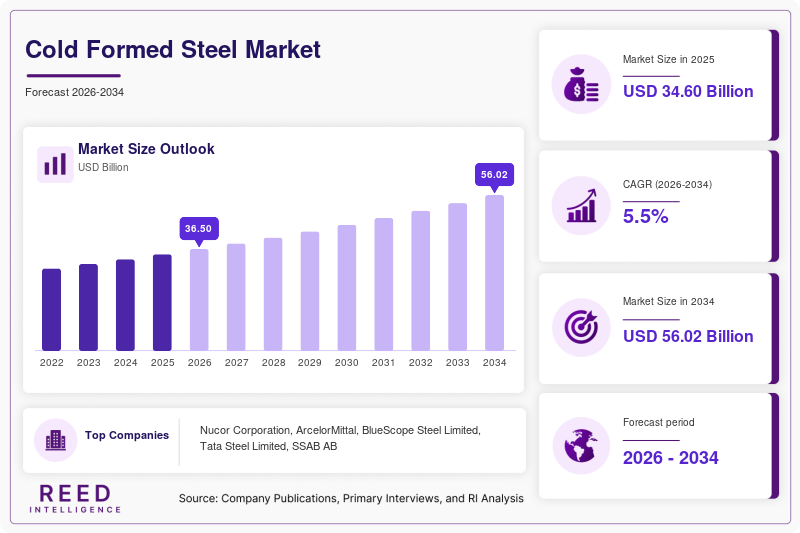
The Cold Formed Steel Market size was valued at USD 34.6 billion in 2024 and is projected to reach USD 55.8 billion by 2033, expanding at a compound annual growth rate (CAGR) of 5.5% during 2025–2033. Cold formed steel, produced through shaping steel sheets or strips at room temperature, is widely used in structural framing, construction components, automotive parts, and industrial equipment. The process enhances strength-to-weight ratio and dimensional accuracy, making it suitable for modern construction and manufacturing applications.
A key global factor supporting the growth of the Cold Formed Steel Market has been the increasing adoption of lightweight structural materials in infrastructure development. Governments and private developers are increasingly prioritizing faster construction timelines and cost efficiency. Cold formed steel components enable prefabrication and modular construction, allowing builders to reduce labor costs and project timelines while maintaining structural integrity.
Key Highlights
- Asia Pacific dominated the Cold Formed Steel Market in 2025 with approximately 39% share, while Latin America is projected to grow at the fastest CAGR of 6.6% through 2033.
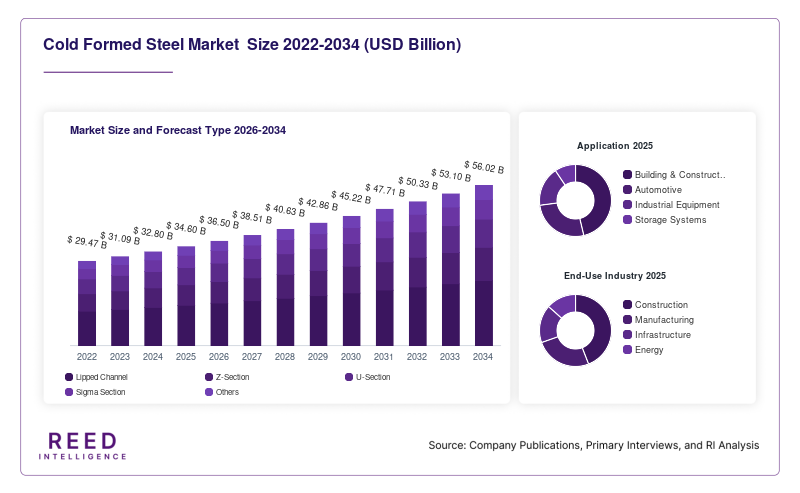
- Lipped channel sections led the Type segment with nearly 41% share in 2024, while Z-sections are projected to expand at a CAGR of 6.2% during the forecast period.
- Building & construction accounted for the largest Application segment share of about 52% in 2024, while automotive applications are projected to grow at a CAGR of 6.4%.
- The United States remained the dominant country market, valued at USD 7.2 billion in 2024 and estimated to reach USD 7.6 billion in 2025.
Market Trends
Increasing Use of Cold Formed Steel in Modular Construction
The growing adoption of modular and prefabricated construction techniques is shaping the Cold Formed Steel Market. Cold formed steel components are widely used in prefabricated wall panels, floor systems, and roof trusses due to their lightweight nature and dimensional precision. Modular construction projects benefit from faster assembly and reduced material waste when using cold formed steel framing systems.
In addition, contractors prefer these systems for mid-rise residential buildings and commercial structures because they simplify transportation and on-site installation. The trend toward industrialized construction methods is therefore strengthening the demand outlook for cold formed steel products worldwide.
Integration of Digital Design and Structural Engineering Tools
Another trend influencing the Cold Formed Steel Market is the integration of advanced design software and structural engineering tools in steel framing projects. Building information modeling (BIM) platforms and automated roll-forming equipment enable manufacturers to produce customized steel components with high precision.
Engineering software can optimize structural performance, reduce material usage, and streamline fabrication workflows. As architects and engineers increasingly rely on digital design technologies, demand for engineered cold formed steel systems is expanding. This trend is expected to improve supply chain coordination and reduce construction errors, supporting the market’s long-term development.
Market Drivers
Expansion of Urban Infrastructure Projects
Rapid urban development and population growth are creating significant demand for structural building materials. The Cold Formed Steel Market is benefiting from the expansion of residential housing, commercial buildings, and public infrastructure projects. Cold formed steel framing systems provide high strength while maintaining lower weight compared to traditional structural materials.
Developers often prefer these systems because they reduce construction time and simplify logistics in urban construction sites where space and labor availability may be limited. As urban infrastructure programs continue to expand in developing economies, the demand for cold formed steel components is expected to increase steadily.
Growth of Industrial Warehousing and Logistics Facilities
The expansion of e-commerce and global supply chains has led to a growing number of warehouses and distribution centers worldwide. Cold formed steel products are widely used in structural frames, storage racks, and mezzanine floors within logistics facilities.
These structures require materials that offer durability, load-bearing strength, and easy installation. Cold formed steel profiles meet these requirements while enabling scalable facility design. The ongoing development of logistics infrastructure is therefore contributing to sustained growth in the Cold Formed Steel Market.
Market Restraint
Volatility in Raw Material Prices
Fluctuations in the prices of steel and other raw materials present a significant restraint for the Cold Formed Steel Market. Steel prices are influenced by global supply-demand dynamics, energy costs, trade policies, and geopolitical factors. Sudden increases in raw material costs can impact production expenses for cold formed steel manufacturers.
Manufacturers often face challenges in maintaining stable pricing for finished products when raw material costs fluctuate significantly. This situation can reduce profit margins and create uncertainty in project budgeting for construction companies.
In addition, smaller manufacturers with limited procurement capacity may struggle to absorb price volatility compared to larger industry participants with long-term supply contracts. These cost pressures can affect investment decisions and production planning in the cold formed steel industry.
Despite these challenges, companies are increasingly focusing on supply chain optimization and strategic sourcing to mitigate raw material price fluctuations.
Market Opportunities
Growth of Sustainable Construction Practices
The increasing focus on environmentally responsible construction presents a promising opportunity for the Cold Formed Steel Market. Cold formed steel components are recyclable and generate minimal waste during manufacturing and installation.
Green building initiatives encourage the use of materials that improve resource efficiency and reduce environmental impact. As sustainability standards become more prominent in the construction sector, cold formed steel is gaining recognition as a material that supports environmentally conscious building practices.
Manufacturers are therefore exploring opportunities to develop eco-friendly product lines and promote cold formed steel systems in green building projects.
Rising Demand in Emerging Infrastructure Markets
Emerging economies in Asia, Africa, and Latin America are witnessing increased investment in infrastructure development. Governments are implementing housing initiatives, transportation projects, and industrial development programs that require efficient structural materials.
Cold formed steel components offer advantages such as rapid installation, design flexibility, and structural reliability. These features make them suitable for large-scale infrastructure development in emerging markets.
As infrastructure spending continues to rise in these regions, new opportunities are expected to emerge for manufacturers operating in the Cold Formed Steel Market.
Segmental Analysis
By Type
Lipped channel sections dominated the Cold Formed Steel Market in 2024, accounting for approximately 41% share. These sections are widely used in structural framing systems due to their high load-bearing capacity and design versatility. Lipped channel sections provide enhanced structural stability and are commonly applied in wall studs, roof trusses, and floor joists.
Z-sections are projected to be the fastest-growing subsegment, expanding at a CAGR of about 6.2% during the forecast period. These components will experience growth due to their suitability for purlins and girts in industrial buildings. Their ability to overlap at joints improves structural efficiency and load distribution, supporting increasing adoption in steel building systems.
By Application
The building and construction segment accounted for the largest share of the Cold Formed Steel Market in 2024, representing around 52% of total market revenue. Cold formed steel components are widely used in structural framing systems for residential housing, commercial buildings, and industrial facilities.
The automotive application segment will grow at a CAGR of approximately 6.4% through 2033. Automotive manufacturers are increasingly using cold formed steel components in vehicle body structures and chassis parts. The need for lightweight materials that maintain structural strength will drive the expansion of this segment during the forecast period.
By End-Use Industry
The construction industry dominated the Cold Formed Steel Market in 2024 with nearly 48% share. Cold formed steel systems are widely used in structural frameworks, roof structures, and wall assemblies across residential and commercial construction projects.
The manufacturing sector will represent the fastest-growing end-use segment, expanding at a CAGR of about 6.1%. Industrial manufacturers will increasingly use cold formed steel components in equipment frames, storage systems, and machine structures due to their dimensional precision and strength.
Regional Analysis
North America
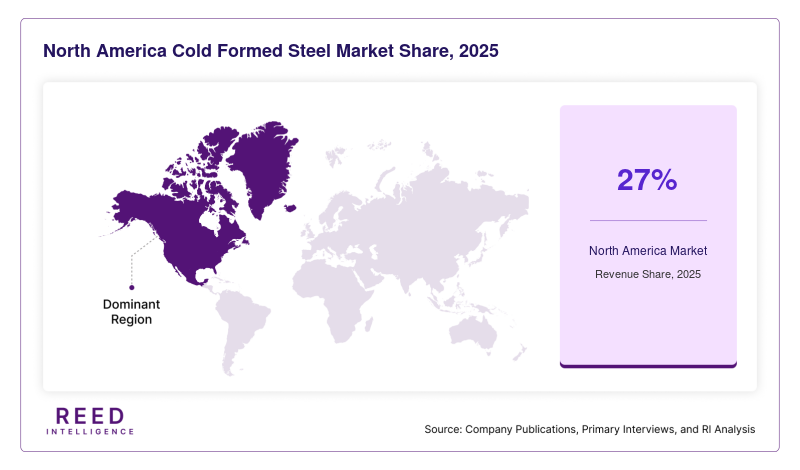
North America accounted for approximately 27% share of the Cold Formed Steel Market in 2025. The region’s market will likely expand at a CAGR of around 5.1% through 2033. Growth in this region has been associated with the increasing adoption of cold formed steel framing systems in residential and commercial construction projects.
The United States represented the dominant country market in the region. The country’s construction industry has increasingly utilized cold formed steel framing for multi-family housing projects and commercial buildings. The availability of advanced manufacturing facilities and established steel processing companies has supported the development of the Cold Formed Steel Market in the United States.
Europe
Europe held around 23% share of the Cold Formed Steel Market in 2025. The regional market will expand at a CAGR of approximately 4.8% during the forecast period. Demand for cold formed steel products in Europe has been influenced by renovation projects and modern structural engineering practices.
Germany represented the dominant country within the European market. The country’s strong manufacturing sector and advanced engineering capabilities have supported the adoption of cold formed steel systems in industrial and commercial applications. Structural engineering firms have integrated cold formed steel components into efficient building designs across Germany.
Asia Pacific
Asia Pacific represented nearly 39% share of the Cold Formed Steel Market in 2025. The regional market will grow at a CAGR of about 5.9% between 2025 and 2033. Rapid industrialization and large-scale infrastructure projects have driven the demand for cold formed steel products across the region.
China remained the dominant country market in Asia Pacific. The country’s construction industry has incorporated cold formed steel framing systems in residential complexes, industrial facilities, and infrastructure projects. The presence of large steel manufacturing capacities has further supported the supply of cold formed steel components within the Chinese market.
Middle East & Africa
The Middle East & Africa region accounted for approximately 6% share of the Cold Formed Steel Market in 2025. The market in this region will expand at a CAGR of nearly 5.7% through 2033. Construction activities related to urban development and tourism infrastructure have supported the regional demand for cold formed steel products.
Saudi Arabia emerged as the dominant country in the region. Infrastructure development initiatives associated with economic diversification programs have supported the adoption of advanced construction materials, including cold formed steel framing systems.
Latin America
Latin America captured about 5% share of the Cold Formed Steel Market in 2025. The regional market will grow at the fastest CAGR of approximately 6.6% through 2033. Infrastructure modernization and industrial development projects have contributed to rising demand for structural steel components.
Brazil represented the dominant country in the region. The country’s construction sector has expanded its use of cold formed steel systems in commercial and industrial structures. Local manufacturing capabilities and infrastructure investments have supported market development across Brazil.
Competitive Landscape
The Cold Formed Steel Market is moderately competitive, with several regional and global manufacturers operating across construction and industrial supply chains. Companies focus on expanding production capacity, improving manufacturing technologies, and strengthening distribution networks to maintain market presence.
Nucor Corporation represented a leading participant in the market due to its diversified steel production capabilities and strong presence in structural steel products. The company has invested in advanced steel processing technologies to improve efficiency and product quality.
Other companies continue to expand product portfolios and collaborate with construction contractors and engineering firms to supply customized cold formed steel solutions. Strategic partnerships, product innovations, and regional expansion remain key competitive strategies among industry participants.
Key Players
- Nucor Corporation
- ArcelorMittal
- BlueScope Steel Limited
- Tata Steel Limited
- SSAB AB
- Steel Dynamics Inc.
- Voestalpine AG
- Nippon Steel Corporation
- JFE Steel Corporation
- HBIS Group
Recent Developments
- In 2024, Nucor Corporation expanded its cold formed steel product portfolio to support structural framing applications in commercial construction projects.
- In 2023, BlueScope Steel introduced new high-strength cold formed steel profiles designed for modular construction systems.
- In 2024, Tata Steel launched advanced roll-formed steel sections aimed at improving structural efficiency in infrastructure projects.
- In 2023, Voestalpine AG enhanced its digital steel fabrication capabilities to improve production precision.
- In 2024, Steel Dynamics Inc. increased its investment in automated roll forming technologies to improve manufacturing productivity.
Cold Formed Steel Market Segments
Type
- Lipped Channel
- Z-Section
- U-Section
- Sigma Section
- Others
Application
- Building & Construction
- Automotive
- Industrial Equipment
- Storage Systems
End-Use Industry
- Construction
- Manufacturing
- Infrastructure
- Energy
By Region
- North America
- Europe
- APAC
- Middle East and Africa
- LATAM