Collagenase Clostridium histolyticum Market Size, Share & Demand Report By Indication (Dupuytren’s Contracture, Peyronie’s Disease, Wound Care, Other Connective Tissue Disorders), By End-Use (Hospitals, Specialty Clinics, Ambulatory Surgical Centers), By Distribution Channel (Hospital Pharmacies, Retail Pharmacies, Online Pharmacies), By Dosage Form (Injectable, Topical), By Region & Segment Forecasts, 2025–2034
USD 3950
Market Overview
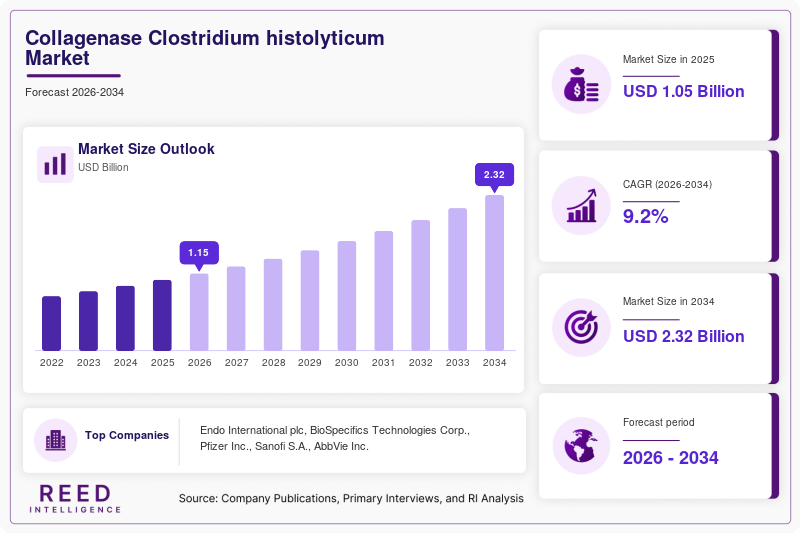
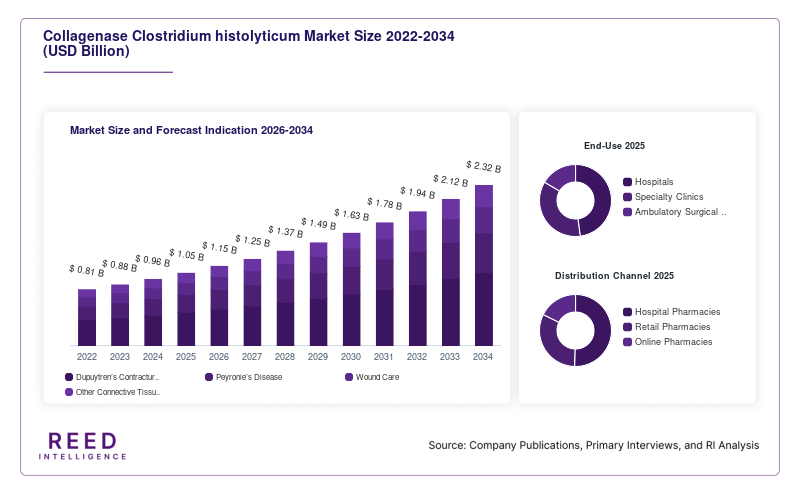
The global Collagenase Clostridium histolyticum Market size was estimated at USD 1.05 billion in 2025 and is projected to reach approximately USD 2.35 billion by 2034, expanding at a compound annual growth rate (CAGR) of 9.2% during the forecast period (2025–2034). The market has witnessed steady growth due to the increasing adoption of enzymatic therapies for fibrotic and connective tissue disorders, including Dupuytren’s contracture and Peyronie’s disease.
A major global factor supporting market expansion has been the shift toward minimally invasive treatments. Healthcare providers and patients increasingly prefer non-surgical approaches that reduce recovery time, hospital stays, and overall procedural risks. Collagenase-based therapies offer targeted enzymatic breakdown of collagen deposits, making them a viable alternative to surgical intervention in several indications.
Key Highlights:
- North America dominated the market with a 42% share in 2025, while Asia Pacific is projected to be the fastest-growing region with a CAGR of 11.3%.
- By indication, Dupuytren’s contracture led with a 48% share, while wound care applications are expected to grow fastest at a CAGR of 10.8%.
- By end-use, hospitals held the largest share at 52%, whereas specialty clinics are projected to grow at a CAGR of 9.9%.
- The United States remained the dominant country, with market values of USD 380 million in 2024 and USD 410 million in 2025.
Market Trends
Expansion into Aesthetic and Dermatological Applications
The Collagenase Clostridium histolyticum Market is witnessing growing interest in aesthetic medicine. Collagenase enzymes are being explored for cellulite treatment and scar remodeling, driven by rising demand for non-invasive cosmetic procedures. Pharmaceutical companies are investing in clinical trials to evaluate safety and efficacy in dermatological applications. This trend is broadening the commercial scope beyond traditional fibrotic disorders and is expected to attract new patient demographics.
Increasing Focus on Combination Therapies
Another notable trend is the integration of collagenase therapies with adjunctive treatments such as physical therapy, shockwave therapy, and pharmacological agents. Combination approaches aim to improve treatment outcomes and reduce recurrence rates in conditions like Dupuytren’s contracture. The trend reflects a shift toward holistic disease management, where collagenase serves as part of a multi-modal therapeutic regimen. This is likely to enhance long-term patient outcomes and drive sustained demand across clinical settings.
Market Drivers
Rising Prevalence of Fibrotic Disorders
The increasing incidence of fibrotic and connective tissue disorders has significantly driven the Collagenase Clostridium histolyticum Market. Conditions such as Dupuytren’s contracture and Peyronie’s disease are becoming more prevalent due to aging populations and lifestyle-related risk factors. Early diagnosis and improved awareness among healthcare professionals have further boosted treatment rates, thereby supporting market growth.
Advancements in Biopharmaceutical Manufacturing
Technological advancements in enzyme production and purification processes have improved the safety, efficacy, and scalability of collagenase-based products. Enhanced manufacturing capabilities have reduced variability in drug formulations and ensured consistent therapeutic outcomes. These developments have encouraged regulatory approvals and expanded global distribution, contributing to the steady growth of the market.
Market Restraint
High Treatment Costs and Limited Accessibility
One of the primary challenges in the Collagenase Clostridium histolyticum Market is the high cost associated with collagenase-based therapies. These treatments often require specialized administration and follow-up care, increasing the overall cost burden on patients. In emerging economies, limited reimbursement coverage and restricted access to advanced healthcare facilities further hinder adoption.
Additionally, pricing pressures from healthcare systems and insurers are affecting market penetration. The relatively high cost compared to alternative treatments, including surgery or generic medications, may limit patient uptake. This restraint is particularly significant in regions with constrained healthcare budgets, where cost-effectiveness remains a key decision-making factor.
Market Opportunities
Expansion into Emerging Markets
Emerging economies in Asia Pacific and Latin America present significant growth opportunities for the Collagenase Clostridium histolyticum Market. Improving healthcare infrastructure, increasing healthcare expenditure, and rising awareness of advanced treatment options are driving demand. Companies are focusing on strategic partnerships and localized manufacturing to enhance market presence in these regions.
Pipeline Development for New Indications
Ongoing research and development activities aimed at expanding the therapeutic applications of collagenase enzymes offer promising opportunities. Clinical trials exploring indications such as adhesive capsulitis, hypertrophic scars, and chronic wounds are expected to open new revenue streams. Successful commercialization of these pipeline products will diversify the market and strengthen long-term growth prospects.
Segmental Analysis
By Indication
Dupuytren’s contracture dominated the Collagenase Clostridium histolyticum Market with a share of approximately 48% in 2024. This dominance was attributed to the high prevalence of the condition and the established efficacy of collagenase therapy in treating it. The availability of approved products and strong clinical evidence supported widespread adoption.
Wound care applications are expected to be the fastest-growing subsegment, with a projected CAGR of 10.8% during the forecast period. The increasing incidence of chronic wounds, including diabetic ulcers, and the growing need for effective debridement solutions will drive demand. Collagenase enzymes offer targeted removal of necrotic tissue, making them a preferred option in advanced wound care.
By End-Use
Hospitals accounted for the largest share of around 52% in 2024. The dominance of this segment was driven by the availability of specialized healthcare professionals and advanced treatment facilities. Hospitals also serve as primary centers for diagnosis and treatment of complex conditions.
Specialty clinics are anticipated to grow at the fastest CAGR of 9.9% over the forecast period. The increasing preference for outpatient care and the rise of specialized treatment centers will support growth. These clinics offer focused care and shorter treatment cycles, making them attractive to patients.
By Distribution Channel
Hospital pharmacies held the dominant share of approximately 55% in 2024, owing to the high volume of prescriptions generated within hospital settings. The integration of treatment and dispensing services in hospitals contributed to this segment’s leadership.
Online pharmacies are expected to register the fastest growth, with a CAGR of 11.1%. The increasing adoption of digital healthcare platforms and the convenience of home delivery services are key growth drivers. This trend is particularly prominent in urban areas with high internet penetration.
By Dosage Form
Injectable formulations dominated the market with a share of around 67% in 2024. The effectiveness of injections in delivering targeted enzymatic action has made them the preferred dosage form for most indications.
Topical formulations are projected to grow at the fastest CAGR of 10.5%. The development of advanced topical delivery systems and their potential use in wound care and dermatological applications will drive growth in this segment.
Regional Analysis
North America
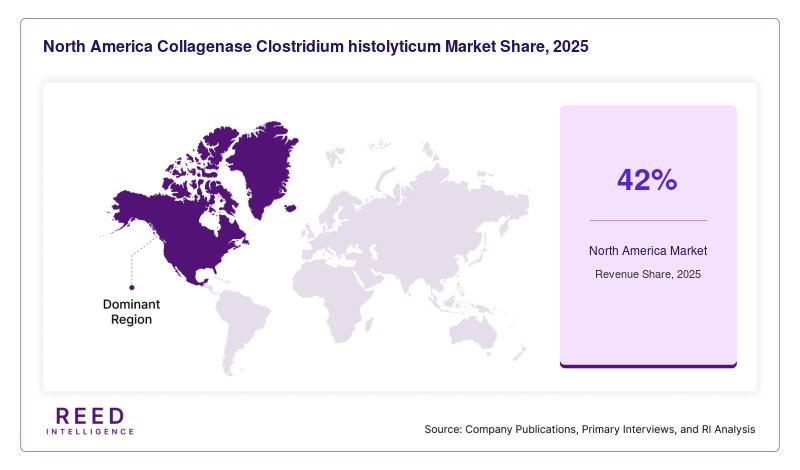
North America accounted for approximately 42% of the global Collagenase Clostridium histolyticum Market share in 2025 and is expected to grow at a CAGR of 8.7% during the forecast period. The region has benefited from advanced healthcare infrastructure, strong reimbursement systems, and widespread adoption of minimally invasive treatments. High awareness among patients and physicians has also contributed to market dominance.
The United States led the regional market due to a well-established pharmaceutical industry and robust clinical research ecosystem. The presence of key market players and continuous product innovation have driven growth. Additionally, increasing diagnosis rates of fibrotic disorders and strong patient access to specialty care have reinforced the country’s leading position.
Europe
Europe held a market share of around 26% in 2025 and is projected to expand at a CAGR of 8.9% through 2034. The region has experienced steady growth due to increasing adoption of advanced therapeutic solutions and supportive regulatory frameworks. Public healthcare systems in several countries have facilitated access to collagenase treatments.
Germany emerged as the dominant country in Europe, supported by its strong healthcare infrastructure and focus on innovative treatments. The country’s emphasis on early diagnosis and effective management of chronic conditions has contributed to higher treatment adoption rates.
Asia Pacific
Asia Pacific captured approximately 18% of the global market share in 2025 and is expected to grow at the fastest CAGR of 11.3% during the forecast period. Rapid economic development, expanding healthcare infrastructure, and increasing patient awareness have driven regional growth.
China led the market within Asia Pacific due to its large patient population and growing investment in healthcare modernization. Government initiatives aimed at improving access to advanced treatments have further accelerated market expansion.
Middle East & Africa
The Middle East & Africa region accounted for about 8% of the market share in 2025 and is projected to grow at a CAGR of 7.8% through 2034. The market has been driven by improving healthcare infrastructure and increasing investments in specialized medical services.
Saudi Arabia emerged as the dominant country in the region, supported by government-led healthcare reforms and rising healthcare expenditure. Efforts to enhance access to advanced therapies have contributed to steady market growth.
Latin America
Latin America held a market share of approximately 6% in 2025 and is expected to grow at a CAGR of 8.4% during the forecast period. The region has seen gradual adoption of collagenase therapies, driven by improving healthcare access and increasing awareness.
Brazil dominated the regional market due to its large healthcare system and growing focus on advanced medical treatments. Increasing investment in healthcare infrastructure and rising patient demand have supported market expansion.
Competitive Landscape
The Collagenase Clostridium histolyticum Market is moderately consolidated, with a few key players holding significant market shares. Companies are focusing on product innovation, strategic collaborations, and geographic expansion to strengthen their market position.
Endo International plc is recognized as a leading player, driven by its established product portfolio and strong presence in key markets. The company has recently invested in expanding its manufacturing capabilities to support increasing demand and enhance supply chain efficiency.
Other major players are actively engaged in research and development activities to explore new indications and improve existing formulations. Strategic partnerships with healthcare providers and research institutions are also shaping the competitive dynamics of the market.
Key Players
- Endo International plc
- BioSpecifics Technologies Corp.
- Pfizer Inc.
- Sanofi S.A.
- AbbVie Inc.
- Merck & Co., Inc.
- Teva Pharmaceutical Industries Ltd.
- Mylan N.V.
- Hikma Pharmaceuticals PLC
- Sun Pharmaceutical Industries Ltd.
- Dr. Reddy’s Laboratories Ltd.
- Cipla Ltd.
- Aurobindo Pharma Ltd.
- Lupin Limited
- Zydus Lifesciences Limited
Recent Developments
- In 2025, leading manufacturers expanded clinical trials to evaluate collagenase therapies for new dermatological indications.
- Several companies entered strategic partnerships to enhance distribution networks in emerging markets.
- New formulation advancements aimed at improving stability and efficacy were introduced.
- Regulatory approvals for expanded indications supported broader market adoption.
- Investments in biopharmaceutical manufacturing facilities increased to meet rising global demand.
Collagenase Clostridium histolyticum Market Segments
Indication
- Dupuytren’s Contracture
- Peyronie’s Disease
- Wound Care
- Other Connective Tissue Disorders
End-Use
- Hospitals
- Specialty Clinics
- Ambulatory Surgical Centers
Distribution Channel
- Hospital Pharmacies
- Retail Pharmacies
- Online Pharmacies
Dosage Form
- Injectable
- Topical
By Region
- North America
- Europe
- APAC
- Middle East and Africa
- LATAM