Collapsible Water Bottle Market Size, Share & Demand Report By Material Type (Silicone, Thermoplastic Polyurethane, Plastic, Stainless Steel Hybrid, Others), By Distribution Channel (Online Retail, Supermarkets and Hypermarkets, Specialty Sports Stores, Convenience Stores, Others), By End User (Adults, Children, Athletes and Outdoor Enthusiasts), By Capacity (Below 500 ml, 500–1000 ml, Above 1000 ml), By Region & Segment Forecasts, 2026–2034
USD 3950
Market Overview
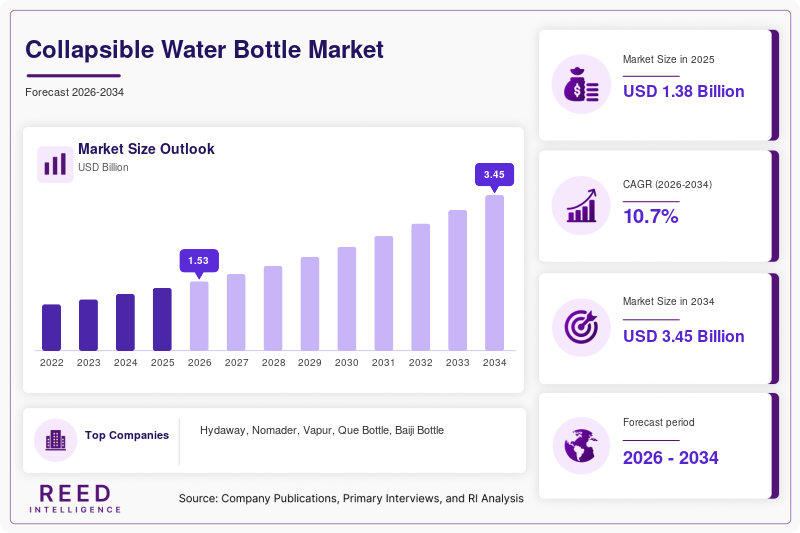
The global Collapsible Water Bottle Market size was valued at USD 1.38 billion in 2026 and is projected to reach USD 3.12 billion by 2034, expanding at a CAGR of 10.7% during the forecast period from 2026 to 2034. The market continues to gain traction as consumers increasingly prioritize lightweight, reusable, and portable hydration products that align with sustainable living practices. The rapid growth of outdoor recreational activities, fitness culture, urban commuting, and travel-based consumption patterns has created strong demand for flexible hydration solutions across developed and emerging economies.
A major global factor supporting market expansion is the rising shift toward sustainable consumer goods and the reduction of single-use plastic waste. Governments, environmental organizations, and consumer advocacy groups have encouraged the adoption of reusable beverage containers through awareness campaigns and regulatory measures. Collapsible water bottles have become increasingly popular because they reduce storage space, support portability, and appeal to environmentally conscious consumers. In addition, the expansion of e-commerce platforms and direct-to-consumer retail channels has improved product accessibility, enabling brands to target travelers, athletes, office workers, students, and outdoor enthusiasts with customized designs and premium materials.
Key Highlights
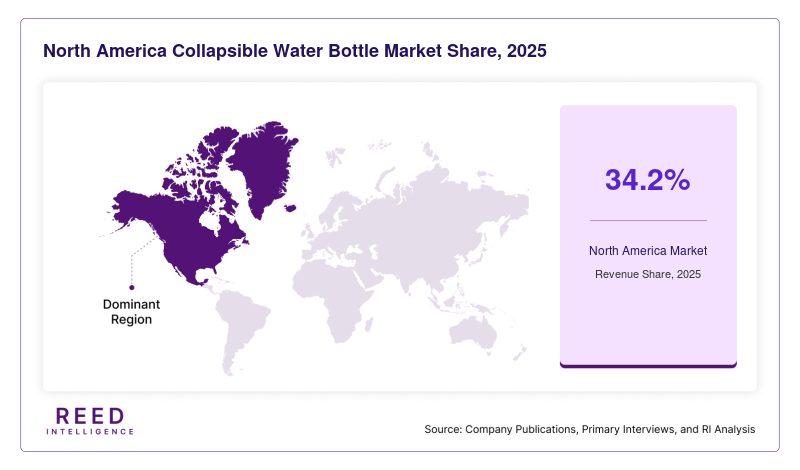
- North America dominated the market with a 34.2% share in 2025, while Asia Pacific is expected to grow at the fastest CAGR of 11.8% during 2026–2034.
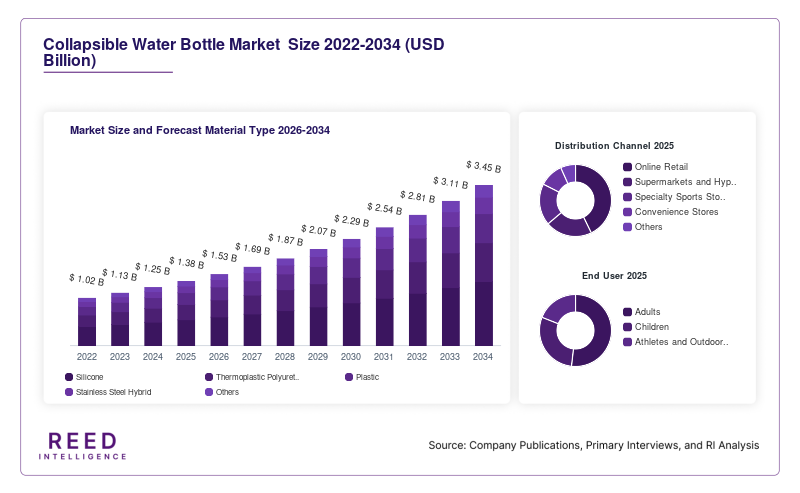
- By material type, silicone bottles accounted for the largest share of 42.6%, while thermoplastic polyurethane bottles are projected to grow at a CAGR of 12.3%.
- By distribution channel, online retail led with a 46.9% share, whereas specialty sports stores are expected to expand at a CAGR of 11.6%.
- By end user, adults represented the largest share of 58.4%, while children’s usage is anticipated to grow at a CAGR of 10.9% during the forecast period.
- The United States remained the dominant country, with market values of USD 410 million in 2024 and USD 458 million in 2025.
Market Trends
Expansion of Sustainable Lifestyle Product Portfolios
The growing integration of sustainable consumer products into mainstream retail portfolios has become a defining trend in the Collapsible Water Bottle Market. Retailers, supermarkets, and online platforms are increasingly dedicating shelf space to reusable hydration products as consumers seek alternatives to disposable plastic bottles. Brands are positioning collapsible water bottles as part of broader eco-friendly lifestyle ecosystems that include reusable straws, lunch containers, and travel accessories. This trend is particularly visible among millennials and younger consumers who prioritize environmentally responsible purchasing decisions. Companies are also using recyclable packaging materials and carbon-conscious supply chain practices to strengthen brand perception. Product aesthetics have become equally important, with foldable designs, vibrant colors, and compact storage features driving impulse purchases in both online and offline retail environments.
Integration of Smart and Multifunctional Features
Manufacturers are increasingly incorporating multifunctional capabilities into collapsible water bottles to improve product differentiation and consumer engagement. Smart hydration reminders, detachable filtration systems, insulated layers, measurement indicators, and UV purification functions are being introduced across premium product categories. Outdoor enthusiasts and fitness-focused consumers are showing interest in products that combine portability with advanced convenience features. Several companies are also developing bottles with integrated carabiners, backpack attachments, and leak-proof compression systems for hiking and travel applications. The increasing use of smartphone-connected hydration tracking systems in sports and wellness segments is further influencing innovation strategies. This trend is creating opportunities for premium pricing while encouraging partnerships between hydration brands, fitness companies, and travel accessory manufacturers.
Market Drivers
Increasing Participation in Outdoor and Fitness Activities
The growing popularity of outdoor recreation, adventure tourism, fitness training, and sports participation continues to support strong demand within the Collapsible Water Bottle Market. Consumers involved in hiking, cycling, camping, gym workouts, and running prefer lightweight hydration products that are easy to carry and store. Collapsible bottles provide space-saving advantages compared to rigid bottles, making them highly suitable for travel and outdoor mobility. Rising health awareness and increasing gym memberships across urban populations have also encouraged consumers to carry reusable water containers throughout daily routines. Sporting events, wellness campaigns, and marathon sponsorships are creating additional exposure for reusable hydration products. The market is also benefiting from increased consumer spending on travel accessories and outdoor gear, particularly among younger demographics and working professionals.
Growth of E-Commerce and Direct-to-Consumer Sales Channels
The rapid expansion of digital commerce platforms has significantly improved market accessibility for collapsible water bottle manufacturers. Online retail channels enable companies to offer wider product selections, personalized customization options, and targeted promotional campaigns to global consumers. Social media marketing, influencer partnerships, and fitness-focused digital advertising have become effective tools for increasing brand visibility. Direct-to-consumer sales models also allow manufacturers to gather customer feedback and rapidly introduce new designs based on changing preferences. Subscription-based fitness products and online travel accessory marketplaces are further contributing to market penetration. In emerging economies, rising smartphone adoption and improved internet connectivity have accelerated online purchases of portable hydration products, supporting market growth across both premium and mid-range product categories.
Market Restraint
Price Sensitivity and Concerns Regarding Product Durability
Despite favorable growth conditions, the Collapsible Water Bottle Market faces challenges related to pricing pressure and consumer concerns regarding long-term durability. Premium collapsible bottles manufactured from high-grade silicone or advanced thermoplastic materials often carry higher prices compared to conventional reusable bottles. In price-sensitive markets, consumers may prefer lower-cost alternatives that provide similar hydration functionality without collapsible features. Additionally, some consumers remain concerned about odor retention, material wear, leakage risks, and reduced structural stability after repeated folding or compression. Negative product reviews associated with poor-quality imports can affect overall market confidence, particularly in online marketplaces where product quality varies significantly. These concerns have encouraged manufacturers to increase investments in quality assurance, food-grade certification, and reinforced design engineering. However, higher production costs may limit affordability and reduce penetration among budget-conscious consumers in developing economies.
Market Opportunities
Rising Demand for Customized and Corporate-Branded Products
The growing demand for personalized hydration products presents substantial opportunities for manufacturers operating in the Collapsible Water Bottle Market. Corporate gifting programs, promotional campaigns, university branding initiatives, and event sponsorships are increasingly incorporating reusable bottles as environmentally responsible merchandise. Businesses prefer collapsible bottles because they combine branding visibility with practical consumer utility. Companies are offering customized printing, logo engraving, and color personalization services to strengthen customer engagement. Demand is particularly strong across technology companies, fitness organizations, educational institutions, and travel-related businesses seeking sustainable promotional products. As environmental awareness continues to influence corporate purchasing decisions, collapsible bottle suppliers are expected to benefit from long-term institutional contracts and bulk procurement agreements.
Expansion Across Emerging Economies and Urban Travel Segments
Emerging economies in Asia Pacific, Latin America, and the Middle East are creating favorable opportunities for market participants due to rising urbanization and increasing disposable income levels. Urban commuters and travelers are seeking compact hydration solutions that fit into backpacks, handbags, and luggage without occupying excessive space. Public transportation usage and rising participation in short-distance travel activities have accelerated demand for portable and foldable consumer products. Additionally, governments and environmental groups in several developing countries are promoting reusable alternatives to reduce plastic waste generation. Local manufacturers are introducing affordable collapsible water bottle variants tailored to regional pricing expectations. The combination of urban mobility trends, growing environmental awareness, and expanding retail infrastructure is expected to create significant revenue opportunities during the forecast period.
Segmental Analysis
By Material Type
Silicone-based collapsible water bottles dominated the market and accounted for 42.6% of the global share in 2024. The dominance of this segment is primarily linked to the material’s flexibility, lightweight properties, heat resistance, and food-grade safety characteristics. Silicone bottles are widely preferred by outdoor enthusiasts, fitness users, travelers, and office workers because they can withstand repeated folding without losing structural integrity. Manufacturers continue to introduce premium silicone variants featuring leak-proof caps, thermal insulation, and antimicrobial coatings to enhance consumer convenience. The segment also benefits from rising consumer awareness regarding BPA-free materials and long-lasting reusable products. Silicone bottles are increasingly available in various capacities, colors, and customized designs, supporting demand across both mass-market and premium consumer categories.
Thermoplastic polyurethane bottles are projected to witness the fastest CAGR of 12.3% during the forecast period. This growth is driven by increasing demand for highly durable and lightweight hydration products suitable for sports and travel applications. Thermoplastic polyurethane offers improved abrasion resistance and enhanced flexibility compared to conventional materials, making it attractive for rugged outdoor usage. Manufacturers are investing in advanced molding technologies to create compact and leak-resistant designs tailored for adventure tourism and fitness activities. Rising interest in high-performance hydration accessories among athletes and cyclists is also accelerating segment expansion. Additionally, growing adoption of recyclable thermoplastic materials is supporting sustainability-focused product innovation across global markets.
By Distribution Channel
Online retail emerged as the leading distribution channel and represented 46.9% of the market share in 2024. The rapid growth of e-commerce platforms has significantly transformed purchasing behavior within the collapsible hydration product industry. Consumers increasingly prefer online channels because they offer broader product variety, customer reviews, competitive pricing, and convenient home delivery services. Digital marketing campaigns, influencer partnerships, and fitness-focused social media promotions have strengthened online sales performance. Brands are also utilizing direct-to-consumer business models to introduce limited-edition designs, customized branding options, and subscription-based product bundles. The increasing use of mobile shopping applications and digital payment systems has further improved consumer accessibility across both developed and emerging economies.
Specialty sports stores are expected to register the fastest CAGR of 11.6% between 2026 and 2034. Growth within this segment is strongly linked to rising participation in outdoor recreation and fitness activities. Consumers purchasing camping equipment, hiking gear, cycling accessories, and gym products frequently prefer specialty stores because they offer product demonstrations and expert guidance. Retailers are expanding their hydration product portfolios by partnering with premium collapsible bottle manufacturers and sports lifestyle brands. The growing popularity of experiential retail environments is also encouraging customers to evaluate product durability, folding mechanisms, and portability features before purchase. As demand for premium outdoor equipment increases, specialty stores are expected to strengthen their role within the market.
By End User
Adults accounted for the largest share of 58.4% in the global Collapsible Water Bottle Market in 2024. The segment’s dominance is driven by strong adoption among office workers, travelers, athletes, and fitness-conscious consumers seeking portable hydration solutions for daily use. Adults increasingly prefer collapsible bottles because they reduce storage requirements and support sustainable lifestyle practices. Rising awareness regarding hydration, wellness, and environmental responsibility has further encouraged product adoption across urban populations. Employers and corporate wellness programs are also promoting reusable bottle usage to reduce workplace plastic waste. In addition, adult consumers are more likely to purchase premium hydration accessories featuring advanced functionalities such as insulation layers, integrated filtration systems, and smart hydration tracking capabilities.
Children represent the fastest-growing end-user segment and are anticipated to expand at a CAGR of 10.9% during the forecast period. Growth is supported by increasing parental awareness regarding sustainable habits and safe hydration practices for school-going children. Manufacturers are introducing child-friendly collapsible bottles featuring colorful designs, cartoon themes, spill-resistant caps, and lightweight materials to improve usability. Educational institutions are also encouraging students to carry reusable bottles as part of environmental awareness initiatives. Rising participation in extracurricular sports activities and outdoor school programs has further strengthened demand for compact hydration products designed specifically for children. The growing availability of affordable and customizable options through online retail channels is expected to accelerate segment expansion globally.
Regional Analysis
North America
North America accounted for 34.2% of the global Collapsible Water Bottle Market share in 2025 and is projected to maintain stable growth at a CAGR of 9.8% during the forecast period. Strong consumer awareness regarding environmental sustainability and reusable consumer goods continues to support regional market expansion. The region benefits from high participation in outdoor recreational activities such as hiking, camping, cycling, and fitness training. E-commerce penetration remains high across the United States and Canada, enabling brands to launch premium hydration products directly to consumers through digital marketing campaigns and subscription-based fitness platforms.
The United States dominates the regional market due to strong consumer spending on wellness products and outdoor accessories. One unique growth factor in the country is the increasing integration of reusable hydration products into corporate sustainability programs and educational institutions. Several schools, universities, and workplaces are reducing single-use plastic bottle usage through refill station installations and reusable bottle awareness campaigns. This institutional support has improved consumer adoption of collapsible water bottles across both commercial and residential applications.
Europe
Europe represented 26.8% of the global market in 2025 and is anticipated to grow at a CAGR of 9.5% from 2026 to 2034. The region has experienced strong growth due to stringent environmental regulations targeting single-use plastics and packaging waste reduction. Consumers across Western Europe increasingly prefer reusable and recyclable hydration products that align with eco-conscious lifestyles. Outdoor tourism, cycling culture, and wellness-focused consumption patterns continue to support product demand. Retail chains and specialty sporting goods stores across Germany, France, Italy, and the Nordic countries have expanded shelf availability for collapsible hydration products.
Germany remains the dominant country within the European market because of its advanced recycling culture and high consumer preference for sustainable consumer goods. A unique growth factor driving the German market is the increasing demand for reusable hydration products in workplace wellness programs and environmentally certified office spaces. Many corporations are replacing disposable plastic bottles with branded reusable alternatives as part of broader carbon reduction strategies. This trend has increased institutional procurement and encouraged premium product innovation across the regional market.
Asia Pacific
Asia Pacific held a 23.4% share of the global Collapsible Water Bottle Market in 2025 and is forecast to register the fastest CAGR of 11.8% during the forecast period. Rising urbanization, increasing disposable income, and rapid expansion of e-commerce infrastructure are supporting regional growth. Consumers in countries such as China, India, Japan, and South Korea are increasingly purchasing compact hydration products for travel, commuting, and fitness activities. Growing environmental awareness and rising concerns regarding plastic waste have further encouraged the adoption of reusable water bottles. Local manufacturers are also introducing affordable products to attract middle-income consumers.
China dominates the Asia Pacific market due to its large manufacturing ecosystem and expanding outdoor recreation sector. A unique growth factor within the country is the rapid growth of domestic travel and mobile lifestyles among younger consumers. Compact hydration products have gained popularity among students, office workers, and travelers seeking portable convenience during daily commuting and tourism activities. The integration of collapsible bottles into lifestyle retail stores and social commerce platforms has significantly increased consumer exposure and market penetration.
Middle East & Africa
The Middle East & Africa region accounted for 7.6% of the global market share in 2025 and is expected to grow at a CAGR of 8.9% through 2034. Market expansion is supported by rising urban tourism, growing participation in fitness activities, and increasing awareness regarding reusable consumer products. Several Gulf countries have implemented sustainability initiatives aimed at reducing plastic waste and promoting eco-friendly alternatives. Consumers are increasingly adopting collapsible hydration products for travel, desert tourism, and sports activities. Retail expansion across shopping malls and online marketplaces has improved product visibility throughout the region.
The United Arab Emirates leads the regional market due to high disposable income levels and strong tourism-related consumption. One unique growth factor driving demand in the country is the rapid expansion of outdoor sporting events, marathons, and wellness festivals that encourage reusable hydration practices. Hospitality companies and tourism operators are increasingly distributing branded collapsible bottles to visitors as part of sustainability-focused marketing campaigns. This trend has strengthened institutional demand and improved consumer familiarity with foldable hydration products.
Latin America
Latin America captured 8.0% of the global Collapsible Water Bottle Market share in 2025 and is projected to grow at a CAGR of 9.1% during the forecast period. Increasing environmental awareness, urban commuting trends, and rising participation in sports activities are contributing to regional demand. Consumers in Brazil, Mexico, Chile, and Argentina are showing greater interest in reusable hydration products due to concerns regarding disposable plastic waste. The expansion of modern retail formats and cross-border e-commerce platforms has improved access to international and domestic collapsible bottle brands across the region.
Brazil remains the dominant country within the Latin American market because of its large urban population and growing sports culture. A unique growth factor supporting the Brazilian market is the increasing popularity of outdoor fitness communities and public wellness campaigns in major cities. Community running clubs, beach fitness programs, and cycling groups frequently promote reusable hydration solutions as part of environmentally responsible lifestyles. This social influence has encouraged stronger adoption of collapsible bottles among younger urban consumers.
Competitive Landscape
The Collapsible Water Bottle Market remains moderately fragmented, with global and regional companies competing through product innovation, sustainability positioning, and digital marketing strategies. Leading manufacturers are focusing on lightweight materials, improved leak-proof technologies, and customized design features to strengthen brand differentiation. Companies are also expanding direct-to-consumer sales channels and partnering with fitness influencers, travel brands, and outdoor recreation companies to improve visibility among younger consumers.
Hydaway emerged as one of the leading players in the market due to its strong focus on foldable silicone bottle technology and travel-friendly hydration solutions. The company recently introduced a compact insulated bottle series designed for outdoor and urban commuting applications, strengthening its premium product portfolio. Other major players are investing in recyclable materials, antimicrobial surfaces, and advanced bottle compression mechanisms to improve durability and sustainability performance.
Key Players
- Hydaway
- Nomader
- Vapur
- Que Bottle
- Baiji Bottle
- Platypus
- HydraPak
- Nefeeko
- Kemier
- Rolla Bottle
- Embrava
- Memo Bottle
- PouchBottle
- AOHAN
- Mountop
Recent Developments
- In February 2026, Hydaway launched a new insulated collapsible bottle collection designed for travel and outdoor recreation applications.
- In July 2025, Vapur expanded its e-commerce distribution partnerships across Asia Pacific to improve market penetration in India and Southeast Asia.
- In November 2025, HydraPak introduced antimicrobial silicone technology aimed at improving hygiene and odor resistance in reusable hydration products.
- In March 2026, Que Bottle announced a collaboration with fitness influencers and wellness retailers to expand brand visibility in North America and Europe.
- In September 2025, Nomader introduced customizable corporate branding solutions targeting institutional gifting and sustainability-focused promotional campaigns.
Collapsible Water Bottle Market Segments
Material Type
- Silicone
- Thermoplastic Polyurethane
- Plastic
- Stainless Steel Hybrid
- Others
Distribution Channel
- Online Retail
- Supermarkets and Hypermarkets
- Specialty Sports Stores
- Convenience Stores
- Others
End User
- Adults
- Children
- Athletes and Outdoor Enthusiasts
By Region
- North America
- Europe
- APAC
- Middle East and Africa
- LATAM