Color Detection Sensor Market Size, Share & Demand Report By Type (RGB Color Sensors, Contrast Sensors, Fiber Optic Color Sensors, Luminescence Sensors, Mark Sensors), By Application (Packaging and Labeling, Automotive Assembly Inspection, Electronics Manufacturing, Food Sorting and Grading, Pharmaceutical Inspection), By End-Use Industry (Manufacturing, Automotive, Healthcare and Pharmaceuticals, Food and Beverage, Consumer Electronics, Logistics and Warehousing), By Region & Segment Forecasts,
USD 3950
Market Overview
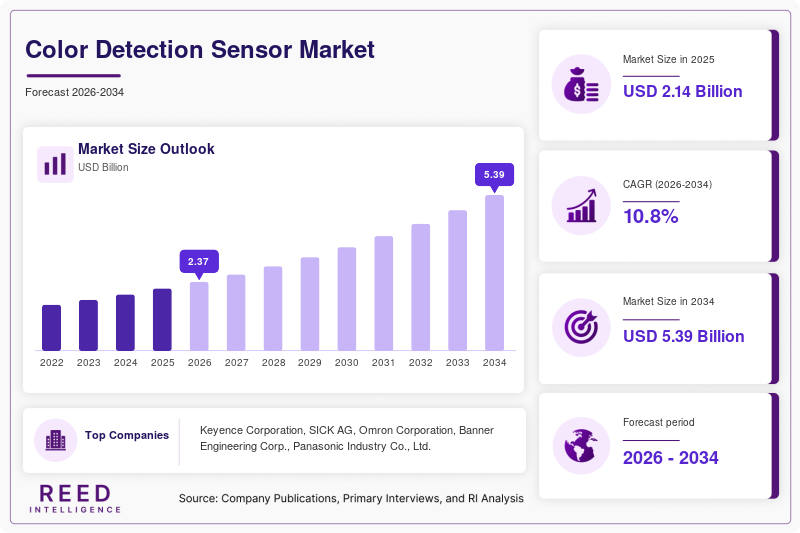
The global Color Detection Sensor Market size was valued at approximately USD 2.14 billion in 2026 and is projected to reach USD 4.87 billion by 2034, expanding at a CAGR of 10.8% during the forecast period from 2026 to 2034. The market is experiencing consistent expansion due to the increasing deployment of automation technologies across manufacturing, packaging, automotive, electronics, and food processing industries. Color detection sensors are widely used for quality inspection, sorting, label verification, object recognition, and automated assembly processes. The rising need for precision-based industrial operations and reduced production errors continues to support long-term market growth.
A major global factor supporting market expansion is the accelerated adoption of Industry 4.0 technologies. Smart factories are increasingly integrating sensor-based automation systems to improve production efficiency and operational consistency. Color detection sensors help manufacturers achieve higher accuracy in object differentiation and product validation, especially in industries where color consistency directly affects product quality. Demand has also increased in consumer electronics and pharmaceutical packaging applications where reliable detection and traceability are essential. Advancements in miniature sensor technologies, AI-enabled machine vision systems, and high-speed production lines are further improving the adoption rate of advanced color sensing solutions across industrial and commercial sectors.
Key Highlights
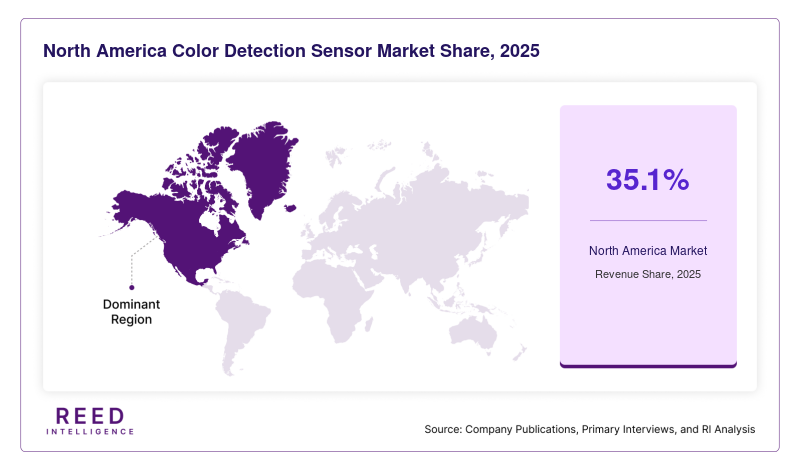
- North America dominated the market with a 35.1% share in 2025.
- Asia Pacific is expected to grow at the fastest CAGR of 12.1% during 2026–2034.
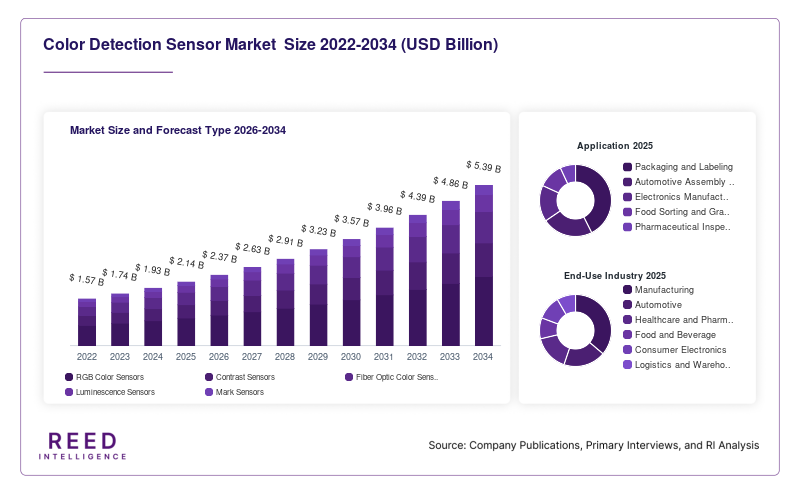
- By type, RGB color sensors accounted for the largest share of 39.4%, while fiber optic color sensors are projected to grow at a CAGR of 12.8%.
- By application, packaging and labeling led with a 36.8% share, whereas automotive assembly inspection is expected to expand at a CAGR of 11.9%.
- The United States remained the dominant country, with market values of USD 520 million in 2024 and USD 575 million in 2025.
Market Trends
Integration of AI-Based Machine Vision Systems
Manufacturers are increasingly combining color detection sensors with AI-powered machine vision systems to improve production accuracy and real-time monitoring capabilities. Traditional sensing systems are being upgraded with intelligent image processing algorithms that can differentiate subtle color variations under changing environmental conditions. This trend is particularly visible in automotive painting lines, pharmaceutical packaging, and electronics assembly operations where precision inspection is critical. AI-enabled systems can analyze multiple color parameters simultaneously and reduce false detection rates during high-speed manufacturing processes.
The growing use of robotics in industrial automation is also supporting this trend. Collaborative robots and autonomous assembly systems require accurate sensing technologies for object identification and positioning. Color detection sensors integrated with machine learning platforms improve operational flexibility and adaptive manufacturing. Several sensor manufacturers are introducing compact smart sensors with embedded analytics capabilities to support edge computing environments. This trend is expected to strengthen as industries continue to prioritize predictive maintenance, automated inspection, and intelligent manufacturing ecosystems.
Rising Adoption in Food and Beverage Processing
The food and beverage industry is becoming a significant user of color detection sensor technologies due to increasing quality assurance requirements and stricter packaging regulations. Food manufacturers are adopting advanced sensors to identify product defects, verify packaging labels, and improve sorting accuracy for fruits, vegetables, grains, and processed products. Color-based quality inspection helps reduce contamination risks and improves consistency across production batches. High-speed packaging operations also rely on color sensors for cap detection, label positioning, and barcode alignment.
The demand for automated food processing equipment has increased significantly in developed and emerging economies. Manufacturers are investing in sensor-enabled production lines to reduce labor dependency and maintain hygiene standards. In beverage production facilities, color detection systems are increasingly used for bottle cap verification and liquid color consistency analysis. Growing consumer expectations regarding food safety and product appearance are encouraging companies to deploy advanced sensing technologies. This trend is expected to create sustained demand for compact and highly accurate color detection solutions during the forecast period.
Market Drivers
Expansion of Industrial Automation Across Manufacturing Facilities
The rapid expansion of industrial automation remains one of the strongest growth drivers for the Color Detection Sensor Market. Manufacturing companies are increasingly adopting automated systems to improve production efficiency, reduce operational costs, and minimize product defects. Color detection sensors play a critical role in automated inspection and sorting systems by identifying color differences in real time. Industries such as electronics, automotive, pharmaceuticals, and packaging require highly accurate color recognition to maintain product consistency and quality standards.
The growing implementation of smart factories and connected production systems is further accelerating sensor adoption. Modern manufacturing environments rely on integrated sensing technologies for process monitoring and quality control. Color detection sensors help improve assembly precision and reduce waste generation during production. In addition, advancements in sensor response speed and miniaturization have increased their compatibility with compact automated equipment. As manufacturers continue investing in digital transformation strategies, demand for intelligent sensing technologies is expected to rise steadily across global industrial sectors.
Increasing Demand for Quality Inspection and Error Reduction
The need for higher product quality and lower rejection rates is significantly driving the adoption of color detection sensors across multiple industries. Manufacturers are under increasing pressure to maintain strict quality standards while managing large-scale production volumes. Color detection sensors provide precise verification capabilities that help identify defective products before they reach consumers. Industries including pharmaceuticals, cosmetics, consumer electronics, and food packaging are using these sensors to improve product reliability and brand consistency.
In pharmaceutical packaging, color sensors are widely used to confirm correct label placement and medicine packaging integrity. In electronics manufacturing, sensors help differentiate components and identify assembly errors during high-speed operations. The increasing cost associated with product recalls and production downtime has encouraged companies to invest in advanced inspection systems. Additionally, growing regulatory compliance requirements in healthcare and food processing industries are strengthening the importance of automated quality assurance technologies. These factors are expected to maintain strong market demand for color detection sensors over the coming years.
Market Restraint
High Integration Costs and Technical Complexity
The high cost associated with advanced sensor integration remains a key restraint affecting the growth of the Color Detection Sensor Market. Although color detection technologies provide operational advantages, many small and medium-sized enterprises face financial limitations when implementing automated sensing systems. The installation of intelligent sensor networks often requires infrastructure upgrades, software integration, and employee training, which increases initial deployment expenses. This challenge is more visible in developing economies where industrial automation adoption remains comparatively slower.
Technical complexity also creates operational barriers for end users. Color detection accuracy can be affected by environmental factors such as lighting conditions, reflective surfaces, dust, and temperature variations. Manufacturers operating in harsh industrial environments may require customized sensing solutions, increasing maintenance and calibration requirements. In addition, compatibility issues between legacy manufacturing systems and modern smart sensors can delay implementation timelines. For example, older packaging facilities often require significant redesigns before integrating AI-enabled color inspection systems. These challenges may limit adoption rates among cost-sensitive industries despite growing awareness regarding automation benefits.
Market Opportunities
Growing Demand for Smart Packaging Solutions
The increasing adoption of smart packaging technologies presents substantial opportunities for the Color Detection Sensor Market. Packaging companies are integrating advanced sensing systems to improve product tracking, authentication, and quality inspection processes. Color detection sensors are widely used to verify labels, identify packaging defects, and ensure proper alignment during high-speed production operations. Rising demand for intelligent packaging in pharmaceuticals, food products, and consumer goods is encouraging manufacturers to deploy automated inspection technologies across supply chains.
E-commerce growth is also contributing to higher demand for packaging automation systems. Distribution centers and logistics companies require reliable sorting and identification technologies to improve operational efficiency. Color detection sensors help reduce packaging errors and improve shipment accuracy in automated facilities. In addition, sustainability initiatives are encouraging manufacturers to adopt recyclable packaging materials with distinct color identification requirements. As smart packaging solutions become more common across global industries, sensor manufacturers are expected to benefit from rising investment in automated packaging infrastructure.
Expansion of Electric Vehicle Manufacturing
The rapid expansion of electric vehicle production is creating new opportunities for color detection sensor manufacturers. Automotive companies are increasing investments in automated assembly systems to improve production efficiency and reduce manufacturing defects. Color detection sensors are used extensively in vehicle painting, wiring identification, battery assembly inspection, and component verification applications. The growing complexity of EV manufacturing processes requires highly accurate sensing technologies capable of supporting automated operations and quality assurance procedures.
Battery manufacturing facilities are increasingly adopting advanced sensors to differentiate components and monitor assembly accuracy. Color detection systems also help ensure consistency in dashboard displays, lighting components, and cable identification. Several automotive manufacturers are modernizing production plants with robotics and intelligent sensing technologies to support high-volume EV production targets. The expansion of electric mobility infrastructure in Asia Pacific, Europe, and North America is expected to create long-term demand for advanced industrial sensors. This trend offers significant growth potential for companies developing high-speed and AI-enabled color detection solutions.
Segmental Analysis
By Type
RGB color sensors accounted for the largest share of approximately 39.4% in 2024 due to their broad industrial applicability and high accuracy in detecting multiple color variations. These sensors are widely used in packaging, printing, electronics manufacturing, and automated assembly systems. Their ability to distinguish complex color combinations and provide rapid response times makes them suitable for high-speed industrial operations. Manufacturers increasingly prefer RGB sensors because they can integrate easily with machine vision systems and programmable logic controllers used in smart factories. In addition, technological improvements in miniaturization and energy efficiency have expanded their adoption in compact automated equipment. The growing need for accurate product verification and defect identification continues to support the dominance of RGB color sensors within the global market.
Fiber optic color sensors are expected to witness the fastest CAGR of 12.8% during the forecast period due to their superior performance in challenging industrial environments. These sensors provide high precision under varying lighting conditions and can operate effectively in confined or hazardous production settings. Industries such as pharmaceuticals, chemicals, and semiconductor manufacturing are increasingly adopting fiber optic sensing technologies for advanced inspection processes. Their compact structure and resistance to electromagnetic interference improve reliability in automated production systems. The expansion of high-speed manufacturing lines and demand for accurate object differentiation are also supporting segment growth. Sensor manufacturers are introducing advanced fiber optic solutions with enhanced detection ranges and real-time analytics capabilities, further strengthening their adoption across complex industrial applications.
By Application
Packaging and labeling represented the dominant application segment with a market share of nearly 36.8% in 2024. Color detection sensors are extensively used in packaging facilities to verify labels, identify printing errors, and ensure accurate product positioning during automated operations. The increasing adoption of high-speed packaging machinery in food processing, pharmaceuticals, and consumer goods industries continues to drive segment growth. Manufacturers rely on color sensors to improve production efficiency and reduce packaging defects that may affect product quality and brand image. The rapid expansion of e-commerce logistics and automated distribution centers has further increased the demand for advanced inspection technologies. In addition, regulatory requirements regarding product traceability and packaging accuracy are encouraging companies to deploy intelligent color sensing systems across modern packaging lines.
Automotive assembly inspection is anticipated to register the fastest CAGR of 11.9% during the forecast period due to rising automation within vehicle manufacturing facilities. Automotive companies are increasingly using color detection sensors for paint verification, wiring identification, component alignment, and quality assurance procedures. The expansion of electric vehicle production is significantly contributing to segment growth as manufacturers invest in advanced automated assembly systems. Color sensing technologies help reduce manufacturing errors and improve consistency in high-volume production environments. Demand is also increasing for sensors capable of supporting robotic operations and AI-enabled inspection platforms. Several automotive manufacturers are modernizing production plants with intelligent automation solutions to improve operational efficiency and reduce labor dependency, creating substantial opportunities for advanced color detection systems.
By End Use Industry
The manufacturing industry accounted for the largest market share of approximately 42.1% in 2024 due to extensive adoption of automation technologies across industrial production facilities. Color detection sensors are widely used for quality inspection, sorting, positioning, and product verification applications in manufacturing environments. Electronics, consumer goods, plastics, and industrial equipment sectors increasingly rely on intelligent sensing technologies to maintain operational accuracy and reduce production waste. The integration of Industry 4.0 solutions has further accelerated the use of advanced sensors within smart manufacturing ecosystems. Manufacturers are focusing on improving production speed and minimizing human error through automated inspection systems. Rising investments in robotics and digital manufacturing infrastructure are expected to continue supporting strong demand for color detection sensors across industrial applications.
The healthcare and pharmaceutical industry is projected to grow at the fastest CAGR of 12.3% during the forecast period due to increasing quality assurance requirements and strict regulatory standards. Pharmaceutical manufacturers are adopting color detection sensors for packaging verification, medicine sorting, and label inspection applications. These sensors help reduce the risk of packaging errors and improve traceability throughout production and distribution processes. Growing investments in automated pharmaceutical manufacturing facilities are creating favorable conditions for advanced sensing technologies. In addition, rising demand for precision-based medical device manufacturing is supporting market expansion within the healthcare sector. The increasing adoption of smart packaging and serialization systems is expected to strengthen the role of color detection sensors in ensuring operational accuracy and patient safety.
Regional Analysis
North America
North America accounted for approximately 35.1% of the global Color Detection Sensor Market share in 2025 and maintained its leadership position due to strong industrial automation adoption across the United States and Canada. The region is expected to grow at a CAGR of 9.8% during the forecast period. High investments in smart manufacturing technologies, robotics integration, and advanced quality inspection systems continue to support market expansion. Packaging, pharmaceuticals, and automotive sectors are among the primary adopters of intelligent color sensing technologies across the region.
The United States remained the dominant country in North America due to its strong manufacturing base and rapid implementation of Industry 4.0 strategies. Major automotive and electronics manufacturers are increasingly investing in AI-enabled production facilities equipped with advanced sensing systems. Another important growth factor is the expansion of e-commerce logistics infrastructure, which requires automated sorting and packaging inspection solutions. Rising demand for precision-based quality control systems across food processing and healthcare industries is also contributing to steady market growth in the country.
Europe
Europe represented nearly 27.4% of the global market share in 2025 and is projected to grow at a CAGR of 9.5% between 2026 and 2034. The region benefits from a well-established industrial manufacturing ecosystem and strong regulatory focus on product quality and operational safety. Automotive production facilities across Germany, France, and Italy are adopting advanced color detection technologies to improve assembly accuracy and reduce production errors. Increasing investments in factory automation are also contributing to regional market expansion.
Germany emerged as the leading country within the European market due to its advanced automotive and industrial equipment sectors. German manufacturers are rapidly integrating robotics and smart inspection systems into production lines to improve operational efficiency. A unique growth factor in the region is the strong emphasis on sustainable manufacturing practices. Companies are increasingly deploying automated inspection technologies to reduce material waste and improve production consistency. This trend is expected to strengthen demand for high-performance color detection sensors across European industries.
Asia Pacific
Asia Pacific held around 24.6% of the Color Detection Sensor Market share in 2025 and is expected to register the fastest CAGR of 12.1% during the forecast period. Rapid industrialization, expanding electronics manufacturing, and rising investments in factory automation are supporting strong market growth across the region. Countries including China, Japan, South Korea, and India are increasing adoption of automated quality inspection systems in automotive, electronics, and packaging industries. The availability of cost-effective manufacturing infrastructure further supports regional expansion.
China dominated the Asia Pacific market due to its extensive manufacturing sector and strong investments in industrial automation technologies. The country continues to expand smart factory initiatives to improve production efficiency and global competitiveness. One unique growth factor is the increasing demand for consumer electronics and semiconductor production. Manufacturers require highly accurate sensing technologies for component identification and inspection during high-speed assembly operations. Rising electric vehicle production and government support for intelligent manufacturing are expected to further accelerate market growth across the region.
Middle East & Africa
The Middle East & Africa region accounted for nearly 6.3% of the global market share in 2025 and is forecast to grow at a CAGR of 8.7% through 2034. Industrial modernization projects and increasing investments in manufacturing infrastructure are supporting gradual adoption of color detection sensor technologies. Food processing, packaging, and logistics industries are among the key users of automated sensing systems in the region. Governments are also encouraging industrial diversification initiatives to reduce dependence on oil-based economies.
Saudi Arabia emerged as the dominant country in the regional market due to growing investments in industrial automation and smart manufacturing facilities. The country’s focus on economic diversification programs is encouraging companies to adopt advanced production technologies across multiple sectors. A unique growth factor is the expansion of large-scale logistics and warehouse infrastructure associated with e-commerce growth. Automated sorting and packaging operations increasingly rely on color detection systems to improve efficiency and operational accuracy within distribution centers.
Latin America
Latin America captured approximately 6.6% of the global market share in 2025 and is projected to expand at a CAGR of 8.9% during the forecast period. Manufacturing industries across Brazil, Mexico, and Argentina are increasingly adopting automated inspection technologies to improve productivity and product quality. Packaging and food processing sectors remain major contributors to market demand due to rising consumer goods production. Investments in industrial automation are gradually increasing as companies modernize aging manufacturing infrastructure.
Brazil remained the leading country within the Latin American market because of its strong food processing and automotive manufacturing industries. Companies are increasingly investing in advanced inspection systems to improve export competitiveness and reduce product defects. A unique growth factor in the country is the growing demand for automated agricultural processing equipment. Food and beverage manufacturers are adopting color detection technologies for sorting, grading, and packaging operations. This trend is expected to support stable market growth across the region over the forecast period.
Competitive Landscape
The Color Detection Sensor Market is moderately competitive, with global and regional manufacturers focusing on technological innovation, automation compatibility, and product miniaturization. Leading companies are investing in AI-enabled sensing technologies and advanced machine vision integration to strengthen market positioning. Strategic partnerships with robotics manufacturers and industrial automation providers are becoming increasingly common as companies aim to expand their industrial customer base.
Key market participants include Keyence Corporation, SICK AG, Omron Corporation, Banner Engineering, and Panasonic Industry. Keyence Corporation remained one of the leading companies due to its extensive portfolio of high-speed sensing solutions and strong global distribution network. The company recently introduced compact color sensors designed for precision inspection in electronics and packaging applications. SICK AG expanded its smart factory automation offerings through enhanced sensor analytics platforms, while Omron Corporation increased investments in AI-based inspection technologies. Banner Engineering focused on rugged industrial sensor systems for harsh manufacturing environments. Panasonic Industry also strengthened its position by developing miniature sensing technologies suitable for compact automation equipment.
Key Players
- Keyence Corporation
- SICK AG
- Omron Corporation
- Banner Engineering Corp.
- Panasonic Industry Co., Ltd.
- Pepperl+Fuchs SE
- Baumer Group
- Rockwell Automation, Inc.
- Leuze electronic GmbH
- Balluff GmbH
- Cognex Corporation
- Schneider Electric SE
- Autonics Corporation
- Datalogic S.p.A.
- IFM Electronic GmbH
Recent Developments
- In February 2026, Keyence Corporation launched an AI-enabled color detection sensor series designed for high-speed electronics manufacturing lines.
- In August 2025, SICK AG expanded its industrial automation portfolio with advanced fiber optic color sensors for pharmaceutical packaging applications.
- In November 2025, Omron Corporation partnered with a robotics automation provider to integrate intelligent color sensing technologies into smart factory systems.
- In March 2026, Banner Engineering introduced ruggedized color detection sensors capable of operating in extreme industrial environments with high contamination exposure.
Color Detection Sensor Market Segments
Type
- RGB Color Sensors
- Contrast Sensors
- Fiber Optic Color Sensors
- Luminescence Sensors
- Mark Sensors
Application
- Packaging and Labeling
- Automotive Assembly Inspection
- Electronics Manufacturing
- Food Sorting and Grading
- Pharmaceutical Inspection
End-Use Industry
- Manufacturing
- Automotive
- Healthcare and Pharmaceuticals
- Food and Beverage
- Consumer Electronics
- Logistics and Warehousing
By Region
- North America
- Europe
- APAC
- Middle East and Africa
- LATAM