Combat Dressing Market Size, Share & Demand Report By Type (Elastic Combat Dressing, Hemostatic Dressing, Pressure Dressing), By Application (Military, Civilian Emergency, Disaster Management), By End-Use (Hospitals, Emergency Medical Services, Defense Organizations), By Region & Segment Forecasts, 2025–2034
USD 3950
Market Overview
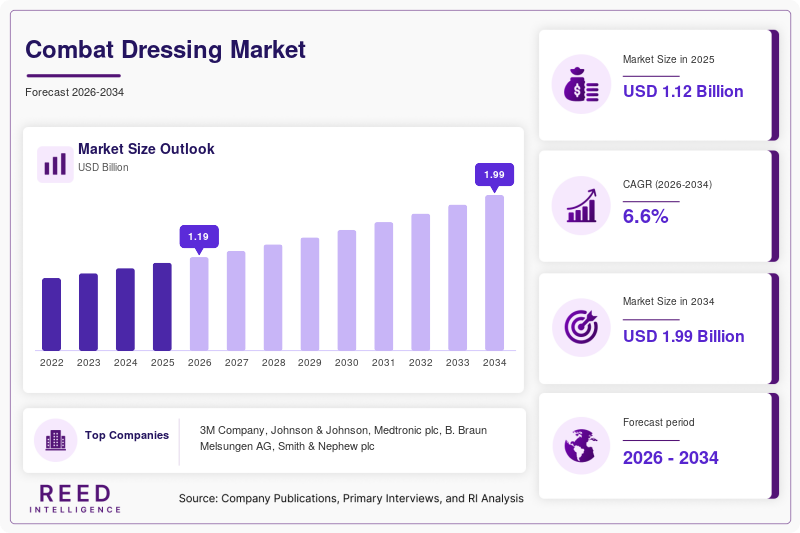
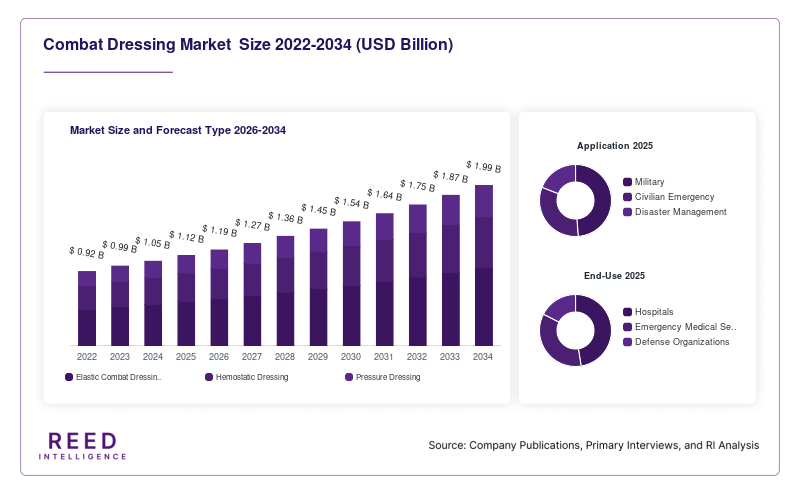
The Combat Dressing Market size is estimated at USD 1.12 billion, and it is expected to reach approximately USD 1.19 billion in 2026. The market is projected to grow significantly, reaching around USD 1.98 billion by 2034, registering a compound annual growth rate (CAGR) of 6.6% from 2025 to 2034.
Combat dressings, designed for rapid hemorrhage control and wound stabilization, play a critical role in battlefield medicine and emergency response. These dressings are widely used by armed forces, paramedics, and disaster relief teams due to their ability to provide immediate care in critical situations. The increasing focus on improving survival rates in trauma cases is contributing to the growing demand for these products.
Key Highlights
- The Combat Dressing Market is projected to reach approximately USD 1.98 billion by 2034, reflecting steady expansion driven by rising demand for advanced trauma care solutions. This growth highlights increasing investments in both military and civilian emergency medical infrastructure worldwide.
- The market is expected to grow at a CAGR of 6.6% during the forecast period from 2025 to 2034. This consistent growth rate indicates stable demand supported by ongoing innovation and expanding application areas.
- Demand for combat dressings is increasing across military and emergency healthcare sectors due to the need for rapid hemorrhage control and effective field treatment. Governments and healthcare providers are prioritizing advanced wound care solutions to improve survival outcomes.
- Continuous technological advancements in wound care materials, including hemostatic agents and antimicrobial properties, are enhancing product effectiveness. These innovations are enabling faster healing, better infection control, and improved usability in critical conditions.
Market Trends
Integration of Advanced Hemostatic Technologies
A notable trend in the Combat Dressing Market is the growing integration of advanced hemostatic agents within dressing products. Manufacturers are incorporating materials such as chitosan and kaolin to enhance clotting efficiency and reduce blood loss in critical injuries. These innovations are particularly valuable in combat scenarios where immediate medical intervention may not be available. The demand for such products is increasing as defense organizations prioritize rapid-response medical solutions. Additionally, the use of bioengineered materials is gaining traction, enabling faster wound healing and reduced infection risks. This trend is expected to redefine product standards and improve the overall effectiveness of combat dressings across various applications.
Expansion of Civilian and Emergency Use Applications
Another emerging trend is the increasing adoption of combat dressings in civilian emergency care and disaster management. Hospitals, ambulatory services, and first responders are integrating these dressings into trauma kits due to their ease of use and effectiveness in controlling severe bleeding. The growing awareness of first aid and the need for immediate hemorrhage control in accidents and natural disasters are driving this trend. Moreover, training programs for emergency responders are incorporating combat dressing usage, further boosting market demand. This expansion beyond military use is broadening the market scope and creating new growth avenues for manufacturers.
Market Drivers
Rising Military Expenditure and Soldier Safety Initiatives
The increasing global defense budgets are a significant driver for the Combat Dressing Market. Governments are investing in advanced medical equipment to enhance the safety and survival rates of military personnel. Combat dressings are a critical component of individual first aid kits, making them a priority procurement item. Modern warfare strategies emphasize rapid medical response, which has led to the adoption of high-performance wound care solutions. Additionally, the focus on reducing fatalities due to hemorrhage is encouraging the development and deployment of innovative dressing products. This driver is expected to maintain consistent demand for combat dressings over the forecast period.
Growth in Emergency Medical Services and Trauma Cases
The expansion of emergency medical services worldwide is another key factor driving market growth. The increasing number of road accidents, industrial injuries, and natural disasters has heightened the need for effective trauma care solutions. Combat dressings are widely used in pre-hospital settings to stabilize patients before they reach medical facilities. Furthermore, governments and healthcare organizations are investing in training programs to improve emergency response capabilities. This has led to a higher adoption rate of advanced dressing products among paramedics and first responders. The growing emphasis on quick and efficient trauma management continues to support market expansion.
Market Restraint
High Cost of Advanced Combat Dressing Products
One of the major restraints affecting the Combat Dressing Market is the relatively high cost associated with advanced dressing products. Innovative dressings that incorporate hemostatic agents and antimicrobial properties tend to be more expensive than traditional wound care solutions. This cost factor can limit their adoption, particularly in low- and middle-income regions where healthcare budgets are constrained.
The high cost also impacts large-scale procurement for military and emergency services, especially in developing countries. While developed economies can allocate significant resources for advanced medical supplies, others may rely on conventional alternatives due to budget limitations. Additionally, the cost of training personnel to use specialized dressings further adds to the overall expenditure.
This restraint can slow market penetration in price-sensitive regions and create challenges for manufacturers aiming to expand globally. Companies are addressing this issue by focusing on cost optimization and developing affordable product variants. However, balancing cost and performance remains a critical challenge in the industry.
Market Opportunities
Increasing Demand in Emerging Economies
Emerging economies present significant growth opportunities for the Combat Dressing Market. Countries in Asia Pacific, Latin America, and Africa are investing in healthcare infrastructure and emergency response systems. As these regions experience economic growth, governments are allocating funds to improve medical preparedness, including the procurement of advanced trauma care products. The rising awareness of first aid and the importance of immediate hemorrhage control is further driving demand. Manufacturers can capitalize on this opportunity by expanding their distribution networks and offering cost-effective solutions tailored to regional needs. This trend is expected to contribute substantially to market growth during the forecast period.
Development of Multi-Functional and Smart Dressings
The development of multi-functional and smart combat dressings is another promising opportunity in the market. Innovations such as dressings with embedded sensors for monitoring wound conditions and drug delivery capabilities are gaining attention. These advanced products can provide real-time data on wound healing and infection, enabling better treatment outcomes. Additionally, the integration of lightweight and compact designs enhances usability in field conditions. As research and development efforts continue, these innovations are expected to transform the market landscape and create new revenue streams for manufacturers.
Segmental Analysis
By Type
The elastic combat dressing segment dominated the market in 2024, accounting for approximately 48% of the total share. These dressings are widely preferred due to their flexibility and ability to provide consistent pressure for hemorrhage control. Elastic dressings are easy to apply and can be used in various injury scenarios, making them suitable for both military and civilian applications. Their versatility and effectiveness have made them a standard component in trauma kits. Additionally, continuous product improvements are enhancing their performance, further supporting their dominance in the market.
The hemostatic dressing segment is expected to be the fastest-growing, with a projected CAGR of 7.8% during the forecast period. These dressings are designed to accelerate blood clotting, making them highly effective in critical situations. The increasing demand for rapid-response medical solutions is driving their adoption. Furthermore, advancements in material science are enabling the development of more efficient hemostatic agents. This growth is supported by the rising focus on reducing mortality rates in trauma cases.
By Application
Military application held the largest market share in 2024, contributing around 55% of the total revenue. Combat dressings are essential in military operations, where immediate medical care is crucial. The increasing emphasis on soldier safety and survival is driving the demand for advanced dressing solutions. Additionally, ongoing military modernization programs are supporting the adoption of innovative products.
The civilian emergency application segment is expected to grow at the fastest CAGR of 7.2%. The rising number of accidents and natural disasters is increasing the need for effective trauma care solutions. Combat dressings are being widely adopted in ambulances and emergency response kits. The growing awareness of first aid and the importance of immediate hemorrhage control are key factors driving this segment’s growth.
By End-Use
Hospitals dominated the market in 2024, accounting for approximately 42% of the total share. These facilities require advanced wound care solutions to manage trauma cases effectively. The availability of skilled healthcare professionals and advanced infrastructure supports the use of combat dressings in hospitals. Additionally, the increasing number of trauma cases is driving demand in this segment.
Emergency medical services (EMS) are expected to be the fastest-growing end-use segment, with a CAGR of 7.4%. The expansion of pre-hospital care systems is driving the adoption of combat dressings in this segment. EMS providers require efficient and easy-to-use solutions for immediate patient care. The increasing focus on improving emergency response capabilities is further supporting this growth.
Regional Analysis
North America
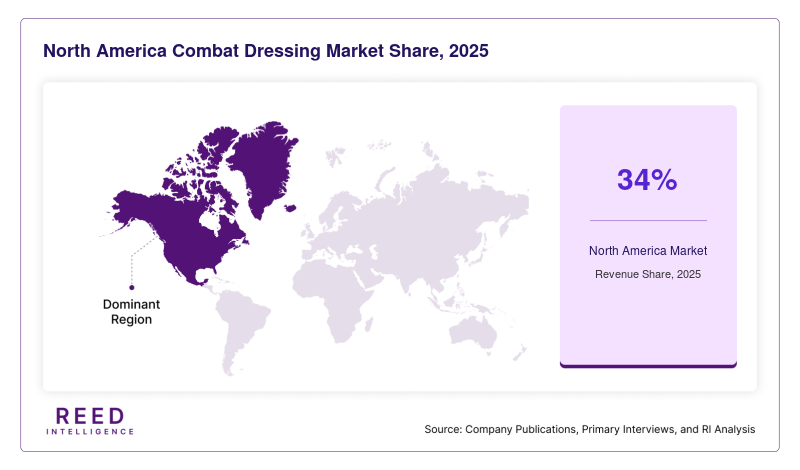
North America held a significant share of the Combat Dressing Market in 2025, accounting for approximately 34% of the global market. The region is expected to grow at a CAGR of around 6.2% during the forecast period. The strong presence of advanced healthcare infrastructure and high defense spending are key factors contributing to market growth. Additionally, the increasing adoption of advanced trauma care solutions in emergency medical services supports market expansion.
The United States dominates the regional market due to its substantial military budget and focus on soldier safety. A unique growth factor in this region is the integration of advanced medical technologies into defense systems. Continuous innovation and collaboration between defense agencies and medical device manufacturers are further strengthening the market.
Europe
Europe accounted for nearly 26% of the global market share in 2025 and is projected to grow at a CAGR of 5.9% through 2034. The region benefits from well-established healthcare systems and increasing investments in emergency medical services. The demand for combat dressings is driven by both military applications and civilian trauma care.
Germany leads the European market, supported by its strong medical device industry and focus on research and development. A unique growth factor is the increasing emphasis on disaster preparedness and response mechanisms. Governments are enhancing their emergency response capabilities, which is boosting the adoption of advanced dressing solutions.
Asia Pacific
Asia Pacific is one of the fastest-growing regions, holding around 22% market share in 2025 and expected to register a CAGR of 7.5%. Rapid economic growth and increasing healthcare investments are driving market expansion. The region is witnessing a growing demand for advanced trauma care solutions in both military and civilian sectors.
China dominates the regional market due to its expanding defense budget and improving healthcare infrastructure. A unique growth factor is the rising focus on domestic manufacturing of medical devices. This is enabling cost-effective production and increasing accessibility of combat dressings across the region.
Middle East & Africa
The Middle East & Africa region accounted for approximately 10% of the global market in 2025 and is projected to grow at a CAGR of 6.8%. The increasing focus on healthcare development and emergency response systems is supporting market growth. Additionally, the region’s geopolitical environment contributes to the demand for advanced medical supplies.
Saudi Arabia is a key market in this region, driven by its investments in healthcare infrastructure and defense. A unique growth factor is the increasing adoption of modern medical technologies in emergency care. Governments are prioritizing rapid response capabilities, which is boosting the demand for combat dressings.
Latin America
Latin America held around 8% of the global market share in 2025 and is expected to grow at a CAGR of 6.1% during the forecast period. The region is gradually improving its healthcare infrastructure, which is supporting the adoption of advanced wound care products.
Brazil dominates the market in Latin America due to its large population and expanding healthcare sector. A unique growth factor is the increasing focus on emergency preparedness and disaster management. This is driving the demand for effective trauma care solutions, including combat dressings.
Competitive Landscape
The Combat Dressing Market is moderately competitive, with several key players focusing on product innovation and strategic partnerships. Leading companies are investing in research and development to enhance product performance and expand their market presence. The competition is driven by the need to provide effective and reliable trauma care solutions.
One of the leading players in the market is 3M Company, which has a strong portfolio of advanced wound care products. The company focuses on continuous innovation and has recently introduced improved hemostatic dressings designed for rapid hemorrhage control. Other major players are also adopting similar strategies, including product launches and collaborations with defense organizations.
The competitive landscape is characterized by the presence of both established companies and emerging players. While established firms dominate the market with their extensive distribution networks, new entrants are focusing on niche innovations. This dynamic environment is expected to drive further advancements in combat dressing technologies.
Key Players
- 3M Company
- Johnson & Johnson
- Medtronic plc
- B. Braun Melsungen AG
- Smith & Nephew plc
- Cardinal Health Inc.
- Mölnlycke Health Care AB
- ConvaTec Group plc
- Integra LifeSciences
- Derma Sciences Inc.
- Tactical Medical Solutions Inc.
- PerSys Medical
- H&H Medical Corporation
- First Care Products Ltd.
- Safeguard Medical
Recent Developments
- In 2024, 3M Company launched an advanced hemostatic dressing with improved absorption capacity and faster clotting performance.
- In 2023, Smith & Nephew introduced a lightweight combat dressing designed for enhanced portability and ease of use in field conditions.
- In 2024, Tactical Medical Solutions partnered with defense agencies to develop customized trauma kits incorporating next-generation combat dressings.
Combat Dressing Market Segments
Type
- Elastic Combat Dressing
- Hemostatic Dressing
- Pressure Dressing
Application
- Military
- Civilian Emergency
- Disaster Management
End-Use
- Hospitals
- Emergency Medical Services
- Defense Organizations
By Region
- North America
- Europe
- APAC
- Middle East and Africa
- LATAM