Commercial Aircraft Battery Management System Market Size, Share Demand Report By Component (Hardware, Software), By Battery Type (Lithium-ion Batteries, Nickel-Cadmium Batteries, Solid-State Batteries), By Aircraft Type (Narrow-Body Aircraft, Wide-Body Aircraft, Regional Jets), By Application (Auxiliary Power Units, Propulsion Systems, Emergency Systems, Cabin Systems), By Region & Segment Forecasts, 2025–2034
USD 3950
Market Overview
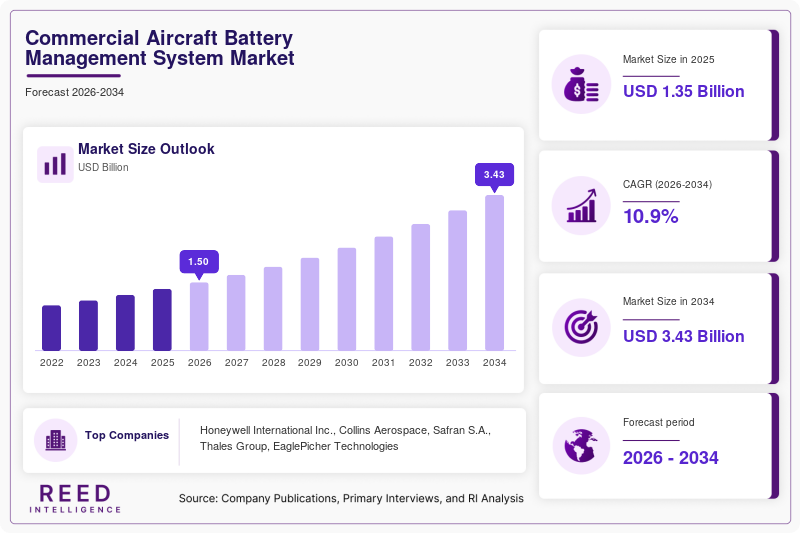
The Commercial Aircraft Battery Management System Market size was valued at approximately USD 1.35 billion in 2025 and is projected to reach around USD 3.42 billion by 2034, expanding at a CAGR of 10.9% during the forecast period (2025–2034). The increasing integration of advanced electrical systems in modern aircraft, coupled with the aviation industry’s shift toward electrification, has significantly contributed to the expansion of battery management systems (BMS) in commercial aviation.
One of the primary global factors supporting market growth is the rising adoption of more-electric aircraft (MEA) architectures. Airlines and aircraft manufacturers are focusing on improving fuel efficiency and reducing carbon emissions by replacing traditional hydraulic and pneumatic systems with electrical alternatives. This transition has elevated the importance of reliable battery management systems to ensure safety, performance optimization, and lifecycle management of onboard batteries.
Key Highlights
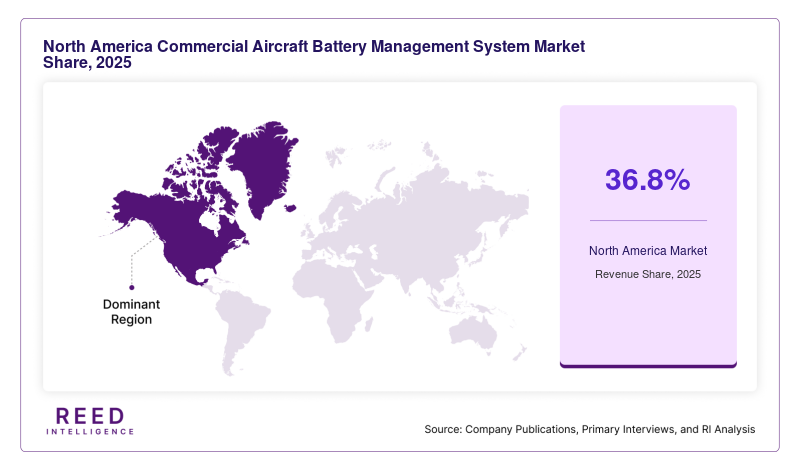
- North America dominated the market with a share of 36.8% in 2025, while Asia Pacific is expected to grow at the fastest CAGR of 12.6%.
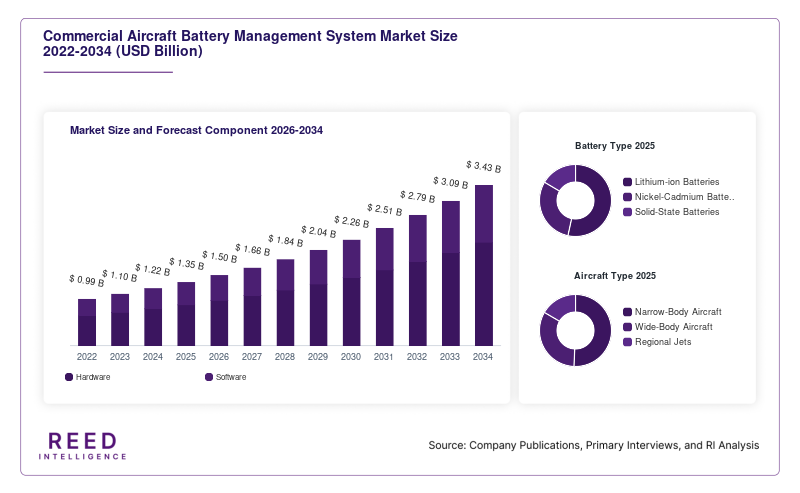
- By component, hardware held the leading share at 58.4%, while software is projected to grow at the fastest CAGR of 12.9%.
- By battery type, lithium-ion batteries dominated with a 64.2% share, while solid-state batteries are expected to grow at a CAGR of 13.8%.
- The U.S. market was valued at USD 420 million in 2025 and is estimated to reach USD 455 million in 2026.
Market Trends
Integration of Smart and Predictive Analytics in BMS
A notable trend shaping the Commercial Aircraft Battery Management System Market is the integration of smart analytics and predictive maintenance technologies. Modern BMS solutions are increasingly equipped with artificial intelligence and machine learning algorithms that analyze battery health data in real time. These systems can predict potential failures, optimize charging cycles, and extend battery life. Airlines are adopting such intelligent systems to minimize downtime and improve operational efficiency. The shift toward digital aviation ecosystems has further accelerated the demand for connected BMS platforms that can communicate with aircraft health monitoring systems and ground-based maintenance infrastructure.
Shift Toward Electrification and Hybrid-Electric Aircraft
The transition toward hybrid-electric and fully electric aircraft is another key trend influencing the market. Aircraft manufacturers are investing in electrification technologies to meet global sustainability targets and reduce carbon emissions. This shift has significantly increased the demand for advanced battery management systems capable of handling high-energy-density batteries. BMS solutions are evolving to support higher voltage ranges, enhanced thermal management, and improved safety features. Additionally, the development of next-generation aircraft platforms is driving innovation in modular and scalable BMS architectures, enabling seamless integration with various battery chemistries and configurations.
Market Drivers
Increasing Demand for Aircraft Electrification
The growing demand for aircraft electrification is a major driver of the Commercial Aircraft Battery Management System Market. Airlines and manufacturers are increasingly focusing on reducing fuel consumption and operational costs by incorporating electric subsystems into aircraft design. Electrification enables improved energy efficiency and reduced reliance on traditional power sources. As a result, battery systems are becoming more critical, necessitating advanced BMS solutions to ensure optimal performance and safety. The expansion of electric taxiing systems, in-flight entertainment systems, and auxiliary power units has further contributed to the demand for robust battery management technologies.
Stringent Safety and Regulatory Standards
The aviation industry is subject to strict safety regulations, which have significantly influenced the adoption of advanced battery management systems. Regulatory authorities mandate rigorous testing and monitoring of aircraft battery systems to prevent failures and ensure passenger safety. BMS solutions provide essential functionalities such as thermal management, fault detection, and real-time monitoring, which are critical for compliance with aviation standards. The increasing focus on safety, especially following incidents related to battery failures, has prompted airlines and manufacturers to invest in more reliable and sophisticated BMS technologies. This regulatory pressure continues to drive innovation and adoption across the market.
Market Restraints
High Development and Certification Costs
One of the major restraints in the Commercial Aircraft Battery Management System Market is the high cost associated with development, testing, and certification. Aviation-grade battery management systems must meet stringent regulatory standards, which require extensive validation processes and compliance with safety certifications. These requirements significantly increase the time and cost involved in product development.
Additionally, the complexity of integrating BMS with existing aircraft systems poses technical challenges, leading to higher engineering and implementation costs. Smaller manufacturers and new entrants may face barriers due to the substantial investment required for research and development. The need for continuous upgrades and maintenance further adds to the overall cost burden, limiting the adoption of advanced BMS solutions, particularly among cost-sensitive operators.
Market Opportunities
Growth of Electric and Urban Air Mobility Aircraft
The emergence of electric and urban air mobility (UAM) aircraft presents significant growth opportunities for the Commercial Aircraft Battery Management System Market. These aircraft rely heavily on battery systems, making efficient BMS solutions essential for safe and reliable operations. The increasing investments in electric aviation startups and pilot projects are expected to create new demand avenues for advanced battery management technologies.
Advancements in Battery Technologies
Technological advancements in battery chemistries, such as solid-state and next-generation lithium batteries, offer promising opportunities for the market. These innovations require sophisticated BMS solutions to manage higher energy densities and ensure safety. As battery technologies evolve, the demand for customized and high-performance BMS systems is expected to grow, providing opportunities for manufacturers to develop innovative solutions tailored to emerging requirements.
Segmental Analysis
By Component
Hardware dominated the Commercial Aircraft Battery Management System Market with a share of 58.4% in 2025. This dominance was attributed to the essential role of physical components such as sensors, controllers, and communication modules in monitoring and managing battery performance. The increasing complexity of aircraft electrical systems has further driven the demand for advanced hardware solutions.
Software is expected to grow at the fastest CAGR of 12.9% during the forecast period. The growth will be driven by the increasing adoption of intelligent algorithms and data analytics for battery monitoring and predictive maintenance. Software solutions enable real-time data processing and enhance system efficiency, making them a critical component of modern BMS.
By Battery Type
Lithium-ion batteries accounted for the largest share of 64.2% in 2025. Their high energy density, lightweight characteristics, and widespread adoption in commercial aircraft contributed to their dominance. These batteries are widely used in auxiliary power units and emergency systems.
Solid-state batteries are projected to grow at the fastest CAGR of 13.8%. Their improved safety, higher energy density, and longer lifecycle will drive adoption in next-generation aircraft. The development of advanced BMS solutions tailored for solid-state batteries will further support this growth.
By Aircraft Type
Narrow-body aircraft dominated the market with a share of 49.7% in 2025. The high volume of narrow-body aircraft in global fleets and their frequent usage in short-haul routes contributed to their leading position.
Wide-body aircraft are expected to grow at a CAGR of 11.5% during the forecast period. The increasing demand for long-haul travel and expansion of international routes will drive the adoption of advanced BMS solutions in this segment.
By Application
Auxiliary power units (APUs) held the largest share of 41.3% in 2025. The critical role of APUs in providing power during ground operations and emergencies has driven the demand for reliable battery management systems.
Propulsion systems are expected to grow at the fastest CAGR of 13.2%. The shift toward electric and hybrid propulsion technologies will significantly increase the demand for advanced BMS solutions capable of managing high-power battery systems.
Regional Analysis
North America
North America accounted for 36.8% of the Commercial Aircraft Battery Management System Market share in 2025 and will expand at a CAGR of 9.8% during the forecast period. The region’s growth is supported by the presence of major aircraft manufacturers and advanced aerospace infrastructure. High investments in research and development and early adoption of innovative technologies have strengthened the market position.
The United States dominated the regional market due to strong demand for technologically advanced aircraft systems. The country’s focus on modernization of fleets and integration of advanced avionics has driven the adoption of battery management systems. Additionally, collaborations between aerospace companies and technology providers have accelerated innovation in BMS solutions.
Europe
Europe held a 27.5% market share in 2025 and will grow at a CAGR of 10.2% through 2034. The region’s emphasis on sustainability and reduction of carbon emissions has driven the adoption of electric and hybrid aircraft technologies. Government initiatives supporting green aviation have further contributed to market growth.
Germany emerged as the dominant country in Europe, driven by its strong aerospace manufacturing base and focus on technological innovation. The country’s investments in research programs aimed at electrification of aircraft have increased demand for advanced BMS systems.
Asia Pacific
Asia Pacific accounted for 22.3% of the market share in 2025 and is expected to grow at the fastest CAGR of 12.6% during the forecast period. Rapid expansion of the aviation sector and increasing air passenger traffic have fueled demand for modern aircraft equipped with advanced systems.
China led the regional market due to its growing domestic aircraft manufacturing capabilities and investments in aviation infrastructure. The country’s efforts to develop indigenous aircraft programs have created significant demand for battery management systems.
Middle East & Africa
The Middle East & Africa region held a 7.1% share in 2025 and will grow at a CAGR of 9.1%. The region’s growth is driven by increasing investments in aviation infrastructure and expansion of airline fleets.
The United Arab Emirates dominated the region due to its position as a global aviation hub. The country’s focus on adopting advanced technologies and enhancing operational efficiency has supported the demand for BMS solutions.
Latin America
Latin America accounted for 6.3% of the market share in 2025 and is projected to grow at a CAGR of 8.7%. The region’s growth is supported by gradual modernization of aircraft fleets and increasing demand for air travel.
Brazil emerged as the leading country in the region, driven by its established aerospace industry and growing investments in aviation technology. The adoption of advanced systems in new aircraft models has contributed to the demand for battery management systems.
Competitive Landscape
The Commercial Aircraft Battery Management System Market is moderately consolidated, with key players focusing on technological innovation and strategic partnerships. Leading companies are investing in research and development to enhance product capabilities and meet evolving industry requirements.
The market leader, Honeywell International Inc., has strengthened its position through continuous innovation and integration of advanced analytics into its BMS solutions. The company recently introduced a next-generation battery management platform designed for hybrid-electric aircraft, enhancing performance and safety.
Other major players are focusing on expanding their product portfolios and forming collaborations with aircraft manufacturers to gain a competitive edge. The emphasis on sustainability and electrification continues to shape competitive strategies across the market.
Key Players
- Honeywell International Inc.
- Collins Aerospace
- Safran S.A.
- Thales Group
- EaglePicher Technologies
- Astronics Corporation
- Meggitt PLC
- Concorde Battery Corporation
- Saft Groupe S.A.
- GS Yuasa Corporation
- EnerSys
- MarathonNorco Aerospace
- Kokam Co., Ltd.
- Tesla, Inc.
- Panasonic Corporation
Recent Developments
- 2025: Honeywell launched an advanced BMS platform for hybrid-electric aircraft applications.
- 2024: Safran introduced a new battery monitoring system with enhanced thermal management capabilities.
- 2024: GS Yuasa expanded its production capacity for aviation batteries and BMS solutions.
- 2023: Collins Aerospace partnered with an aircraft manufacturer to develop next-generation electric propulsion systems.
- 2023: Thales Group invested in research programs focused on smart battery management technologies.
Commercial Aircraft Battery Management System Market Segments
Component
- Hardware
- Software
Battery Type
- Lithium-ion Batteries
- Nickel-Cadmium Batteries
- Solid-State Batteries
Aircraft Type
- Narrow-Body Aircraft
- Wide-Body Aircraft
- Regional Jets
Application
- Auxiliary Power Units (APUs)
- Propulsion Systems
- Emergency Systems
- Cabin Systems
By Region
- North America
- Europe
- APAC
- Middle East and Africa
- LATAM