Commercial Airport Full Body Scanner Market Size, Share & Demand Report By Technology (Terahertz Imaging Systems, Infrared Scanning Systems), By Application (Passenger Screening, Employee Screening, Integrated Security Screening), By Airport Type (Regional Airports, Private Commercial Airports), By Region & Segment Forecasts, 2026–2034
USD 3950
Market Overview
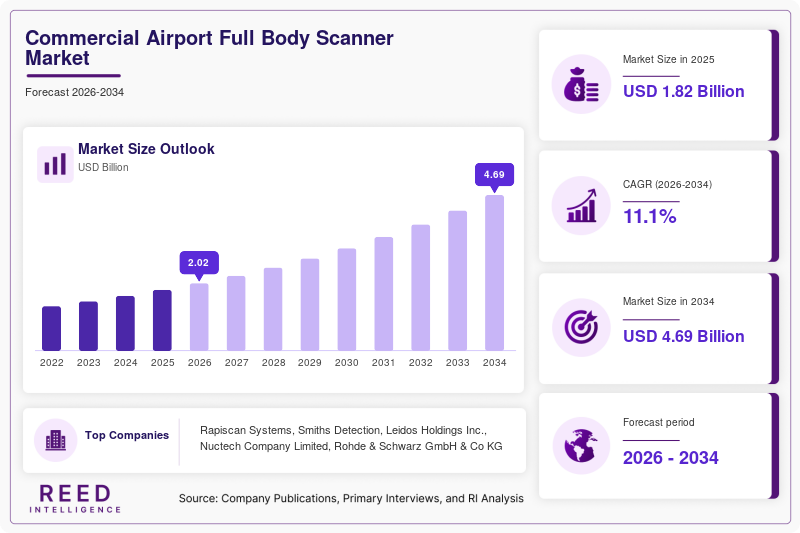
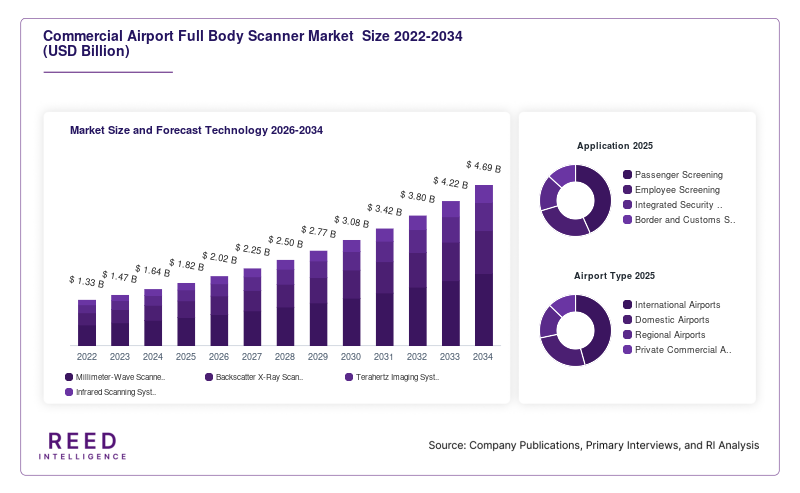
The Commercial Airport Full Body Scanner Market size was valued at approximately USD 1.82 billion in 2026 and is projected to reach nearly USD 4.21 billion by 2034, expanding at a CAGR of 11.1%during the forecast period from 2026 to 2034. The market is gaining momentum due to the increasing emphasis on aviation security modernization across developed and emerging economies. Airports worldwide continue to invest in advanced passenger screening systems to improve threat detection efficiency, reduce manual inspections, and strengthen border security operations. Growing international passenger traffic and rising investments in airport infrastructure modernization programs are also supporting the long-term expansion of the market.
The adoption of millimeter-wave and advanced imaging technologies has accelerated in commercial airports as aviation authorities focus on minimizing security risks while improving passenger throughput. Regulatory agencies in North America, Europe, and Asia Pacific are encouraging the deployment of automated security screening systems that can identify concealed metallic and non-metallic objects without extensive physical checks. In addition, increasing concerns regarding terrorism, illegal trafficking, and cross-border security threats continue to encourage airports to implement next-generation full body scanning solutions.
Key Highlights
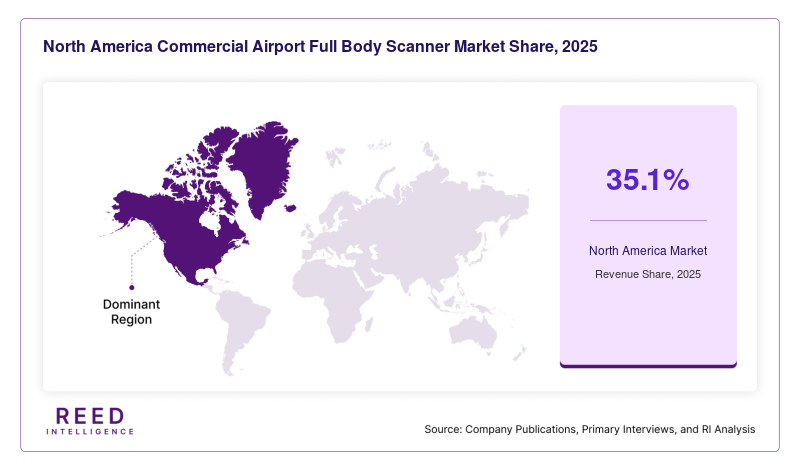
- North America dominated the market with a 35.1% share in 2025.
- Asia Pacific is expected to grow at the fastest CAGR of 12.3% during 2026–2034.
- By technology, millimeter-wave scanners accounted for the largest share of 44.6%.
- while terahertz imaging systems are projected to grow at a CAGR of 13.4%.
- By application, passenger screening led with a 61.8% share.
- whereas baggage-linked integrated security screening is expected to expand at a CAGR of 12.1%.
- By airport type, international airports held the dominant share of 58.7%.
- while regional airports are anticipated to register a CAGR of 11.9% during the forecast period.
- The United States remained the dominant country, with market values of USD 490 million in 2024 and USD 545 million in 2025.
Market Trends
Integration of Artificial Intelligence in Security Screening
Artificial intelligence integration is becoming a major trend in the Commercial Airport Full Body Scanner Market as airports seek faster and more reliable passenger screening solutions. AI-powered body scanners can automatically identify suspicious objects, reduce dependency on manual operator interpretation, and minimize false alarms. This capability improves operational efficiency and reduces passenger wait times during peak travel periods. Several airports are deploying machine learning-enabled systems that continuously improve detection accuracy based on real-time screening data. The growing use of automated threat recognition software also supports privacy protection because passengers no longer require detailed body image analysis by human operators. As global airport traffic continues to recover and expand, airports are investing in intelligent screening technologies that can process large passenger volumes with improved security outcomes.
Shift Toward Contactless and Privacy-Focused Screening Systems
Commercial airports are increasingly adopting contactless full body scanner technologies to improve passenger experience and maintain hygiene standards. Airports are prioritizing non-invasive scanning systems that can conduct rapid security checks while reducing physical interactions between passengers and security personnel. Privacy-focused solutions using generic avatar imaging and encrypted data processing are also gaining traction as governments strengthen passenger data protection regulations. Scanner manufacturers are focusing on compact designs, faster scan cycles, and low-radiation systems to increase adoption rates among airports with high daily passenger traffic. In addition, the integration of biometric identity verification with body scanning systems is improving checkpoint efficiency and supporting seamless airport operations. This trend is expected to remain important as airports continue digital transformation initiatives.
Market Drivers
Expansion of Global Airport Infrastructure Projects
Rising investments in airport construction and modernization projects are supporting the growth of the Commercial Airport Full Body Scanner Market. Governments and private airport operators are expanding airport terminals, upgrading passenger handling capacity, and modernizing security checkpoints to accommodate rising air travel demand. Large-scale airport development programs in countries such as India, China, Saudi Arabia, and the United States are increasing demand for advanced passenger screening equipment. Newly constructed airports are integrating automated security technologies from the planning stage to improve operational efficiency and comply with international aviation safety standards. Growing tourism activity and increasing international business travel are also contributing to higher passenger volumes, creating strong demand for scalable and high-speed security screening systems across commercial airports.
Rising Concerns Regarding Aviation Security Threats
Increasing security concerns related to terrorism, smuggling, cyber-enabled threats, and illegal trafficking are driving airport authorities to strengthen screening procedures. Commercial airports require highly accurate body scanning systems capable of identifying concealed metallic and non-metallic threats without disrupting passenger movement. Aviation security agencies are encouraging airports to adopt advanced imaging technologies that improve detection capabilities while maintaining compliance with privacy regulations. The growing frequency of cross-border travel has further increased the importance of efficient passenger verification systems. Many governments are also increasing budgets for homeland security and aviation protection programs, creating favorable conditions for market growth. Enhanced security regulations introduced by international aviation organizations are accelerating the replacement of conventional metal detectors with modern full body scanners.
Market Restraint
High Installation and Maintenance Costs Limiting Adoption
The high cost associated with deploying advanced airport full body scanner systems remains a major restraint for market expansion, particularly in developing economies and smaller regional airports. Modern body scanning systems require significant investment in hardware, software integration, cybersecurity infrastructure, operator training, and routine maintenance. Airports with limited financial resources often delay technology upgrades because of budget constraints and competing infrastructure priorities. In addition, advanced imaging systems require periodic software updates, calibration, and technical support to maintain operational accuracy and regulatory compliance.
Concerns related to passenger privacy and radiation exposure can also create resistance to large-scale implementation in some regions. Regulatory approval processes for new screening technologies are often lengthy, increasing deployment timelines for manufacturers and airport operators. Smaller airports may continue relying on traditional security systems because of lower operational costs and limited passenger traffic volumes. For example, several regional airports in Latin America and parts of Africa continue using metal detection and manual screening systems due to restricted security modernization budgets. These financial and operational barriers may slow the pace of adoption despite rising global demand for advanced aviation security solutions.
Market Opportunities
Growing Adoption Across Emerging Aviation Markets
Emerging economies are creating substantial opportunities for the Commercial Airport Full Body Scanner Market as governments increase investment in aviation infrastructure development. Countries across Asia Pacific, the Middle East, and Africa are expanding international airport networks to support tourism growth, business travel, and economic diversification strategies. Many new airports are integrating advanced security screening systems to comply with international aviation standards and improve passenger confidence. The rapid increase in middle-class air travelers is also encouraging airport operators to improve security efficiency and reduce checkpoint congestion. Manufacturers are introducing cost-effective scanning systems specifically designed for mid-sized and regional airports, further supporting market penetration across developing economies.
Public-private partnerships are also creating favorable opportunities for technology providers. Governments are collaborating with private airport management companies to modernize airport security systems using digital technologies and automated passenger screening platforms. As emerging countries continue expanding aviation capacity, demand for scalable and intelligent body scanning systems is expected to increase significantly during the forecast period.
Increasing Demand for Integrated Smart Airport Solutions
The growing focus on smart airport development is creating new opportunities for full body scanner manufacturers and software providers. Airports are increasingly integrating body scanning systems with biometric verification, baggage screening, access control, and centralized security management platforms. These integrated solutions improve operational visibility and enable faster response to security incidents. Smart airport initiatives are encouraging the adoption of cloud-based monitoring systems and real-time analytics that can support predictive maintenance and operational optimization.
The use of connected security ecosystems is becoming increasingly important at high-traffic international airports where passenger throughput efficiency directly affects operational performance. Scanner manufacturers are investing in artificial intelligence, automated threat recognition, and remote diagnostics to differentiate products and improve long-term service revenues. In addition, growing investments in digital airport transformation programs are encouraging airports to replace standalone legacy systems with fully integrated security platforms. This shift is expected to create long-term opportunities for both hardware manufacturers and airport security software developers.
Segmental Analysis
By Technology
Millimeter-wave scanners represented the dominant technology segment in the Commercial Airport Full Body Scanner Market, accounting for approximately 44.6% of the global share in 2024. These systems are widely used in commercial airports because they can detect metallic and non-metallic threats while maintaining high passenger throughput efficiency. Airports prefer millimeter-wave technology due to its non-ionizing radiation properties, improved passenger safety profile, and compatibility with automated threat recognition software. Major international airports continue replacing older security systems with advanced millimeter-wave scanners to strengthen security compliance and reduce manual inspection procedures. The technology also supports privacy-focused screening through generic image representation and automated detection features. Growing deployment across large international terminals and transit hubs has further reinforced the leading position of this segment in the global market.
Terahertz imaging systems are expected to register the fastest CAGR of 13.4% during the forecast period due to their enhanced detection capabilities and improved imaging precision. These scanners can identify concealed items with greater accuracy while reducing false alarm rates, making them increasingly attractive for high-security airport environments. Technology providers are investing heavily in research and development to improve scan speed, reduce equipment size, and lower deployment costs. The increasing focus on advanced aviation threat detection is encouraging airports to evaluate terahertz-based systems for next-generation security checkpoints. Growing integration with artificial intelligence and cloud-based analytics platforms is also supporting the rapid growth of this segment. As regulatory authorities continue prioritizing advanced threat identification technologies, demand for terahertz imaging solutions is expected to rise significantly.
By Application
Passenger screening accounted for the largest share of the Commercial Airport Full Body Scanner Market in 2024, contributing nearly 61.8% of total revenue. Airports continue prioritizing passenger screening applications because of increasing international travel volumes and stricter aviation security regulations. Full body scanners are extensively deployed at security checkpoints to identify concealed threats without causing major disruptions to passenger flow. The segment benefits from growing investment in airport security modernization and increasing adoption of automated screening technologies. Major international airports are deploying advanced imaging systems capable of handling high passenger throughput while improving operational accuracy. Passenger screening remains the primary application area because airports require reliable and scalable security systems that can maintain compliance with global aviation standards.
Integrated security screening linked with baggage and biometric systems is anticipated to witness the fastest CAGR of 12.1% during the forecast period. Airports are increasingly adopting connected security ecosystems that combine body scanning, baggage analysis, identity verification, and centralized monitoring capabilities. This integrated approach improves operational coordination and enhances threat detection efficiency across airport terminals. The growing trend toward smart airport development is further supporting demand for interconnected screening platforms. Technology providers are introducing advanced software solutions that enable real-time data sharing between multiple security systems. Increasing pressure to reduce passenger wait times while maintaining high security standards is expected to drive substantial growth within this application segment over the coming years.
By Airport Type
International airports held the dominant share of 58.7% in the Commercial Airport Full Body Scanner Market in 2024 due to higher passenger traffic volumes and stronger security requirements. Large international airports manage substantial cross-border passenger movement, making advanced security screening systems essential for operational efficiency and threat prevention. These airports often receive greater government funding for security modernization projects and typically adopt advanced imaging technologies earlier than smaller facilities. International terminals also require scalable screening systems capable of processing thousands of passengers daily while maintaining strict compliance with aviation regulations. The increasing number of international travelers and the expansion of global airline networks continue supporting the strong market position of this segment.
Regional airports are expected to register the fastest CAGR of 11.9% during the forecast period as governments invest in broader aviation connectivity and infrastructure upgrades. Smaller airports are increasingly adopting modern full body scanning systems to align with evolving aviation security requirements and improve passenger confidence. Manufacturers are introducing compact and cost-efficient solutions specifically designed for regional airport operations with moderate passenger volumes. Rising domestic tourism, regional business travel, and low-cost carrier expansion are increasing passenger traffic at secondary airports worldwide. Governments in developing economies are also allocating funding to improve regional aviation infrastructure, creating favorable conditions for body scanner deployment. This trend is expected to significantly expand the addressable market for security technology providers.
Regional Analysis
North America
North America accounted for approximately 35.1% of the global Commercial Airport Full Body Scanner Market share in 2025 and is expected to maintain a stable growth trajectory throughout the forecast period. The region is projected to expand at a CAGR of 9.8% between 2026 and 2034 due to ongoing airport security modernization projects and strong regulatory enforcement. Commercial airports across the United States and Canada continue investing in advanced passenger screening technologies to improve checkpoint efficiency and strengthen aviation security infrastructure. High passenger traffic volumes and stringent airport security standards continue to support demand for technologically advanced body scanning systems.
The United States remained the dominant country within the regional market because of its extensive network of international airports and substantial aviation security spending. The Transportation Security Administration continues deploying advanced imaging systems across major airports to improve passenger screening accuracy and reduce operational delays. Another important growth factor is the strong presence of leading security technology manufacturers and software developers in the country. Continuous investments in artificial intelligence-enabled screening systems and cybersecurity integration are further supporting regional market expansion.
Europe
Europe represented nearly 27.4% of the global market share in 2025 and is expected to witness moderate but consistent growth during the forecast period. The region is projected to grow at a CAGR of 10.1% from 2026 to 2034 as airport operators focus on upgrading aging security infrastructure. Increasing international travel within the European Union and rising concerns regarding cross-border threats are encouraging airports to deploy advanced body scanning systems. Regulatory support for automated threat detection and passenger privacy compliance is also contributing to technology adoption.
Germany emerged as the leading country in the European market due to strong airport modernization programs and advanced aviation infrastructure. Major airports in Frankfurt, Munich, and Berlin are investing in high-speed passenger screening systems to manage growing passenger traffic efficiently. A unique growth factor supporting the regional market is the increasing emphasis on sustainability and energy-efficient airport operations. European airports are increasingly adopting low-power security technologies and integrated smart terminal systems that improve operational efficiency while meeting environmental targets.
Asia Pacific
Asia Pacific held approximately 22.6% of the Commercial Airport Full Body Scanner Market share in 2025 and is anticipated to register the fastest CAGR of 12.3% during the forecast period. Rapid growth in commercial aviation, expanding middle-class populations, and rising tourism activity are increasing passenger volumes across regional airports. Governments in China, India, Japan, and Southeast Asian countries are heavily investing in airport expansion projects to improve connectivity and support economic growth. As new airport terminals are developed, demand for advanced passenger screening technologies is increasing significantly.
China remained the dominant country in the regional market due to aggressive airport infrastructure expansion and large-scale investment in smart aviation technologies. The country continues developing new international airports and upgrading existing transportation hubs with advanced automated screening systems. Another important growth factor is the rapid adoption of digital technologies and artificial intelligence in airport operations. Chinese airports are integrating biometric verification, automated immigration systems, and intelligent passenger screening solutions to improve throughput efficiency and strengthen national security capabilities.
Middle East & Africa
The Middle East & Africa region accounted for around 8.3% of the global market share in 2025 and is expected to grow at a CAGR of 10.8% during 2026–2034. The market is supported by increasing investment in international aviation hubs and tourism-driven infrastructure projects. Gulf countries are focusing on building technologically advanced airports capable of handling rising international passenger traffic. Governments are prioritizing aviation security modernization as part of broader economic diversification initiatives. Demand for premium airport experiences and seamless passenger movement is also encouraging adoption of advanced body scanning systems.
Saudi Arabia dominated the regional market because of extensive investments in airport infrastructure development under long-term economic transformation programs. Several airports in Riyadh, Jeddah, and other major cities are adopting next-generation passenger screening technologies to strengthen aviation security standards. A unique growth factor for the region is the rapid expansion of religious tourism and international transit travel. Large passenger volumes during religious events and international connecting flights are increasing the need for efficient and scalable airport security solutions.
Latin America
Latin America captured nearly 6.6% of the global Commercial Airport Full Body Scanner Market share in 2025 and is forecast to grow at a CAGR of 9.5% during the assessment period. Governments across the region are gradually investing in airport modernization and border security improvement programs. Rising tourism activity, increasing regional air connectivity, and growing business travel are supporting the demand for upgraded passenger screening technologies. Although adoption remains slower compared to developed regions, several major airports are implementing advanced security systems to align with international aviation standards.
Brazil remained the leading country in the Latin American market because of its large aviation network and expanding airport privatization initiatives. Major airports in São Paulo and Rio de Janeiro are investing in automated screening systems to improve passenger management and strengthen operational security. One unique growth factor supporting the market is the increasing participation of private investors in airport infrastructure projects. Public-private partnerships are enabling airports to adopt modern security technologies while improving operational efficiency and passenger service quality.
Competitive Landscape
The Commercial Airport Full Body Scanner Market remains moderately consolidated, with several global security technology companies competing through product innovation, software integration, and long-term airport contracts. Leading companies are focusing on artificial intelligence integration, automated threat recognition, and privacy-focused imaging technologies to strengthen their competitive position. Strategic partnerships with airport authorities and government agencies continue to play an important role in market expansion.
Rapiscan Systems maintained a leading market position due to its broad portfolio of aviation security products and strong global airport presence. The company continues investing in advanced imaging technologies and integrated checkpoint security solutions. Smiths Detection, Leidos Holdings, Nuctech Company Limited, and Rohde & Schwarz are also significant participants in the market. These companies are expanding research and development investments to improve scanning speed, reduce false alarm rates, and enhance cybersecurity capabilities.
A recent industry development involved increased deployment of artificial intelligence-enabled body scanners across major international airports to improve passenger throughput efficiency. Several manufacturers are also collaborating with airport operators to develop smart security ecosystems integrating biometric verification, baggage screening, and centralized monitoring systems. Competitive intensity is expected to increase as airports continue prioritizing digital transformation and automated security infrastructure modernization.
Key Players
- Rapiscan Systems
- Smiths Detection
- Leidos Holdings Inc.
- Nuctech Company Limited
- Rohde & Schwarz GmbH & Co KG
- L3Harris Technologies
- Tek84 Inc.
- Westminster Group Plc
- Adani Systems Inc.
- CEIA SpA
- Gilardoni S.p.A.
- Astrophysics Inc.
- OD Security
- Brijot Imaging Systems
- Micro-X Ltd.
Recent Developments
- Rapiscan Systems introduced an upgraded automated threat recognition platform in 2025 designed to improve passenger throughput and reduce manual image analysis requirements at high-traffic commercial airports.
- Smiths Detection expanded its airport security partnership network in Asia Pacific during 2025 to support the deployment of integrated passenger screening and biometric verification systems across newly developed airport terminals.
- Leidos Holdings announced the deployment of next-generation contactless full body scanners at multiple North American airports in 2024 to strengthen aviation security while improving passenger convenience.
- Rohde & Schwarz developed enhanced cybersecurity capabilities for airport screening systems in 2025 to support secure data management and real-time monitoring across smart airport infrastructure networks.
Commercial Airport Full Body Scanner Market Segments
Technology
- Millimeter-Wave Scanners
- Backscatter X-Ray Scanners
- Terahertz Imaging Systems
- Infrared Scanning Systems
Application
- Passenger Screening
- Employee Screening
- Integrated Security Screening
- Border and Customs Security
Airport Type
- International Airports
- Domestic Airports
- Regional Airports
- Private Commercial Airports
By Region
- North America
- Europe
- APAC
- Middle East and Africa
- LATAM