Commercial Duct Smoke Detector Market Size, Share & Demand Report By Product Type (Photoelectric Duct Smoke Detectors, Intelligent Addressable Duct Smoke Detectors, Multi-Criteria Duct Smoke Detectors), By Application (Healthcare Facilities, Educational Institutions, Retail and Shopping Centers, Industrial and Manufacturing Facilities, Hospitality Infrastructure), By End Use (New Installations, Retrofit Installations), By Region & Segment Forecasts, 2026–2034
USD 3950
Market Overview
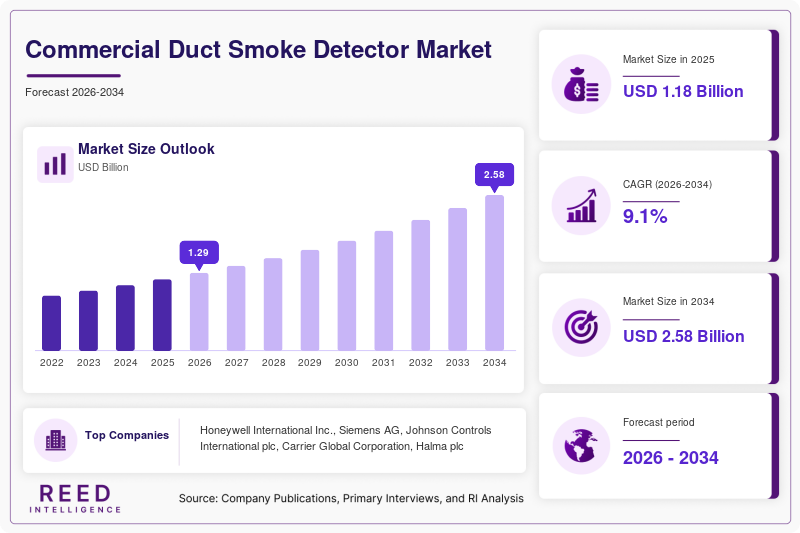
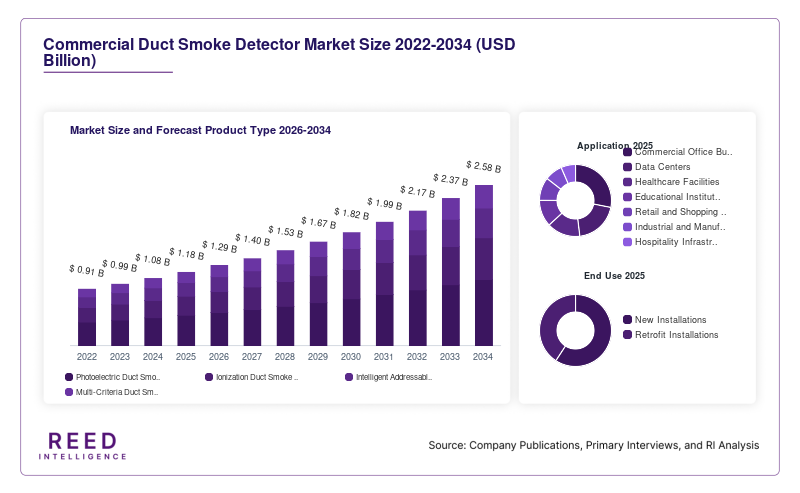
The global Commercial Duct Smoke Detector Market size was valued at USD 1.18 billion in 2026 and is projected to reach USD 2.37 billion by 2034, expanding at a CAGR of 9.1% during 2026–2034. The market growth is being supported by the increasing adoption of advanced fire safety infrastructure across commercial buildings, industrial facilities, healthcare centers, data centers, airports, and educational institutions. Rising investments in intelligent building management systems and stricter fire safety regulations across developed and emerging economies are accelerating product deployment in both new construction and retrofit projects.
Commercial duct smoke detectors are designed to detect smoke particles moving through HVAC duct systems before smoke spreads throughout a building. Their role in improving occupant safety and supporting emergency response systems has become increasingly important in high-density commercial spaces. Growing urbanization, expanding commercial real estate development, and higher awareness regarding workplace safety standards continue to contribute to market demand. Integration with smart monitoring platforms and wireless communication technologies is also supporting product modernization and long-term market expansion.
Key Highlights
- North America dominated the market with a 34.2% share in 2025.
- Asia Pacific is expected to grow at the fastest CAGR of 10.8% during 2026–2034.
- By product type, photoelectric duct smoke detectors accounted for the largest share of 44.6%.
- while intelligent addressable detectors are projected to grow at a CAGR of 11.4%.
- By application, commercial office buildings led with a 39.1% share.
- whereas data centers are expected to expand at a CAGR of 12.1%.
- By end use, new installations held the dominant share of 58.7%.
- while retrofit installations are projected to grow at a CAGR of 10.9%.
- The United States remained the dominant country, with market values of USD 382 million in 2024 and USD 417 million in 2025.
Market Trends
Integration of Smart Building Technologies
The integration of commercial duct smoke detectors with smart building management systems has emerged as a significant market trend. Modern commercial infrastructure increasingly relies on interconnected systems that allow centralized monitoring of fire safety, ventilation, lighting, and energy consumption. Building operators are adopting intelligent smoke detection solutions capable of transmitting real-time alerts through cloud platforms and mobile applications. These connected systems improve response times and support predictive maintenance strategies by identifying detector faults before operational failures occur.
Manufacturers are introducing detectors equipped with IoT-enabled communication modules and advanced analytics features. Demand for remote diagnostics and automated testing capabilities is increasing in office complexes, hospitals, airports, and shopping malls. Smart commercial facilities are also prioritizing energy-efficient HVAC operations, making integrated smoke monitoring systems more relevant. The shift toward digital building ecosystems is expected to create sustained demand for technologically advanced duct smoke detectors throughout the forecast period.
Rising Demand for Multi-Criteria Detection Systems
Commercial facilities are increasingly adopting multi-criteria smoke detection systems to improve accuracy and reduce false alarms. Traditional smoke detectors often face operational challenges in environments with dust, humidity, or varying airflow conditions. As a result, end users are shifting toward detectors that combine photoelectric, thermal, and air sampling technologies for more reliable smoke identification. This trend is particularly strong in industrial plants, healthcare facilities, and data centers where operational continuity is critical.
Manufacturers are investing in sensor innovation to improve detection sensitivity while minimizing nuisance alarms. Advanced algorithms capable of distinguishing between smoke particles and environmental contaminants are gaining popularity in commercial HVAC applications. Regulatory agencies and insurance providers are also encouraging adoption of enhanced detection technologies to strengthen building safety compliance. The growing emphasis on reliability and operational efficiency is expected to increase the penetration of intelligent multi-sensor duct smoke detectors across global commercial infrastructure projects.
Market Drivers
Expansion of Commercial Construction Activities
The rapid expansion of commercial construction projects across urban centers is a major factor driving the Commercial Duct Smoke Detector Market. Growing investments in office towers, hospitals, transportation hubs, educational institutions, hotels, and mixed-use developments are increasing the need for integrated fire safety systems. Commercial property developers are incorporating advanced HVAC smoke detection systems during the initial design phase to meet safety regulations and building certification standards.
Emerging economies in Asia Pacific, Latin America, and the Middle East are witnessing significant infrastructure modernization supported by government funding and private investments. The growing number of smart city initiatives is also contributing to higher deployment of intelligent smoke detection solutions. Additionally, international fire safety codes increasingly require smoke detection systems within air duct installations to prevent smoke circulation during emergencies. These factors continue to support stable market growth across both developed and developing regions.
Increasing Regulatory Compliance Requirements
Stringent fire protection regulations and workplace safety standards are significantly influencing market growth. Governments and fire safety authorities across North America and Europe have established strict guidelines requiring commercial facilities to install smoke detection systems within HVAC networks. Compliance with standards issued by organizations such as NFPA and local fire authorities has become essential for obtaining occupancy permits and maintaining insurance eligibility.
Commercial property owners are increasingly investing in advanced duct smoke detectors to avoid penalties, reduce liability risks, and improve emergency preparedness. The healthcare, hospitality, and data center industries are particularly focused on compliance-driven installations due to the high financial impact of fire incidents. Regular safety inspections and mandatory upgrades of aging detection infrastructure are further supporting replacement demand. As regulatory frameworks continue to evolve globally, the market is expected to experience consistent expansion during the forecast period.
Market Restraint
High Installation and Maintenance Costs
The relatively high cost associated with installation, testing, and maintenance of commercial duct smoke detectors remains a key challenge for market growth. Advanced intelligent detection systems require integration with HVAC units, centralized fire alarm panels, and building automation systems, increasing overall deployment expenses. Small and medium-sized commercial facilities often face budget limitations that delay upgrades from conventional smoke alarm systems to advanced duct-based detection technologies.
Maintenance requirements also create operational challenges for building owners and facility managers. Duct smoke detectors require periodic sensitivity testing, cleaning, and calibration to maintain compliance with fire safety regulations. In large commercial facilities with complex HVAC networks, inspection and servicing costs can become substantial over time. False alarms caused by improper installation or poor maintenance may also disrupt operations and reduce user confidence in automated fire safety systems. These cost-related concerns are particularly significant in price-sensitive developing markets where commercial infrastructure budgets remain constrained.
Market Opportunities
Growth of Data Centers and Digital Infrastructure
The rapid expansion of global data center infrastructure presents strong growth opportunities for the Commercial Duct Smoke Detector Market. Data centers require highly reliable fire detection systems to protect servers, network equipment, and mission-critical operations. HVAC-based smoke detection solutions are increasingly being installed to identify smoke at an early stage before it spreads through ventilation systems. The growth of cloud computing, artificial intelligence infrastructure, and digital storage facilities is increasing demand for advanced smoke detection technologies worldwide.
Large technology companies and colocation providers are investing heavily in hyperscale data centers across North America, Europe, and Asia Pacific. These facilities prioritize low false alarm rates, continuous monitoring, and rapid response capabilities. Intelligent duct smoke detectors integrated with building management systems are becoming essential components of modern data center safety strategies. As digital infrastructure investments continue to rise, manufacturers are expected to benefit from expanding commercial deployment opportunities in high-value technology environments.
Increasing Retrofit Demand in Aging Commercial Buildings
The modernization of aging commercial infrastructure is creating significant opportunities for duct smoke detector manufacturers. Many older office buildings, educational facilities, retail centers, and healthcare institutions still rely on outdated fire safety systems that do not meet current regulatory requirements. Property owners are increasingly investing in retrofit projects to improve occupant safety, comply with updated fire codes, and enhance property value.
Retrofit installations often involve replacing conventional detectors with intelligent addressable systems capable of remote monitoring and automated diagnostics. Governments in several regions are also introducing incentives and stricter compliance timelines for commercial fire safety upgrades. The trend is particularly visible in North America and Europe where large volumes of aging infrastructure require modernization. As building operators prioritize safety improvements and operational efficiency, retrofit demand is expected to create long-term revenue opportunities for market participants.
Segmental Analysis
By Product Type
Photoelectric duct smoke detectors accounted for the largest share of the Commercial Duct Smoke Detector Market in 2024, representing approximately 44.6% of global revenue. These detectors are widely used due to their effectiveness in identifying smoldering fires commonly associated with commercial HVAC environments. Commercial facilities such as office buildings, hospitals, schools, and shopping centers prefer photoelectric systems because of their reliable smoke sensitivity and relatively low false alarm rates. Their compatibility with modern fire alarm panels and building management systems has further strengthened market adoption. Additionally, regulatory agencies in several countries recommend photoelectric detection technology for commercial buildings because of its ability to detect slow-burning smoke particles before flames spread throughout ventilation systems. Manufacturers continue to improve sensor sensitivity and maintenance efficiency to support broader deployment across large commercial facilities.
Intelligent addressable duct smoke detectors are expected to witness the fastest CAGR of 11.4% during the forecast period. These systems provide advanced communication capabilities that allow individual detectors to transmit real-time status information directly to centralized control systems. Commercial facility operators are increasingly adopting addressable technologies to improve fire response accuracy and reduce maintenance complexity. The ability to identify the exact detector location during emergencies significantly enhances operational efficiency in large buildings with complex HVAC networks. Data centers, airports, industrial facilities, and smart commercial buildings are among the key adopters of intelligent addressable systems. Rising integration with cloud-based monitoring platforms and predictive maintenance software is also supporting segment growth. As building automation becomes more sophisticated, demand for connected and remotely managed smoke detection technologies is expected to increase steadily.
By Application
Commercial office buildings represented the dominant application segment in 2024, accounting for 39.1% of the global market share. The increasing construction of office towers and mixed-use commercial complexes has created significant demand for advanced HVAC smoke detection systems. Modern office environments require comprehensive fire safety infrastructure capable of protecting large occupant populations and minimizing operational disruption during emergencies. Property developers and facility managers are prioritizing duct smoke detectors integrated with centralized building management systems to improve emergency coordination and compliance with fire safety regulations. Additionally, corporate organizations are increasingly investing in intelligent safety technologies to support workplace risk management strategies. The rising adoption of flexible office spaces and technologically advanced commercial campuses continues to strengthen the demand for reliable smoke detection systems across the office building segment.
Data centers are projected to expand at the fastest CAGR of 12.1% throughout the forecast period due to increasing investments in digital infrastructure. Data center operators require highly sensitive smoke detection technologies capable of identifying fire hazards at an early stage before equipment damage occurs. HVAC-based smoke monitoring systems are particularly important in data center environments because smoke can spread rapidly through ventilation networks. Cloud computing growth, rising enterprise digitalization, and expanding artificial intelligence infrastructure are contributing to increased construction of hyperscale data centers worldwide. Operators are prioritizing intelligent smoke detection solutions with low false alarm rates and advanced diagnostics capabilities to maintain uninterrupted operations. The growing demand for high-performance computing infrastructure is expected to create sustained opportunities for manufacturers specializing in advanced commercial duct smoke detectors.
By End Use
New installations accounted for the largest share of the Commercial Duct Smoke Detector Market in 2024, contributing approximately 58.7% of global revenue. The growth of commercial construction activities across emerging and developed economies continues to drive demand for newly installed fire safety systems. Large infrastructure projects including airports, hospitals, educational institutions, shopping centers, and office complexes are increasingly incorporating duct smoke detectors during the construction phase. Integration with intelligent HVAC systems and automated fire alarm networks has become a standard requirement in modern commercial buildings. Developers are prioritizing advanced smoke detection technologies to comply with updated building codes and improve occupant safety standards. The increasing adoption of smart building concepts and energy-efficient commercial infrastructure is also supporting the growth of the new installation segment across multiple regions.
Retrofit installations are anticipated to register the fastest CAGR of 10.9% during 2026–2034 due to modernization of aging commercial infrastructure. Many existing commercial facilities continue to operate with outdated fire detection systems that lack modern connectivity and diagnostic features. Building owners are investing in retrofit projects to improve compliance with evolving fire safety regulations and reduce long-term operational risks. Retrofit demand is particularly strong in North America and Europe where older office buildings, hospitals, and educational institutions require upgraded HVAC smoke monitoring systems. Manufacturers are introducing compact and wireless-enabled detectors designed specifically for retrofit applications to reduce installation complexity and minimize operational downtime. Increasing insurance compliance requirements and growing awareness regarding workplace safety are expected to continue driving retrofit adoption globally.
Regional Analysis
North America
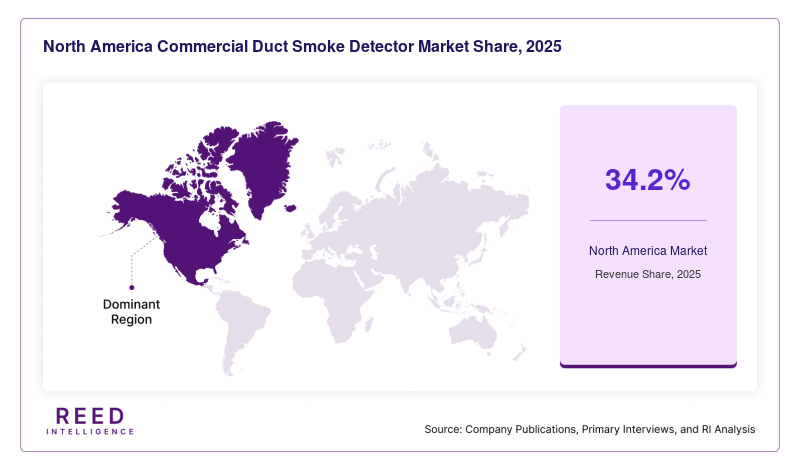
North America accounted for 34.2% of the global Commercial Duct Smoke Detector Market share in 2025 and is expected to maintain a steady growth trajectory during the forecast period. The regional market is projected to expand at a CAGR of 8.4% from 2026 to 2034. Strong regulatory frameworks, high awareness regarding workplace fire safety, and large-scale adoption of intelligent building systems continue to support market growth. Commercial property owners across the region are increasingly investing in advanced smoke detection technologies to improve compliance and reduce operational risks.
The United States remained the dominant country within the regional market due to the extensive presence of commercial infrastructure and strict enforcement of fire protection standards. The growing number of hyperscale data centers and healthcare facilities is creating additional demand for advanced HVAC smoke monitoring systems. Increased investments in retrofitting aging commercial buildings with smart fire detection technologies are also supporting market expansion across major metropolitan areas.
Europe
Europe represented a substantial share of the Commercial Duct Smoke Detector Market in 2025 and is projected to grow at a CAGR of 8.1% during the forecast period. The region benefits from strong fire safety regulations and increasing investments in sustainable commercial construction. Countries across Europe are emphasizing energy-efficient building designs integrated with advanced safety systems. The demand for intelligent smoke detectors is increasing in office complexes, transportation facilities, and industrial buildings where automated building management systems are widely adopted.
Germany emerged as the dominant country in the European market due to its advanced commercial infrastructure and strong industrial base. The country’s focus on smart factory development and modern building automation systems continues to drive product adoption. Rising investments in green commercial buildings and strict compliance requirements for workplace safety are encouraging widespread installation of technologically advanced duct smoke detection systems throughout the region.
Asia Pacific
Asia Pacific is expected to register the fastest CAGR of 10.8% during 2026–2034 due to rapid urbanization and expanding commercial infrastructure development. The region is witnessing large-scale investments in smart cities, transportation hubs, shopping centers, and healthcare facilities. Increasing awareness regarding fire safety standards and rising adoption of intelligent HVAC systems are contributing to market growth. Governments across several Asian economies are strengthening building safety regulations to reduce fire-related incidents in densely populated urban environments.
China dominated the regional market due to extensive commercial construction activities and rapid industrial expansion. The country continues to invest heavily in high-rise office buildings, manufacturing facilities, and public infrastructure projects that require integrated fire safety systems. Rising adoption of cloud-based monitoring technologies and increasing demand for connected building solutions are also supporting the deployment of advanced commercial duct smoke detectors across major Chinese cities.
Middle East & Africa
The Middle East & Africa Commercial Duct Smoke Detector Market is projected to experience stable growth throughout the forecast period. The region is benefiting from increasing infrastructure modernization and rising investments in tourism, healthcare, and commercial real estate development. Large-scale construction projects across the Gulf Cooperation Council countries are creating strong demand for advanced fire safety systems. Commercial facilities are increasingly adopting duct smoke detectors to comply with international safety standards and improve emergency preparedness capabilities.
Saudi Arabia emerged as the dominant country in the regional market due to major investments in smart infrastructure and urban development initiatives. Large commercial projects associated with economic diversification programs are increasing the need for advanced HVAC smoke monitoring systems. The growing hospitality sector and expansion of airports, shopping malls, and mixed-use developments are further supporting demand for intelligent smoke detection technologies throughout the country.
Latin America
Latin America accounted for a moderate share of the global Commercial Duct Smoke Detector Market in 2025 and is expected to expand at a CAGR of 7.6% during the forecast period. The region is witnessing increasing awareness regarding commercial fire safety and growing adoption of automated building management systems. Governments and private developers are investing in modern commercial infrastructure, particularly in urban centers. The demand for reliable smoke detection systems is increasing across retail facilities, educational institutions, and healthcare environments.
Brazil remained the leading country within the regional market due to ongoing investments in commercial real estate and infrastructure modernization. The expansion of large office complexes, transportation networks, and industrial facilities is contributing to product demand. Regulatory efforts aimed at improving fire safety compliance following several high-profile fire incidents are encouraging building owners to adopt advanced duct smoke detection systems across commercial establishments.
Competitive Landscape
The Commercial Duct Smoke Detector Market is moderately consolidated with the presence of several international and regional manufacturers competing on product innovation, pricing, regulatory compliance, and distribution strength. Leading companies are focusing on expanding intelligent product portfolios that integrate with building automation and cloud-based fire safety platforms. Strategic partnerships with HVAC system providers and commercial construction firms are also becoming common as companies aim to strengthen long-term market positioning.
Honeywell International Inc. remained one of the leading participants in the market due to its extensive fire safety product portfolio and strong global distribution network. The company has focused on developing intelligent smoke detection systems with enhanced remote monitoring capabilities for commercial facilities. Siemens AG, Johnson Controls International plc, Halma plc, and Carrier Global Corporation also maintain significant market presence through investments in smart building technologies and advanced fire protection solutions.
Recent industry developments include the launch of AI-enabled smoke monitoring systems, expansion of wireless detection technologies, and increased adoption of predictive maintenance software. Several companies are also investing in low-power sensors and multi-criteria detection platforms to improve reliability and reduce false alarms in large HVAC environments.
Key Players
- Honeywell International Inc.
- Siemens AG
- Johnson Controls International plc
- Carrier Global Corporation
- Halma plc
- Eaton Corporation plc
- Hochiki Corporation
- Gentex Corporation
- Mircom Group of Companies
- Bosch Building Technologies
- System Sensor
- Nohmi Bosai Ltd.
- Fike Corporation
- Potter Electric Signal Company LLC
Recent Developments
- Honeywell International Inc. introduced an advanced connected duct smoke detector platform with remote diagnostics capabilities for large commercial facilities in 2025.
- Siemens AG expanded its smart fire safety product line with AI-assisted smoke monitoring features designed for intelligent commercial buildings in 2024.
- Johnson Controls International plc partnered with a major HVAC automation provider in 2025 to improve integration between commercial ventilation systems and smoke detection networks.
- Carrier Global Corporation launched a compact wireless duct smoke detector solution targeted at retrofit commercial projects in 2024
Commercial Duct Smoke Detector Market Segments
Product Type
- Photoelectric Duct Smoke Detectors
- Ionization Duct Smoke Detectors
- Intelligent Addressable Duct Smoke Detectors
- Multi-Criteria Duct Smoke Detectors
Application
- Commercial Office Buildings
- Data Centers
- Healthcare Facilities
- Educational Institutions
- Retail and Shopping Centers
- Industrial and Manufacturing Facilities
- Hospitality Infrastructure
End Use
- New Installations
- Retrofit Installations
By Region
- North America
- Europe
- APAC
- Middle East and Africa
- LATAM