Commercial Fishing Market Size, Share & Demand Report By Type (Trawlers, Longliners, Purse Seiners), By Application (Fish, Crustaceans, Mollusks), By Region & Segment Forecasts, 2026–2034
USD 3950
Commercial Fishing Market Size
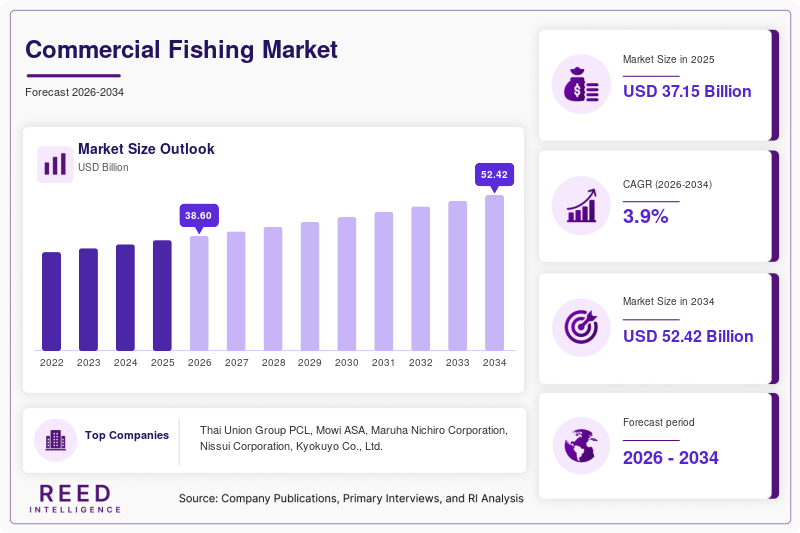
Commercial Fishing Market size is projected at USD 38.6 billion in 2026 and is expected to hit USD 52.42 billion by 2034 with a CAGR of 3.9%. Growing seafood consumption, fleet modernization, sustainable harvesting requirements, and increasing demand for traceable marine products are creating a strong need for detailed market data. Analysis by fishing type, application, geography, production capacity, and competitive positioning helps stakeholders identify investment opportunities and evolving industry dynamics.
Key takeaways
- Asia Pacific dominated the market with approximately 48.2% share in 2026, while Europe is among the fastest-growing regions at an estimated 4.2% CAGR through 2034.
- Trawlers accounted for nearly 43.5% of the global market in 2026, while purse seiners are projected to record one of the fastest growth rates at approximately 4.5% CAGR.
- Fish represented approximately 69.4% of commercial fishing applications in 2026, supported by strong demand from food processing, retail, and aquaculture feed industries.
- India is an emerging commercial fishing market and is forecast to reach approximately USD 3.9 billion by 2034, expanding at a CAGR of about 5.1%.
- Technology adoption involving electronic monitoring, satellite tracking, sonar systems, automated navigation, and fuel-efficient propulsion is increasingly influencing fleet productivity and operating economics.
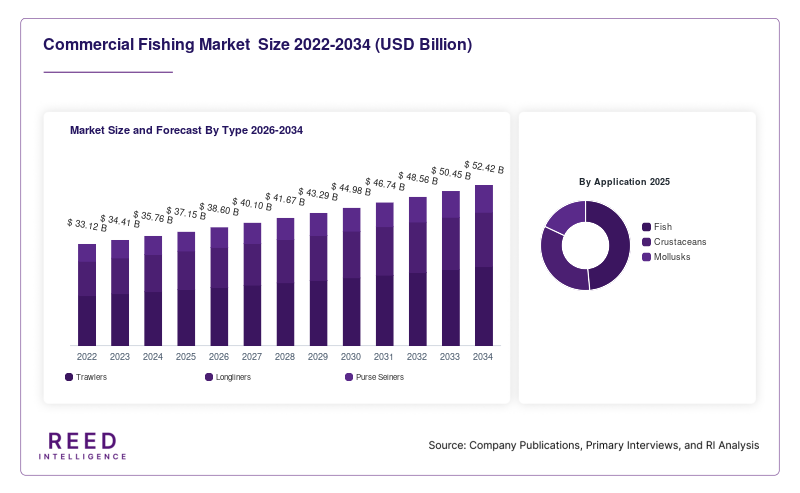
The Commercial Fishing Market covers the economic activity associated with harvesting marine and inland aquatic resources for commercial purposes, including vessel operations, fishing gear, onboard handling, preservation, and primary processing. Global commercial fleets are estimated to operate more than 4.5 million fishing vessels, ranging from small coastal boats to large industrial vessels. Asia Pacific accounts for the largest proportion of fleet activity and production, supported by extensive coastlines, established fishing communities, and high seafood consumption. Adoption of satellite vessel monitoring, GPS navigation, sonar, electronic catch documentation, automated sorting, and cold-chain systems is increasing, particularly among medium and large fleets. Trawlers contribute approximately 43.5% of market value, followed by longliners at around 31.8% and purse seiners at 24.7%. By application, fish contributes approximately 69.4%, crustaceans 19.1%, and mollusks 11.5%.
Commercial Fishing Market Trends
Digitalization, Sustainable Fleet Modernization, and Selective Harvesting
Commercial fishing operators are increasingly adopting digital technologies to improve catch efficiency, navigation, safety, and regulatory compliance. Modern vessels integrate satellite positioning, electronic monitoring systems, advanced sonar, fish-finding radar, onboard sensors, automated winches, and digital catch-recording platforms. Fuel-efficiency improvements are also gaining importance as operators seek to reduce operating costs and emissions. Hybrid auxiliary systems, optimized hull designs, energy-efficient refrigeration, and improved propulsion technologies are gradually entering new vessel programs.
Sector-specific demand is shifting toward higher-value seafood, reliable year-round supply, and traceable products. Restaurants, seafood processors, retailers, and foodservice companies increasingly require documented catch origin and sustainability information. Demand for tuna, salmon, cod, shrimp, crab, squid, and other commercially valuable species is supporting specialized fleets, while selective fishing gear and bycatch-reduction technologies are becoming increasingly important in regulated fisheries.
Commercial Fishing Market Drivers
Rising Global Seafood Consumption
Increasing consumption of seafood across Asia, Europe, North America, and emerging economies is a primary market driver. Population growth, urbanization, expanding foodservice industries, and consumer preference for protein-rich foods are supporting demand for commercially harvested fish and shellfish. Large-scale processors are also seeking consistent volumes and standardized supply, encouraging fleet operators to improve vessel capacity, preservation systems, and fishing efficiency.
Commercial Fishing Market Restraints
Resource Depletion and Increasing Regulatory Pressure
Overfishing, declining stocks in selected fisheries, marine ecosystem degradation, and stricter catch quotas can limit commercial fishing activity. Governments are implementing vessel monitoring, seasonal restrictions, licensing controls, protected areas, minimum-size requirements, and catch documentation. Compliance increases operational costs and can reduce fishing days, particularly for fleets operating in heavily regulated waters.
Commercial Fishing Market Opportunities
Smart Fishing and Sustainable Fleet Technologies
Digital fleet management, artificial intelligence-assisted fish detection, remote monitoring, electronic catch documentation, selective fishing equipment, and low-emission propulsion systems create significant opportunities. Technology providers can address demand for higher catch-per-unit effort, reduced fuel consumption, improved worker safety, and lower bycatch. Expansion of premium certified seafood markets also provides opportunities for operators capable of demonstrating traceability and responsible harvesting practices.
Challenges in Commercial Fishing Market
Climate Variability and Volatile Operating Costs
Changing ocean temperatures, shifting fish migration patterns, extreme weather events, fuel-price fluctuations, labor shortages, and maintenance expenses create uncertainty for commercial fleets. Changes in species distribution can force vessels to travel farther from traditional fishing grounds, increasing fuel consumption and voyage duration. Small and medium operators may face additional difficulty financing vessel upgrades and digital monitoring systems.
Commercial Fishing Market Segmentation Analysis
By type, trawlers held the dominant position with approximately 43.5% share in 2026 because of their broad use in bottom and midwater fishing. Longliners represented 31.8%, while purse seiners accounted for 24.7%. By application, fish dominated with 69.4% share, followed by crustaceans and mollusks. The segmentation reflects differences in vessel design, fishing gear, target species, operating depth, catch volume, and processing requirements.
By Type
Trawlers represented approximately 43.5% of market value in 2026 and remain the largest commercial vessel category. Global active trawler fleets are estimated at more than 700,000 vessels, including small coastal and industrial vessels. Typical commercial trawlers range from approximately 10 to more than 80 meters in length and use bottom, midwater, or beam trawling systems. Larger vessels increasingly feature hydraulic winches, sonar, refrigeration, automated sorting, and onboard processing.
Longliners accounted for nearly 31.8% share and are widely used for tuna, swordfish, cod, halibut, and other high-value species. The global commercial longline fleet comprises hundreds of thousands of vessels, ranging from small coastal boats to industrial vessels exceeding 50 meters. Modern systems can deploy thousands of hooks per fishing operation and increasingly incorporate satellite navigation, electronic monitoring, baiting automation, and selective hook configurations to reduce unwanted catch.
Purse seiners contributed approximately 24.7% of market value in 2026 and are particularly important for schooling species such as tuna, sardines, anchovies, and mackerel. Commercial purse seiners typically range from 20 to more than 80 meters, with large vessels capable of carrying several hundred tonnes of catch. Sonar, fish aggregating device monitoring, hydraulic net handling, refrigerated seawater systems, and automated catch-management equipment are widely used in modern operations.
By Application
Fish accounted for approximately 69.4% of commercial fishing market value in 2026. Global commercial marine and inland capture fisheries produce more than 90 million tonnes of aquatic animals annually, with finfish representing the majority. Tuna, cod, sardines, anchovies, mackerel, salmon, pollock, and hake are among the major commercially targeted species. Demand from fresh seafood, frozen products, canned foods, and fishmeal and fish-oil processing supports this segment.
Crustaceans represented approximately 19.1% of market value, with shrimp, crab, lobster, and related species driving demand. Commercial fleets use trawlers, pots, traps, and specialized vessels depending on species and geography. The segment benefits from premium pricing and strong consumption in North America, Europe, East Asia, and major foodservice markets. Improved refrigerated storage and onboard handling help preserve product quality and reduce post-harvest losses.
Mollusks accounted for approximately 11.5% of market value and include squid, octopus, clams, scallops, and other commercially harvested species. Specialized trawlers, dredgers, jigs, and coastal vessels support production. Growing demand for squid and octopus in Asian and European cuisines is supporting commercial harvesting, while improved sorting, freezing, and onboard preservation technologies are strengthening export-oriented operations.
Commercial Fishing Market Regional Analysis
Asia Pacific Commercial Fishing Market
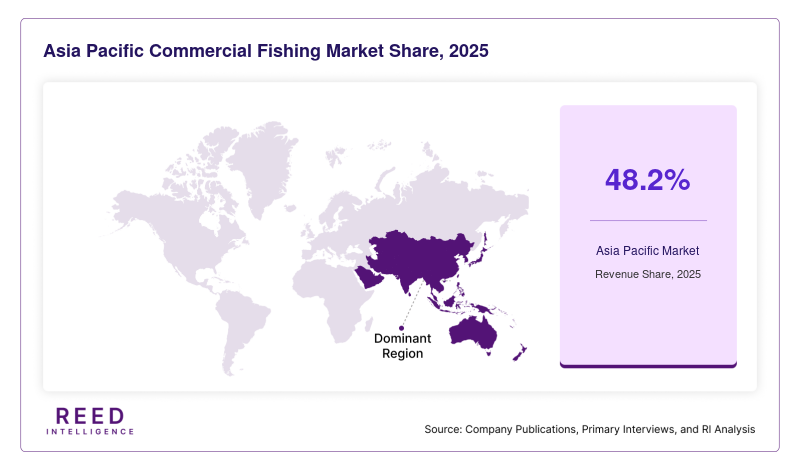
Asia Pacific dominated the global market with approximately 48.2% share in 2026. China, Indonesia, Japan, India, Vietnam, Thailand, and South Korea contribute substantially through large fishing fleets, extensive coastlines, seafood processing industries, and high domestic consumption. Fish represents the largest sector split, followed by crustaceans and mollusks. China and Japan remain major commercial seafood markets, while India, Indonesia, and Vietnam provide strong growth potential through fleet modernization and export expansion.
Europe Commercial Fishing Market
Europe represented approximately a 19.7% share in 2026, supported by established fisheries in Norway, Spain, Iceland, the United Kingdom, Denmark, and France. The region has a strong emphasis on fleet efficiency, traceability, sustainability, and resource management. Fish dominates the sector, while crustaceans provide significant value in northern European markets. Modernization toward fuel-efficient vessels and digital monitoring is expected to support approximately 4.2% CAGR through 2034.
North America Commercial Fishing Market
North America accounted for approximately 14.8% of global market value in 2026. The U.S. and Canada contribute through fisheries targeting salmon, pollock, cod, tuna, crab, shrimp, and lobster. Fish represents the largest sector, while crustaceans generate high-value revenues. Strict fisheries management, advanced vessel monitoring, cold-chain infrastructure, and demand from domestic foodservice and seafood processing industries support market development.
Latin America Commercial Fishing Market
Latin America contributed approximately 10.1% share, with Peru, Chile, Argentina, Mexico, and Ecuador forming important commercial fishing centers. Peru benefits from large anchoveta fisheries, while Chile and Argentina have strong seafood export industries. Fish remains the leading segment, although crustaceans and mollusks provide important export revenues. Fleet modernization and improved processing capacity are expected to increase regional competitiveness.
Middle East & Africa Commercial Fishing Market
The Middle East & Africa region held approximately 7.2% share in 2026. Morocco, South Africa, Egypt, Namibia, and several Gulf countries contribute to commercial fishing activity. Fish dominates regional production, with crustaceans and mollusks forming smaller but commercially valuable segments. Investments in port infrastructure, cold storage, vessel upgrades, and seafood exports are expected to support gradual expansion.
Top Players in the Commercial Fishing Market
- Thai Union Group PCL
- Mowi ASA
- Maruha Nichiro Corporation
- Nissui Corporation
- Kyokuyo Co., Ltd.
- Trident Seafoods Corporation
- Pacific Seafood
- High Liner Foods Incorporated
- Dongwon Industries Co., Ltd.
- Austral Fisheries Pty Ltd
- Pescanova S.A.
- Grupo Nueva Pescanova
Recent Developments in the Commercial Fishing Market
- January 2026: Commercial fishing operators increased deployment of electronic monitoring and digital catch-reporting systems to strengthen traceability and regulatory compliance.
- March 2026: Fleet modernization programs increasingly focused on fuel-efficient propulsion, improved refrigeration, and vessel energy-management technologies.
- May 2026: Seafood companies expanded digital supply-chain initiatives designed to improve catch traceability from fishing vessels through processors and distributors.
- July 2026: Commercial fleet operators increased adoption of advanced sonar, satellite tracking, and onboard analytics to improve fishing efficiency and reduce unnecessary fishing effort.
- September 2026: Sustainability-focused fishing programs placed greater emphasis on selective gear, bycatch reduction, electronic monitoring, and responsible fisheries management.
Commercial Fishing Market Segments
By Type
- Trawlers
- Longliners
- Purse Seiners
By Application
- Fish
- Crustaceans
- Mollusks
By Region
- North America
- Europe
- APAC
- Middle East and Africa
- LATAM