Commercial Foodservice Equipment Market Size, Share & Trends Analysis Report By Equipment Type (Cooking Equipment, Refrigeration Equipment, Food Preparation Equipment, Warewashing Equipment, Beverage Equipment), By Application (Full-Service Restaurants, Quick-Service Restaurants, Hotels & Hospitality, Institutional Foodservice, Catering), By End User (Independent Restaurants, Chain Restaurants, Hotels & Resorts, Healthcare & Educational Institutions, Corporate & Other Institutions) Forecasts, 20
USD 3950
Commercial Foodservice Equipment Market Size
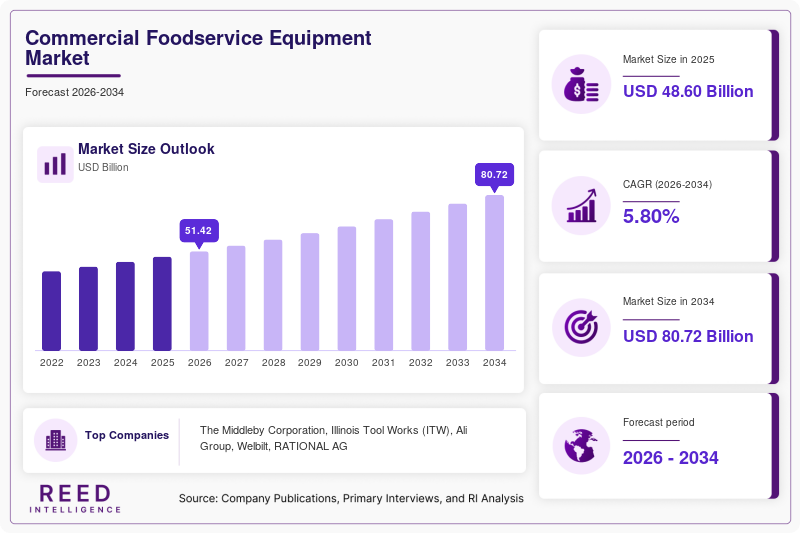
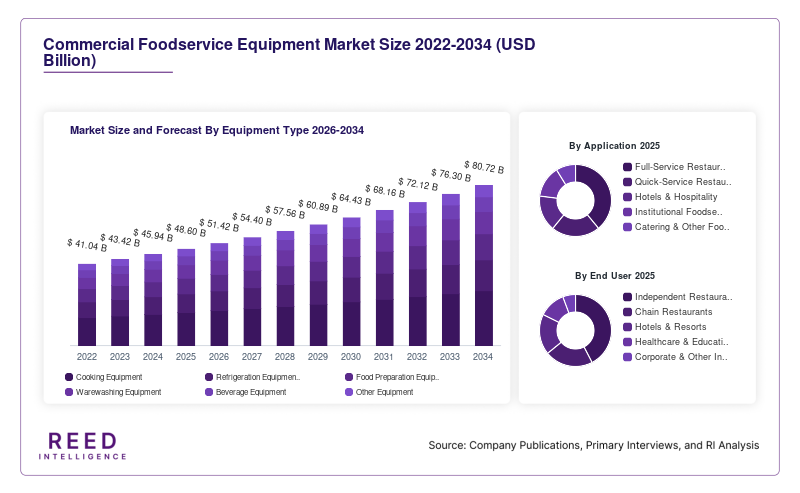
The global commercial foodservice equipment market size was valued at USD 48.60 Billion in 2025 and is projected to grow from USD 51.42 Billion in 2026 to USD 80.72 Billion by 2034, registering a CAGR of 5.80% during the forecast period from 2026 to 2034.
Commercial foodservice equipment demand is increasingly tied to restaurant expansion, replacement of aging kitchen assets, labor shortages, energy costs, food-safety requirements and the adoption of automated cooking and preparation systems. The U.S. National Restaurant Association projects restaurant and foodservice sales of USD 1.55 trillion in 2026, while operators continue to report pressure from labor and operating costs and an intention to increase technology investment.
Equipment purchasing is therefore shifting from simple capacity additions toward productivity and total-cost-of-ownership decisions. RATIONAL's 2025 annual report identifies labor shortages, energy efficiency, digitalization and growing out-of-home catering demand as important commercial-kitchen demand factors. ENERGY STAR estimates that a suite of certified commercial foodservice equipment can save operators approximately 350 MMBTU of energy annually, equivalent to around USD 4,000 in annual savings under its stated assumptions.
Regulation is also influencing product specifications. The FDA issued the 2026 Food Code, providing the latest model framework for foodservice and retail-food safety regulation in the U.S. In Europe, commercial refrigeration is subject to Ecodesign and energy-labelling requirements, creating a direct incentive for more efficient refrigeration technology.
Commercial Foodservice Equipment Market Drivers
Restaurant expansion and replacement demand
The commercial foodservice equipment market benefits from two distinct purchasing cycles: new-unit construction and replacement or upgrading of installed equipment. The U.S. restaurant industry illustrates the underlying demand base, with 2026 sales projected at USD 1.55 trillion and operators planning additional employment and technology investment. Middleby's 2025 sales mix shows the importance of replacement demand: 39% of its commercial foodservice sales were associated with replacement and upgrades, while 35% were new-build demand. This creates a recurring market rather than one dependent solely on new restaurant openings. Aging ovens, refrigerators, dishwashers, fryers, ice machines and beverage systems are replaced when repair costs rise, energy efficiency becomes inadequate or menu requirements change. Chain restaurants create additional purchasing volume through standardized equipment rollouts, remodels and new locations.
Energy efficiency and operating-cost reduction
Commercial kitchens are unusually energy-intensive environments. ENERGY STAR states that restaurants and commercial kitchens can consume approximately two to three times more energy per square foot than other commercial buildings, with high-volume quick-service restaurants potentially using substantially more. This makes energy efficiency a direct financial issue rather than only a sustainability consideration. Efficient refrigeration, induction cooking, combi ovens, fryers, steamers and warewashing systems can reduce utility consumption while maintaining throughput. In Europe, Ecodesign and energy-labelling rules for commercial refrigeration have established minimum efficiency requirements and are projected by the European Commission to generate substantial electricity and user-cost savings. Manufacturers are consequently competing around lifetime operating costs, heat recovery, water efficiency, connected monitoring and lower consumption.
Labor shortages and automation
Labor availability is changing equipment specifications. Restaurants and institutional kitchens are looking for systems that reduce manual intervention, standardize cooking results and allow fewer employees to manage higher volumes. RATIONAL explicitly identifies skills shortages as a reason for increasing demand for automated and efficient cooking systems. Middleby's portfolio is also expanding around automated beverage dispensing, ice production, coffee, cold brew, blending and other beverage technologies. Connected ovens, programmable cooking, automated dispensing, smart refrigeration and digital kitchen controls can transfer repetitive tasks from employees to equipment. The commercial implication is a shift toward equipment with higher upfront prices but stronger labor-saving and productivity economics.
Commercial Foodservice Equipment Market Restraints
High capital expenditure and financing pressure
Commercial foodservice equipment represents a substantial upfront investment for restaurants, hotels and institutional kitchens. New locations may require complete packages covering cooking, refrigeration, ventilation, food preparation, warewashing, storage and beverage equipment. Higher financing costs and uncertainty around restaurant traffic can delay large replacement or expansion projects. The National Restaurant Association reported that U.S. operators entered 2026 with persistent cost pressures, uneven traffic and margin challenges. Middleby's 2025 filing similarly reported weaker domestic commercial-foodservice conditions even while international markets improved. Smaller independent restaurants are particularly sensitive to equipment financing, making repair and refurbishment a competing option when cash flow is constrained.
Installation complexity and regulatory requirements
Commercial kitchens require equipment to satisfy electrical, gas, ventilation, sanitation, fire-safety and food-temperature requirements. The FDA Food Code provides a regulatory model that state, local, tribal and other authorities use to develop foodservice requirements. Refrigeration products also face energy-efficiency and product-information requirements in Europe. These rules increase engineering and certification requirements and can extend installation timelines. Operators also need compatible ventilation, drainage, electrical capacity and kitchen layouts before equipment can be installed. Consequently, replacing one appliance can sometimes require modifications elsewhere in the kitchen, raising the total project cost.
Commercial Foodservice Equipment Market Opportunities
Connected and automated kitchen equipment provides a major technology opportunity. Equipment manufacturers are increasingly integrating IoT controls, remote monitoring, programmable cooking and data-driven maintenance. Middleby describes its commercial portfolio as including integrated IoT solutions and universal controllers, while ITW emphasizes integrated service offerings alongside cooking, refrigeration, warewashing and food-processing equipment. Connected equipment allows operators to monitor temperatures, utilization, energy consumption and maintenance requirements. This creates recurring service opportunities for manufacturers and distributors while helping restaurant chains standardize operating procedures across locations.
Energy-efficient equipment replacement offers another expansion route. ENERGY STAR provides certification across commercial ovens, fryers, dishwashers, ice makers, refrigerators, freezers, steam cookers, griddles and other equipment categories. Because commercial kitchens have high energy intensity, replacing inefficient equipment can generate measurable operating savings. This creates demand even when restaurants are not adding capacity. Utility rebates and energy-efficiency programs can further reduce the effective purchase price of qualifying equipment. Manufacturers that combine energy savings with labor reduction and productivity improvements can therefore address both sustainability requirements and operator economics.
Segmental Analysis
By Equipment Type
Cooking Equipment: Cooking equipment represents approximately 32% of the global market in 2025, making it the largest equipment category. Ovens, ranges, fryers, griddles, steamers and combi ovens are fundamental to restaurant production and are purchased both for new kitchens and replacement projects. RATIONAL reports that automated and efficient cooking systems are increasingly relevant as foodservice operators face skills shortages and higher input costs.
Beverage Equipment: Beverage equipment is the fastest-growing equipment category, with a CAGR of approximately 7.2%. Demand is supported by automated dispensing, coffee, cold brew, smoothies, specialty beverages and higher beverage attachment rates. Middleby's 2026 proxy materials identify ice and beverage as an important expansion platform, covering automated dispensing, coffee and espresso, nitro and cold brew, soda, tea, water and blended beverages.
By Application
Full-Service Restaurants: Full-service restaurants account for approximately 35% of the global market in 2025. These operators typically require broad equipment packages covering cooking, refrigeration, preparation, warewashing and beverage service. Equipment requirements vary according to menu complexity, seating capacity and kitchen throughput.
Quick-Service Restaurants: Quick-service restaurants are the fastest-growing application at approximately 6.8% CAGR. Their high transaction volumes increase the economic value of speed, consistency and automation. ENERGY STAR notes that high-volume QSR kitchens can use substantially more energy than other foodservice environments, increasing the incentive to adopt efficient fryers, ovens, refrigeration and holding equipment.
By End User
Chain Restaurants: Chain restaurants represent approximately 42% of the global market in 2025. Their standardized menus and multi-location purchasing structures allow equipment manufacturers to supply repeatable configurations across large restaurant networks. Chains also have greater capacity to deploy connected monitoring and standardized maintenance programs.
Hotels & Resorts: Hotels and resorts are the fastest-growing end-user category at approximately 6.6% CAGR. Hotel kitchens serve restaurants, banquets, room service, conferences and other foodservice occasions, creating demand for higher-capacity and multi-purpose equipment. Hospitality operators also increasingly prioritize energy and water efficiency because equipment operates for long hours.
Regional Analysis
North America Commercial Foodservice Equipment Market
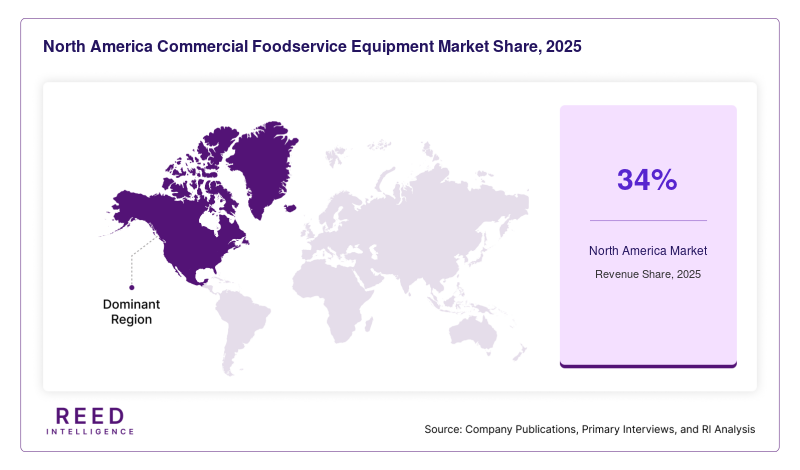
North America represents approximately 34% of the global commercial foodservice equipment market in 2025. The region benefits from a mature restaurant sector, high replacement demand and a large installed base of commercial kitchens. The U.S. National Restaurant Association projects restaurant and foodservice sales of USD 1.55 trillion in 2026, creating a large operating base for equipment purchases.
Replacement and upgrade spending is particularly important. Middleby's 2025 commercial-foodservice sales mix allocated 39% to replacement and upgrade demand, illustrating why mature markets continue generating equipment orders even without equivalent rates of restaurant-unit expansion.
Technology adoption is also strengthening the region's equipment value proposition. ITW Food Equipment generated USD 2.7 billion in 2025 revenue, with North America representing approximately 60% of segment revenue, and its portfolio spans warewashing, cooking, refrigeration, food processing and service.
The U.S. regulatory environment is also important. The FDA's 2026 Food Code provides the latest model framework for foodservice safety, while ENERGY STAR creates efficiency benchmarks across major kitchen equipment categories.
North America is projected to expand at approximately 5.0% CAGR through 2034.
Europe Commercial Foodservice Equipment Market
Europe accounts for approximately 28% of the global market in 2025. Demand is supported by established hospitality markets, restaurant replacement cycles and strong regulatory emphasis on energy efficiency. European commercial kitchens face high energy costs, increasing the commercial value of efficient refrigeration, cooking and warewashing systems.
Commercial refrigeration provides a clear regulatory example. EU Ecodesign and energy-labelling requirements apply to refrigerating appliances with a direct sales function, with efficiency classes and product information required for covered products. The European Commission estimates that these measures can generate substantial electricity and user-cost savings.
Manufacturers are responding through equipment redesign and portfolio expansion. Electrolux Professional's 2025 report highlights sustainability, modular cooking innovation and the January 2026 acquisition of Royal Range's U.S. commercial-cooking assets. RATIONAL likewise identifies sustainability, digitalization and energy-saving investment as longer-term demand factors for commercial kitchens.
Europe is projected to register approximately 4.7% CAGR.
APAC Commercial Foodservice Equipment Market
APAC represents approximately 24% of the global market in 2025 and is the fastest-growing region, with a CAGR of approximately 7.1%. The region combines expanding restaurant networks, hospitality investment, urbanization and increasing adoption of organized foodservice formats.
China is an important technology signal. Major restaurant operators are increasingly applying automation and AI to kitchen operations, scheduling, inventory, food safety and delivery logistics. Recent reporting on Chinese restaurant chains shows that operators are using robotics and automated kitchen functions to improve throughput and reduce operating costs.
India is another important expansion market, with restaurant operators, hotels, institutional kitchens and organized foodservice chains increasing the requirement for commercial cooking, refrigeration, preparation and beverage equipment. Demand differs substantially by market, with premium chains favoring connected and automated systems while smaller operators remain more price-sensitive.
International manufacturers are also strengthening global portfolios. ITW reports that its food-equipment business serves restaurant, retail and institutional customers globally, while Ali Group's acquisition strategy has expanded its geographic and product footprint.
The principal constraints are fragmented distribution, price sensitivity, infrastructure differences and varying regulatory requirements. Nevertheless, APAC is projected to maintain the highest regional growth rate at approximately 7.1% CAGR.
Middle East and Africa Commercial Foodservice Equipment Market
Middle East and Africa account for approximately 6% of the global market in 2025. Demand is concentrated around hospitality, tourism, institutional catering, airports, commercial developments and expanding restaurant infrastructure.
The Gulf markets have particularly strong requirements for hotel and hospitality kitchen equipment because large accommodation and tourism projects require complete foodservice installations. Hotels and resorts typically need high-capacity cooking, refrigeration, warewashing and beverage systems capable of supporting restaurants, banquets and catering.
The region also offers replacement opportunities as established hotels modernize kitchens to reduce energy, water and maintenance costs. Energy efficiency is commercially relevant because commercial kitchens operate for extended periods and may experience high cooling and cooking loads.
Market development remains constrained by project financing, imported equipment costs, distribution infrastructure and differences in food-safety standards. The region is projected to expand at approximately 5.5% CAGR.
Latin America Commercial Foodservice Equipment Market
LATAM represents approximately 8% of the global market in 2025 and is projected to expand at approximately 6.0% CAGR. Restaurant chains, hotels, foodservice operators and institutional kitchens represent the principal equipment demand pools.
Brazil and Mexico provide major addressable markets because of their large urban populations and established restaurant and hospitality sectors. Equipment purchasing is strongly influenced by upfront cost, availability of local service and replacement-part networks, energy consumption and financing conditions.
International manufacturers are increasingly using distributors and local partners to reach fragmented restaurant operators. The region also provides replacement demand because older equipment can have higher energy and maintenance costs than modern systems.
The main constraint is purchasing power among independent restaurants, which can extend replacement cycles and increase demand for refurbished or lower-cost equipment. Larger restaurant chains and hotels are more capable of adopting connected and energy-efficient equipment.
Competitive Landscape
The Commercial Foodservice Equipment Market has a relatively concentrated group of global manufacturers but remains fragmented across specialized product categories and regional distributors. Competition is based on product reliability, energy efficiency, automation, total cost of ownership, service coverage, brand reputation and the ability to supply complete kitchen packages.
ITW operates a broad food-equipment portfolio spanning warewashing, cooking, refrigeration, food processing and service. Its 2025 Food Equipment segment generated USD 2.7 billion in revenue and held a 28% operating margin, while its portfolio includes brands such as Hobart, Traulsen and Vulcan.
Middleby has built a broad portfolio through acquisitions and technology development. Its 2025 proxy materials identify cooking and ice-and-beverage equipment as important categories, while its acquisition program has expanded the company's brand and technology portfolio.
Ali Group strengthened its beverage-equipment portfolio through the March 2026 acquisition of BUNN Commercial. BUNN became part of Ali Group's portfolio, operating within Welbilt in North America, expanding the group's coffee and beverage capabilities.
Key Market Players
- The Middleby Corporation
- Illinois Tool Works (ITW)
- Ali Group
- Welbilt
- RATIONAL AG
- Electrolux Professional
- Hoshizaki Corporation
- True Manufacturing
- Alto-Shaam
- Duke Manufacturing
- Hobart
- Vulcan
- Traulsen
- Manitowoc Foodservice
- MKN
- Meiko
- Winterhalter
- Hatco
- BUNN
- Scotsman Industries
- Panasonic Commercial Food Equipment
- Fujimak
- T&S Brass and Bronze Works
Recent Market Developments
- March 2026 – Ali Group completed its acquisition of BUNN Commercial, adding BUNN's coffee and beverage equipment portfolio and strengthening its position in North American commercial beverage equipment.
- January 2026 – Electrolux Professional completed its acquisition of Royal Range's U.S. commercial-cooking assets, expanding its cooking portfolio in North America.
Commercial Foodservice Equipment Market Segments
By Equipment Type
- Cooking Equipment
- Refrigeration Equipment
- Food Preparation Equipment
- Warewashing Equipment
- Beverage Equipment
- Other Equipment
By Application
- Full-Service Restaurants
- Quick-Service Restaurants
- Hotels & Hospitality
- Institutional Foodservice
- Catering & Other Foodservice
By End User
- Independent Restaurants
- Chain Restaurants
- Hotels & Resorts
- Healthcare & Educational Institutions
- Corporate & Other Institutions
By Region
- North America
- Europe
- APAC
- Middle East and Africa
- LATAM