Commercial Hovercraft Market Size, Share & Demand Report By Type (Lightweight Hovercraft, Medium Hovercraft, Heavy Hovercraft), By Application (Passenger Transport, Cargo & Logistics, Rescue & Emergency Services, Military Support), By Propulsion Type (Diesel, Electric, Hybrid), By End-Use Industry (Tourism & Leisure, Defense & Public Safety, Commercial Transport, Industrial), By Region & Segment Forecasts, 2025–2034
USD 3950
Market Overview
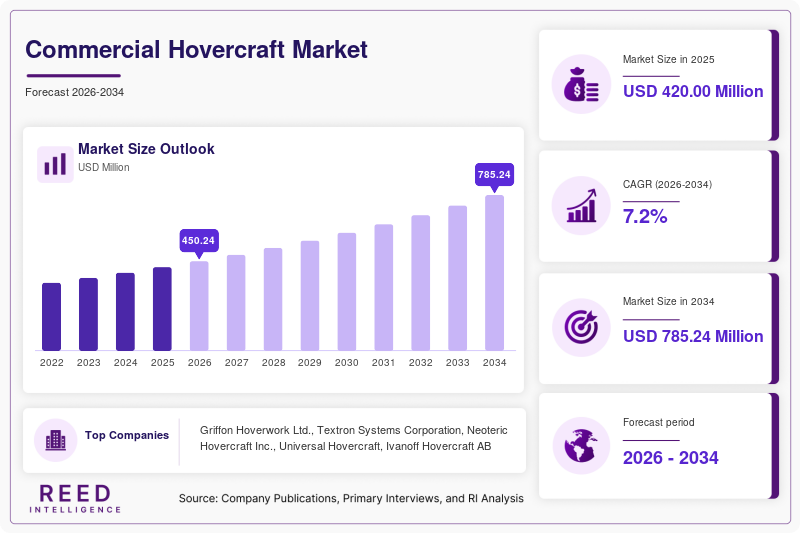
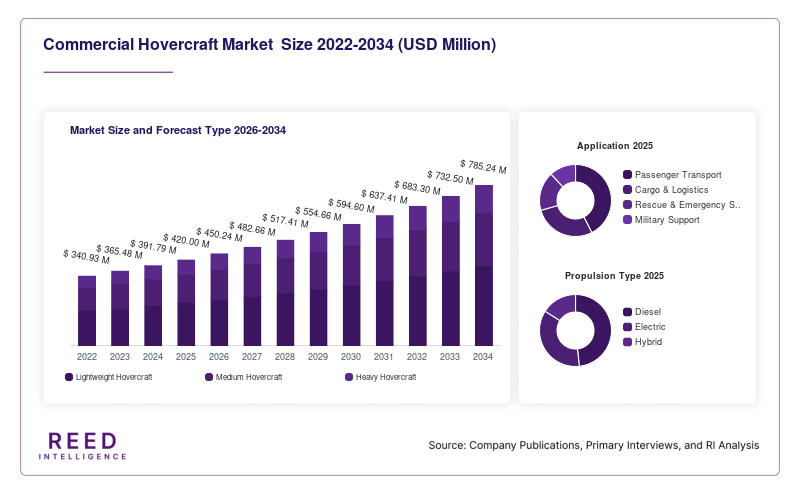
The Commercial Hovercraft Market size was valued at approximately USD 420 million in 2025 and is projected to reach USD 785 million by 2034, expanding at a CAGR of 7.2% from 2025 to 2034. The market growth is supported by the increasing demand for amphibious transport solutions capable of operating across water, mud, ice, and marshlands without the need for conventional infrastructure. Hovercraft technology offers flexibility in logistics, defense support, tourism, and rescue operations, making it a practical alternative in geographically challenging regions.
One of the key global factors driving market expansion is the rising focus on efficient coastal and inland waterway transportation systems. Governments and private operators are investing in hovercraft fleets to enhance connectivity in remote and underserved areas, especially where traditional vessels or land vehicles face limitations.
Key Highlights
- North America dominated the market with 34% share in 2025, while Asia Pacific is expected to grow at the fastest CAGR of 8.5% during the forecast period.
- By type, medium-sized hovercraft led with a 42% share, while lightweight hovercraft is projected to grow at a CAGR of 8.1%.
- By application, passenger transport dominated with 46% share, while rescue and emergency services are expected to grow fastest at 8.8% CAGR.
- The United States accounted for USD 110 million in 2025 and is estimated to reach USD 118 million in 2026.
Market Trends
Integration of Advanced Navigation and Automation Systems
The Commercial Hovercraft Market is witnessing increased adoption of advanced navigation technologies, including GPS-based systems, automated controls, and collision avoidance sensors. Manufacturers are integrating digital control panels and real-time monitoring systems to improve operational efficiency and safety. This trend is particularly relevant for commercial operators in logistics and tourism, where precision and reliability are critical. The shift toward semi-autonomous hovercraft is expected to reduce human error and operational costs over time.
Growing Adoption in Eco-Tourism and Coastal Tourism
The use of hovercraft in eco-tourism and coastal tourism is expanding steadily. Their ability to traverse fragile ecosystems without causing significant environmental disruption makes them suitable for protected areas such as wetlands and mangroves. Tourism operators are incorporating hovercraft rides as a unique travel experience, especially in regions with extensive coastlines and water bodies. This trend is contributing to diversified revenue streams for operators and supporting the growth of the Commercial Hovercraft Market globally.
Market Drivers
Rising Demand for Amphibious Transport Solutions
The increasing need for transportation systems that can operate seamlessly across diverse terrains is a major driver for the Commercial Hovercraft Market. Hovercraft eliminate the dependency on developed infrastructure such as roads or ports, making them suitable for remote and disaster-prone areas. Industries such as oil & gas, defense support, and logistics are adopting hovercraft for their versatility and operational efficiency.
Expansion of Search and Rescue Operations
The growing emphasis on disaster preparedness and emergency response capabilities is boosting the adoption of hovercraft. These vehicles are highly effective in flood-prone and ice-covered regions where traditional vehicles cannot operate. Governments and emergency service organizations are investing in hovercraft fleets to enhance response times and coverage, which is expected to drive sustained demand over the forecast period.
Market Restraint
High Initial Investment and Maintenance Costs
One of the primary challenges in the Commercial Hovercraft Market is the high cost associated with procurement and maintenance. Hovercraft require specialized materials, advanced propulsion systems, and regular servicing to ensure optimal performance. Additionally, operational costs, including fuel consumption and skilled workforce requirements, can be significant. These factors may limit adoption among small-scale operators and emerging markets, where budget constraints are more prominent. The lack of standardized regulations and infrastructure for hovercraft operations in certain regions further adds to the complexity, potentially slowing market growth.
Market Opportunities
Expansion in Emerging Economies
Emerging economies present significant growth opportunities for the Commercial Hovercraft Market. Countries in Asia Pacific, Africa, and Latin America are investing in improving transportation connectivity in rural and remote regions. Hovercraft can play a critical role in bridging infrastructure gaps, particularly in areas with extensive water bodies or challenging terrain. Increasing government support and infrastructure development initiatives are expected to create favorable conditions for market expansion.
Technological Advancements in Lightweight Materials
The development of lightweight and durable materials is opening new avenues for hovercraft manufacturing. Advanced composites and alloys can reduce overall vehicle weight, improve fuel efficiency, and enhance performance. Manufacturers focusing on innovation in material science are likely to gain a competitive edge. These advancements are expected to lower operational costs and make hovercraft more accessible to a broader range of end-users, driving future growth in the Commercial Hovercraft Market.
Segmental Analysis
By Type
Medium-sized hovercraft dominated the Commercial Hovercraft Market in 2025, accounting for 42% of the total share. These hovercraft offer a balance between capacity and operational efficiency, making them suitable for a wide range of applications, including passenger transport and logistics. Their versatility and cost-effectiveness have contributed to their widespread adoption across various industries.
Lightweight hovercraft are expected to witness the fastest growth, with a projected CAGR of 8.1% during the forecast period. The increasing demand for portable and fuel-efficient solutions is driving this segment. Lightweight models are particularly suitable for rescue operations and recreational activities, where ease of deployment and maneuverability are critical.
By Application
Passenger transport emerged as the dominant application segment, holding a 46% market share in 2025. Hovercraft are widely used for ferry services and tourism, offering a unique travel experience and the ability to operate in shallow waters and challenging terrains.
Rescue and emergency services are projected to grow at the fastest CAGR of 8.8%. The increasing frequency of natural disasters and the need for rapid response solutions are driving demand in this segment. Hovercraft provide unmatched accessibility in flooded and inaccessible areas, making them essential for emergency operations.
By Propulsion Type
Diesel-powered hovercraft dominated the market in 2025, accounting for 55% of the share. These systems are preferred for their reliability and ability to support heavy-duty operations. Diesel engines provide the necessary power for large hovercraft used in commercial and industrial applications.
Electric and hybrid propulsion systems are expected to grow at a CAGR of 8.3%. The push for sustainable and environmentally friendly transportation solutions is driving innovation in this segment. Advancements in battery technology and energy efficiency are expected to support the adoption of electric hovercraft in the coming years.
By End-Use Industry
The tourism and leisure segment held the largest share of 39% in 2025, driven by the growing popularity of hovercraft rides in coastal and eco-tourism destinations. Operators are leveraging hovercraft to offer unique experiences that attract tourists.
Defense support and public safety applications are expected to grow at the fastest CAGR of 8.6%. Governments are investing in hovercraft for surveillance, patrol, and rescue operations. The ability to operate in diverse environments makes hovercraft an essential asset for defense and public safety agencies.
Regional Analysis
North America
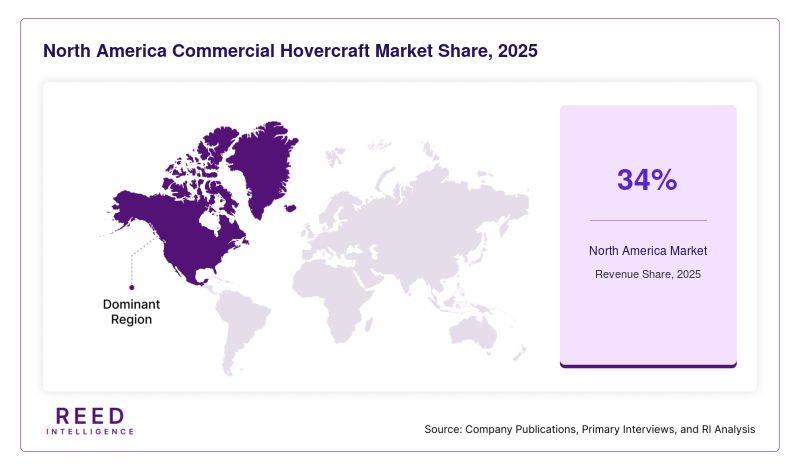
North America accounted for 34% of the Commercial Hovercraft Market share in 2025 and is expected to grow at a CAGR of 6.8% from 2025 to 2034. The region's growth is supported by well-established infrastructure, technological advancements, and the presence of key manufacturers. Hovercraft are widely used for coastal patrol, tourism, and rescue operations across the United States and Canada.
The United States remained the dominant country due to its extensive coastline and focus on emergency response systems. The integration of hovercraft into disaster management frameworks has enhanced operational efficiency in flood-prone regions. Additionally, investments in advanced navigation systems and fleet modernization are contributing to steady market growth.
Europe
Europe held a 28% market share in 2025 and is projected to grow at a CAGR of 6.5% during the forecast period. The region benefits from strong maritime industries and increasing adoption of sustainable transportation solutions.
The United Kingdom dominated the European market due to its long history of hovercraft usage and established manufacturing base. The demand for efficient cross-channel transport and tourism applications has supported steady growth. Government initiatives promoting low-impact transportation solutions are further driving adoption.
Asia Pacific
Asia Pacific captured 22% of the market share in 2025 and is expected to register the fastest CAGR of 8.5% through 2034. Rapid urbanization and infrastructure development are key factors driving growth in this region.
China emerged as the leading country due to significant investments in coastal and inland waterway transportation. The government’s focus on improving connectivity in remote regions has accelerated the adoption of hovercraft. Increasing tourism activities and expanding logistics networks are also contributing to market expansion.
Middle East & Africa
The Middle East & Africa region accounted for 9% of the market share in 2025 and is projected to grow at a CAGR of 7.4%. The region's diverse geography, including deserts and coastal areas, creates demand for versatile transportation solutions.
The United Arab Emirates dominated the regional market due to its focus on tourism and infrastructure development. Hovercraft are increasingly used for luxury tourism experiences and coastal patrol operations. Investments in innovative transport solutions are expected to support future growth.
Latin America
Latin America held 7% of the market share in 2025 and is anticipated to grow at a CAGR of 7.0% during the forecast period. The region’s extensive river networks and remote communities create opportunities for hovercraft deployment.
Brazil led the market due to its vast inland waterways and need for efficient transportation solutions. Hovercraft are being adopted for logistics and emergency services in remote areas, supporting gradual market growth.
Competitive Landscape
The Commercial Hovercraft Market is moderately consolidated, with a mix of established manufacturers and emerging players. Companies are focusing on product innovation, technological advancements, and strategic partnerships to strengthen their market position.
Griffon Hoverwork Ltd. is recognized as a market leader, known for its extensive product portfolio and global presence. The company recently introduced a next-generation hovercraft model featuring enhanced fuel efficiency and advanced navigation systems, reflecting its commitment to innovation.
Other key players are investing in research and development to introduce lightweight and eco-friendly hovercraft solutions. Strategic collaborations with government agencies and private operators are also common, enabling companies to expand their market reach and enhance their service offerings.
Key Players List
- Griffon Hoverwork Ltd.
- Textron Systems Corporation
- Neoteric Hovercraft Inc.
- Universal Hovercraft
- Ivanoff Hovercraft AB
- Vanair Hovercraft
- Hovertechnics LLC
- The British Hovercraft Company
- Garden Reach Shipbuilders & Engineers Ltd.
- Airlift Hovercraft Pty Ltd.
- Hoverstream LLC
- Almaz Shipbuilding Company
- Christy Hovercraft
- QinetiQ Group plc
- Kaiman Hovercraft
Recent Developments
- In 2024, Griffon Hoverwork Ltd. launched an upgraded hovercraft model with improved fuel efficiency and reduced emissions.
- In 2023, Textron Systems Corporation expanded its hovercraft production capabilities to meet rising demand in North America.
- In 2024, Neoteric Hovercraft Inc. introduced a lightweight hovercraft designed for rescue and recreational applications.
- In 2023, Garden Reach Shipbuilders & Engineers Ltd. secured a contract to supply hovercraft for coastal security operations.
- In 2024, The British Hovercraft Company announced a partnership with tourism operators to expand its presence in the leisure segment.
Commercial Hovercraft Market Segments
Type
- Lightweight Hovercraft
- Medium Hovercraft
- Heavy Hovercraft
Application
- Passenger Transport
- Cargo & Logistics
- Rescue & Emergency Services
- Military Support
Propulsion Type
- Diesel
- Electric
- Hybrid
End-Use Industry
- Tourism & Leisure
- Defense & Public Safety
- Commercial Transport
- Industrial
By Region
- North America
- Europe
- APAC
- Middle East and Africa
- LATAM