Commercial Toaster Market Size, Share & Demand Report By Product Type (Conveyor Toasters, Pop-Up Toasters, Bun Toasters), By End-Use (Quick-Service Restaurants, Full-Service Restaurants, Institutional Catering, Hotels), By Distribution Channel (Online, Offline) By Region & Segment Forecasts, 2026–2034
USD 3950
Market Overview
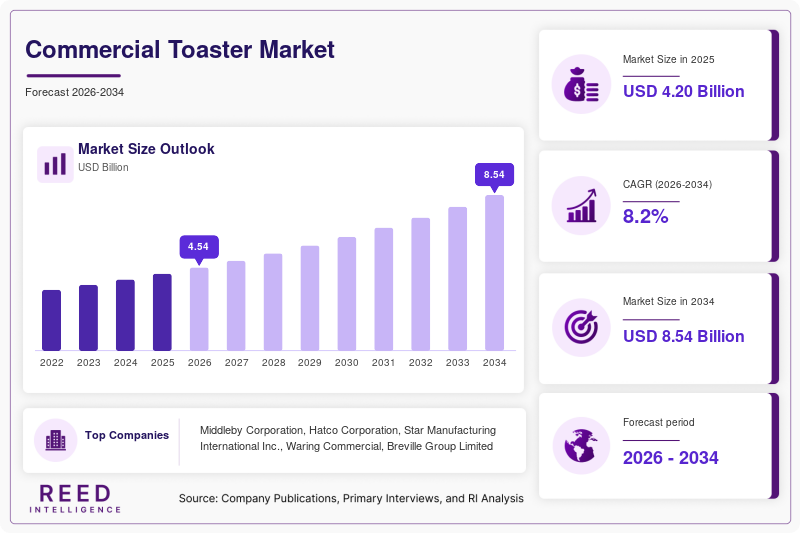
The global Commercial Toaster Market size was valued at approximately USD 4.2 billion in 2026 and is projected to reach USD 7.9 billion by 2034, expanding at a CAGR of 8.2% during the forecast period. The market is experiencing steady growth driven by the expansion of quick-service restaurants, cafes, and institutional kitchens across both developed and emerging economies. Increasing urbanization and rising demand for standardized food preparation equipment have encouraged foodservice operators to invest in reliable, high-capacity toasting solutions that ensure consistency and operational efficiency.
A key global factor supporting market growth is the rapid proliferation of organized foodservice chains and franchised restaurant models. These establishments require uniform cooking outcomes and faster turnaround times, making commercial toasters an essential component of kitchen infrastructure. Additionally, advancements in energy-efficient heating elements and automation features have improved product performance, enabling operators to reduce labor costs while maintaining output quality. The integration of smart controls and programmable settings further enhances usability and supports scalability for multi-location businesses.
Key Highlights
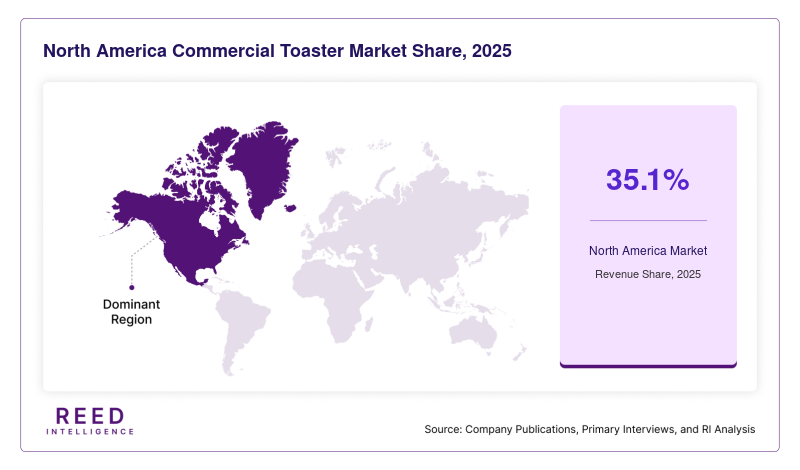
- North America dominated the market with a 35.1% share in 2025.
- Asia Pacific is expected to grow at the fastest CAGR of 10.8% during 2026–2034.
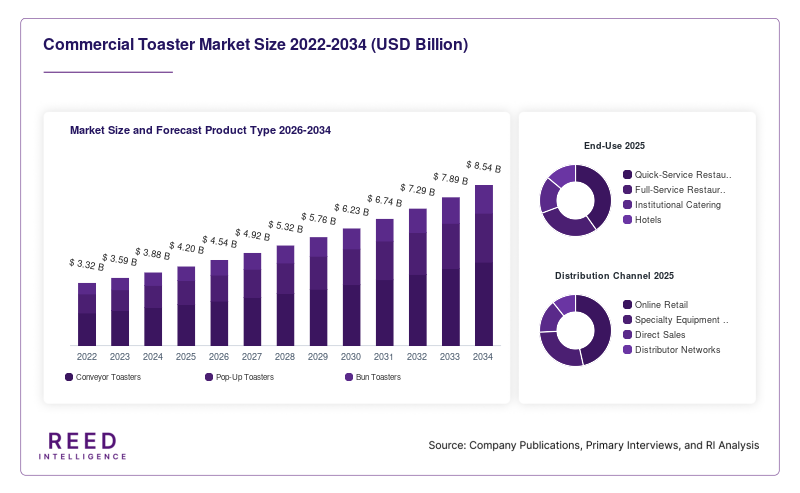
- By product type, conveyor toasters accounted for the largest share of 42.3%, while pop-up toasters are projected to grow at a CAGR of 9.6%.
- By end-use, quick-service restaurants led with a 46.8% share, whereas institutional catering is expected to expand at a CAGR of 9.1%.
- The United States remained the dominant country, with market values of USD 920 million in 2024 and USD 990 million in 2025.
Market Trends
Increasing Adoption of Smart and Programmable Toasters
The integration of smart technologies in commercial kitchen equipment is influencing the Commercial Toaster Market significantly. Manufacturers are incorporating programmable settings, touchscreen controls, and IoT-enabled monitoring systems into modern toaster models. These features allow operators to customize browning levels, adjust speed settings, and monitor performance remotely. The ability to maintain consistency across multiple outlets is particularly beneficial for franchise-based foodservice businesses. Furthermore, predictive maintenance alerts and energy consumption tracking are helping operators optimize operational efficiency. This trend is expected to gain traction as foodservice operators increasingly prioritize automation and digitalization to improve productivity and reduce downtime in high-volume kitchen environments.
Rising Demand for Energy-Efficient Equipment
Energy efficiency has emerged as a critical consideration in commercial kitchen operations, driving innovation in toaster design. Modern commercial toasters are being engineered with improved insulation, rapid heating elements, and standby energy-saving modes to reduce electricity consumption. This trend is particularly relevant in regions with high energy costs and strict environmental regulations. Operators are increasingly opting for equipment that minimizes operational expenses while meeting sustainability goals. Additionally, manufacturers are focusing on eco-friendly materials and designs that align with green certification standards. The growing emphasis on reducing carbon footprints across the foodservice industry is expected to sustain demand for energy-efficient commercial toasters in the coming years.
Market Drivers
Expansion of Quick-Service Restaurant Chains
The rapid growth of quick-service restaurants (QSRs) worldwide is a primary driver of the Commercial Toaster Market. These establishments rely heavily on efficient kitchen equipment to maintain high service speeds and consistent product quality. Commercial toasters play a crucial role in preparing items such as sandwiches, buns, and breakfast offerings. As global food chains expand into emerging markets, the demand for standardized kitchen equipment is increasing. Franchised outlets require identical equipment configurations to ensure uniformity across locations. This trend has led to bulk procurement of commercial toasters, contributing significantly to market growth. Additionally, the rising popularity of takeaway and delivery services further amplifies the need for high-capacity toasting solutions.
Growth in Institutional and Hospitality Sectors
The expansion of institutional kitchens, including hotels, hospitals, schools, and corporate cafeterias, is driving demand for commercial toasters. These facilities require durable and high-performance equipment capable of handling large volumes of food preparation. The hospitality industry, in particular, is witnessing steady growth due to increasing travel and tourism activities. Breakfast buffets and self-service stations often rely on commercial toasters to provide quick and convenient meal options. Furthermore, the growing emphasis on hygiene and food safety standards has encouraged institutions to invest in reliable and easy-to-clean equipment. This driver is expected to remain strong as infrastructure development and urbanization continue to expand globally.
Market Restraint
High Initial Investment and Maintenance Costs
One of the primary challenges in the Commercial Toaster Market is the relatively high initial cost associated with advanced models. Conveyor toasters and high-capacity units equipped with smart features often require significant capital investment, which can be a barrier for small and medium-sized foodservice operators. In addition to the upfront cost, ongoing maintenance and repair expenses can further increase the total cost of ownership. Components such as heating elements and conveyor belts require periodic replacement, adding to operational costs. This restraint is particularly evident in developing regions where budget constraints limit the adoption of premium equipment. As a result, some operators may opt for lower-cost alternatives, potentially affecting the growth of high-end product segments.
Market Opportunities
Expansion in Emerging Economies
Emerging economies present significant growth opportunities for the Commercial Toaster Market due to increasing urbanization and changing consumer lifestyles. Rising disposable incomes and the growing popularity of dining out are driving the expansion of foodservice establishments in these regions. Countries in Asia Pacific, Latin America, and the Middle East are witnessing a surge in new restaurant openings, creating demand for commercial kitchen equipment. Additionally, government initiatives supporting small businesses and entrepreneurship are encouraging the establishment of cafes and quick-service outlets. Manufacturers can capitalize on this opportunity by offering cost-effective and region-specific product variants that cater to the needs of local operators.
Innovation in Compact and Multi-Functional Designs
The development of compact and multi-functional commercial toasters is creating new opportunities in the market. Space constraints in urban kitchens and small foodservice outlets have increased the demand for equipment that combines multiple functionalities in a single unit. Manufacturers are introducing toasters with integrated grilling, warming, and toasting capabilities, allowing operators to maximize utility while minimizing space usage. These innovations are particularly appealing to food trucks, small cafes, and convenience stores. Additionally, the focus on ergonomic design and ease of use enhances operational efficiency. As the foodservice industry continues to evolve, the demand for versatile and space-saving equipment is expected to grow steadily.
Segmental Analysis
By Product Type
Conveyor toasters dominated the Commercial Toaster Market in 2024, accounting for approximately 42.3% of the total share. These toasters are widely used in high-volume foodservice environments such as quick-service restaurants and cafeterias. Their ability to continuously toast large quantities of bread products makes them ideal for operations requiring speed and consistency. Conveyor toasters also offer adjustable speed and temperature controls, allowing operators to customize output according to specific requirements. The durability and efficiency of these machines contribute to their widespread adoption. Additionally, their compatibility with various bread types enhances their versatility, making them a preferred choice for large-scale foodservice operations.
Pop-up toasters are expected to be the fastest-growing subsegment, with a projected CAGR of 9.6% during the forecast period. The growth of this segment is driven by increasing demand from small cafes, convenience stores, and office kitchens. Pop-up toasters are compact, cost-effective, and easy to operate, making them suitable for establishments with limited space and lower volume requirements. Manufacturers are introducing advanced models with multiple slots and adjustable settings to enhance functionality. The rising popularity of specialty cafes and boutique food outlets is further supporting the growth of this segment, as these establishments seek efficient yet affordable equipment solutions.
By End-Use
Quick-service restaurants held the largest share of the Commercial Toaster Market in 2024, accounting for 46.8% of total revenue. These establishments rely heavily on commercial toasters for preparing menu items such as sandwiches, burgers, and breakfast dishes. The need for high-speed operations and consistent product quality makes commercial toasters indispensable in QSR kitchens. The expansion of global food chains and the increasing demand for takeaway and delivery services are driving growth in this segment. Additionally, the standardization of kitchen equipment across franchise outlets ensures uniformity in food preparation, further boosting demand for commercial toasters.
Institutional catering is expected to be the fastest-growing subsegment, with a CAGR of 9.1% during the forecast period. This growth is driven by the increasing number of large-scale foodservice operations in schools, hospitals, and corporate offices. These institutions require reliable and high-capacity equipment to handle large volumes of food preparation. The focus on hygiene and efficiency is encouraging the adoption of advanced commercial toasters. Furthermore, the expansion of corporate campuses and educational institutions is creating new opportunities for this segment, as they invest in modern kitchen infrastructure.
By Distribution Channel
Offline distribution channels dominated the Commercial Toaster Market in 2024, accounting for a significant share of 63.5%. Traditional retail stores, specialty kitchen equipment suppliers, and direct sales channels play a crucial role in product distribution. Buyers often prefer offline channels to physically evaluate product features, durability, and performance before making a purchase. Additionally, these channels provide after-sales support and maintenance services, which are important considerations for commercial buyers. The presence of established dealer networks further strengthens the dominance of offline distribution in the market.
Online distribution channels are expected to grow at the fastest CAGR of 10.2% during the forecast period. The increasing adoption of e-commerce platforms and digital procurement systems is driving this growth. Online channels offer a wide range of products, competitive pricing, and convenient purchasing options. Businesses can compare specifications and read customer reviews before making decisions. The rise of digitalization in procurement processes, particularly among small and medium-sized enterprises, is contributing to the expansion of online distribution. Manufacturers are also leveraging online platforms to reach a broader customer base and enhance market penetration.
Regional Analysis
North America
North America held the largest share of the Commercial Toaster Market in 2025, accounting for approximately 35.1% of global revenue. The region is expected to grow at a CAGR of 7.6% during the forecast period. The presence of a well-established foodservice industry, along with a high concentration of quick-service restaurant chains, drives demand for commercial toasters. Technological advancements and early adoption of smart kitchen equipment further support market growth in this region.
The United States dominates the North American market due to its extensive network of restaurants and foodservice establishments. A key growth factor is the strong emphasis on operational efficiency and automation in commercial kitchens. Businesses are increasingly investing in advanced toasters with programmable features to enhance productivity and maintain consistency across multiple outlets.
Europe
Europe accounted for a significant share of the Commercial Toaster Market in 2025, driven by the region’s mature hospitality sector. The market is projected to grow at a CAGR of 7.9% during the forecast period. Increasing demand for energy-efficient equipment and strict environmental regulations are influencing purchasing decisions. The region also benefits from a strong presence of premium cafes and bakery chains.
Germany is a leading market within Europe, supported by its robust foodservice industry and high standards for kitchen equipment. A unique growth factor is the increasing focus on sustainability and energy conservation. Operators are adopting energy-efficient toasters to comply with regulatory requirements and reduce operational costs, driving demand for advanced models.
Asia Pacific
Asia Pacific is the fastest-growing region in the Commercial Toaster Market, with a projected CAGR of 10.8% from 2026 to 2034. The region’s market share in 2025 was approximately 24.6%. Rapid urbanization, increasing disposable incomes, and the expansion of international food chains are key factors driving growth. The rising popularity of Western-style breakfast options is also contributing to demand.
China dominates the Asia Pacific market due to its large population and growing foodservice sector. A significant growth factor is the rapid expansion of quick-service restaurants in urban areas. The increasing adoption of modern kitchen equipment by local and international chains is driving demand for commercial toasters across the country.
Middle East & Africa
The Middle East & Africa region is experiencing steady growth in the Commercial Toaster Market, with a CAGR of 8.5% during the forecast period. The market share in 2025 was approximately 8.3%. Growth is supported by the expansion of the hospitality and tourism sectors, particularly in the Gulf countries. Increasing investments in infrastructure and foodservice establishments are also contributing to market development.
The United Arab Emirates is a key market in this region, driven by its thriving tourism industry. A unique growth factor is the high demand for premium dining experiences and international cuisines. This has led to increased adoption of advanced kitchen equipment, including commercial toasters, in hotels and restaurants.
Latin America
Latin America accounted for around 6.7% of the Commercial Toaster Market in 2025 and is expected to grow at a CAGR of 8.1% during the forecast period. The region’s growth is driven by the increasing number of cafes, restaurants, and fast-food outlets. Economic development and changing consumer preferences are also supporting market expansion.
Brazil is the dominant country in Latin America, with a growing foodservice industry. A key growth factor is the rising popularity of quick-service dining and casual eateries. This trend is driving demand for efficient and cost-effective kitchen equipment, including commercial toasters, across the country.
Competitive Landscape
The Commercial Toaster Market is characterized by the presence of several established players competing on product innovation, quality, and pricing. Companies are focusing on developing energy-efficient and technologically advanced products to meet evolving customer requirements. Strategic partnerships, product launches, and expansion into emerging markets are common strategies adopted by market participants.
One of the leading companies in the market is Middleby Corporation, known for its extensive portfolio of commercial kitchen equipment. The company has recently introduced advanced conveyor toaster models with improved energy efficiency and digital controls. Other key players are also investing in research and development to enhance product performance and durability. The competitive landscape remains moderately fragmented, with both global and regional players contributing to market growth.
Key Players
- Middleby Corporation
- Hatco Corporation
- Star Manufacturing International Inc.
- Waring Commercial
- Breville Group Limited
- Dualit Limited
- Panasonic Corporation
- Hamilton Beach Brands Inc.
- De’Longhi Appliances S.r.l.
- Smeg S.p.A.
- Electrolux Professional
- Ali Group S.r.l.
- Toastmaster Inc.
- Avantco Equipment
- Krampouz SAS
Recent Developments
- Several manufacturers have launched energy-efficient commercial toaster models with advanced heating technologies to reduce power consumption and improve performance.
- A leading company introduced a new line of smart toasters equipped with IoT-enabled monitoring systems, allowing operators to track usage and maintenance requirements remotely.
- Strategic partnerships between equipment manufacturers and foodservice chains have increased, enabling customized product development tailored to specific operational needs.
Commercial Toaster Market Segments
Product Type
- Conveyor Toasters
- Pop-Up Toasters
- Bun Toasters
End-Use
- Quick-Service Restaurants
- Full-Service Restaurants
- Institutional Catering
- Hotels
Distribution Channel
- Online Retail
- Specialty Equipment Stores
- Direct Sales
- Distributor Networks
By Region
- North America
- Europe
- APAC
- Middle East and Africa
- LATAM