Commercial Water Hauling Service Market Size, Share, Demand Report By Service Type (Potable Water Hauling, Industrial Water Hauling, Emergency Water Supply Services), By Application (Construction, Oil & Gas, Mining, Municipal Services, Agriculture), By End-Use (Residential Emergency Supply, Industrial Operations, Infrastructure Development, Energy & Utilities) – Global Forecast Analysis, 2026–2034
USD 3950
Market Overview
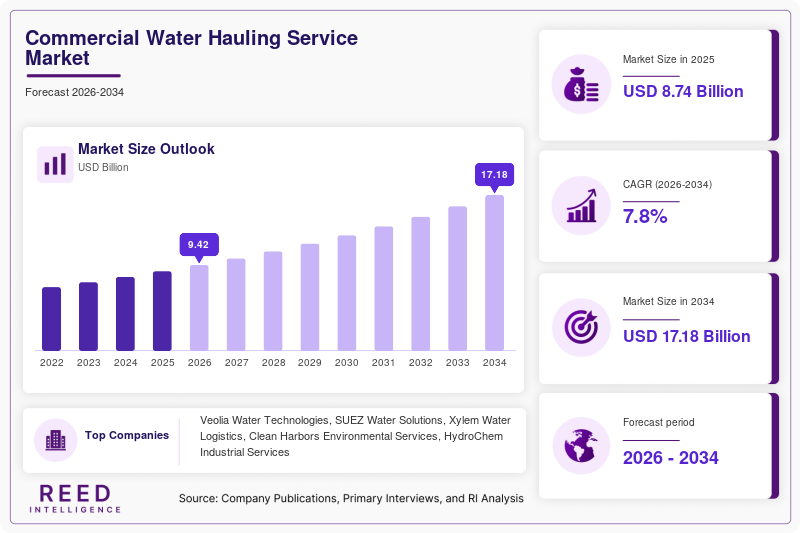
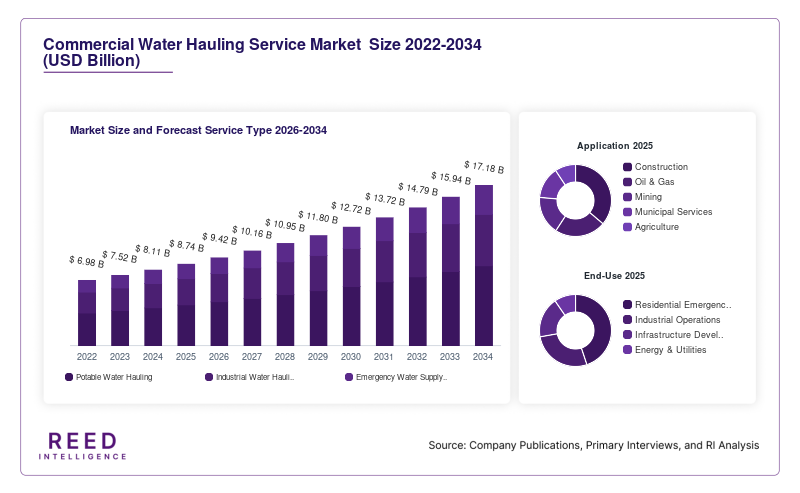
The Commercial Water Hauling Service Market size was valued at approximately USD 8.74 billion in 2026 and is projected to reach nearly USD 15.96 billion by 2034, expanding at a CAGR of 7.8% during the forecast period from 2026 to 2034. The market is gaining momentum due to increasing industrial and municipal dependence on outsourced water transportation services in regions facing infrastructure limitations, groundwater stress, and seasonal water shortages. Commercial water hauling services are widely used across construction, mining, agriculture, oil & gas, hospitality, and municipal emergency operations where continuous water access is essential for operational continuity.
A major global factor supporting market expansion is the increasing frequency of drought conditions and water infrastructure disruptions across both developed and emerging economies. Climate variability has intensified pressure on centralized water supply systems, encouraging industries and local governments to adopt mobile water delivery services for temporary and long-term operational needs. Growing urbanization, industrial expansion in remote areas, and rising investments in infrastructure projects are also strengthening demand for bulk potable and non-potable water transportation services. In addition, stricter environmental regulations regarding water extraction and wastewater handling are encouraging companies to partner with licensed commercial water haulers that comply with water quality and transportation standards.
Key Highlights
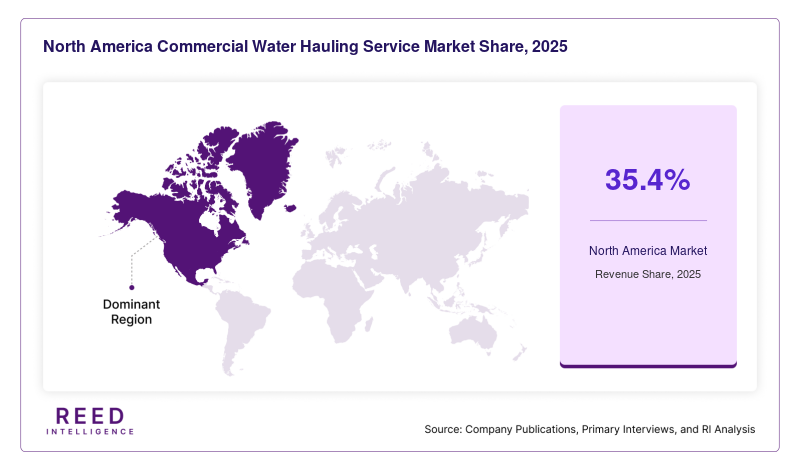
- North America dominated the market with a 35.4% share in 2025.
- Asia Pacific is expected to grow at the fastest CAGR of 9.8% during 2026–2034.
- By service type, potable water hauling accounted for the largest share of 43.7%, while emergency water delivery services are projected to grow at a CAGR of 10.6%.
- By end-use industry, construction and infrastructure led with a 31.8% share, whereas mining operations are expected to expand at a CAGR of 9.9%.
- The United States remained the dominant country, with market values of USD 2.41 billion in 2024 and USD 2.63 billion in 2025.
Market Trends
Expansion of Smart Fleet and Route Optimization Technologies
Commercial water hauling companies are increasingly investing in smart fleet management technologies to improve operational efficiency and reduce transportation costs. GPS-enabled tanker tracking systems, automated dispatching platforms, and predictive route optimization tools are helping operators minimize fuel consumption and delivery delays. Many service providers are integrating cloud-based scheduling systems that allow real-time coordination between dispatch centers, drivers, and customers. These technologies are becoming important as demand for emergency water delivery services rises across construction sites, industrial facilities, and municipalities. Companies are also using data analytics to predict seasonal demand fluctuations and allocate tanker fleets more effectively. As transportation costs continue to influence profitability, digital fleet optimization is emerging as a major operational trend across the commercial water hauling service industry.
Rising Demand from Remote Industrial and Infrastructure Projects
Large-scale industrial projects located in remote regions are increasingly depending on commercial water hauling services to maintain continuous operations. Mining sites, renewable energy projects, highway construction, and oilfield developments often operate in locations lacking permanent water infrastructure. This has created strong demand for dependable bulk water transportation services. Governments across developing economies are expanding infrastructure spending, which is further increasing temporary water supply requirements for road construction, tunnel projects, and urban development initiatives. In addition, the expansion of data centers and logistics hubs in semi-urban areas is generating demand for temporary water support during construction phases. Commercial water hauling providers are responding by increasing fleet capacity, expanding regional distribution networks, and offering customized delivery schedules for industrial clients.
Market Drivers
Increasing Water Scarcity and Aging Infrastructure
Growing water scarcity across urban and industrial regions is significantly supporting the growth of the Commercial Water Hauling Service Market. Many cities and rural communities continue to face unreliable water infrastructure due to aging pipelines, reservoir limitations, and rising population pressure. Seasonal drought conditions and groundwater depletion are further intensifying the need for supplemental water transportation services. Commercial water hauling companies play a critical role in delivering potable and non-potable water to businesses, municipalities, and construction sites during supply interruptions. In several countries, infrastructure modernization programs remain slow due to budget constraints, increasing dependence on temporary water delivery solutions. Industrial operators are also adopting outsourced water hauling services to reduce capital expenditures associated with building dedicated water storage and pipeline systems.
Growth of Construction, Mining, and Energy Activities
Rapid expansion of construction, mining, and energy operations is another important factor accelerating market growth. Large infrastructure projects require substantial volumes of water for dust suppression, concrete mixing, drilling, and workforce support. Mining operations also depend on water hauling services for extraction processes and environmental management activities in remote regions. Oil and gas exploration projects frequently utilize commercial water transportation services for hydraulic fracturing operations and temporary camp facilities. Emerging economies in Asia Pacific, Africa, and Latin America are witnessing increased investments in industrial development projects, creating sustained demand for commercial water logistics. The growth of renewable energy infrastructure, including solar and wind farms in remote areas, is further contributing to market expansion by increasing demand for temporary and mobile water supply solutions.
Market Restraint
High Transportation Costs and Regulatory Compliance Challenges
The Commercial Water Hauling Service Market faces considerable challenges related to rising transportation expenses and strict regulatory compliance requirements. Fuel price volatility significantly impacts operating margins because water hauling services depend heavily on tanker fleet transportation over long distances. Maintenance costs for specialized tanker vehicles, labor shortages, and insurance expenses also contribute to higher operational expenditures. In addition, commercial water haulers must comply with varying regional regulations regarding water sourcing, sanitation standards, wastewater disposal, and tanker hygiene practices. Regulatory approvals for potable water transportation can increase administrative burdens and delay service expansion into new markets. Smaller service providers often struggle to invest in advanced water quality monitoring systems and fleet modernization programs, limiting their ability to compete with larger operators. These factors may restrict market expansion, particularly in regions with fragmented regulatory frameworks and inadequate transportation infrastructure.
Market Opportunities
Expansion of Emergency Water Management Programs
Governments and municipal agencies are increasingly investing in emergency water management programs, creating substantial opportunities for commercial water hauling companies. Natural disasters such as floods, droughts, hurricanes, and wildfires frequently disrupt public water supply systems, requiring rapid deployment of temporary water transportation services. Many local authorities are forming long-term partnerships with private water hauling providers to strengthen disaster preparedness strategies. These partnerships include emergency potable water delivery contracts, mobile storage solutions, and rapid-response logistics support. In addition, military bases, healthcare facilities, and disaster relief organizations are increasing investments in backup water supply systems. Commercial operators capable of maintaining large tanker fleets and fast-response distribution networks are expected to benefit from rising government procurement activities related to emergency water infrastructure resilience.
Growing Adoption of Sustainable and Recycled Water Transportation
The increasing focus on sustainable water management is creating new growth opportunities for recycled and non-potable water hauling services. Industrial facilities and municipalities are adopting recycled water solutions for landscaping, dust suppression, irrigation, and industrial cooling applications. Commercial water hauling companies are expanding their service portfolios to include treated wastewater transportation and environmentally compliant disposal services. This trend is especially visible in regions facing severe freshwater shortages and rising environmental regulations regarding water conservation. Companies investing in advanced tanker sanitation systems, water treatment partnerships, and environmentally efficient transportation fleets are likely to gain a competitive advantage. The growing acceptance of recycled water in industrial and municipal applications is expected to diversify revenue streams and support long-term market growth across multiple sectors.
Segmental Analysis
By Service Type
Potable water hauling emerged as the dominant subsegment within the Commercial Water Hauling Service Market and accounted for approximately 43.7% of the market share in 2024. This segment maintains a strong position due to rising demand from municipalities, construction projects, hospitality facilities, healthcare institutions, and emergency response operations. Potable water transportation services are essential in regions experiencing pipeline disruptions, seasonal droughts, and infrastructure limitations. Many commercial establishments depend on outsourced potable water supply systems to maintain uninterrupted operations during peak consumption periods. Regulatory emphasis on water quality and sanitation standards has also increased reliance on licensed water hauling providers capable of ensuring safe transportation and storage practices. Growing urbanization and temporary workforce accommodations across remote industrial sites continue to support steady demand for potable water delivery services.
Emergency water delivery services are expected to register the fastest CAGR of 10.6% during the forecast period due to increasing climate-related disruptions and rising disaster preparedness initiatives. Governments, municipalities, and industrial operators are investing heavily in emergency response infrastructure to address water supply interruptions caused by natural disasters, infrastructure failures, and environmental emergencies. Commercial water hauling providers are expanding rapid-response tanker fleets and mobile storage capabilities to support emergency operations more effectively. Rising wildfire incidents, flooding events, and drought conditions are increasing the frequency of emergency water transportation requirements across several regions. In addition, healthcare facilities, military operations, and humanitarian organizations are strengthening backup water supply systems, creating sustained growth opportunities for emergency water hauling service providers globally.
By End-Use Industry
Construction and infrastructure represented the largest end-use segment in the Commercial Water Hauling Service Market and accounted for approximately 31.8% of the global share in 2024. Large-scale construction activities require substantial water volumes for concrete production, dust control, equipment cleaning, and workforce accommodation. Infrastructure development projects such as highways, rail systems, tunnels, and industrial complexes frequently operate in areas lacking permanent water supply infrastructure, increasing reliance on commercial water hauling services. Governments across developing and developed economies continue to increase investments in transportation and urban development initiatives, further supporting segment growth. Commercial water hauling companies are also benefiting from rising demand associated with renewable energy infrastructure projects, including solar farms and wind energy installations located in remote regions.
Mining operations are projected to witness the fastest CAGR of 9.9% during the forecast period due to increasing global demand for minerals and metals used in energy transition technologies and industrial manufacturing. Mining activities require continuous water supply support for drilling, mineral processing, dust suppression, and environmental management operations. Many mining projects are located in isolated regions where centralized water infrastructure is limited or unavailable. As global investments in lithium, copper, and rare earth mineral extraction continue to increase, commercial water hauling providers are expanding specialized services tailored for mining clients. Companies are also investing in large-capacity tanker fleets and recycled water transportation systems to improve operational sustainability and meet stricter environmental regulations within mining operations.
By Water Source
Municipal water sources dominated the Commercial Water Hauling Service Market in 2024 and accounted for nearly 46.5% of the overall market share. Municipal supply systems remain the preferred source for commercial water hauling operations due to their regulated water quality standards, reliable treatment infrastructure, and broad accessibility. Potable water delivery contracts for residential developments, healthcare facilities, educational institutions, and hospitality operations commonly rely on municipal water sourcing arrangements. Commercial operators frequently partner with local authorities to secure approved water extraction permits and maintain compliance with public health regulations. In addition, municipalities increasingly outsource temporary water supply support during maintenance shutdowns, infrastructure repairs, and emergency shortages. These factors continue to strengthen the dominance of municipal water sources across the commercial hauling industry.
Recycled and reclaimed water sources are expected to expand at the fastest CAGR of 10.1% during the forecast period as industries and governments prioritize sustainable water management strategies. Growing environmental concerns and stricter freshwater conservation regulations are encouraging broader adoption of treated wastewater for industrial and municipal applications. Commercial water hauling companies are increasingly transporting recycled water for landscaping, agricultural irrigation, construction dust suppression, and industrial cooling operations. Investments in advanced water treatment facilities and wastewater recycling infrastructure are improving the commercial viability of reclaimed water transportation services. Industries seeking to reduce freshwater dependency are also entering long-term contracts with commercial water haulers specializing in sustainable water logistics solutions. This transition is expected to create new revenue opportunities for operators focusing on environmentally compliant transportation services.
Regional Analysis
North America
North America accounted for approximately 35.4% of the global Commercial Water Hauling Service Market share in 2025 and continues to maintain a leading position due to strong industrial demand and advanced logistics infrastructure. The region is projected to expand at a CAGR of 7.1% during the forecast period. Commercial water hauling services are widely utilized across construction, shale energy operations, agriculture, and municipal emergency supply programs. Increasing climate-related water stress across western parts of the United States and Canada is further strengthening demand for mobile water transportation services.
The United States remains the dominant country within the region due to its extensive oil and gas industry, large-scale construction activities, and recurring drought conditions in several states. Rising investments in infrastructure modernization and emergency preparedness programs are supporting market growth. Industrial facilities operating in remote shale basins continue to rely heavily on commercial water transportation providers for operational continuity. The expansion of smart fleet technologies and digital dispatch systems is also improving service efficiency across the country.
Europe
Europe represented nearly 24.1% of the global market in 2025 and is expected to register a CAGR of 6.9% through 2034. Demand for commercial water hauling services in the region is supported by stricter environmental regulations, increasing industrial sustainability initiatives, and rising infrastructure maintenance activities. Construction and municipal sectors are major users of temporary water delivery services across several European countries. Seasonal drought conditions in southern Europe are also contributing to higher demand for supplemental water transportation.
Germany remains the leading country in the European market due to its strong industrial base and advanced infrastructure development programs. The country is witnessing increased demand for sustainable water transportation services associated with manufacturing operations and urban redevelopment projects. Regulatory emphasis on wastewater reuse and efficient water resource management is encouraging commercial water haulers to expand recycled water transportation capabilities. Technological adoption within fleet management operations is also supporting market efficiency improvements across the German market.
Asia Pacific
Asia Pacific accounted for approximately 21.8% of the global Commercial Water Hauling Service Market in 2025 and is expected to witness the fastest CAGR of 9.8% during the forecast period. Rapid industrialization, urban expansion, and rising infrastructure investments are driving significant demand for commercial water transportation services throughout the region. Countries with uneven water infrastructure development continue to depend heavily on mobile water delivery systems for construction projects, mining activities, and municipal support services. Population growth and increasing water stress are further supporting long-term market expansion.
China remains the dominant country in the regional market due to extensive infrastructure development, large-scale industrial operations, and rising investments in urban construction projects. The country continues to experience growing demand for temporary water delivery services in rapidly expanding industrial zones and remote construction locations. Government efforts to improve disaster preparedness and strengthen water security programs are also increasing demand for emergency water hauling services. Rapid digitalization within logistics operations is helping local providers improve operational performance and delivery efficiency.
Middle East & Africa
The Middle East & Africa region held nearly 10.7% of the global market share in 2025 and is projected to expand at a CAGR of 8.3% through 2034. Severe water scarcity, desert climate conditions, and expanding industrial activities are major factors driving regional market growth. Commercial water hauling services are extensively used for construction projects, oilfield operations, hospitality facilities, and municipal supply support in areas lacking centralized infrastructure. Increasing investments in smart cities and industrial diversification programs are also contributing to higher service demand.
Saudi Arabia remains the leading market within the region due to ongoing infrastructure megaprojects and extensive dependence on transported water resources. The country’s construction and energy sectors require continuous water supply support for operational and workforce needs. Investments in tourism infrastructure and industrial economic zones are creating additional opportunities for commercial water hauling companies. The adoption of advanced desalination systems and recycled water transportation services is also supporting market development within the country.
Latin America
Latin America represented approximately 8.0% of the global Commercial Water Hauling Service Market in 2025 and is expected to grow at a CAGR of 7.5% during the forecast period. Mining operations, agricultural activities, and infrastructure development projects continue to drive regional demand for commercial water transportation services. Several countries in the region face water infrastructure limitations and seasonal drought conditions, increasing dependence on temporary water delivery systems. Rising public investments in transportation and urban development projects are also contributing to market expansion.
Brazil remains the dominant country in the Latin American market due to its extensive mining industry and growing infrastructure investments. Commercial water hauling services are widely used in remote mining locations and agricultural production areas where centralized water supply systems remain limited. Increasing environmental regulations regarding water resource management are encouraging industries to partner with licensed water hauling operators. Expanding renewable energy projects and industrial development initiatives are expected to create additional growth opportunities across the Brazilian market.
Competitive Landscape
The Commercial Water Hauling Service Market remains moderately fragmented, with regional operators competing alongside large integrated environmental service companies. Market participants are focusing on fleet modernization, geographic expansion, digital logistics management, and strategic partnerships to strengthen their competitive positions. Companies are increasingly investing in advanced tanker sanitation systems, GPS-enabled fleet monitoring, and rapid-response emergency delivery capabilities to improve operational efficiency and customer retention. Service differentiation through sustainable water transportation and recycled water logistics is also becoming a key competitive strategy.
Among leading companies, Badger Infrastructure Solutions continues to maintain a strong market presence due to its extensive fleet network and diversified industrial customer base. The company recently expanded its water logistics operations in North America through additional fleet investments and digital route optimization technologies. Other notable market participants include United Site Services, Aveda Transportation and Energy Services, Select Water Solutions, and TETRA Technologies. These companies are expanding service portfolios through acquisitions, infrastructure partnerships, and specialized industrial contracts to address growing demand from construction, mining, and emergency management sectors.
Key Players
- Badger Infrastructure Solutions
- United Site Services
- Aveda Transportation and Energy Services
- Select Water Solutions
- TETRA Technologies
- Nuverra Environmental Solutions
- Veolia
- Suez
- Halliburton
- Clean Harbors
- Water Truck Services Inc.
- Mammoet
- Aqua America
- Layne Water Resources
- Culligan International
Recent Developments
- In February 2026, Select Water Solutions expanded its mobile water infrastructure fleet to support growing industrial demand across North American energy projects.
- In September 2025, Veolia launched a recycled water transportation initiative focused on industrial sustainability projects in Europe and the Middle East.
- In June 2025, Badger Infrastructure Solutions introduced AI-enabled route optimization systems designed to improve tanker utilization efficiency and reduce fuel costs across its logistics operations.
Commercial Water Hauling Service Market Segments
Service Type
- Potable Water Hauling
- Industrial Water Hauling
- Emergency Water Supply Services
Application
- Construction
- Oil & Gas
- Mining
- Municipal Services
- Agriculture
End-Use
- Residential Emergency Supply
- Industrial Operations
- Infrastructure Development
- Energy & Utilities
By Region
- North America
- Europe
- APAC
- Middle East and Africa
- LATAM