Compact Road Sweeper Market Size, Share & Demand Report By Product Type (Mechanical Sweepers, Vacuum Sweepers, Regenerative Air Sweepers, Electric Compact Sweepers), By Application (Municipal Cleaning, Industrial Facility Cleaning, Commercial Spaces, Airport & Transportation Hubs), By End-Use (Municipalities, Private Contractors, Industrial Users, Commercial Establishments) By Region & Segment Forecasts, 2026–2034
USD 3950
Market Overview
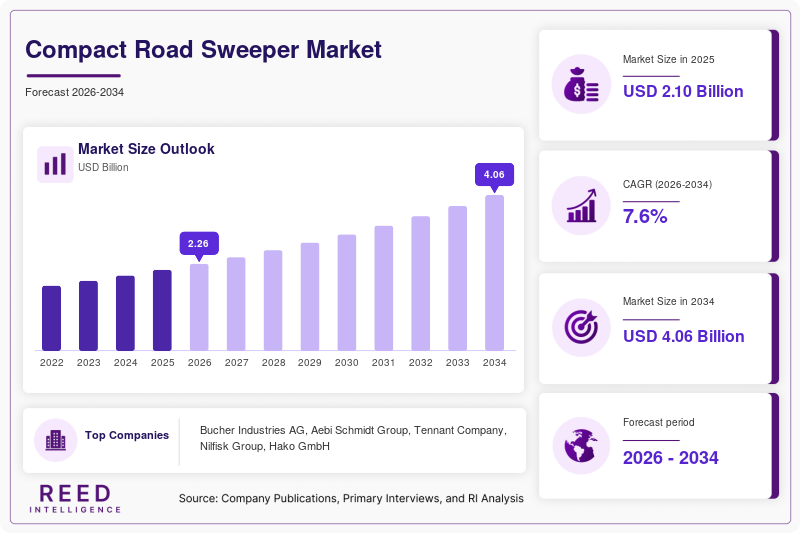
The Compact Road Sweeper Market size was valued at approximately USD 2.1 billion in 2026 and is projected to reach around USD 3.8 billion by 2034, expanding at a CAGR of 7.6% during the forecast period (2026–2034). The market continues to evolve due to increasing urbanization, growing emphasis on environmental hygiene, and rising investments in smart city infrastructure. Municipal authorities and private contractors are increasingly adopting compact road sweepers due to their ability to efficiently clean narrow streets, pedestrian pathways, and densely populated urban zones where traditional sweeping vehicles are less effective.
A key global factor supporting market growth is the expansion of smart city initiatives across both developed and developing economies. Governments are investing in urban cleanliness, air quality control, and efficient waste management systems. Compact road sweepers play a crucial role in reducing particulate matter and maintaining cleanliness standards, particularly in cities with high traffic density. Additionally, advancements in electric and hybrid compact sweepers are aligning with sustainability goals, further boosting adoption.
Key Highlights
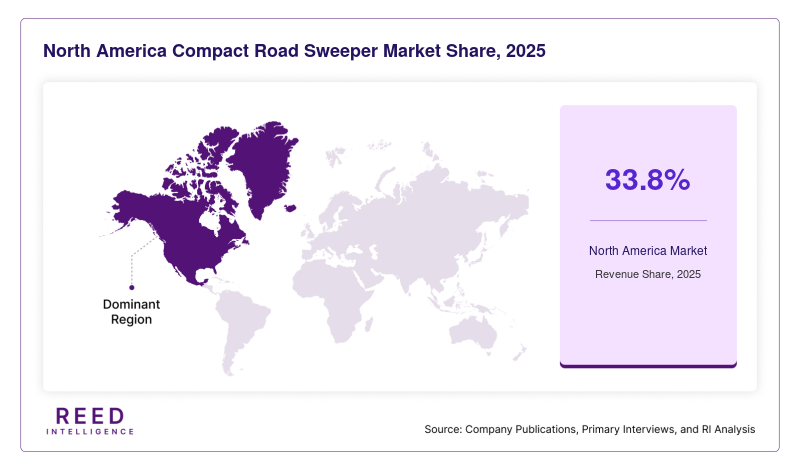
- North America dominated the market with a 33.8% share in 2025.
- Asia Pacific is expected to grow at the fastest CAGR of 9.4% during 2026–2034.
- By product type, vacuum sweepers accounted for the largest share of 42.6%, while electric compact sweepers are projected to grow at a CAGR of 10.8%.
- By application, municipal cleaning led with a 48.9% share, whereas industrial facility cleaning is expected to expand at a CAGR of 9.7%.
- The United States remained the dominant country, with market values of USD 520 million in 2024 and USD 565 million in 2025.
Market Trends
Rising Adoption of Electric and Hybrid Sweepers
The transition toward electric and hybrid compact road sweepers is becoming a notable trend in the market. Increasing environmental regulations and emission reduction targets are encouraging municipalities and private operators to replace conventional diesel-powered sweepers with low-emission alternatives. Electric compact sweepers offer quieter operation, lower maintenance costs, and reduced carbon footprints, making them suitable for urban environments, residential areas, and nighttime operations. Battery technology improvements have also enhanced operational efficiency and runtime, addressing earlier limitations related to charging cycles and performance.
In addition, government incentives and subsidies for electric vehicles are accelerating adoption across regions such as Europe and Asia Pacific. Manufacturers are focusing on integrating advanced battery systems and energy-efficient motors to improve performance. The growing availability of charging infrastructure further supports this trend, making electric compact road sweepers a viable long-term solution for sustainable urban cleaning operations.
Integration of Smart Technologies and IoT
The integration of smart technologies and IoT capabilities into compact road sweepers is transforming operational efficiency and maintenance practices. Modern sweepers are increasingly equipped with sensors, GPS tracking systems, and telematics platforms that enable real-time monitoring of performance, route optimization, and predictive maintenance. These features help reduce downtime, improve resource allocation, and enhance productivity for municipal operators and service providers.
Furthermore, data analytics derived from connected sweepers allows authorities to make informed decisions regarding cleaning schedules and resource deployment. The adoption of automation and semi-autonomous features is also gaining traction, particularly in developed regions. This trend aligns with the broader digital transformation in urban infrastructure, where smart equipment contributes to efficient city management and improved service delivery.
Market Drivers
Growing Urbanization and Infrastructure Development
Rapid urbanization and infrastructure expansion are key drivers of the compact road sweeper market. As cities grow, the demand for efficient street cleaning solutions increases significantly. Compact road sweepers are particularly suited for urban environments with narrow streets, congested areas, and high pedestrian traffic. Governments are investing heavily in road construction, urban redevelopment, and transportation networks, which in turn increases the need for regular cleaning and maintenance.
Moreover, the rise in population density leads to higher waste generation, making it essential to adopt effective cleaning technologies. Compact sweepers help maintain hygiene standards and reduce environmental pollution caused by dust and debris. Their ability to operate in confined spaces provides a distinct advantage over larger machines, making them a preferred choice for municipalities and private contractors.
Increasing Focus on Environmental Sustainability
Environmental sustainability is another major driver influencing the growth of the compact road sweeper market. Rising concerns about air pollution and particulate matter emissions have prompted governments to implement strict regulations regarding urban cleanliness and emission control. Compact road sweepers play a vital role in reducing dust levels and improving air quality, particularly in high-traffic areas.
Additionally, the shift toward eco-friendly equipment, including electric and hybrid sweepers, supports sustainability goals. Manufacturers are investing in innovative technologies that minimize energy consumption and emissions while maintaining high cleaning efficiency. The increasing adoption of green cleaning solutions across industries further contributes to market growth, as organizations seek to align with environmental standards and corporate sustainability objectives.
Market Restraint
High Initial Investment and Maintenance Costs
One of the primary restraints affecting the compact road sweeper market is the high initial investment required for purchasing advanced equipment. Modern compact sweepers equipped with electric powertrains, smart technologies, and automation features often come at a premium price. This can be a significant barrier for small municipalities and contractors with limited budgets, particularly in developing regions.
In addition to the initial cost, maintenance and operational expenses can also be relatively high, especially for technologically advanced models. The need for skilled personnel to operate and maintain these machines further adds to the overall cost burden. For example, electric sweepers require specialized battery maintenance and charging infrastructure, which may not be readily available in all regions. These factors can slow down adoption rates and limit market growth, particularly in cost-sensitive markets.
Market Opportunities
Expansion in Emerging Economies
Emerging economies present significant growth opportunities for the compact road sweeper market. Rapid urbanization, increasing government spending on infrastructure, and growing awareness of environmental hygiene are driving demand in regions such as Asia Pacific, Latin America, and parts of Africa. Governments in these regions are focusing on improving urban cleanliness and waste management systems, creating a favorable environment for market expansion.
Additionally, the development of smart cities and modernization of municipal services are further boosting demand for compact road sweepers. Manufacturers are increasingly targeting these markets by offering cost-effective and customized solutions tailored to local requirements. The availability of financing options and public-private partnerships also supports market penetration in emerging economies.
Technological Advancements and Product Innovation
Technological advancements and continuous product innovation offer substantial opportunities for market growth. Manufacturers are investing in research and development to introduce advanced features such as autonomous operation, enhanced filtration systems, and improved energy efficiency. These innovations not only improve performance but also reduce operational costs, making compact sweepers more attractive to end users.
Furthermore, the integration of artificial intelligence and machine learning into cleaning equipment is expected to revolutionize the industry. Automated route planning, obstacle detection, and real-time decision-making capabilities can significantly enhance efficiency and productivity. As technology continues to evolve, the adoption of advanced compact road sweepers is likely to increase, creating new growth avenues for market players.
Segmental Analysis
By Product Type
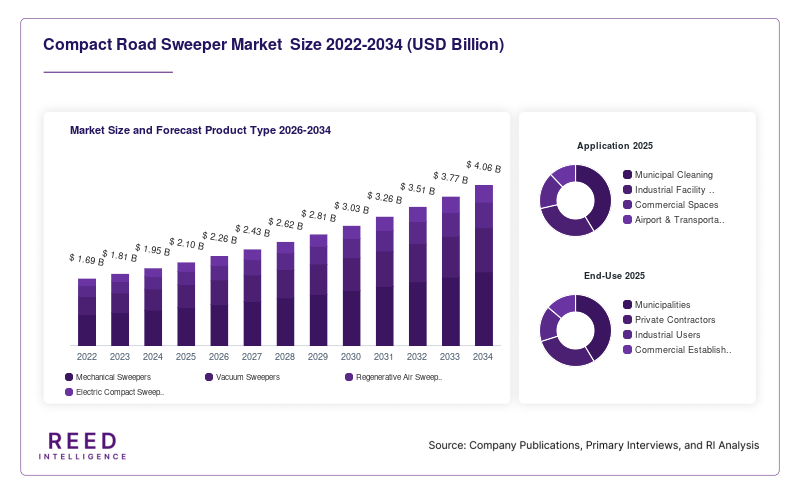
Vacuum sweepers dominated the compact road sweeper market in 2024, accounting for approximately 42.6% of the total market share. These sweepers are widely used due to their high efficiency in removing fine dust, debris, and particulate matter from urban streets and industrial areas. Their ability to provide thorough cleaning and improve air quality makes them a preferred choice for municipalities and contractors. Additionally, advancements in filtration systems and suction technology have enhanced their performance, making them suitable for various applications.
Electric compact sweepers are expected to be the fastest-growing subsegment, with a projected CAGR of 10.8% during the forecast period. The growth is driven by increasing environmental regulations and the need for sustainable cleaning solutions. Electric sweepers offer reduced noise levels and zero emissions, making them ideal for urban environments. The availability of government incentives and advancements in battery technology further support the growth of this subsegment.
By Application
Municipal cleaning emerged as the dominant application segment in 2024, holding a market share of 48.9%. The segment is driven by the increasing need for maintaining cleanliness in public spaces, roads, and urban areas. Municipal authorities are investing in advanced cleaning equipment to improve hygiene standards and reduce environmental pollution. Compact road sweepers are particularly effective in urban environments, where space constraints and high traffic require efficient cleaning solutions.
Industrial facility cleaning is expected to be the fastest-growing application segment, with a CAGR of 9.7% during the forecast period. The growth is attributed to the increasing adoption of compact sweepers in manufacturing plants, warehouses, and logistics centers. These facilities require regular cleaning to maintain operational efficiency and comply with safety standards. The ability of compact sweepers to operate in confined spaces and provide efficient cleaning drives their adoption in industrial applications.
By End-Use
Municipalities dominated the end-use segment in 2024, accounting for a significant share of the market. The segment is driven by increasing government investments in urban infrastructure and public services. Municipal authorities are focusing on improving cleanliness standards and reducing environmental pollution, which drives the demand for compact road sweepers. The adoption of advanced technologies and smart solutions further enhances the efficiency of municipal cleaning operations.
Private contractors are expected to be the fastest-growing end-use segment, with a projected CAGR of 8.9% during the forecast period. The growth is driven by the increasing outsourcing of cleaning services by municipalities and commercial establishments. Private contractors are investing in advanced equipment to improve service quality and operational efficiency. The rising demand for professional cleaning services in commercial and industrial sectors further supports the growth of this segment.
Regional Analysis
North America
North America accounted for a significant share of the compact road sweeper market, holding approximately 33.8% in 2025. The region is expected to grow at a steady CAGR of 6.9% during the forecast period. Strong investments in urban infrastructure, coupled with stringent environmental regulations, are driving demand for advanced cleaning equipment. The presence of established manufacturers and early adoption of innovative technologies further contribute to market growth.
The United States dominates the regional market due to its well-developed municipal infrastructure and high adoption of smart city initiatives. A unique growth factor in this region is the increasing emphasis on reducing urban air pollution through efficient street cleaning practices. Government funding for sustainable urban development also supports the adoption of electric and hybrid compact sweepers.
Europe
Europe held a substantial share of the compact road sweeper market in 2025, supported by strict environmental policies and high standards of urban cleanliness. The region is projected to grow at a CAGR of 7.2% during the forecast period. Countries across Europe are focusing on reducing carbon emissions and promoting sustainable transportation and cleaning solutions, which boosts demand for eco-friendly sweepers.
Germany emerges as the dominant country in this region due to its strong industrial base and focus on technological innovation. A unique growth factor is the widespread adoption of electric compact sweepers driven by stringent emission norms and government incentives. The presence of leading manufacturers and advanced infrastructure further enhances market growth in Europe.
Asia Pacific
Asia Pacific is expected to be the fastest-growing region, with a projected CAGR of 9.4% during 2026–2034. The region accounted for a considerable market share in 2025, driven by rapid urbanization and increasing investments in infrastructure development. Growing population density and rising waste generation are key factors contributing to the demand for compact road sweepers.
China leads the regional market due to its large-scale urban development projects and focus on improving environmental conditions. A unique growth factor is the implementation of smart city initiatives across major cities, which drives the adoption of advanced cleaning technologies. Government support and increasing awareness of environmental sustainability further boost market growth.
Middle East & Africa
The Middle East & Africa region is witnessing gradual growth in the compact road sweeper market, with a projected CAGR of 6.5% during the forecast period. The market is driven by increasing investments in urban infrastructure and tourism development, particularly in the Middle East. The need for maintaining cleanliness in public spaces and commercial areas is contributing to market expansion.
The United Arab Emirates is the dominant country in this region, supported by its focus on smart city development and high standards of urban cleanliness. A unique growth factor is the increasing use of advanced cleaning equipment in tourism-centric cities, where maintaining aesthetic appeal is essential. Government initiatives and infrastructure projects further support market growth.
Latin America
Latin America accounted for a moderate share of the compact road sweeper market in 2025 and is expected to grow at a CAGR of 7.0% during the forecast period. The region is experiencing steady growth due to increasing urbanization and government efforts to improve municipal services. The demand for efficient cleaning solutions is rising in major cities.
Brazil dominates the regional market due to its large urban population and ongoing infrastructure development projects. A unique growth factor is the increasing adoption of compact sweepers for maintaining cleanliness in densely populated urban areas. Government initiatives to improve waste management systems also contribute to market growth in Latin America.
Competitive Landscape
The compact road sweeper market is moderately fragmented, with several global and regional players competing based on product innovation, pricing strategies, and technological advancements. Leading companies are focusing on expanding their product portfolios and enhancing their presence in emerging markets. Strategic partnerships, mergers, and acquisitions are common strategies adopted by market players to strengthen their market position.
Bucher Industries AG is considered a leading player in the market, known for its advanced product offerings and strong global presence. The company has recently introduced electric compact sweepers with improved battery performance and efficiency, catering to the growing demand for sustainable solutions. Other key players are also investing in research and development to introduce innovative products and gain a competitive edge.
Key Players
- Bucher Industries AG
- Aebi Schmidt Group
- Tennant Company
- Nilfisk Group
- Hako GmbH
- Fayat Group
- Boschung Group
- Dulevo International S.p.A.
- Zoomlion Environmental Industry Co., Ltd.
- Elgin Sweeper Company
- Schwarze Industries
- Global Environmental Products
- TYMCO, Inc.
- FAUN Umwelttechnik GmbH
- Alfred Kärcher SE & Co. KG
Recent Developments
- A leading manufacturer introduced a new range of electric compact road sweepers with extended battery life and enhanced efficiency for urban applications.
- A major company expanded its production facility in Asia Pacific to meet the growing demand for compact sweepers in emerging markets.
- A global player launched a smart compact sweeper equipped with IoT-based monitoring systems for real-time performance tracking and predictive maintenance.
Compact Road Sweeper Market Segments
Product Type
- Mechanical Sweepers
- Vacuum Sweepers
- Regenerative Air Sweepers
- Electric Compact Sweepers
Application
- Municipal Cleaning
- Industrial Facility Cleaning
- Commercial Spaces
- Airport & Transportation Hubs
End-Use
- Municipalities
- Private Contractors
- Industrial Users
- Commercial Establishments
By Region
- North America
- Europe
- APAC
- Middle East and Africa
- LATAM