Complex Regional Pain Syndrome Therapeutic Market Size, Share & Demand Report By Drug Class (Analgesics, Corticosteroids, Antidepressants, Anticonvulsants, Biologics), By Route of Administration (Oral, Injectable, Topical), By Treatment Type (Pharmacological, Non-Pharmacological), By End-User (Hospitals, Specialty Clinics, Rehabilitation Centers), By Region & Segment Forecasts, 2026–2034
USD 3950
Market Overview
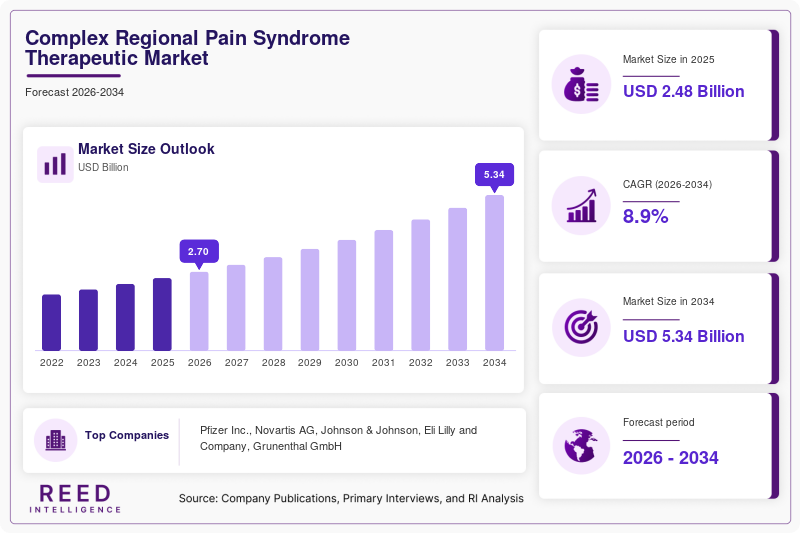
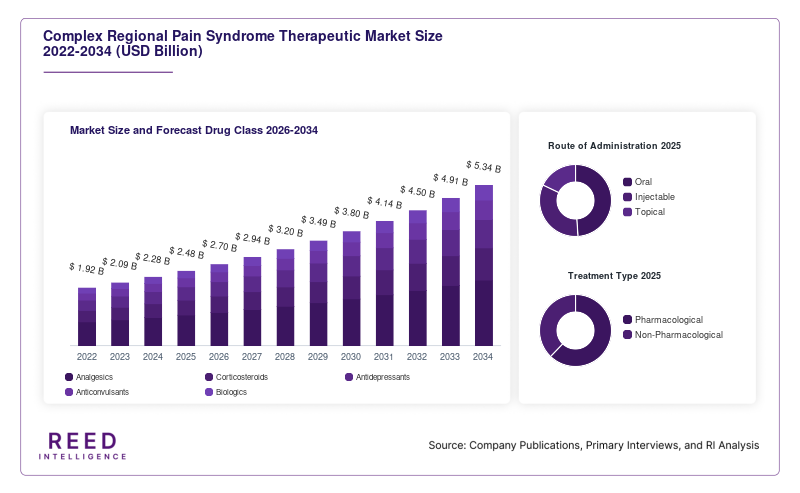
The Complex Regional Pain Syndrome Therapeutic Market size was valued at USD 2.48 billion in 2026 and is projected to reach USD 4.91 billion by 2034, expanding at a CAGR of 8.9% during the forecast period (2026–2034). The market growth is primarily supported by the rising global burden of chronic pain disorders and increased clinical awareness of neuropathic pain conditions, including complex regional pain syndrome (CRPS).
A key global factor driving market expansion has been the growing emphasis on pain management as a critical healthcare priority, supported by evolving reimbursement frameworks and multidisciplinary treatment approaches. Healthcare systems worldwide are increasingly integrating pharmacological and non-pharmacological therapies, which has strengthened demand for CRPS therapeutics.
Key Highlights
- North America dominated the market with a 42.6% share in 2025, while Asia Pacific is expected to register the fastest CAGR of 10.8% (2026–2034).
- In drug class segmentation, analgesics dominated with 38.4% share in 2025, while biologics are projected to grow fastest at a CAGR of 11.5%.
- By route of administration, oral therapies led with 54.2% share in 2025, whereas injectable therapies are expected to grow at a CAGR of 10.2%.
- The United States remained the dominant country, with market values of USD 890 million in 2024 and USD 950 million in 2025, driven by advanced healthcare infrastructure and high diagnosis rates.
Market Trends
Rising Adoption of Multimodal Pain Management Approaches
The market is witnessing a shift toward multimodal treatment strategies combining pharmacological therapies with physical rehabilitation and neuromodulation techniques. This integrated approach improves patient outcomes and reduces long-term dependency on opioids. Healthcare providers are increasingly prescribing combination therapies, boosting demand across multiple therapeutic classes within the Complex Regional Pain Syndrome Therapeutic Market.
Advancements in Neuromodulation and Targeted Therapies
Technological advancements in spinal cord stimulation and targeted drug delivery systems are reshaping treatment paradigms. These innovations offer enhanced precision and reduced side effects, leading to increased adoption among patients with severe or refractory CRPS. As a result, the market outlook reflects growing investment in advanced therapeutic technologies.
Market Drivers
Increasing Prevalence of Neuropathic Pain Disorders
The rising incidence of neuropathic pain conditions globally has significantly contributed to market growth. Factors such as aging populations, increased trauma cases, and post-surgical complications have led to higher CRPS diagnosis rates. This trend continues to expand the patient pool requiring long-term therapeutic interventions.
Expansion of Clinical Research and Drug Development
Ongoing research initiatives aimed at understanding CRPS pathophysiology have accelerated drug development activities. Pharmaceutical companies are investing in innovative treatment options, including immunomodulators and biologics. This has enhanced the availability of diverse therapeutic solutions, driving overall market expansion.
Market Restraint
Limited Awareness and Delayed Diagnosis
A major challenge in the Complex Regional Pain Syndrome Therapeutic Market is the limited awareness among healthcare providers and patients, leading to delayed diagnosis. CRPS symptoms often overlap with other conditions, resulting in misdiagnosis and delayed treatment initiation, which restrains market growth.
Market Opportunities
Emergence of Personalized Medicine Approaches
Personalized treatment strategies based on genetic profiling and patient-specific factors are creating new growth opportunities. These approaches enable targeted therapy selection, improving treatment efficacy and patient satisfaction.
Growth in Emerging Healthcare Markets
Developing regions are witnessing improvements in healthcare infrastructure and access to advanced therapies. This expansion provides significant opportunities for market players to introduce cost-effective CRPS treatment solutions and expand their global footprint.
Segmental Analysis
By Drug Class
Analgesics dominated the market with a 38.4% share in 2025, driven by their widespread use in initial CRPS treatment. These medications remain the first line of therapy due to their accessibility and effectiveness in pain relief.
Biologics are expected to register the fastest CAGR of 11.5%, supported by their ability to target underlying inflammatory pathways. Their growing adoption is driven by improved clinical outcomes in severe cases.
By Route of Administration
Oral therapies held the largest share of 54.2% in 2025, owing to ease of administration and patient compliance. These therapies are commonly prescribed for long-term management.
Injectable therapies are projected to grow at a CAGR of 10.2%, driven by their rapid onset of action and effectiveness in acute pain scenarios. Increasing use of targeted injections is boosting segment growth.
By Treatment Type
Pharmacological treatments dominated with a 62.7% share in 2025, reflecting widespread reliance on medications for symptom management.
Non-pharmacological therapies are anticipated to grow at a CAGR of 10.6%, supported by increasing adoption of physical therapy and neuromodulation techniques. These approaches offer complementary benefits and reduce drug dependency.
By End-User
Hospitals accounted for 48.9% share in 2025, driven by availability of specialized pain management units and advanced treatment options.
Specialty clinics are expected to grow at a CAGR of 9.8%, as patients increasingly seek targeted and personalized care in dedicated facilities.
Regional Analysis
North America
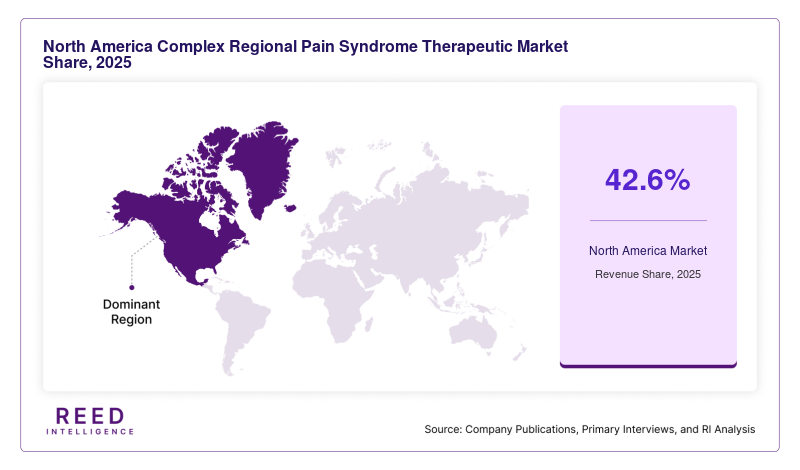
North America accounted for 42.6% of the Complex Regional Pain Syndrome Therapeutic Market share in 2025 and is expected to grow at a CAGR of 8.2% during the forecast period. The United States dominated the region due to advanced diagnostic capabilities and high healthcare expenditure. The presence of specialized pain management centers contributed significantly to regional growth.
Europe
Europe held 27.3% market share in 2025 and is projected to expand at a CAGR of 8.5% (2026–2034). Germany emerged as the leading country, driven by strong reimbursement policies and increased adoption of innovative therapies. The region benefits from structured healthcare systems and growing research collaborations.
Asia Pacific
Asia Pacific represented 18.9% share in 2025 and is anticipated to grow at the fastest CAGR of 10.8%. China dominated the regional market, supported by rapid healthcare infrastructure development and increasing awareness of chronic pain management. Rising patient populations and improving access to treatment are key growth factors.
Middle East & Africa
The Middle East & Africa held 6.2% market share in 2025 and is expected to grow at a CAGR of 7.6%. The United Arab Emirates led regional growth due to investments in advanced healthcare facilities and increasing medical tourism. Awareness campaigns have also contributed to improved diagnosis rates.
Latin America
Latin America accounted for 5.0% share in 2025 and is forecast to grow at a CAGR of 7.9%. Brazil dominated the region owing to expanding healthcare coverage and increasing demand for pain management therapies. Government initiatives aimed at improving access to treatment further supported market growth.
Competitive Landscape
The Complex Regional Pain Syndrome Therapeutic Market is moderately fragmented, with key players focusing on product innovation and strategic collaborations. Leading companies are investing in research and development to expand their therapeutic portfolios and strengthen market presence.
Pfizer Inc. remains a market leader due to its extensive range of pain management therapies and strong global distribution network. The company recently introduced an advanced formulation aimed at improving treatment efficacy and patient adherence.
Other prominent players such as Novartis AG, Eli Lilly and Company, and Johnson & Johnson are actively engaged in developing novel therapeutics targeting neuropathic pain pathways. Meanwhile, companies like Grunenthal GmbH focus on specialized pain management solutions, enhancing their competitive positioning.
Strategic partnerships, mergers, and acquisitions are common in the market, enabling companies to leverage technological advancements and expand into emerging regions. The competitive environment continues to evolve with increasing emphasis on personalized medicine and innovative treatment approaches.
Key Players List
- Pfizer Inc.
- Novartis AG
- Johnson & Johnson
- Eli Lilly and Company
- Grunenthal GmbH
- Teva Pharmaceutical Industries Ltd.
- Abbott Laboratories
- GlaxoSmithKline plc
- Sanofi S.A.
- Bayer AG
- Merck & Co., Inc.
- AstraZeneca plc
- Endo International plc
- Mallinckrodt Pharmaceuticals
- Boston Scientific Corporation
Recent Developments
- In 2025, a major pharmaceutical company launched a novel biologic therapy targeting inflammatory pathways associated with CRPS.
- In 2024, a leading medical device firm introduced an advanced spinal cord stimulation system designed for chronic pain management.
- In 2025, strategic collaborations between research institutions and pharmaceutical companies accelerated clinical trials for innovative CRPS therapies.
- In 2024, several companies expanded their presence in Asia Pacific through distribution partnerships and product launches.
- In 2025, advancements in digital health technologies enabled remote monitoring and improved patient adherence to treatment plans.
Complex Regional Pain Syndrome Therapeutic Market Segments
Drug Class
- Analgesics
- Corticosteroids
- Antidepressants
- Anticonvulsants
- Biologics
Route of Administration
- Oral
- Injectable
- Topical
Treatment Type
- Pharmacological
- Non-Pharmacological
End-User
- Hospitals
- Specialty Clinics
- Rehabilitation Centers
By Region
- North America
- Europe
- APAC
- Middle East and Africa
- LATAM