Compliance Software Market Size, Share & Trends Analysis Report By Component (Software, Services), By Application (Regulatory Compliance, Risk Management, Audit & Reporting, Data Privacy & Security Compliance, Others), By Deployment (Cloud, On-Premises) and By Region (North America, Europe, Asia Pacific, Latin America, Middle East & Africa) Forecasts, 2026–2034
USD 3950
Compliance Software Market Size
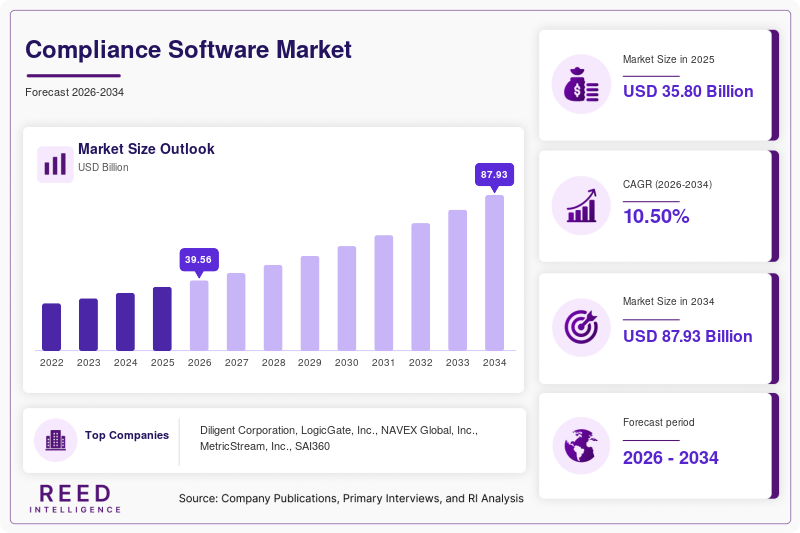
The global compliance software market was valued at USD 35.80 billion in 2025 and is projected to grow from USD 39.30 billion in 2026 to USD 78.90 billion by 2034, registering a CAGR of 10.50% during the forecast period from 2026 to 2034.
The compliance software market is increasingly organized around continuous compliance rather than periodic compliance exercises. Traditional approaches often depended on spreadsheets, manual evidence collection, email-based approvals and periodic audits. Modern platforms centralize regulatory requirements, policies, controls, assessments, evidence and reporting, allowing compliance teams to maintain a more persistent view of control effectiveness.
Regulatory complexity is one of the strongest mechanisms changing purchasing behavior. Organizations operating across multiple jurisdictions must monitor overlapping obligations and demonstrate that internal controls remain effective as requirements change. This is particularly relevant to financial services, healthcare, technology, manufacturing and other highly regulated industries. The resulting workload makes workflow automation and centralized regulatory intelligence increasingly relevant to compliance teams.
Compliance Software Market Drivers
Regulatory Complexity Is Increasing the Need for Continuous Compliance Monitoring
Organizations increasingly operate under multiple regulatory frameworks covering privacy, cybersecurity, financial reporting, financial crime, workplace requirements, sustainability and operational resilience. The overlap between these requirements increases the amount of evidence, documentation and control testing that compliance teams must maintain.
PwC's 2025 global compliance research shows that organizations already use technology extensively across compliance activities, including training, risk assessment, transaction monitoring, customer due diligence and regulatory reporting. The survey also found that 82% of companies planned to invest more in at least one technology to automate or optimize compliance activities.
The market mechanism is straightforward: as regulatory obligations multiply, manually maintaining control libraries and evidence becomes more resource-intensive. Compliance software converts these activities into workflows that can assign owners, establish deadlines, track evidence and generate audit trails.
The counterbalance is that software cannot independently determine every regulatory interpretation. Organizations still require legal, compliance and risk professionals to validate policies and determine how regulatory requirements apply to specific business activities.
AI Is Turning Compliance Platforms Into Active Workflow Systems
AI is changing compliance software from a repository and workflow tool into a system capable of analyzing large volumes of regulatory, operational and risk information. This can reduce the time required to identify relevant requirements, summarize evidence and prioritize risk issues.
Gartner's 2026 risk, compliance and audit research identifies a broad range of automation technologies while emphasizing the importance of evaluating AI maturity and ROI. KPMG's 2026 Global Chief Ethics and Compliance Officer Survey found that 68% of surveyed CCOs had a mixed-to-positive view of AI use, while 50% reported AI use for compliance risk assessment and management.
The commercial impact is strongest where AI can connect unstructured information with existing controls and workflows. Instead of simply generating summaries, AI-enabled compliance platforms can help identify missing evidence, classify obligations and prioritize activities for human review.
Accuracy and explainability remain counterbalances. Compliance decisions can carry legal and financial consequences, so enterprises generally require traceability, human review and documented reasoning before allowing AI-generated outputs to influence material decisions.
Cloud Deployment Is Changing the Economics of Compliance Technology
Cloud-based compliance software allows organizations to centralize regulatory content, workflows, evidence and reporting without maintaining equivalent on-premises infrastructure. This is particularly relevant to organizations operating across multiple locations and jurisdictions.
Cloud deployment also enables vendors to release regulatory updates and platform improvements centrally. Customers can therefore receive new workflows, integrations and analytical capabilities without undertaking traditional software upgrade projects.
The model supports subscription-based purchasing and makes compliance technology more accessible to organizations that do not want to build large internal software infrastructure. It also supports integrations with cloud ERP, HR, cybersecurity and identity systems.
The counterbalance is data governance. Compliance information can contain sensitive employee, customer, financial and operational data, making security, residency, access control and vendor risk assessment important components of enterprise purchasing decisions.
Compliance Software Market Restraints
Integration Complexity Can Delay Enterprise Compliance Software Deployment
Compliance software rarely operates independently. Effective automation requires connections with enterprise systems that contain the underlying evidence, including ERP, HR, financial, cybersecurity, identity and operational platforms.
The integration burden becomes larger when organizations operate multiple business units or have acquired companies with different technology environments. Data mapping, control rationalization and workflow redesign can extend implementation timelines.
For this reason, enterprises may adopt compliance software incrementally, beginning with a specific regulatory program or risk function before expanding across the organization. Forrester's 2026 GRC research notes that many platforms still face challenges involving manual data entry, workflow automation, complexity and cost.
AI Governance and Data Quality Requirements Limit Fully Automated Compliance
AI-enabled compliance requires reliable source data, clearly defined controls and governance around model outputs. Poor-quality data can generate incomplete risk assessments or incorrect classifications, while opaque AI decisions can create difficulties during internal or regulatory reviews.
The growing regulatory focus on AI governance increases this challenge. Gartner estimated that fragmented AI regulation could extend across 75% of the world's economies by 2030 and projected AI-governance compliance spending to exceed USD 1 billion by that year.
As a result, enterprises need compliance platforms that provide auditability, permissions, validation and human oversight rather than simply adding generative AI interfaces to existing workflows.
Compliance Software Market Opportunities
AI Governance Is Creating a New Compliance Software Category
The expansion of AI regulation is creating a new compliance workload around AI inventories, risk classification, model governance, transparency, documentation and ongoing monitoring. This extends compliance software beyond conventional corporate controls.
Gartner's 2026 research estimates AI-governance spending at USD 492 million in 2026, with spending projected to exceed USD 1 billion by 2030 as organizations respond to expanding AI regulation.
This creates an opportunity for established GRC vendors to extend existing platforms into AI governance. Companies can potentially manage AI risks alongside privacy, cybersecurity, third-party risk and enterprise controls instead of operating separate governance systems.
The adoption barrier is regulatory fragmentation. Requirements differ across jurisdictions and continue to evolve, making regulatory content, policy interpretation and update mechanisms important differentiators.
Product Compliance and Supply-Chain Regulation Are Expanding the Addressable Customer Base
Manufacturers increasingly need to track product composition, supplier information, sustainability attributes and regulatory obligations throughout product lifecycles. Digital Product Passport requirements and expanding product-stewardship rules are creating new compliance data requirements.
Assent's July 2026 acquisition of IPOINT demonstrates this expansion. The combination brought together AI-powered product compliance, lifecycle assessment and product intelligence capabilities intended to help manufacturers and distributors prepare for Digital Product Passports and evolving regulatory requirements.
The opportunity extends compliance software into manufacturing, automotive, electronics and other product-intensive industries. The primary adoption requirement is high-quality product and supplier data, because automated compliance reporting depends on accurate information from multiple tiers of the supply chain.
Compliance Software Market Segmental Analysis
By Component
Software Is Largest Because Compliance Workflows Are Moving Into Integrated Platforms
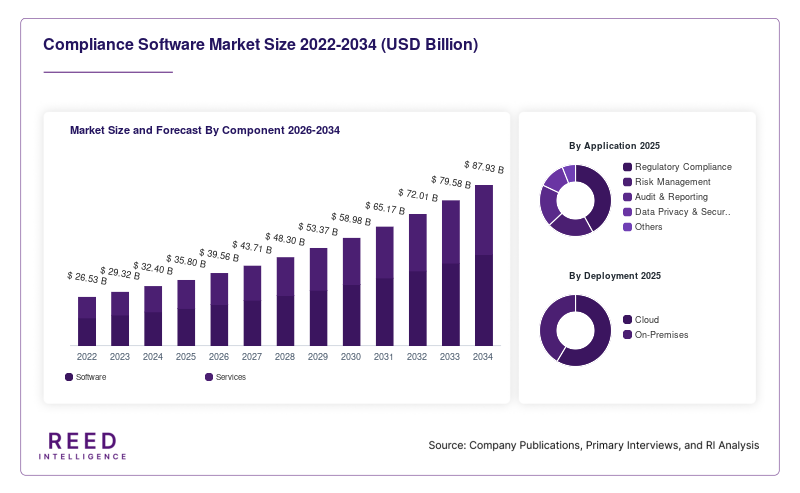
Software accounted for an estimated 74.0% share in 2026, making it the dominant component. Compliance software provides the core infrastructure for regulatory tracking, control management, risk assessments, evidence collection, audit workflows, reporting and monitoring.
The segment benefits from enterprises replacing disconnected spreadsheets and manually maintained compliance repositories with centralized platforms. Integration with ERP, HR, cybersecurity and financial systems further increases the value of software because compliance evidence can be drawn directly from operational systems.
Cloud delivery is also strengthening the software component by reducing infrastructure requirements and enabling vendors to update regulatory content and functionality centrally.
Services remain important because implementation, integration, consulting, managed compliance and training are frequently required before organizations can obtain value from the software. Services account for an estimated 26.0% share and are projected to grow at 9.1% CAGR, while Software is estimated to expand at 11.0% CAGR.
Services Are Expanding Through Implementation and Managed Compliance Requirements
Services are projected to grow at a CAGR of 9.1% during 2026–2034. Compliance software frequently requires configuration around an organization's regulatory obligations, control structure, risk taxonomy and reporting requirements.
Implementation providers can connect compliance platforms with enterprise applications and translate existing manual procedures into digital workflows. Managed services can further extend adoption among organizations without sufficient internal compliance technology expertise.
The services segment is nevertheless constrained by the increasing automation of routine compliance activities. As platforms become more configurable and AI-assisted, certain implementation and recurring manual activities can require fewer labor hours.
By Application
Regulatory Compliance Is Largest Because Regulatory Obligations Remain the Core Software Use Case
Regulatory Compliance accounted for an estimated 31.0% share in 2026, making it the largest application segment. Organizations use compliance platforms to maintain regulatory requirements, map obligations to controls, assign responsibilities, collect evidence and demonstrate compliance during audits or regulatory reviews.
The application benefits from the continuing expansion of regulatory requirements across sectors. Privacy, cybersecurity, operational resilience, financial reporting and AI governance all require organizations to document how obligations translate into internal controls.
Risk Management represents another major use case because compliance data increasingly overlaps with enterprise risk programs. Audit and Reporting applications similarly benefit from centralized evidence and automated reporting.
Regulatory Compliance is estimated to grow at 11.2% CAGR, while Risk Management accounts for an estimated 24.0% share and grows at 10.8% CAGR. Audit & Reporting represents approximately 18.0% share with a 9.7% CAGR, while Data Privacy & Security Compliance accounts for 17.0% share with a 12.0% CAGR.
Data Privacy & Security Compliance Is Expanding Faster as Digital Regulation Intensifies
Data Privacy & Security Compliance is estimated to be the fastest-growing application, with a CAGR of 12.0% during the forecast period. Organizations increasingly need to connect privacy obligations with cybersecurity controls, data inventories, access management and incident processes.
The convergence of privacy and cybersecurity regulation creates demand for software capable of maintaining evidence across multiple control frameworks. The IAPP's 2026 RegTech research highlights the growing overlap between privacy, AI governance, cybersecurity and digital responsibility requirements.
The segment's growth is also supported by AI adoption because organizations need visibility into how sensitive data is used by AI applications and models. Others account for an estimated 10.0% share and grow at 8.4% CAGR, while the broader Regulatory Compliance category remains the largest application.
By Deployment
Cloud Deployment Is Largest Because Compliance Requires Continuous Regulatory Updates
Cloud deployment accounted for an estimated 68.0% share in 2026, making it the dominant deployment model. Cloud platforms allow compliance vendors to update regulatory content, workflows, security capabilities and integrations without requiring customers to maintain equivalent infrastructure.
Cloud delivery also supports geographically distributed organizations that need centralized compliance policies across multiple business units and jurisdictions. This makes the model particularly suitable for multinational enterprises managing overlapping regulatory obligations.
The model is reinforced by the growing use of SaaS applications and cloud infrastructure. Compliance software can integrate directly with these environments, reducing the need to manually transfer evidence between systems.
Cloud deployment is estimated to grow at 12.1% CAGR, while On-Premises represents approximately 32.0% share and grows at 6.8% CAGR. On-premises deployments remain relevant where organizations have strict data-residency, security or legacy-infrastructure requirements.
Cloud Deployment Is Expanding Faster Through SaaS-Based Compliance Automation
Cloud deployment is projected to grow at a CAGR of 12.1%, reflecting increasing preference for subscription-based platforms and centralized compliance operations.
The growth mechanism extends beyond infrastructure savings. Cloud architecture allows compliance vendors to introduce AI capabilities, regulatory updates and integrations centrally, while customers can expand functionality without replacing physical infrastructure.
However, cloud deployment must address security and sovereignty requirements. Enterprises handling highly sensitive financial, healthcare, government or employee information may require specific geographic processing controls and detailed vendor-risk assessments.
Compliance Software Market Regional Analysis
North America Compliance Software Market
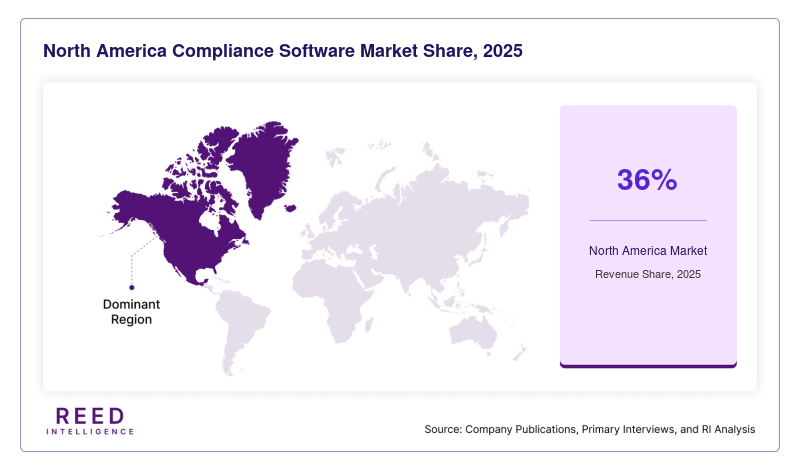
North America is the dominant regional market, accounting for an estimated 36.0% share in 2026. The region benefits from mature enterprise software adoption, extensive regulatory requirements, established GRC providers and strong investment in cybersecurity, privacy and risk management.
The United States represents the largest demand center because financial services, healthcare, technology, government contractors and other industries operate under complex compliance frameworks. Organizations also increasingly need to manage AI governance alongside existing privacy, cybersecurity and enterprise-risk programs.
The region's competitive environment includes established GRC vendors as well as cybersecurity companies expanding into compliance. Diligent, LogicGate, SAI360 and other providers are adding AI-driven capabilities, indicating that compliance platforms are increasingly competing on workflow intelligence rather than documentation alone.
North America's principal constraint is enterprise complexity. Large organizations often have multiple legacy compliance tools, creating integration and data-standardization requirements before a centralized platform can provide organization-wide visibility.
Europe Compliance Software Market
Europe is projected to register a CAGR of 9.8% during 2026–2034. Demand is supported by extensive privacy, cybersecurity, operational-resilience, sustainability and financial regulations across the European Union and individual jurisdictions.
The regulatory environment creates demand for software that can map obligations to controls and maintain evidence continuously. Organizations operating across Europe also need to track differences between EU-wide requirements and country-specific obligations.
AI governance is becoming an additional compliance workload. As AI-related requirements develop, enterprises increasingly require systems capable of maintaining inventories, risk classifications and documentation.
The primary constraint is regulatory fragmentation across sectors and countries. Vendors therefore need comprehensive regulatory content and localization capabilities rather than a single standardized compliance workflow.
Asia Pacific Compliance Software Market
Asia Pacific is projected to be the fastest-growing regional market, with a CAGR of 12.4%. Adoption is supported by digital transformation, expanding financial and technology sectors, cloud migration and increasing regulatory requirements around data protection and cybersecurity.
China, Japan, India, South Korea, Singapore and Australia represent important demand centers, although their compliance requirements differ considerably. Multinational enterprises operating across these markets require centralized systems capable of mapping local obligations to global control frameworks.
The region also presents an opportunity for cloud-native compliance vendors because newer digital businesses can adopt SaaS-based platforms without maintaining large legacy compliance infrastructures.
The principal challenge is regulatory diversity and uneven enterprise technology maturity. Local regulatory content and implementation services therefore remain important to adoption.
Middle East & Africa Compliance Software Market
Middle East & Africa is projected to grow at a CAGR of 11.3% through 2034. Digital-government programs, financial-sector modernization, cybersecurity investment and expansion of regulated industries are creating additional demand for automated compliance management.
Gulf economies are increasingly developing sophisticated digital infrastructure and regulatory frameworks, supporting demand for GRC, data-security and risk-management software.
Financial institutions represent a particularly relevant customer group because compliance processes involve regulatory reporting, customer due diligence, transaction monitoring and risk assessment.
Adoption remains constrained by differences in regulatory maturity, enterprise software penetration and specialist compliance resources. Cloud deployment and managed compliance services can reduce the operational burden for organizations building digital compliance capabilities.
Latin America Compliance Software Market
Latin America is projected to register a CAGR of 10.7% during 2026–2034. Demand is supported by financial-sector regulation, digital banking, data-protection requirements, cybersecurity programs and increasing adoption of cloud enterprise software.
Brazil and Mexico represent major enterprise technology markets, while regional and multinational organizations increasingly require centralized compliance systems that can accommodate different national requirements.
The strongest adoption mechanism is the digitization of previously manual regulatory workflows. Organizations can use software to maintain evidence, automate approvals and standardize reporting across business units.
The main constraint is uneven technology maturity among organizations. This creates opportunities for cloud-based and managed compliance solutions that require less internal infrastructure and specialized personnel.
Competitive Landscape
The compliance software market is moderately fragmented across large enterprise software providers, dedicated GRC vendors, RegTech companies, cybersecurity providers and specialized compliance platforms. Competitive differentiation increasingly centers on workflow automation, regulatory intelligence, AI capabilities, integrations and the breadth of risk and compliance functions covered.
Diligent is a major GRC platform provider with capabilities spanning governance, risk, audit, compliance and board management. Its 2026 product development has focused heavily on agentic AI, including AI agents embedded across Diligent One and AI-powered cyber-risk management. These developments indicate a strategic shift toward using AI to connect risk information with action and executive oversight.
Key Market Players
- Diligent Corporation
- LogicGate, Inc.
- NAVEX Global, Inc.
- MetricStream, Inc.
- SAI360
- SAP SE
- ServiceNow, Inc.
- IBM Corporation
- OneTrust Technology Limited
- Thomson Reuters Corporation
- ComplyAdvantage
- Assent Inc.
- VComply
- RSA Security LLC
- Wolters Kluwer N.V.
Recent Market Developments
September 2026- Diligent announced new agentic capabilities in Diligent One designed to connect fragmented GRC information, surface relevant issues and accelerate execution while retaining human governance and professional judgment. The development strengthens the role of AI within enterprise compliance and risk workflows.
July 2026- Assent completed its acquisition of IPOINT, combining AI, product-compliance data and lifecycle expertise. The transaction expands capabilities around product intelligence, product stewardship and Digital Product Passport requirements, strengthening compliance software coverage across manufacturing and supply-chain applications.
Compliance Software Market Segments
By Component
- Software
- Services
By Application
- Regulatory Compliance
- Risk Management
- Audit & Reporting
- Data Privacy & Security Compliance
- Others
By Deployment
- Cloud
- On-Premises
By Region
- North America
- Europe
- APAC
- Middle East and Africa
- LATAM