Compliance Training Market Size, Share & Trends Analysis Report By Training Type (Regulatory Compliance, Ethics & Code of Conduct, Data Privacy & Cybersecurity, Workplace Safety & Health, Financial Compliance), By Delivery Mode (Online, Instructor-Led, Blended), By Enterprise Size (Large Enterprises, SMEs), By Industry (BFSI, Healthcare, IT & Telecom, Manufacturing, Retail & Consumer Goods, Government), and By Region (North America, Europe, Asia-Pacific, Middle East and Africa, Latin America) Fo
USD 3950
Compliance Training Market Size
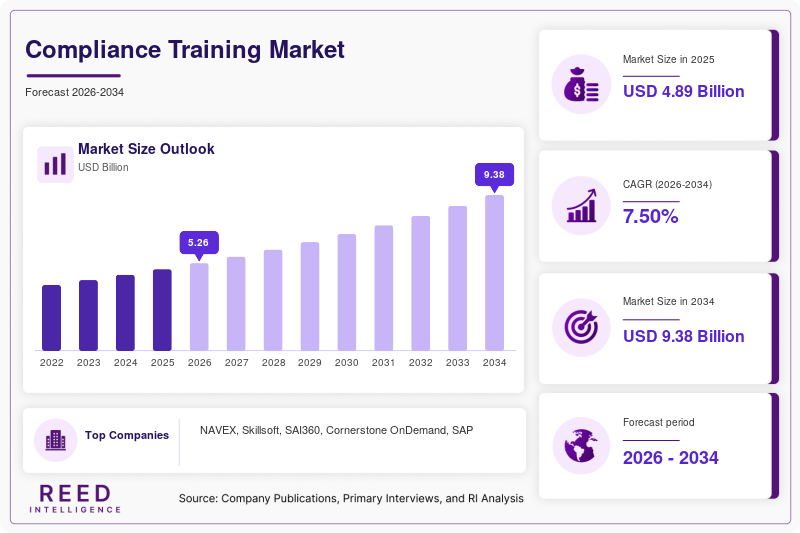
The compliance training market was valued at USD 4.89 billion in 2025 and is projected to grow from USD 5.26 billion in 2026 to USD 9.16 billion by 2034, registering a CAGR of 7.50% during the forecast period from 2026 to 2034.
Compliance training is shifting from periodic, standardized courses toward more continuous, role-specific learning linked to regulatory obligations, employee responsibilities and measurable risk. The change is visible in financial services, where the FCA requires firms to assess employee competence, identify training needs, provide appropriate training and periodically review its effectiveness.
Regulatory requirements also create recurring demand. OSHA states that numerous workplace-safety standards explicitly require employers to train employees, while certain OSHA standards treat failure to provide required training to each affected employee as a separate compliance duty.
Compliance Training Market Drivers
Expanding Regulatory Requirements Create Recurring Training Obligations
The regulatory environment increasingly requires organizations to demonstrate that employees possess appropriate knowledge, competence and awareness rather than simply maintain written policies. The FCA, for example, requires regulated firms to maintain employee competence and regularly review training needs, while its insurance rules include continuing professional development requirements for certain personnel.
This creates a recurring purchasing mechanism because regulatory changes, employee turnover, role changes and periodic competence reviews require organizations to update and redistribute training. OSHA similarly identifies numerous standards requiring employee training on workplace hazards and related matters.
The strongest demand therefore comes from regulated industries such as BFSI, healthcare, manufacturing and other safety-sensitive operations. The counterbalance is that organizations may consolidate vendors and favor platforms that combine training with compliance monitoring, reporting and broader GRC functions.
New Digital Regulations Are Expanding the Addressable Training Content
New technology-related regulation is creating compliance topics that did not previously occupy a major position in corporate training programs. The EU AI Act's AI-literacy requirement, applicable from February 2025, requires providers and deployers to take measures to support AI literacy among relevant employees and other people working with AI systems.
The mechanism is broader than a single new course category. Organizations deploying AI must increasingly educate employees about appropriate use, risks and organizational responsibilities. This can create recurring requirements as AI applications, internal policies and regulatory interpretations change.
The opportunity is particularly relevant to IT, professional services, financial institutions, healthcare and other knowledge-intensive industries. Adoption may nevertheless vary because the AI Act's AI-literacy obligation does not prescribe a single standardized training curriculum or identical competency level for every worker.
Digital Delivery Makes Frequent, Role-Specific Training More Practical
Online and blended compliance training allow organizations to distribute updated content across geographically dispersed workforces while maintaining completion records. Skillsoft's Compliance Suite illustrates the movement toward risk-based personalization, with dynamic content intended to tailor training to employee roles, locations, responsibilities and regulations.
The market mechanism is lower friction in updating and administering training. Instead of assigning identical annual courses to every employee, organizations can increasingly match content to specific responsibilities and regulatory exposure.
SAI360 has similarly expanded learner-performance analytics and offline learning options for deskless workers, demonstrating demand for delivery models that accommodate different employee environments.
The limitation is that digital delivery does not automatically establish effective compliance behavior. Regulators such as the FCA emphasize assessing competence and training effectiveness rather than merely recording course completion.
Compliance Training Market Restraints
Training Fatigue Can Reduce the Effectiveness of Mandatory Programs
Employees may receive multiple mandatory courses covering overlapping regulatory and organizational topics. The FCA specifically notes that effective training should be relevant to the employee's role and has indicated that interactive, realistic scenarios are preferable to simple computer-based training with little tailoring.
The commercial consequence is that buyers increasingly need platforms capable of reducing repetitive content while maintaining defensible records. Providers offering only large libraries of standardized courses can face pressure when customers prioritize relevance and completion quality.
The constraint can be reduced through microlearning, adaptive content, role-based assignment and scenario-driven training. However, personalization requires more sophisticated content management and regulatory mapping.
Regulatory Fragmentation Raises Content Maintenance Costs
Compliance requirements differ by jurisdiction, industry, employee role and regulatory framework. The FCA's training and competence requirements, for example, contain specific requirements for different financial activities, while OSHA requirements vary according to workplace hazards and applicable standards.
For training providers, this creates a continuous content-maintenance requirement. Courses must be reviewed when laws, regulations or organizational requirements change.
For enterprise buyers, the challenge is ensuring that the correct employees receive the correct version of training. Vendors therefore increasingly compete on regulatory content management, automated updates, localization and integration with compliance systems.
Compliance Training Market Opportunities
Risk-Based Training Can Shift Spending From Course Completion Toward Measurable Compliance Outcomes
A specific opportunity is the integration of employee risk profiles, regulatory requirements and learning systems. Skillsoft's Compliance Suite uses role, location, management responsibilities and applicable regulations to support more targeted training programs.
The commercial opportunity arises because large organizations need to demonstrate not only that employees completed courses but that training addresses relevant risk. Platforms that connect training assignments with employee roles and compliance requirements can reduce unnecessary training while improving audit evidence.
The strongest opportunity lies in multinational organizations managing different regulations across jurisdictions. Adoption may be constrained by fragmented HR, LMS and GRC infrastructure, requiring stronger integrations before organizations can fully automate risk-based assignment.
Compliance Training for AI Governance Creates a New Training Category
AI adoption is creating demand for workforce education around responsible AI use, governance and organizational policies. The European Commission states that AI literacy is an obligation under Article 4 of the AI Act for providers and deployers of AI systems.
This creates a new market opportunity because AI-related compliance extends beyond technical teams. Employees using AI systems may require training appropriate to their role, technical knowledge, experience and the context in which the system is deployed.
Training providers can therefore develop role-specific AI governance modules for employees, managers, developers, compliance teams and executives. The limitation is that requirements differ according to the AI system and organization, making generic AI-awareness courses less sufficient for higher-risk applications.
Training Type Analysis
By Training Type
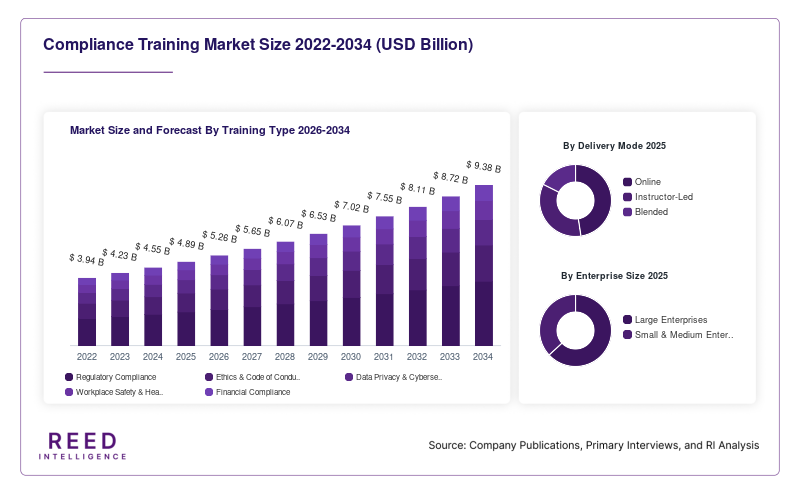
Regulatory Compliance accounts for approximately 29% of the global market in 2025. Demand is supported by requirements that employees maintain knowledge and competence relevant to their roles. The FCA, for example, requires regulated firms to assess competence, identify training needs and review competence regularly.
Data Privacy & Cybersecurity accounts for approximately 22% and is projected to grow at approximately 9.10% CAGR, making it the fastest-growing training type. The segment benefits from the expansion of data governance and digital-risk obligations and the increasing number of employees who interact with sensitive information and digital systems.
Workplace Safety & Health represents approximately 21% and is projected to grow at approximately 6.90% CAGR, supported by mandatory training requirements under workplace-safety regulations.
Ethics & Code of Conduct represents approximately 17% and is projected to grow at approximately 7.30% CAGR, while Financial Compliance represents approximately 11% and is projected to grow at approximately 7.80% CAGR, supported by regulated financial activities and continuing competence requirements.
Delivery Mode Analysis
By Delivery Mode
Online compliance training accounts for approximately 54% of the market in 2025. Digital delivery allows organizations to distribute mandatory courses across multiple locations while maintaining completion records and updating content without physically assembling employees.
Blended training accounts for approximately 27% and is projected to grow at approximately 8.40% CAGR, making it the fastest-growing delivery mode. The model combines digital modules with instructor-led or scenario-based activities, addressing the limitation of purely self-paced learning for subjects requiring discussion, judgment or behavioral practice.
Instructor-led training accounts for approximately 19% and is projected to grow at approximately 5.80% CAGR. It remains relevant for complex regulatory subjects, leadership-level training and environments where practical discussion is important.
Enterprise Size Analysis
By Enterprise Size
Large Enterprises Represent the Largest Customer Group Because Regulatory Complexity Increases With Workforce and Geographic Scale
Large enterprises account for approximately 68% of the market in 2025. Multinational and highly regulated organizations must manage training across multiple employee groups, locations and regulatory regimes. The FCA's requirements to assess and maintain competence illustrate why regulated enterprises need ongoing processes rather than one-time training.
SMEs account for approximately 32% and are projected to grow at approximately 8.60% CAGR. Increasing availability of cloud-based compliance platforms lowers the infrastructure burden associated with deploying training programs.
SME adoption is particularly relevant where organizations face regulatory requirements without having dedicated compliance-learning teams. However, limited training budgets and preference for bundled HR or LMS solutions can constrain specialized compliance-training purchases.
Industry Analysis
By Industry
BFSI Holds the Largest Industry Share Because Employee Competence Is Closely Linked to Regulatory Compliance
BFSI accounts for approximately 27% of the 2025 market. Financial institutions operate under extensive requirements covering employee competence, conduct, consumer protection, financial products and risk management. The FCA requires relevant firms to maintain employee competence and provide appropriate training, while specific activities can carry qualification requirements.
Healthcare accounts for approximately 19% and is projected to grow at approximately 8.50% CAGR, making it the fastest-growing industry segment. Healthcare organizations must train employees around privacy, safety, ethics and role-specific regulatory requirements, creating multiple recurring training categories.
IT & Telecom represents approximately 17% and is projected to grow at approximately 8.30% CAGR, supported by cybersecurity, data governance and emerging AI-related compliance requirements.
Manufacturing accounts for approximately 15% and is projected to grow at approximately 6.80% CAGR, with workplace safety representing an important recurring training requirement. OSHA identifies numerous standards that explicitly require worker training.
Retail & Consumer Goods represents approximately 12% and is projected to grow at approximately 6.90% CAGR, while Government and Other Industries account for approximately 10% collectively and are projected to grow at approximately 7.20% CAGR.
Compliance Training Market Regional Analysis
North America Holds the Largest Regional Share Through Established Corporate Compliance Infrastructure
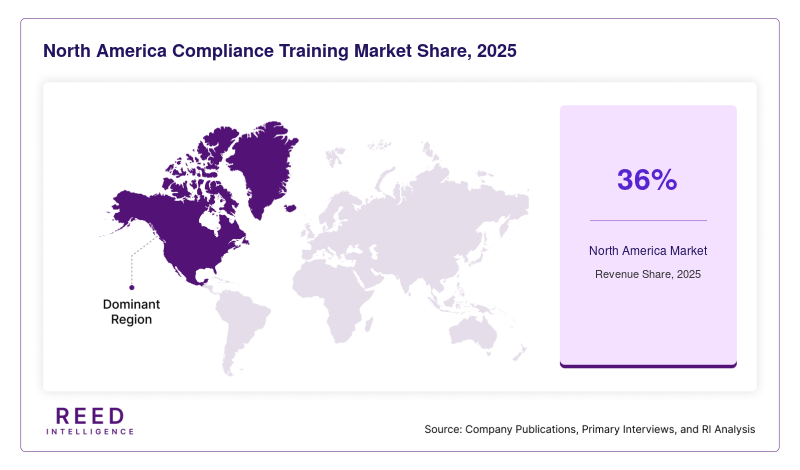
North America accounts for approximately 36% of the global compliance training market in 2025 and is projected to grow at approximately 6.90% CAGR through 2034.
The region benefits from established compliance programs across financial services, healthcare, manufacturing, technology and other regulated industries. In the U.S., OSHA explicitly identifies numerous standards requiring employee training, creating recurring demand for safety-related compliance education.
The market is also supported by the maturity of corporate learning platforms and the use of digital systems to track employee completion. Demand is shifting toward role-based learning and integration with broader governance and risk systems rather than standalone annual courses.
Large enterprises are important buyers because they must coordinate training across dispersed workforces and multiple business units. North American providers therefore compete through content breadth, integrations, analytics and automation.
The main constraint is vendor consolidation. Organizations with established LMS, HR and GRC systems may prefer integrated compliance functionality rather than purchasing multiple standalone platforms.
Europe Maintains a Significant Market as Regulatory Complexity Supports Continuous Compliance Learning
Europe accounts for approximately 29% of the market in 2025 and is projected to grow at approximately 7.40% CAGR through 2034.
The region's compliance-training demand is supported by financial-services competence requirements, workplace regulations, privacy obligations and newer technology regulation. The EU AI Act's AI-literacy requirement became applicable in February 2025, adding AI governance to the set of workforce-learning considerations for organizations deploying or providing AI systems.
Financial services provide a particularly structured training environment. The FCA requires regulated firms to assess and maintain employee competence and consider changes in regulation and legislation when maintaining competence.
European organizations also face multilingual and multi-jurisdictional requirements, increasing the value of localized content and centralized compliance management.
The principal constraint is regulatory fragmentation across countries and sectors, which increases the cost of maintaining accurate localized content.
Asia-Pacific Is the Fastest-Growing Region as Enterprise Digitization Broadens Compliance Training Adoption
Asia-Pacific accounts for approximately 22% of the 2025 market and is projected to grow at approximately 9.10% CAGR through 2034, making it the fastest-growing region.
The region's growth mechanism is the expansion of formal corporate compliance systems as organizations digitize operations and participate in global supply chains. Large employers increasingly need standardized training programs that can reach distributed workforces.
Demand spans workplace safety, cybersecurity, data privacy, ethics and industry-specific regulatory requirements. Online delivery is particularly relevant because it enables companies to train employees across geographically dispersed facilities without relying entirely on physical classroom programs.
Japan, China, India, South Korea, Australia and Southeast Asian economies represent important demand centers, although regulatory structures differ substantially across these markets.
The main constraints are varying levels of digital infrastructure, differences in compliance maturity and localization requirements. Providers that can combine multilingual content with centralized reporting have greater scope to serve multinational enterprises.
Middle East and Africa Expand Through Formalization of Corporate Governance and Workforce Training
Middle East and Africa account for approximately 7% of the market in 2025 and are projected to grow at approximately 7.90% CAGR through 2034.
Demand is associated with financial-services regulation, workplace safety, governance requirements and the expansion of digitally enabled corporate operations.
Large organizations operating across energy, construction, financial services, healthcare and government-related activities require structured workforce training. Digital delivery can also reduce the logistical cost of reaching employees distributed across multiple sites.
The opportunity is strongest where organizations are developing formal compliance frameworks and need centralized evidence of employee training.
Constraints include uneven digital infrastructure, differences in regulatory maturity and budget limitations among smaller organizations. These factors can make cloud-based and mobile-accessible solutions more relevant than complex on-premise deployments.
Latin America Develops as Cloud-Based Learning Reduces the Cost of Compliance Program Deployment
Latin America accounts for approximately 6% of the global market in 2025 and is projected to grow at approximately 7.70% CAGR through 2034.
Financial services, healthcare, manufacturing and large consumer-facing companies create demand for training around ethics, data protection, workplace safety and industry-specific obligations.
Cloud-based delivery provides a mechanism for organizations to standardize training across multiple facilities without maintaining extensive local learning infrastructure. Spanish and Portuguese content is important for workforce accessibility.
Multinational companies operating in the region can also use centralized compliance platforms to maintain consistent policies while adapting training to local requirements.
The principal constraints include purchasing budgets, differences in regulatory enforcement and varying levels of enterprise learning-system maturity.
Compliance Training Market Competitive Landscape
The competitive environment combines specialized compliance and ethics platforms, enterprise learning-management providers and broader GRC vendors.
NAVEX operates at the intersection of compliance management and employee learning, with its NAVEX One platform combining ethics, risk and compliance capabilities. In October 2025, Goldman Sachs Alternatives completed the acquisition of a majority stake in NAVEX, with the company stating that the new capitalization would support global expansion and continued innovation of NAVEX One.
Skillsoft competes through a broader corporate-learning portfolio while strengthening compliance specialization. Its Compliance Suite introduced dynamic content that can tailor training according to employee role, location, responsibilities and applicable regulations.
Key Market Players
- NAVEX
- Skillsoft
- SAI360
- Cornerstone OnDemand
- SAP
- Oracle
- LRN
- Thomson Reuters
- KnowBe4
- Udemy Business
Compliance Training Market Recent Developments
- July 2026 – NAVEX launched Nira, an agentic AI capability within NAVEX One. The company described Nira as an intelligent response agent designed for risk and compliance workflows. The development illustrates the movement of compliance platforms toward AI-assisted analysis and workflow automation.
- June 2026 – NAVEX introduced a Workplace Violence Prevention training portfolio. The company positioned the training around evolving regulatory expectations, risk mitigation and audit readiness. The development expands compliance-learning content into a workplace-risk category where regulatory requirements can generate recurring employee training.
Compliance Training Market Segments
By Training Type
- Regulatory Compliance
- Ethics & Code of Conduct
- Data Privacy & Cybersecurity
- Workplace Safety & Health
- Financial Compliance
By Delivery Mode
- Online
- Instructor-Led
- Blended
By Enterprise Size
- Large Enterprises
- Small & Medium Enterprises
By Industry
- BFSI
- Healthcare
- IT & Telecom
- Manufacturing
- Retail & Consumer Goods
- Government
- Other Industries
By Region
- North America
- Europe
- APAC
- Middle East and Africa
- LATAM