Composite Hydrogen Cylinder Market Size, Share & Demand Report By Cylinder Type (Type I, Type II, Type III, Type IV, Type V), By Application (Fuel Cell Vehicles, Stationary Hydrogen Storage, Industrial Gas Transportation, Aerospace Applications, Marine Applications), By End Use (Transportation, Energy and Utilities, Industrial Manufacturing, Aerospace & Defense, Others), By Region & Segment Forecasts, 2026–2034
USD 3950
Market Overview
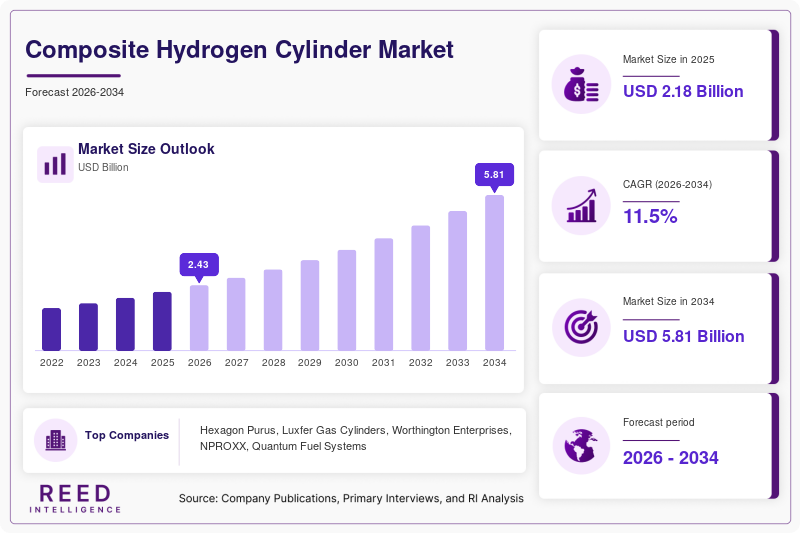
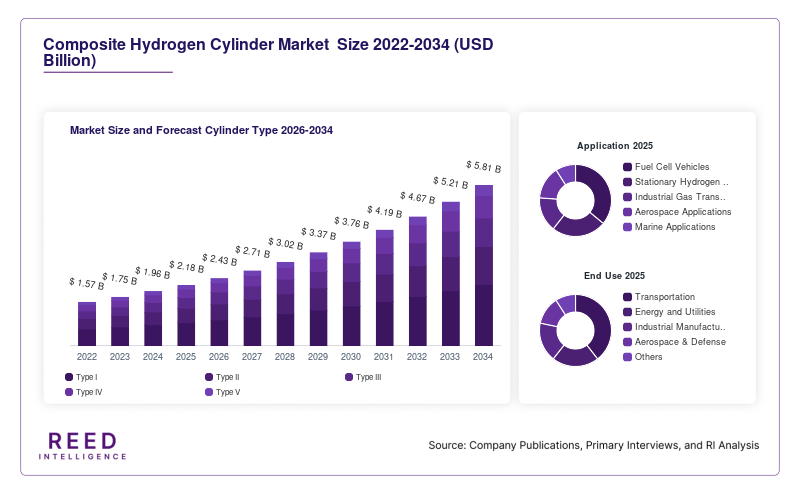
The global Composite Hydrogen Cylinder Market size was valued at approximately USD 2.18 billion in 2026 and is projected to reach USD 5.21 billion by 2034, expanding at a CAGR of 11.5% during 2026–2034. The market is experiencing steady growth due to the increasing adoption of hydrogen as a low-carbon energy carrier across transportation, industrial processing, power generation, and energy storage applications. Composite hydrogen cylinders play a critical role in hydrogen infrastructure by providing lightweight, high-strength, and corrosion-resistant storage solutions capable of handling high-pressure hydrogen environments.
One of the primary global factors supporting market expansion is the acceleration of hydrogen economy initiatives. Governments, energy companies, and transportation operators are investing in hydrogen production, distribution, and fueling infrastructure to reduce carbon emissions and improve energy security. Composite cylinders offer significant weight reduction compared to traditional steel alternatives, enabling higher storage efficiency and enhanced vehicle performance. As fuel cell electric vehicles, hydrogen buses, trucks, trains, and industrial mobility equipment gain adoption, demand for advanced storage systems continues to increase.
Key Highlights
- North America dominated the market with a 36.4% share in 2025, while Asia Pacific is expected to grow at the fastest CAGR of 13.1% during 2026–2034.
- By cylinder type, Type IV composite cylinders accounted for the largest share of 44.8%, while Type V composite cylinders are projected to grow at a CAGR of 14.2%.
- By application, fuel cell vehicles led with a 47.3% share, whereas stationary hydrogen storage systems are expected to expand at a CAGR of 12.9%.
- By end-use, transportation held the largest share of 52.1%, while the energy and utilities sector is projected to grow at a CAGR of 13.5%.
- The United States remained the dominant country, with market values of USD 645 million in 2024 and USD 718 million in 2025.
Market Trends
Expansion of Hydrogen Mobility Infrastructure
A major trend shaping the Composite Hydrogen Cylinder Market is the rapid expansion of hydrogen mobility infrastructure across developed and emerging economies. Governments are supporting hydrogen-powered transportation through incentive programs, fleet deployment targets, and investments in fueling stations. Public transit agencies are increasingly adopting hydrogen buses, while logistics companies are evaluating fuel cell trucks for long-distance freight operations. Composite cylinders are becoming essential components because they enable higher hydrogen storage capacity without significantly increasing vehicle weight. As hydrogen mobility ecosystems mature, demand for advanced storage cylinders is increasing across passenger vehicles, buses, trucks, rail systems, and specialty transport applications. Manufacturers are responding by introducing lighter and more durable cylinder designs that improve vehicle range and operational efficiency.
Development of High-Pressure Storage Technologies
Another important trend involves the advancement of high-pressure hydrogen storage technologies. Industry participants are focusing on cylinders capable of storing hydrogen at pressures of 700 bar and above to maximize storage density. Continuous improvements in carbon fiber reinforcement, polymer liners, and composite winding processes are enhancing performance while maintaining strict safety requirements. The emergence of next-generation Type V cylinders is attracting attention due to their potential to eliminate liners and reduce overall system weight. These innovations are helping manufacturers meet evolving requirements from transportation, aerospace, and industrial sectors. As hydrogen applications become more sophisticated, demand for technologically advanced composite cylinders is expected to increase significantly throughout the forecast period.
Market Drivers
Rising Adoption of Fuel Cell Electric Vehicles
The growing deployment of fuel cell electric vehicles is a major factor driving market growth. Hydrogen-powered vehicles offer long driving ranges, rapid refueling times, and reduced emissions, making them attractive alternatives for commercial transportation. Governments and automotive manufacturers are increasing investments in fuel cell technologies to support decarbonization goals. Composite hydrogen cylinders are critical for these vehicles because they provide lightweight and high-capacity storage solutions capable of handling compressed hydrogen safely. Fleet operators are increasingly adopting hydrogen trucks, buses, and commercial vehicles for heavy-duty transportation where battery-electric alternatives may face range limitations. As vehicle production scales and fueling infrastructure expands, demand for composite hydrogen cylinders is expected to rise steadily across global markets.
Increasing Investments in Hydrogen Energy Projects
Large-scale investments in hydrogen production, storage, and distribution infrastructure are creating substantial demand for composite cylinders. Countries pursuing net-zero emissions targets are allocating funding toward green hydrogen facilities and integrated hydrogen supply chains. Industrial companies are exploring hydrogen as a substitute for fossil fuels in manufacturing processes, power generation, and energy storage systems. Composite cylinders offer practical solutions for transporting and storing hydrogen across various operational environments. Their durability, corrosion resistance, and weight advantages make them suitable for both stationary and mobile applications. As governments continue implementing hydrogen strategies and private sector investments accelerate, the requirement for reliable hydrogen storage technologies is expected to strengthen considerably during the forecast period.
Market Restraint
High Manufacturing Costs and Carbon Fiber Dependency
The Composite Hydrogen Cylinder Market faces challenges associated with high production costs and dependence on carbon fiber materials. Carbon fiber remains one of the most expensive components used in cylinder manufacturing, accounting for a substantial portion of overall product costs. Fluctuations in raw material prices can affect profit margins and limit affordability for end users. In addition, advanced manufacturing processes require specialized equipment, quality control systems, and skilled labor, increasing capital investment requirements for producers. These cost-related barriers can slow adoption in price-sensitive markets where conventional storage alternatives remain available. Small-scale hydrogen projects often struggle to justify premium cylinder investments, particularly during early development stages. Although technological advancements and manufacturing scale are expected to reduce costs over time, pricing challenges continue to influence purchasing decisions and market penetration across several regions.
Market Opportunities
Growth of Renewable Hydrogen Storage Networks
The expansion of renewable hydrogen production presents significant opportunities for market participants. As countries increase investments in wind and solar energy projects, hydrogen is gaining attention as an effective long-term energy storage medium. Composite cylinders can support decentralized hydrogen storage networks by enabling safe transportation and distribution between production facilities and consumption sites. Renewable hydrogen projects often require flexible storage solutions that can operate under varying environmental conditions. Lightweight composite cylinders are well positioned to address these requirements while improving transportation efficiency. Increasing deployment of green hydrogen hubs, industrial clusters, and distributed energy systems is expected to create new revenue opportunities for cylinder manufacturers across both developed and emerging markets.
Emerging Applications in Aerospace and Marine Sectors
New opportunities are emerging from the adoption of hydrogen technologies in aerospace and marine applications. Aircraft developers and maritime operators are evaluating hydrogen as a low-emission fuel alternative capable of supporting sustainability objectives. These sectors require lightweight storage solutions that can maximize fuel capacity while minimizing structural weight. Composite hydrogen cylinders align well with these requirements due to their strength-to-weight advantages and operational reliability. Research programs involving hydrogen-powered ships, ferries, drones, and regional aircraft are progressing in multiple countries. As commercial deployment advances, demand for specialized composite cylinders designed for aerospace and marine environments is expected to increase, creating additional growth avenues for manufacturers and technology developers.
Segmental Analysis
By Cylinder Type
Type IV composite cylinders represented the dominant subsegment, accounting for approximately 44.8% of market share in 2024. These cylinders utilize polymer liners reinforced with carbon fiber composites, providing an effective balance between performance, weight reduction, and cost efficiency. Their widespread adoption across fuel cell vehicles, industrial gas transportation, and stationary storage applications has supported market leadership. Type IV cylinders offer high pressure resistance while significantly reducing system weight compared with traditional metal-based alternatives. Manufacturers continue to enhance production capabilities and certification compliance, further strengthening demand. Growing hydrogen mobility programs and expanding infrastructure investments have also contributed to increasing deployment of Type IV solutions across both mature and developing hydrogen markets.
Type V composite cylinders are expected to be the fastest-growing category, expanding at a CAGR of 14.2% during 2026–2034. These cylinders eliminate conventional liners and rely entirely on composite materials, resulting in substantial weight savings and improved storage efficiency. Their lightweight characteristics make them particularly attractive for aerospace, advanced transportation, and specialized industrial applications. Ongoing research initiatives aimed at improving structural integrity and manufacturing scalability are accelerating commercial interest. As industries seek higher performance hydrogen storage solutions capable of supporting next-generation mobility systems, demand for Type V cylinders is expected to increase significantly. Continued innovation in composite materials and production processes will further strengthen growth opportunities within this segment.
By Application
Fuel cell vehicles emerged as the leading application segment, holding approximately 47.3% market share in 2024. Hydrogen-powered passenger vehicles, buses, trucks, and commercial fleets require high-pressure storage systems capable of delivering reliable performance and safety. Composite cylinders provide an ideal solution due to their lightweight construction and ability to store compressed hydrogen efficiently. Automotive manufacturers are increasing investments in fuel cell platforms to address emissions regulations and sustainability objectives. The expansion of hydrogen refueling networks is also supporting vehicle adoption across multiple regions. These factors have contributed to strong demand for composite hydrogen cylinders within transportation applications, reinforcing the segment's leading market position.
Stationary hydrogen storage systems are projected to register the fastest growth, with a CAGR of 12.9% through 2034. Renewable energy integration, grid balancing requirements, and industrial hydrogen usage are driving adoption of stationary storage infrastructure. Composite cylinders offer flexibility and scalability for energy storage applications, enabling efficient hydrogen management across decentralized and centralized facilities. As green hydrogen projects expand globally, operators require storage solutions that provide durability, safety, and operational efficiency. Increasing deployment of renewable power systems combined with long-duration energy storage requirements is expected to create favorable conditions for accelerated growth in this application segment over the forecast period.
By End Use
The transportation sector accounted for the largest share of approximately 52.1% in 2024, making it the dominant end-use segment. Hydrogen-powered mobility solutions continue to gain traction as governments and industries pursue decarbonization objectives. Composite hydrogen cylinders play a critical role in enabling vehicle performance by reducing weight and maximizing storage capacity. Public transportation fleets, freight operators, and commercial vehicle manufacturers are increasingly incorporating fuel cell technologies into their operations. Growing investments in hydrogen infrastructure and supportive regulatory frameworks are further supporting adoption. These factors have positioned transportation as the largest consumer of composite hydrogen cylinders globally and are expected to sustain strong demand throughout the forecast period.
The energy and utilities sector is anticipated to experience the fastest growth, recording a CAGR of 13.5% during 2026–2034. Utilities and energy developers are increasingly utilizing hydrogen for renewable energy storage, grid stabilization, and power generation applications. Composite cylinders offer practical solutions for storing and transporting hydrogen within energy systems while maintaining operational efficiency. The rise of green hydrogen projects, energy transition initiatives, and distributed power infrastructure is creating substantial opportunities for storage technology providers. As utilities seek reliable methods for balancing intermittent renewable energy production, hydrogen storage is becoming an increasingly important component of future energy systems, supporting rapid growth within this end-use segment.
Regional Analysis
North America
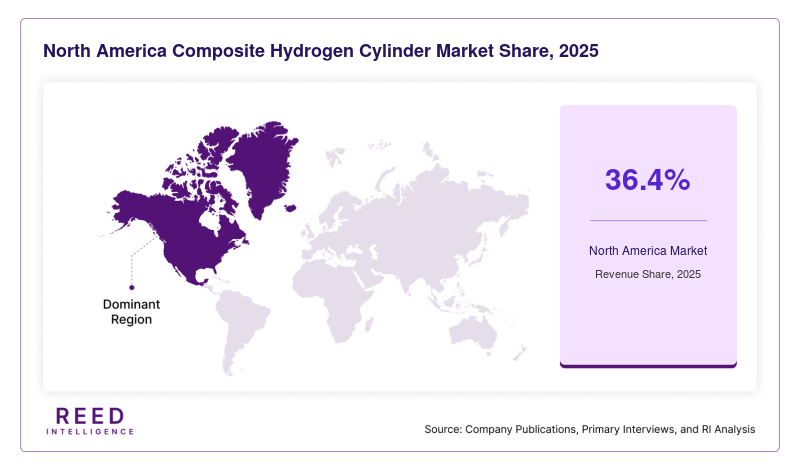
North America accounted for approximately 36.4% of the global Composite Hydrogen Cylinder Market in 2025, making it the largest regional market. The region is projected to expand at a CAGR of 10.8% through 2034, supported by strong hydrogen infrastructure investments and growing adoption of fuel cell transportation. Federal funding programs, clean energy initiatives, and corporate sustainability commitments continue to accelerate hydrogen deployment. Demand for lightweight and high-pressure storage systems is increasing across transportation, industrial, and energy sectors, contributing to stable market growth throughout the forecast period.
The United States remains the dominant country within the region. A key growth factor is the increasing deployment of hydrogen-powered commercial transportation fleets. Logistics operators, public transit agencies, and industrial vehicle manufacturers are investing in fuel cell technologies to reduce emissions while maintaining operational efficiency. These developments are creating substantial demand for composite hydrogen cylinders across multiple end-use industries.
Europe
Europe represented approximately 28.7% of the global market in 2025 and is expected to register a CAGR of 11.3% during the forecast period. The region benefits from ambitious decarbonization policies and comprehensive hydrogen roadmaps established by national governments and regional organizations. Investments in green hydrogen production facilities and hydrogen transportation corridors are supporting demand for advanced storage technologies. Composite cylinders are increasingly being utilized in mobility, industrial, and energy storage applications throughout the European market.
Germany continues to lead regional demand due to its extensive hydrogen strategy and industrial innovation capabilities. A unique growth factor is the integration of hydrogen into manufacturing and heavy industry operations. Steel production facilities, chemical plants, and energy-intensive industries are exploring hydrogen as a cleaner fuel source, generating sustained demand for efficient storage and transportation solutions.
Asia Pacific
Asia Pacific held nearly 24.5% of the global Composite Hydrogen Cylinder Market in 2025 and is forecast to achieve the fastest CAGR of 13.1% through 2034. Rapid industrialization, urbanization, and government support for hydrogen technologies are driving market expansion. Several countries in the region are actively investing in hydrogen-powered transportation, renewable energy storage, and domestic hydrogen production capacity. Increasing adoption of fuel cell vehicles is also contributing to strong growth prospects.
China dominates the regional market owing to its large manufacturing base and aggressive hydrogen deployment plans. A distinct growth factor is the rapid expansion of hydrogen bus and commercial vehicle fleets. National and local government programs supporting clean transportation are encouraging the adoption of hydrogen-powered mobility solutions, creating substantial demand for composite storage cylinders.
Middle East & Africa
The Middle East & Africa accounted for approximately 5.4% of the global market in 2025 and is anticipated to grow at a CAGR of 10.5% during the forecast period. The region is emerging as an important hydrogen production hub due to abundant renewable energy resources and increasing investments in large-scale hydrogen projects. Countries are pursuing export-oriented hydrogen strategies that require advanced storage and transportation infrastructure.
Saudi Arabia remains the leading market within the region. A significant growth factor is the development of large green hydrogen production facilities linked to renewable energy projects. These initiatives are driving demand for hydrogen storage technologies capable of supporting production, transportation, and export operations while maintaining operational safety and efficiency.
Latin America
Latin America captured approximately 5.0% of the global market in 2025 and is expected to expand at a CAGR of 10.1% through 2034. Governments across the region are increasingly exploring hydrogen as part of long-term energy transition strategies. Investments in renewable energy generation and emerging hydrogen projects are supporting gradual market development. Composite cylinders are gaining attention for use in industrial, transportation, and energy storage applications.
Brazil leads the regional market due to its strong renewable energy capacity and growing hydrogen ecosystem. A unique growth factor is the integration of hydrogen production with renewable power generation projects. The country's expanding wind and solar infrastructure provides favorable conditions for green hydrogen development, supporting future demand for advanced composite storage cylinders.
Competitive Landscape
The Composite Hydrogen Cylinder Market is characterized by a combination of established gas containment manufacturers and specialized composite technology providers. Competition is focused on product innovation, cylinder weight reduction, pressure performance, safety certification, and manufacturing scalability. Companies are increasingly investing in advanced carbon fiber technologies and automated production systems to improve cost efficiency and meet rising market demand.
Hexagon Purus is widely recognized as a market leader due to its extensive portfolio of hydrogen storage solutions and strong presence in transportation applications. The company recently expanded production capabilities to support growing demand from fuel cell vehicle manufacturers. Other prominent participants continue to strengthen their market positions through strategic partnerships, product launches, and investments in hydrogen infrastructure projects.
Manufacturers are also pursuing collaborations with automotive companies, energy developers, and industrial gas suppliers to accelerate commercialization of advanced storage technologies. The increasing adoption of hydrogen across multiple sectors is expected to intensify competition and encourage continuous technological innovation throughout the forecast period.
Key Players
- Luxfer Gas Cylinders
- Worthington Enterprises
- NPROXX
- Quantum Fuel Systems
- Faber Industrie
- CIMC Enric
- Toyota Industries Corporation
- ILJIN Hysolus
- Doosan Mobility Innovation
- Plastic Omnium
- Hyundai Rotem
- Beijing Tianhai Industry
- Sinoma Science & Technology
- Everest Kanto Cylinder
- Time Technoplast
Recent Developments
- In 2025, a leading composite pressure vessel manufacturer expanded its carbon fiber cylinder production facility to meet rising demand from hydrogen-powered commercial vehicle and mobility projects.
- In 2025, a major hydrogen storage technology provider launched a next-generation Type V composite hydrogen cylinder designed to reduce system weight and improve storage efficiency for transportation applications.
- In 2024, several fuel cell vehicle manufacturers entered strategic partnerships with composite cylinder suppliers to strengthen hydrogen storage capabilities and support large-scale vehicle deployment programs.
- In 2024, a global industrial gas company expanded its hydrogen distribution infrastructure by integrating advanced composite storage cylinders for transportation and bulk storage operations.
- In 2025, a prominent energy technology company invested in high-pressure hydrogen storage solutions utilizing composite cylinders to support renewable hydrogen production and long-duration energy storage projects.
Composite Hydrogen Cylinder Market Segments
Cylinder Type
- Type I
- Type II
- Type III
- Type IV
- Type V
Application
- Fuel Cell Vehicles
- Stationary Hydrogen Storage
- Industrial Gas Transportation
- Aerospace Applications
- Marine Applications
End Use
- Transportation
- Energy and Utilities
- Industrial Manufacturing
- Aerospace & Defense
- Others
By Region
- North America
- Europe
- APAC
- Middle East and Africa
- LATAM