Concrete Conditioner Market Size, Share & Demand Report By Type (Surface Conditioners, Penetrating Conditioners, Reactive Conditioners), By Material Type (Polymer-Based, Bio-Based, Chemical-Based), By Application (Residential Construction, Commercial Construction, Infrastructure Projects, Industrial Flooring), By End-Use Industry (Construction, Industrial, Transportation, Others), By Region & Segment Forecasts, 2025–2034
USD 3950
Market Overview
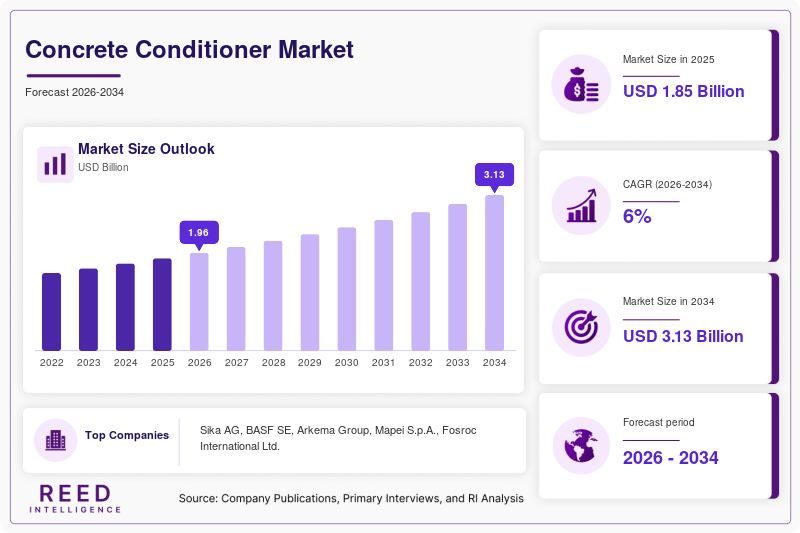
The global Concrete Conditioner Market size was valued at USD 1.85 billion in 2025 and is projected to reach approximately USD 3.12 billion by 2034, expanding at a CAGR of 6.0% during the forecast period (2025–2034). The market growth has been consistently supported by the rising demand for durable and high-performance construction materials across residential, commercial, and industrial infrastructure projects.
A key global factor contributing to market expansion is the increasing emphasis on extending the lifecycle of concrete structures. Governments and private developers are prioritizing maintenance solutions that improve structural integrity, reduce repair costs, and enhance resistance to environmental degradation. Concrete conditioners play a vital role in enhancing surface strength, moisture resistance, and adhesion properties, making them an essential component in modern construction and renovation practices.
Key Highlights:
- North America dominated the market with a 34.2% share, while Asia Pacific is projected to register the fastest CAGR of 7.4% during the forecast period.
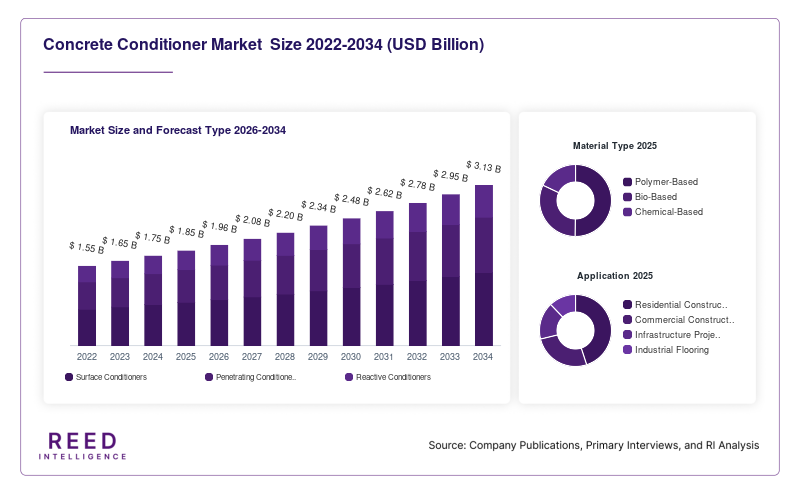
- By type, surface conditioners led with a 41.5% share, while penetrating conditioners are expected to grow fastest at a CAGR of 6.8%.
- By application, residential construction held the largest share, while infrastructure projects are projected to expand at the highest CAGR of 7.1%.
- The U.S. remained the dominant country, with a market value of USD 420 million in 2024, increasing to USD 445 million in 2025.
Market Trends
Shift Toward Eco-Friendly Formulations
The Concrete Conditioner Market is witnessing a transition toward environmentally sustainable products. Manufacturers are increasingly developing low-VOC and water-based conditioners to comply with environmental regulations and meet green building standards. This trend is particularly strong in developed economies where construction projects must adhere to strict sustainability guidelines. As a result, eco-friendly conditioners are gaining traction across residential and commercial applications.
Integration of Advanced Chemical Technologies
Another notable trend is the integration of advanced chemical technologies to enhance product performance. Modern concrete conditioners are being engineered with nanotechnology and polymer-based additives that improve penetration, bonding strength, and durability. These innovations allow conditioners to provide longer-lasting protection against moisture ingress, chemical exposure, and surface wear. The adoption of such high-performance solutions is increasing in infrastructure projects, including bridges, highways, and industrial flooring systems.
Market Drivers
Increasing Infrastructure Development Activities
Rapid infrastructure development across emerging economies is a major driver of the Concrete Conditioner Market. Governments are investing heavily in transportation networks, smart cities, and public utilities, creating strong demand for concrete treatment solutions. Concrete conditioners are widely used to improve the durability and performance of infrastructure assets, making them essential for long-term project sustainability.
Rising Demand for Maintenance and Repair Solutions
The growing need to maintain aging infrastructure is another significant driver. Many existing structures require rehabilitation to extend their service life and ensure safety. Concrete conditioners are used extensively in repair and maintenance applications to restore surface strength and prevent further deterioration. This demand is particularly strong in regions with mature infrastructure, where refurbishment projects are increasing.
Market Restraint
Fluctuations in Raw Material Prices
One of the major restraints affecting the Concrete Conditioner Market is the volatility in raw material prices. The production of concrete conditioners relies on various chemical compounds, including polymers, resins, and additives, which are subject to price fluctuations due to supply chain disruptions and changes in crude oil prices. These variations can increase production costs and impact profit margins for manufacturers.
Additionally, price sensitivity in developing markets may limit the adoption of premium conditioning products. Smaller construction firms often opt for lower-cost alternatives, which may not deliver the same level of performance. This creates a challenge for manufacturers aiming to expand their presence in price-sensitive regions.
Market Opportunities
Growth in Green Building Initiatives
The increasing adoption of green building practices presents a significant opportunity for the Concrete Conditioner Market. Sustainable construction standards are encouraging the use of environmentally friendly materials, including eco-compatible concrete conditioners. Manufacturers that focus on developing biodegradable and low-emission products are likely to gain a competitive edge in this evolving landscape.
Expansion in Emerging Markets
Emerging economies offer substantial growth potential due to rapid urbanization and industrialization. Countries in Asia Pacific, Latin America, and Africa are experiencing a surge in construction activities, creating demand for concrete enhancement solutions. As infrastructure development accelerates in these regions, the adoption of concrete conditioners is expected to increase significantly.
Segmental Analysis
By Type
Surface conditioners dominated the market, accounting for 41.5% of the share in 2024. This dominance had been attributed to their widespread use in enhancing surface adhesion and preparing concrete for coatings and finishes. Their ease of application and cost-effectiveness made them a preferred choice in residential and commercial projects.
Penetrating conditioners are expected to be the fastest-growing subsegment, with a projected CAGR of 6.8%. Their ability to deeply penetrate concrete surfaces and provide long-lasting protection against moisture and chemical damage will drive their adoption in infrastructure and industrial applications.
By Material Type
Polymer-based conditioners held the largest share of 38.7% in 2024. Their superior bonding strength and flexibility made them widely used in various construction applications. These materials had been particularly effective in improving durability and resistance to environmental stress.
Bio-based conditioners are anticipated to grow at the fastest CAGR of 7.2%. Increasing environmental concerns and regulatory pressures will drive the demand for sustainable materials, encouraging the adoption of bio-based solutions.
By Application
Residential construction accounted for the largest share of 35.9% in 2024. The segment’s growth had been driven by increasing housing demand and renovation activities. Concrete conditioners were widely used to enhance the durability and appearance of residential structures.
Infrastructure projects are expected to register the highest CAGR of 7.1%. The need for durable and long-lasting materials in large-scale projects will boost the demand for advanced conditioning solutions.
By End-Use Industry
The construction industry dominated the market with a share of 48.3% in 2024. The extensive use of concrete conditioners in building and infrastructure projects had been a key factor driving this segment.
The industrial sector is projected to grow at a CAGR of 6.7%, driven by increasing demand for durable flooring and protective coatings in manufacturing facilities.
Regional Analysis
North America
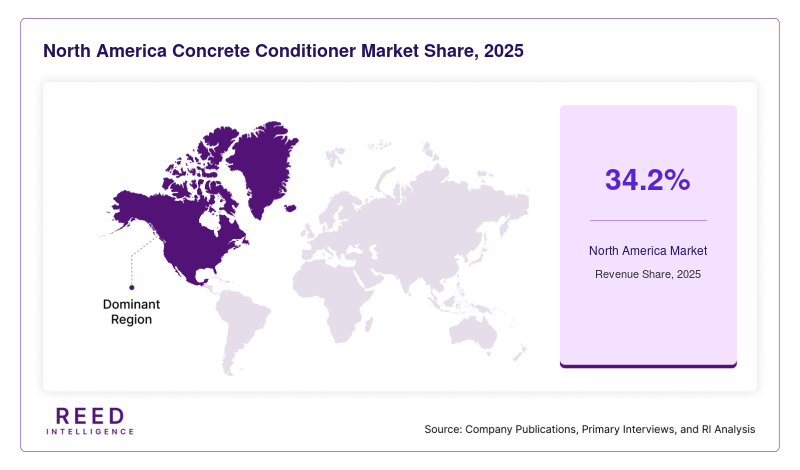
North America accounted for 34.2% of the global Concrete Conditioner Market share in 2025 and is expected to grow at a CAGR of 5.6% during the forecast period. The region’s market had been driven by strong demand for advanced construction materials and a well-established infrastructure sector.
The United States dominated the regional market due to its extensive network of highways, bridges, and commercial buildings requiring regular maintenance. A key growth factor was the increasing focus on infrastructure rehabilitation programs, which drove demand for concrete conditioners to enhance durability and extend structural lifespan.
Europe
Europe held a 26.8% market share in 2025 and is projected to expand at a CAGR of 5.4%. The market had been supported by stringent environmental regulations and a strong emphasis on sustainable construction practices.
Germany emerged as the dominant country, driven by its advanced construction industry and adoption of eco-friendly materials. The country’s focus on energy-efficient buildings and renovation of aging infrastructure contributed significantly to the demand for concrete conditioners.
Asia Pacific
Asia Pacific captured 22.5% of the market share in 2025 and is expected to grow at the fastest CAGR of 7.4%. The region had been characterized by rapid urbanization and large-scale infrastructure projects.
China led the regional market due to massive investments in construction and industrial development. The country’s continuous expansion of transportation networks and urban infrastructure created a strong demand for concrete conditioners, particularly in high-performance applications.
Middle East & Africa
The Middle East & Africa region accounted for 9.1% of the market share in 2025 and is anticipated to grow at a CAGR of 6.2%. The market had been driven by increasing construction activities in the Gulf Cooperation Council countries.
Saudi Arabia dominated the region, supported by large-scale infrastructure and real estate projects. The country’s focus on diversification and urban development initiatives contributed to the rising demand for concrete conditioning solutions.
Latin America
Latin America held a 7.4% share of the Concrete Conditioner Market in 2025 and is projected to grow at a CAGR of 5.9%. The region had been experiencing steady growth due to infrastructure development and urban expansion.
Brazil emerged as the leading country, driven by investments in residential construction and transportation infrastructure. The need for durable and cost-effective construction materials played a key role in driving the adoption of concrete conditioners.
Competitive Landscape
The Concrete Conditioner Market is moderately competitive, with several global and regional players focusing on product innovation and strategic expansion. Companies are investing in research and development to introduce high-performance and environmentally friendly products.
A leading player in the market is Sika AG, which has consistently expanded its product portfolio and strengthened its global presence. The company recently introduced advanced concrete conditioning solutions designed for enhanced durability and sustainability.
Other key players are adopting strategies such as mergers, acquisitions, and partnerships to expand their market reach and improve technological capabilities. The competitive environment is expected to intensify as companies focus on innovation and regional expansion.
Key Players List
- Sika AG
- BASF SE
- Arkema Group
- Mapei S.p.A.
- Fosroc International Ltd.
- RPM International Inc.
- W. R. Meadows, Inc.
- GCP Applied Technologies Inc.
- Evonik Industries AG
- Saint-Gobain Weber
- Pidilite Industries Ltd.
- Kryton International Inc.
- Chryso S.A.S.
- CICO Technologies Ltd.
- Xypex Chemical Corporation
Recent Developments
- In 2024, Sika AG launched a new range of eco-friendly concrete conditioners aimed at reducing environmental impact.
- BASF SE expanded its production capacity to meet growing demand in Asia Pacific.
- Mapei S.p.A. introduced advanced polymer-based conditioners for high-performance applications.
- Fosroc International Ltd. strengthened its distribution network in emerging markets.
- Arkema Group invested in research to develop next-generation sustainable construction chemicals.
Concrete Conditioner Market Segments
Type
- Surface Conditioners
- Penetrating Conditioners
- Reactive Conditioners
Material Type
- Polymer-Based
- Bio-Based
- Chemical-Based
Application
- Residential Construction
- Commercial Construction
- Infrastructure Projects
- Industrial Flooring
End-Use Industry
- Construction
- Industrial
- Transportation
- Others
By Region
- North America
- Europe
- APAC
- Middle East and Africa
- LATAM