Concrete Testers Market Size, Share & Demand Report By Type (Compression Testing Equipment, Non-Destructive Testing Equipment, Flexural Testing Equipment), By Application (Quality Control Laboratories, On-Site Testing, Research Institutions), By End-Use (Construction, Infrastructure Maintenance, Industrial Applications), By Region & Segment Forecasts, 2026–2034
USD 3950
Market Overview
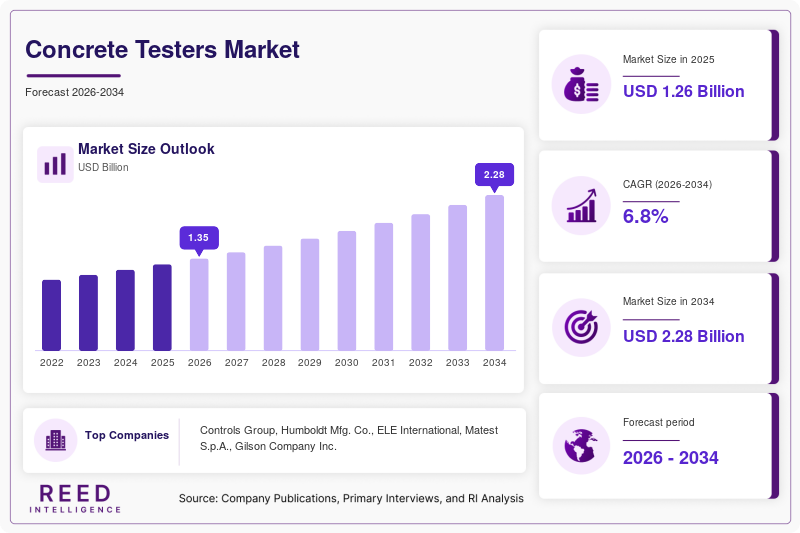
The Concrete Testers Market size is projected to reach a value of approximately USD 1.35 billion in 2026 and is expected to grow to around USD 2.28 billion by 2034, registering a compound annual growth rate (CAGR) of 6.8% during the forecast period (2026–2034). The market expansion is primarily driven by the rising demand for quality assurance and compliance in construction activities worldwide. Increasing infrastructure investments across both developed and emerging economies have intensified the need for accurate material testing, especially in large-scale projects such as highways, bridges, and commercial buildings.
A key global factor supporting market growth is the rapid pace of urbanization, particularly in developing regions. Governments are investing heavily in smart city projects, transportation networks, and sustainable housing, all of which require stringent testing of concrete to ensure durability, safety, and compliance with regulatory standards. The integration of digital technologies into testing equipment has further improved efficiency, enabling real-time data collection and analysis.
Key Highlights
- Asia Pacific accounted for a dominant regional share of 38.6% in 2025 and is projected to grow at the fastest CAGR of 7.5%.
- Compression testing equipment emerged as the leading subsegment under type with a 41.2% share, while non-destructive testing equipment is anticipated to grow at the fastest CAGR of 7.9%. In application, quality control laboratories dominated with a 46.5% share, whereas on-site testing is expected to grow at a CAGR of 7.2%.
- China remained the dominant country, with market values estimated at USD 210 million in 2024 and USD 225 million in 2025.
Market Trends
Integration of Digital and Automated Testing Solutions
The market is witnessing a noticeable shift toward digital and automated concrete testing solutions. Traditional manual testing methods are gradually being replaced by advanced equipment that incorporates sensors, cloud connectivity, and data analytics. These technologies allow construction professionals to monitor real-time performance metrics and improve decision-making processes. Automated testers reduce human error and ensure higher precision, which is essential in large infrastructure projects where safety and compliance are critical.
The adoption of Internet of Things (IoT)-enabled devices has also expanded, allowing remote monitoring of testing processes. Laboratories and construction firms are increasingly investing in software-integrated systems that store and analyze test results over time. This trend not only enhances efficiency but also ensures traceability and regulatory compliance. As digital transformation accelerates in the construction sector, demand for smart testing equipment is expected to increase steadily.
Growing Preference for Non-Destructive Testing Methods
Another significant trend shaping the Concrete Testers Market is the increasing preference for non-destructive testing (NDT) methods. These techniques allow engineers to assess the quality and strength of concrete without causing damage to the structure. This is particularly useful in assessing aging infrastructure, where maintaining structural integrity is critical.
Technologies such as ultrasonic pulse velocity testing and rebound hammer testing are gaining traction due to their efficiency and cost-effectiveness. The growing focus on sustainability and resource optimization has further encouraged the adoption of NDT methods, as they minimize material waste. Additionally, regulatory bodies are promoting these techniques to ensure long-term durability and safety of structures. This trend is expected to continue as infrastructure maintenance becomes a priority globally.
Market Drivers
Expansion of Global Infrastructure Projects
The rapid expansion of infrastructure projects worldwide is a major driver for the Concrete Testers Market. Governments and private organizations are investing heavily in transportation, energy, and urban development projects. These initiatives require rigorous quality control measures to ensure structural integrity and longevity, thereby increasing the demand for concrete testing equipment.
Large-scale projects such as highways, bridges, and metro rail systems require continuous testing of materials at different stages of construction. This has led to the widespread adoption of advanced testing tools in both laboratories and on-site environments. The emphasis on safety standards and compliance with international construction codes further drives the demand for reliable testing equipment. As infrastructure spending continues to rise, the market is expected to witness sustained growth.
Increasing Stringency of Construction Regulations
Another important driver is the increasing stringency of construction regulations across various regions. Governments and regulatory authorities are implementing strict guidelines to ensure the safety and durability of structures. Compliance with these standards requires accurate testing of concrete properties such as compressive strength, permeability, and durability.
Construction companies are investing in advanced testing equipment to meet these regulatory requirements and avoid penalties. The growing awareness about structural failures and their consequences has also prompted stakeholders to adopt better testing practices. This regulatory environment is encouraging the adoption of high-precision testing instruments, thereby boosting market growth. As standards continue to evolve, the demand for innovative and reliable testing solutions is expected to increase.
Market Restraint
High Cost of Advanced Testing Equipment
The high cost associated with advanced concrete testing equipment acts as a restraint for market growth. Modern testing systems that incorporate digital technologies, automation, and real-time data analysis require significant investment. Small and medium-sized construction firms often face budget constraints, limiting their ability to adopt these advanced solutions.
Additionally, maintenance and calibration costs further add to the overall expenditure. In developing regions, where cost sensitivity is high, many companies continue to rely on traditional testing methods. This limits the penetration of advanced equipment in certain markets. For example, small contractors working on local infrastructure projects may prioritize cost savings over technological upgrades, which can hinder the adoption of innovative testing solutions. This cost barrier is expected to remain a challenge, particularly in price-sensitive regions.
Market Opportunities
Rising Demand for Smart Cities and Sustainable Construction
The increasing focus on smart cities and sustainable construction presents significant opportunities for the Concrete Testers Market. Governments are investing in eco-friendly infrastructure projects that require advanced testing solutions to ensure material efficiency and structural durability. Concrete testing plays a critical role in assessing the performance of sustainable construction materials.
Smart city projects involve complex infrastructure systems that demand high-quality construction standards. This creates a need for accurate and reliable testing equipment. Additionally, the use of recycled materials and green concrete requires specialized testing methods, further driving demand for innovative solutions. As sustainability becomes a key priority in construction, the market is expected to benefit from increased investments in advanced testing technologies.
Growth in Infrastructure Maintenance and Rehabilitation
Another promising opportunity lies in the growing focus on infrastructure maintenance and rehabilitation. Aging infrastructure in developed regions requires regular inspection and testing to ensure safety and performance. Concrete testers are essential in evaluating the condition of existing structures and identifying potential issues.
Non-destructive testing methods are particularly useful in maintenance applications, as they allow for efficient assessment without causing damage. Governments are allocating budgets for infrastructure repair and maintenance, creating demand for testing equipment. This trend is expected to gain momentum as the lifespan of infrastructure assets becomes a critical concern. Companies offering innovative and cost-effective testing solutions are likely to benefit from this growing demand.
Segmental Analysis
By Type
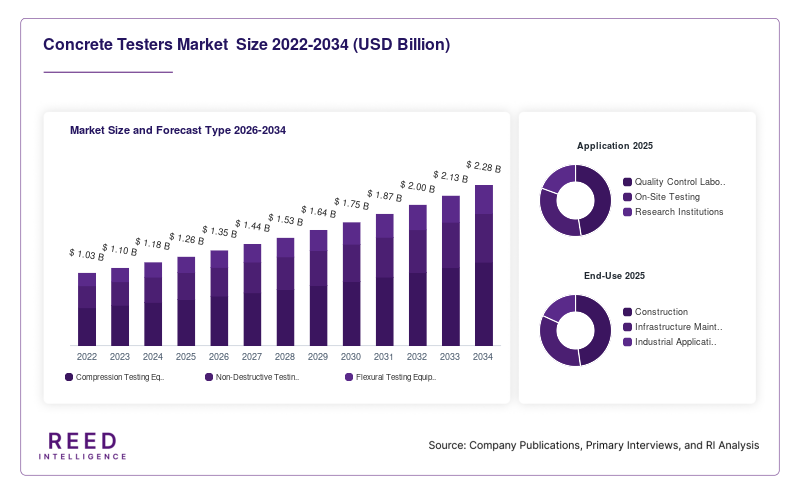
Compression testing equipment dominated the market in 2024, accounting for a share of approximately 41.2%. These devices are widely used to measure the compressive strength of concrete, which is a critical parameter in construction. Their widespread adoption in laboratories and construction sites contributes to their leading position. The reliability and accuracy of compression testing equipment make it essential for ensuring compliance with construction standards.
Non-destructive testing equipment is expected to be the fastest-growing subsegment, with a CAGR of 7.9%. The increasing demand for efficient and cost-effective testing methods is driving growth. These tools allow for quick assessment without damaging the structure, making them suitable for maintenance and inspection applications. The growing focus on sustainability and resource efficiency further supports their adoption.
By Application
Quality control laboratories held the largest share of 46.5% in 2024. These facilities play a crucial role in ensuring the quality and performance of construction materials. The use of advanced testing equipment in laboratories ensures accurate results and compliance with standards. This segment benefits from the increasing demand for certified testing services.
On-site testing is projected to grow at the fastest CAGR of 7.2%. The need for real-time testing during construction is driving this segment. Portable and easy-to-use testing equipment enables engineers to assess material properties directly at the construction site. This improves efficiency and reduces project delays, contributing to segment growth.
By End-Use
The construction sector dominated the market with a share of 52.8% in 2024. The extensive use of concrete in infrastructure projects drives demand for testing equipment. Construction companies rely on these tools to ensure the quality and durability of materials, making this segment a major contributor to market growth.
Infrastructure maintenance is expected to grow at the fastest CAGR of 7.4%. The increasing focus on maintaining and upgrading existing infrastructure is driving demand for testing solutions. Regular inspection and testing are essential to ensure safety and performance, creating opportunities for market growth in this segment.
Regional Analysis
North America
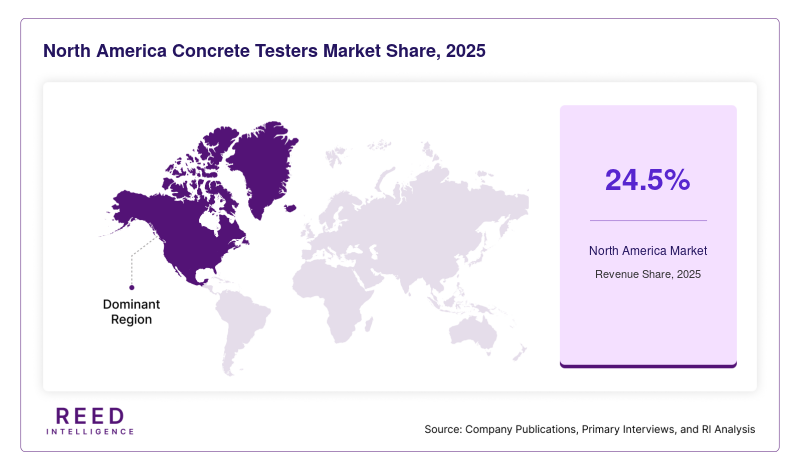
North America accounted for approximately 24.5% of the global Concrete Testers Market share in 2025 and is expected to grow at a CAGR of 5.9% during the forecast period. The region benefits from well-established construction standards and a strong focus on quality assurance. The presence of advanced infrastructure projects and the adoption of innovative technologies contribute to market growth.
The United States dominates the regional market due to its extensive infrastructure network and ongoing renovation projects. A key growth factor is the increasing investment in infrastructure modernization, supported by government initiatives. This has led to a higher demand for advanced testing equipment to ensure compliance with stringent regulations.
Europe
Europe held a market share of around 21.3% in 2025 and is projected to grow at a CAGR of 5.7%. The region emphasizes sustainability and energy-efficient construction practices, which drive the demand for concrete testing equipment. Strict regulatory frameworks also play a significant role in shaping the market.
Germany is the leading country in the region, supported by its strong construction industry and focus on innovation. The adoption of sustainable building materials is a key growth factor, requiring specialized testing methods. This trend is expected to support market expansion in the coming years.
Asia Pacific
Asia Pacific emerged as the largest regional market with a share of 38.6% in 2025 and is anticipated to grow at the fastest CAGR of 7.5%. Rapid urbanization and infrastructure development are the primary factors driving market growth. Countries in the region are investing heavily in transportation and housing projects.
China leads the market, driven by large-scale infrastructure investments and government initiatives. A unique growth factor is the expansion of smart city projects, which require advanced testing solutions. This has resulted in increased adoption of modern testing equipment across the region.
Middle East & Africa
The Middle East & Africa region accounted for a 8.2% share in 2025 and is expected to grow at a CAGR of 6.3%. The region is experiencing growth due to increasing investments in construction and infrastructure development, particularly in urban areas.
Saudi Arabia dominates the market, supported by large-scale construction projects and economic diversification efforts. A key growth factor is the development of mega projects, which require extensive testing of construction materials. This is driving demand for advanced testing equipment.
Latin America
Latin America held a market share of 7.4% in 2025 and is projected to grow at a CAGR of 6.1%. The region is witnessing gradual growth due to infrastructure development and urban expansion. Governments are focusing on improving transportation and public infrastructure.
Brazil is the leading country in the region, driven by investments in construction and infrastructure projects. A unique growth factor is the increasing focus on infrastructure rehabilitation, which requires regular testing and maintenance. This is expected to support market growth in the region.
Competitive Landscape
The Concrete Testers Market is moderately competitive, with several global and regional players operating in the industry. Companies focus on product innovation, technological advancements, and strategic partnerships to strengthen their market position. The presence of established players ensures a steady supply of advanced testing solutions.
One of the leading companies in the market is Controls Group, known for its comprehensive range of testing equipment. The company has recently introduced advanced digital testing systems to enhance accuracy and efficiency. Other key players are also investing in research and development to introduce innovative products and expand their global footprint.
Key Players
- Controls Group
- Humboldt Mfg. Co.
- ELE International
- Matest S.p.A.
- Gilson Company Inc.
- Aimil Ltd.
- Tinius Olsen
- ZwickRoell Group
- Shimadzu Corporation
- Qualitest International Inc.
- UTEST Material Testing Equipment
- Cooper Technology
- James Instruments Inc.
- Proceq (Screening Eagle Technologies)
- Test Mark Industries
Recent Developments
- Controls Group launched a new range of automated compression testing machines with enhanced data analytics capabilities.
- Screening Eagle Technologies introduced advanced non-destructive testing devices with cloud-based reporting features.
- Humboldt Mfg. Co. expanded its product portfolio by introducing portable testing equipment designed for on-site applications.
Concrete Testers Market Segments
Type
- Compression Testing Equipment
- Non-Destructive Testing Equipment
- Flexural Testing Equipment
Application
- Quality Control Laboratories
- On-Site Testing
- Research Institutions
End-Use
- Construction
- Infrastructure Maintenance
- Industrial Applications
By Region
- North America
- Europe
- APAC
- Middle East and Africa
- LATAM