Confocal Laser Endomicroscopy System Market Size, Share & Demand Report By Product Type (Endoscope-Based Systems, Probe-Based Systems), By Application (Gastroenterology, Oncology, Pulmonology, Urology), By End-Use (Hospitals, Ambulatory Surgical Centers, Diagnostic Clinics), By Region & Segment Forecasts, 2025–2034
USD 3950
Market Overview
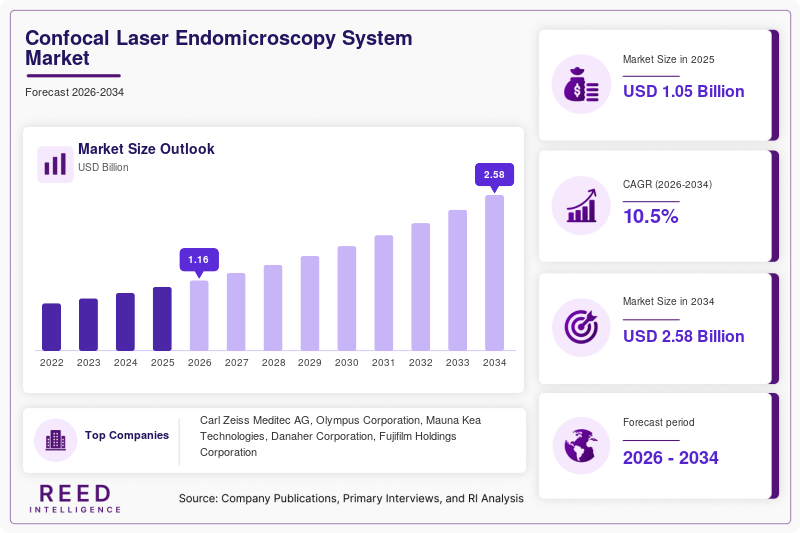
The Confocal Laser Endomicroscopy System Market size is experiencing steady expansion due to the growing demand for advanced diagnostic imaging technologies that enable real-time, high-resolution visualization of tissues at the cellular level. In 2025, the global market size is estimated to reach USD 1.05 billion, and it is projected to grow to USD 1.18 billion in 2026. By 2034, the market is forecast to reach approximately USD 2.85 billion, registering a compound annual growth rate (CAGR) of 10.5% from 2025 to 2034. This growth trajectory reflects increasing adoption in gastroenterology, pulmonology, and oncology diagnostics, where precise imaging plays a crucial role in early disease detection.
One of the primary growth factors driving the market is the rising prevalence of gastrointestinal and respiratory diseases, including colorectal cancer and chronic obstructive pulmonary disease (COPD). Confocal laser endomicroscopy (CLE) systems provide in vivo histology, enabling clinicians to make faster and more accurate decisions, reducing the need for traditional biopsies. Another key driver is technological advancements, including integration with artificial intelligence (AI) and improved probe designs, which enhance usability and diagnostic accuracy. Additionally, increasing healthcare expenditure and the expansion of minimally invasive procedures are supporting the adoption of CLE systems across both developed and emerging markets.
Key Highlights
- Market size projected to grow from USD 1.05 billion (2025) to USD 2.85 billion (2034)
- CAGR of 10.5% during the forecast period (2025–2034)
- Increasing adoption in oncology and gastroenterology diagnostics
- Technological advancements enhancing diagnostic precision and workflow efficiency
Market Trends
Integration of Artificial Intelligence in Imaging Systems
A prominent trend in the Confocal Laser Endomicroscopy System Market is the integration of artificial intelligence and machine learning algorithms into imaging platforms. AI-powered systems assist clinicians in real-time interpretation of microscopic images, improving diagnostic accuracy and reducing inter-observer variability. These solutions can automatically identify abnormal cellular structures, enabling early detection of malignancies. As healthcare providers increasingly prioritize precision medicine, AI-enabled CLE systems are becoming an essential component of advanced diagnostic workflows. This trend is also supported by growing investments in digital health technologies and the need for faster clinical decision-making in high-volume healthcare settings.
Expansion of Point-of-Care Diagnostic Applications
Another key trend is the expansion of CLE systems into point-of-care settings. Traditionally used in specialized hospitals, these systems are now being adapted for use in outpatient clinics and ambulatory surgical centers. Compact and portable designs are enabling broader accessibility, especially in regions with limited healthcare infrastructure. This shift supports faster diagnosis and immediate treatment decisions, improving patient outcomes. Additionally, the increasing demand for minimally invasive diagnostic procedures is encouraging the adoption of CLE systems in point-of-care environments, further contributing to market growth.
Market Drivers
Rising Prevalence of Chronic Diseases
The increasing incidence of chronic diseases, particularly gastrointestinal cancers and inflammatory conditions, is a significant driver for the Confocal Laser Endomicroscopy System Market. Early detection is critical in managing these conditions, and CLE systems offer real-time cellular imaging that enhances diagnostic accuracy. With a growing aging population and lifestyle-related health issues, the demand for advanced diagnostic tools is rising steadily. Healthcare providers are adopting CLE systems to improve patient outcomes and reduce diagnostic delays. This trend is particularly evident in developed regions, where screening programs are expanding and driving the adoption of advanced imaging technologies.
Growing Demand for Minimally Invasive Procedures
The shift toward minimally invasive diagnostic and therapeutic procedures is another major driver of market growth. CLE systems enable real-time visualization without the need for invasive tissue removal, reducing patient discomfort and recovery time. This aligns with the broader healthcare trend of improving patient experience while maintaining high diagnostic standards. Hospitals and clinics are increasingly investing in technologies that support minimally invasive approaches, which is boosting the adoption of CLE systems. Additionally, advancements in endoscopic technologies are complementing the use of CLE, further driving market expansion.
Market Restraint
High Cost of Equipment and Limited Accessibility
One of the primary restraints in the Confocal Laser Endomicroscopy System Market is the high cost associated with the equipment and its maintenance. These systems require significant capital investment, making them less accessible for smaller healthcare facilities and institutions in developing regions. The cost barrier also extends to training healthcare professionals to effectively use the technology, which can limit widespread adoption. For example, many mid-sized hospitals in emerging economies continue to rely on conventional diagnostic methods due to budget constraints. This financial limitation impacts market growth by restricting the adoption rate, especially in price-sensitive regions. Additionally, reimbursement challenges in certain countries further hinder the deployment of CLE systems, creating disparities in access to advanced diagnostic technologies.
Market Opportunities
Expansion in Emerging Markets
Emerging economies present significant growth opportunities for the Confocal Laser Endomicroscopy System Market. Countries in Asia Pacific, Latin America, and parts of Africa are investing in healthcare infrastructure and expanding access to advanced diagnostic technologies. Increasing government initiatives to improve healthcare services and rising awareness about early disease detection are driving demand for CLE systems. As healthcare facilities upgrade their equipment, there is a growing opportunity for manufacturers to introduce cost-effective solutions tailored to these markets. This expansion is expected to contribute substantially to overall market growth during the forecast period.
Technological Advancements and Product Innovation
Continuous innovation in imaging technology is creating new opportunities in the market. Developments such as high-definition imaging, improved probe flexibility, and integration with digital platforms are enhancing the functionality of CLE systems. Manufacturers are focusing on developing user-friendly interfaces and portable devices to expand their customer base. These advancements not only improve diagnostic accuracy but also reduce procedure time, making CLE systems more attractive to healthcare providers. As technology evolves, the adoption of these systems is expected to increase, opening new avenues for market growth.
Segmental Analysis
By Product Type
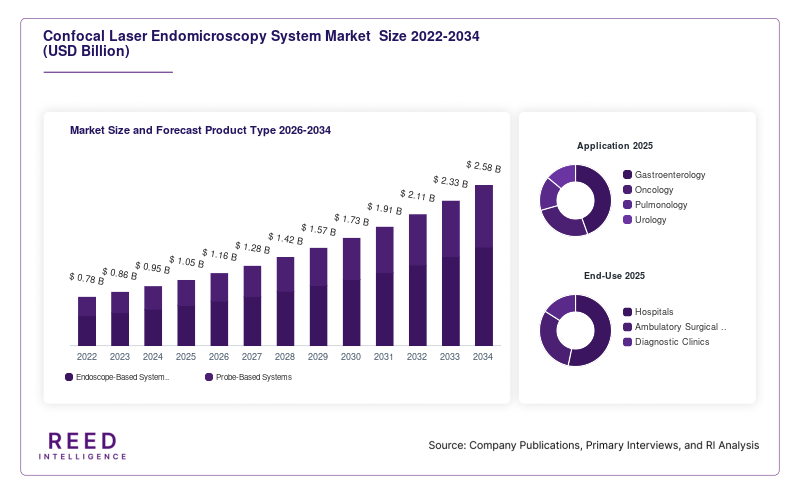
The endoscope-based confocal laser endomicroscopy systems segment dominated the market in 2024, accounting for approximately 62% of the total share. These systems are widely used in gastrointestinal procedures due to their ability to provide real-time imaging during endoscopy. Their integration with existing endoscopic equipment makes them a preferred choice among healthcare providers. The high adoption rate is also attributed to their efficiency in detecting early-stage cancers and improving diagnostic accuracy.
The probe-based confocal laser endomicroscopy systems segment is expected to be the fastest-growing, with a CAGR of 11.8%. These systems offer greater flexibility and can be used across multiple applications, including pulmonology and urology. Their compact design and ease of use are key factors driving their adoption. As healthcare providers seek versatile diagnostic tools, the demand for probe-based systems is expected to increase significantly.
By Application
Gastroenterology applications dominated the market in 2024, holding a share of approximately 55%. CLE systems are extensively used for diagnosing gastrointestinal disorders, including colorectal cancer and inflammatory bowel disease. The high prevalence of these conditions and the need for accurate diagnosis are driving the demand for CLE systems in this segment.
Oncology applications are expected to grow at the fastest rate, with a CAGR of 12.2%. The increasing focus on early cancer detection and personalized treatment is driving the adoption of CLE systems in oncology. These systems enable real-time visualization of tumor cells, improving diagnostic accuracy and treatment planning. As cancer cases continue to rise globally, this segment is expected to witness significant growth.
By End-Use
Hospitals dominated the market in 2024, accounting for approximately 68% of the share. The availability of advanced infrastructure and skilled professionals makes hospitals the primary users of CLE systems. These facilities handle a high volume of diagnostic procedures, driving the demand for advanced imaging technologies.
Ambulatory surgical centers are projected to be the fastest-growing segment, with a CAGR of 11.5%. The increasing preference for outpatient procedures and cost-effective healthcare solutions is driving the growth of this segment. These centers are adopting CLE systems to enhance diagnostic capabilities and improve patient outcomes, contributing to overall market expansion.
Regional Analysis
North America
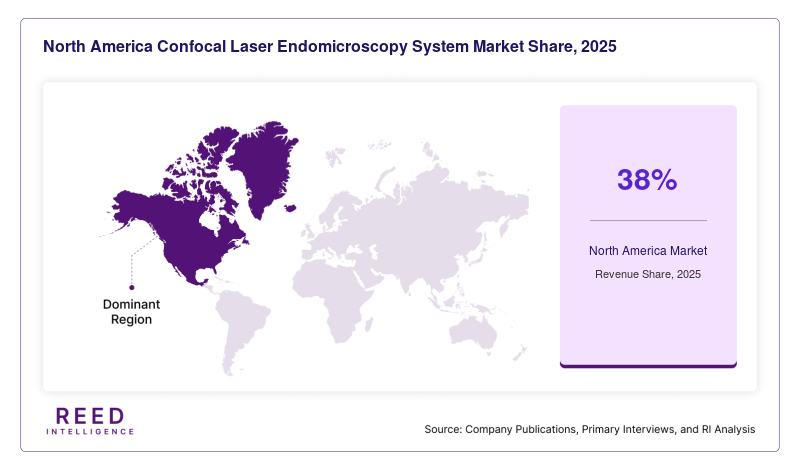
North America holds the largest share of the Confocal Laser Endomicroscopy System Market, accounting for approximately 38% in 2025, with a projected CAGR of 9.8% during the forecast period. The region benefits from advanced healthcare infrastructure, high adoption of innovative technologies, and strong reimbursement frameworks. The presence of leading market players and continuous investment in research and development further supports market growth. Additionally, increasing awareness about early disease detection is driving demand for CLE systems.
The United States dominates the regional market due to its well-established healthcare system and high prevalence of chronic diseases. A key growth factor is the increasing adoption of AI-integrated imaging systems, which enhance diagnostic accuracy and efficiency. Healthcare providers in the country are actively investing in advanced technologies to improve patient outcomes, contributing to market expansion.
Europe
Europe represents a significant share of the market, accounting for around 27% in 2025, with a CAGR of 9.5% through 2034. The region's growth is supported by strong healthcare systems, increasing adoption of minimally invasive procedures, and favorable government initiatives. Countries such as Germany, France, and the UK are at the forefront of adopting advanced diagnostic technologies, including CLE systems.
Germany leads the European market due to its robust healthcare infrastructure and focus on technological innovation. A unique growth factor is the increasing collaboration between research institutions and medical device companies, which accelerates the development and adoption of advanced imaging solutions. This collaborative environment supports continuous market growth.
Asia Pacific
Asia Pacific is the fastest-growing region, holding a market share of 20% in 2025 and expected to register a CAGR of 12.5%. Rapid urbanization, increasing healthcare expenditure, and growing awareness about early diagnosis are driving market growth. Countries such as China, India, and Japan are investing heavily in healthcare infrastructure, creating opportunities for CLE system adoption.
China dominates the regional market due to its large patient population and expanding healthcare sector. A key growth factor is the government's focus on improving healthcare access and promoting advanced medical technologies. This has led to increased adoption of CLE systems in both urban and rural healthcare facilities.
Middle East & Africa
The Middle East & Africa region accounts for approximately 8% of the market in 2025, with a CAGR of 10.2%. The market is driven by improving healthcare infrastructure and increasing investments in medical technologies. Countries in the Gulf Cooperation Council (GCC) are leading the adoption of advanced diagnostic systems.
Saudi Arabia is a dominant market in the region, supported by government initiatives to modernize healthcare services. A unique growth factor is the increasing number of specialized medical centers equipped with advanced imaging technologies, which is driving the adoption of CLE systems.
Latin America
Latin America holds a market share of around 7% in 2025, with a projected CAGR of 10.0%. The region is witnessing gradual growth due to improving healthcare infrastructure and increasing awareness about advanced diagnostic technologies. Brazil and Mexico are key contributors to the market.
Brazil leads the regional market due to its expanding healthcare sector and rising demand for minimally invasive procedures. A key growth factor is the increasing investment in private healthcare facilities, which are adopting advanced imaging systems to enhance diagnostic capabilities and attract patients.
Competitive Landscape
The Confocal Laser Endomicroscopy System Market is moderately consolidated, with several key players competing based on technological innovation, product quality, and strategic partnerships. The market leader is Carl Zeiss Meditec AG, known for its advanced imaging solutions and strong global presence. The company continues to invest in research and development to enhance its product portfolio.
Other prominent players include Olympus Corporation, Mauna Kea Technologies, Danaher Corporation, and Fujifilm Holdings Corporation. These companies are focusing on product innovation and expanding their market reach through collaborations and acquisitions. A recent development includes the introduction of AI-enabled imaging systems by leading players, aimed at improving diagnostic accuracy and workflow efficiency.
Key Players
- Carl Zeiss Meditec AG
- Olympus Corporation
- Mauna Kea Technologies
- Danaher Corporation
- Fujifilm Holdings Corporation
- Boston Scientific Corporation
- Medtronic plc
- Pentax Medical
- Leica Microsystems
- Abbott Laboratories
- Siemens Healthineers
- GE Healthcare
- Stryker Corporation
- Hoya Corporation
- Cook Medical
Recent Developments
- In 2024, a leading medical device company launched an AI-integrated confocal laser endomicroscopy system to enhance real-time diagnostic capabilities.
- In 2023, a major player expanded its product portfolio with a portable CLE system designed for point-of-care applications.
- In 2023, a strategic collaboration between a technology firm and a healthcare provider led to the development of advanced imaging software for CLE systems.
Confocal Laser Endomicroscopy System Market Segments
Product Type
- Endoscope-Based Systems
- Probe-Based Systems
Application
- Gastroenterology
- Oncology
- Pulmonology
- Urology
End-Use
- Hospitals
- Ambulatory Surgical Centers
- Diagnostic Clinics
By Region
- North America
- Europe
- APAC
- Middle East and Africa
- LATAM