Connected Bottle Market Size, Share & Demand Report By Product Type (Smart Hydration Bottles, Pharmaceutical Tracking Bottles, Beverage Authentication Bottles, Multi-Functional Connected Bottles), By Application (Hydration Tracking, Medication Adherence, Product Authentication, Consumer Engagement & Marketing), By Distribution Channel & Segment Forecasts, 2025–2034
USD 3950
Market Overview
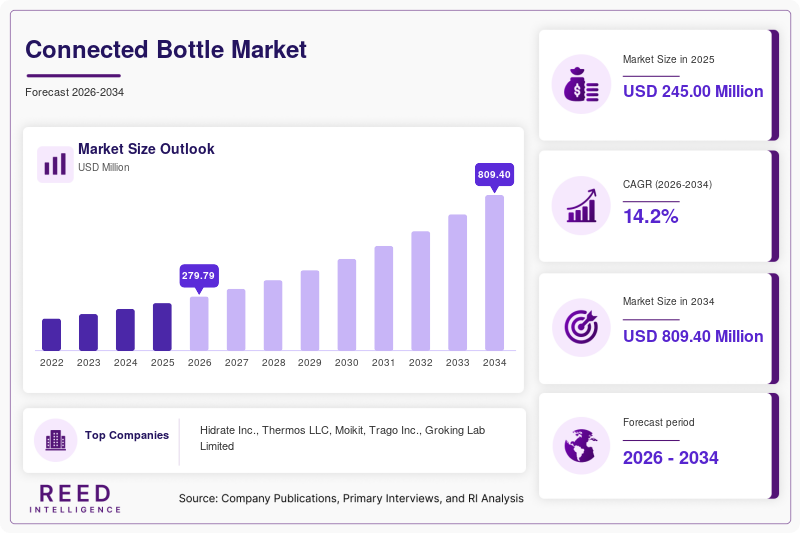
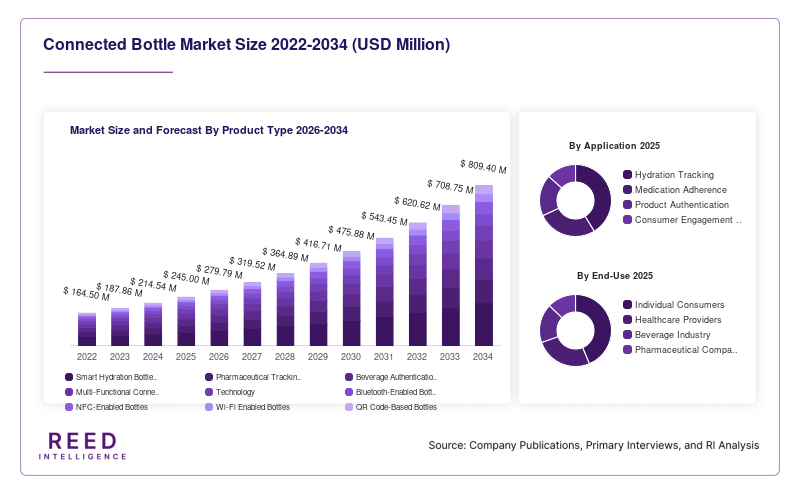
The global Connected Bottle Market size was valued at USD 245 million in 2025 and is projected to reach USD 812 million by 2034, expanding at a CAGR of 14.2% during the forecast period (2025–2034). The market is gaining traction due to the growing convergence of smart packaging, Internet of Things (IoT), and consumer health monitoring technologies. Connected bottles, equipped with sensors and connectivity features, enable real-time tracking of hydration levels, product authenticity, and consumer engagement, making them increasingly relevant across beverages, pharmaceuticals, and personal wellness applications.
A key global factor supporting the growth of the Connected Bottle Market is the rising demand for personalized consumer experiences driven by digital transformation. Brands are leveraging connected packaging to interact directly with consumers through smartphones, enabling product authentication, usage tracking, and marketing engagement. This shift toward data-driven consumer insights has significantly accelerated adoption across premium beverage and healthcare segments.
Key Highlights:
- North America dominated the market with a 38% share in 2025, while Asia Pacific is expected to grow at the fastest CAGR of 16.1% during 2025–2034.
- By product type, smart hydration bottles led with a 42% share, while pharmaceutical tracking bottles are projected to grow at a CAGR of 17.3%.
- By technology, Bluetooth-enabled bottles held the largest share, whereas NFC-enabled bottles are expected to witness the fastest growth at a CAGR of 18.5%.
- The U.S. market was valued at USD 82 million in 2025 and is estimated to reach USD 93 million in 2026, driven by rising adoption in fitness and wellness applications.
Market Trends
Integration of IoT and Mobile Health Ecosystems
The Connected Bottle Market is witnessing increased integration with mobile health applications and wearable ecosystems. Consumers are adopting smart hydration bottles that sync with smartphones and fitness trackers to monitor water intake and health metrics. This integration enhances user engagement and supports preventive healthcare, especially among urban populations. Manufacturers are also incorporating AI-based analytics to provide personalized hydration recommendations, improving product value and differentiation.
Expansion of Smart Packaging in Premium Beverages
Beverage companies are increasingly adopting connected bottles as part of premiumization strategies. Smart labels and QR/NFC-enabled bottles are being used for authentication, traceability, and interactive marketing. These features allow brands to share product origin, sustainability credentials, and promotional content directly with consumers. This trend is particularly prominent in alcoholic beverages, luxury water brands, and functional drinks, where customer engagement and brand storytelling play a crucial role.
Market Drivers
Rising Demand for Personalized Health Monitoring
The increasing focus on health and wellness is driving demand for connected bottles that monitor hydration levels. Consumers are becoming more aware of the importance of daily water intake, especially in fitness and lifestyle management. Smart bottles equipped with sensors and reminders help users maintain optimal hydration, thereby supporting growth in the Connected Bottle Market.
Growth of Smart Packaging and Digital Consumer Engagement
Brands are increasingly adopting smart packaging technologies to enhance customer interaction. Connected bottles provide direct communication channels between brands and consumers, enabling personalized promotions, product authentication, and real-time feedback. This capability is particularly valuable in combating counterfeit products and improving supply chain transparency, further boosting market growth.
Market Restraint
High Cost and Limited Consumer Awareness
One of the major challenges in the Connected Bottle Market is the relatively high cost of smart bottles compared to conventional alternatives. The integration of sensors, connectivity modules, and mobile applications increases production costs, which are often passed on to consumers. This limits adoption, particularly in price-sensitive markets.
Additionally, limited consumer awareness regarding the benefits of connected bottles remains a barrier. Many users perceive these products as non-essential or niche, especially outside fitness and healthcare segments. Concerns related to data privacy and device compatibility also affect adoption rates. Furthermore, battery dependency and maintenance requirements can discourage long-term usage. These factors collectively restrain widespread penetration of connected bottles, particularly in developing regions where affordability and awareness are key concerns.
Market Opportunities
Expansion in Healthcare and Pharmaceutical Applications
The Connected Bottle Market presents significant opportunities in the healthcare sector, particularly in medication adherence and patient monitoring. Smart bottles can track dosage schedules and send reminders, improving treatment compliance among patients with chronic conditions. This application is expected to gain traction as healthcare systems focus on remote monitoring and digital health solutions.
Adoption in Emerging Markets through Affordable Innovations
Emerging economies present untapped potential for connected bottle manufacturers. Companies are developing cost-effective solutions with simplified features to cater to a broader consumer base. The growing penetration of smartphones and internet connectivity in these regions supports the adoption of connected devices. Additionally, partnerships with local distributors and e-commerce platforms can enhance market reach and accessibility, creating new growth avenues.
Segmental Analysis
By Product Type
Smart hydration bottles dominated the Connected Bottle Market in 2025, accounting for 42% of the total share. These bottles are widely used by fitness enthusiasts and health-conscious consumers due to their ability to track water intake and provide reminders. Their user-friendly design and compatibility with mobile applications have contributed to their strong market presence.
Pharmaceutical tracking bottles are expected to grow at the fastest CAGR of 17.3% during the forecast period. The growth factor is the increasing need for medication adherence solutions in healthcare. These bottles can monitor dosage schedules and send alerts, improving patient compliance and supporting remote healthcare initiatives.
By Technology
Bluetooth-enabled bottles held the largest share of 46% in 2025, as they offer seamless connectivity with smartphones and wearable devices. Their widespread compatibility and ease of use have made them the preferred choice among consumers.
NFC-enabled bottles are projected to grow at a CAGR of 18.5%, driven by their application in smart packaging and product authentication. The growth factor is the rising demand for interactive consumer experiences, where users can access product information and promotional content by simply tapping their smartphones.
By Application
Hydration tracking applications dominated the market with a 39% share in 2025, reflecting the growing focus on personal health and wellness. These applications are widely used in fitness and lifestyle management, where consumers seek to maintain optimal hydration levels.
Medication adherence applications are expected to grow at a CAGR of 17.8%, supported by increasing adoption in healthcare. The growth factor is the need for effective patient monitoring solutions that enhance treatment outcomes and reduce healthcare costs.
By End-Use
Individual consumers accounted for the largest share of 48% in 2025, driven by rising awareness of health and fitness. The availability of connected bottles through online platforms has further supported consumer adoption.
Healthcare providers are anticipated to witness the fastest growth at a CAGR of 16.9%, as hospitals and clinics increasingly adopt connected devices for patient monitoring. The growth factor is the integration of smart technologies in healthcare systems to improve efficiency and patient care.
Regional Analysis
North America
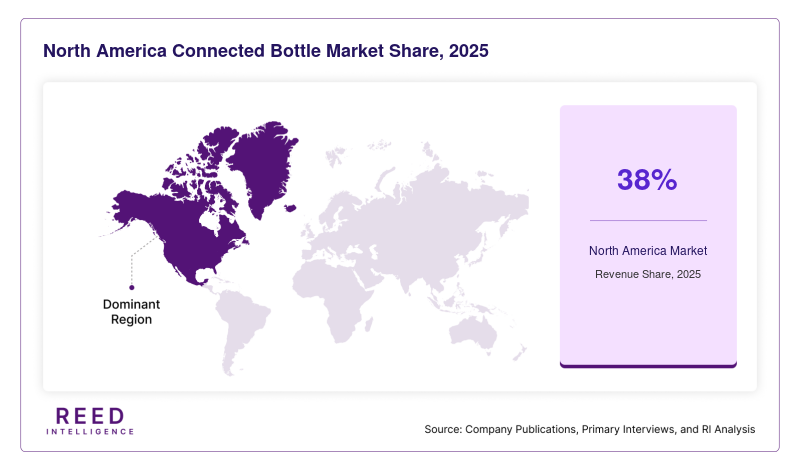
North America accounted for 38% of the Connected Bottle Market share in 2025 and is expected to grow at a CAGR of 13.5% during the forecast period. The region’s growth is supported by strong adoption of smart consumer products and advanced digital infrastructure. High awareness regarding health monitoring and connected devices has contributed to the widespread use of smart hydration bottles and connected packaging solutions.
The United States dominated the regional market due to the presence of technology-driven startups and established beverage brands adopting smart packaging. A key growth factor is the integration of connected bottles with fitness ecosystems, where consumers actively track hydration alongside other health metrics. This trend has encouraged innovation and product development in the U.S. market.
Europe
Europe held a 26% share of the Connected Bottle Market in 2025 and is projected to grow at a CAGR of 13.8%. The region’s focus on sustainability and product transparency has driven the adoption of connected packaging technologies. Consumers increasingly demand information about product origin, ingredients, and environmental impact, which connected bottles can provide.
Germany emerged as the dominant country in Europe, driven by its strong manufacturing base and emphasis on quality standards. The growth factor lies in the integration of connected bottles in premium beverage segments, where brands focus on authenticity and traceability to enhance consumer trust.
Asia Pacific
Asia Pacific accounted for 22% of the market share in 2025 and is anticipated to register the fastest CAGR of 16.1% during 2025–2034. Rapid urbanization, increasing smartphone penetration, and rising disposable incomes are key factors supporting market growth in the region.
China led the regional market due to its large consumer base and growing adoption of smart devices. The growth factor is the expansion of e-commerce platforms, which facilitate the distribution of connected bottles and enable direct-to-consumer sales. This has significantly improved product accessibility and market penetration.
Middle East & Africa
The Middle East & Africa region held a 7% share of the Connected Bottle Market in 2025 and is expected to grow at a CAGR of 14.0%. The market is gradually expanding due to increasing adoption of smart consumer products and growing awareness of health and wellness.
The United Arab Emirates dominated the region, driven by its high-income population and strong retail infrastructure. A key growth factor is the adoption of premium lifestyle products, including smart hydration bottles, among urban consumers seeking advanced and convenient solutions.
Latin America
Latin America accounted for 7% of the market share in 2025 and is projected to grow at a CAGR of 13.2%. The region’s growth is supported by rising internet penetration and increasing adoption of connected devices.
Brazil emerged as the dominant country in the region, driven by its expanding consumer electronics market. The growth factor lies in the growing popularity of fitness and wellness trends, which has increased demand for smart hydration solutions among health-conscious consumers.
Competitive Landscape
The Connected Bottle Market is characterized by the presence of both technology-driven startups and established consumer electronics companies. Leading players focus on product innovation, strategic partnerships, and expanding distribution channels to strengthen their market position.
Hidrate Inc. is recognized as a market leader due to its strong portfolio of smart hydration bottles and continuous product development. The company recently introduced advanced models with enhanced sensor accuracy and app integration, improving user experience.
Other key players such as Thermos LLC, Moikit, and Trago Inc. are actively investing in R&D to develop innovative solutions. Companies are also focusing on collaborations with fitness and healthcare platforms to expand their customer base. The competitive landscape remains dynamic, with new entrants introducing cost-effective products to capture emerging market opportunities.
Key Players List
- Hidrate Inc.
- Thermos LLC
- Moikit
- Trago Inc.
- Groking Lab Limited
- HydraCoach Inc.
- Caktus Inc.
- Ecomo Inc.
- Out of Galaxy Inc.
- ICEWATER
- Sippo Technologies
- H2OPal
- Adherium Limited
- MyHydrate Inc.
- SmartBottle Technologies
Recent Developments
- Hidrate Inc. launched a next-generation smart bottle with AI-based hydration tracking features in 2024.
- Thermos LLC expanded its connected product line with improved battery efficiency and mobile integration.
- Moikit introduced NFC-enabled bottles targeting premium beverage brands for enhanced consumer engagement.
- Trago Inc. partnered with fitness app providers to integrate hydration tracking with health monitoring platforms.
- ICEWATER developed LED-enabled smart bottles with interactive notification features for lifestyle users.
Connected Bottle Market Segments
By Product Type
- Smart Hydration Bottles
- Pharmaceutical Tracking Bottles
- Beverage Authentication Bottles
- Multi-Functional Connected Bottles
- Technology
- Bluetooth-Enabled Bottles
- NFC-Enabled Bottles
- Wi-Fi Enabled Bottles
- QR Code-Based Bottles
By Application
- Hydration Tracking
- Medication Adherence
- Product Authentication
- Consumer Engagement & Marketing
By End-Use
- Individual Consumers
- Healthcare Providers
- Beverage Industry
- Pharmaceutical Companies
By Distribution Channel
- Online Retail
- Specialty Stores
- Direct Sales
- Medical Distributors
By Region
- North America
- Europe
- APAC
- Middle East and Africa
- LATAM