Connected Street Lights Market Size, Share & Demand Report By Component (Hardware, Software Platforms, Services), By Communication Technology (Wired Systems, Wireless Systems, LPWAN Networks), By End Use (Municipal Infrastructure, Smart Highway Projects, Commercial & Industrial Areas, Public Parks and Recreational Spaces), By Region & Segment Forecasts, 2026–2034
USD 3950
Market Overview
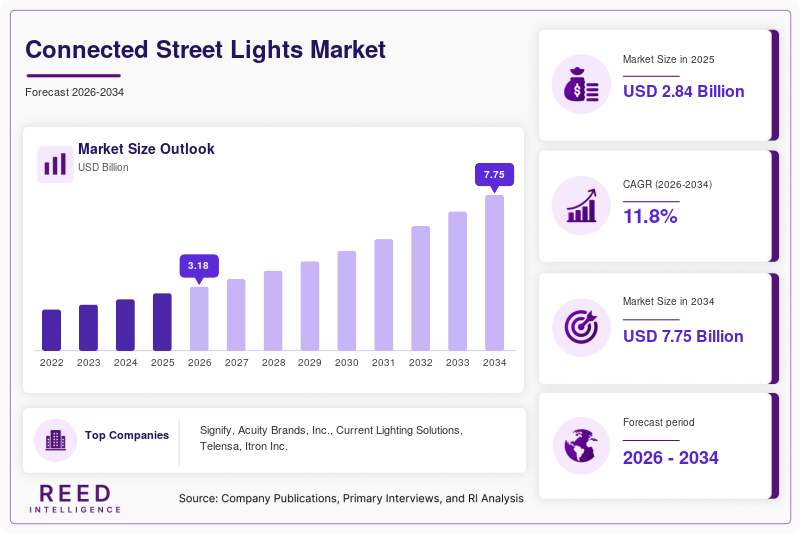
The Connected Street Lights Market size was valued at approximately USD 2.84 billion in 2026 and is projected to reach USD 6.92 billion by 2034, expanding at a CAGR of 11.8% during 2026–2034. Connected street lighting systems integrate LED luminaires, sensors, communication networks, centralized management software, and analytics platforms to improve urban lighting efficiency and support smart city infrastructure. These systems enable remote monitoring, adaptive brightness control, predictive maintenance, energy optimization, and public safety enhancements.
A major global factor supporting market expansion is the accelerating development of smart city initiatives across developed and emerging economies. Governments and municipalities are increasingly investing in digital infrastructure to improve urban sustainability, reduce electricity consumption, and lower maintenance costs. Connected street lights have become a foundational component of intelligent city ecosystems because they provide communication platforms capable of supporting traffic management, environmental monitoring, surveillance, public Wi-Fi, and electric vehicle charging integration. Rising pressure to reduce carbon emissions has further encouraged municipalities to replace conventional lighting systems with connected LED networks. In addition, advancements in wireless communication technologies, cloud computing, edge analytics, and Internet of Things (IoT) platforms have improved deployment flexibility and operational efficiency.
Key Highlights
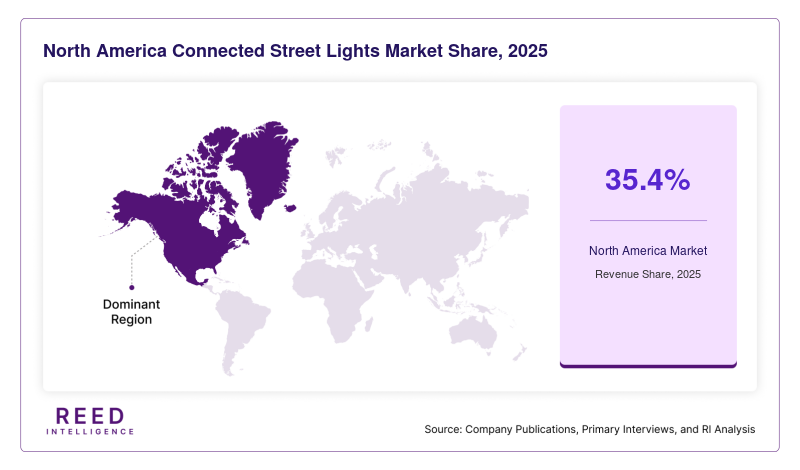
- North America dominated the market with a 35.4% share in 2025, while Asia Pacific is expected to grow at the fastest CAGR of 13.1% during 2026–2034.
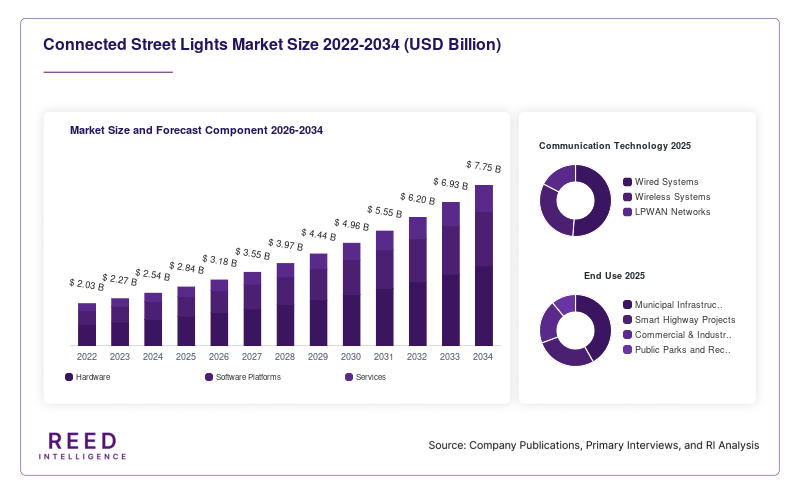
- By Component, Hardware accounted for the largest share of 46.8%, while Software Platforms are projected to grow at a CAGR of 13.9%.
- By Communication Technology, Wireless Systems led with a 61.3% share, whereas LPWAN Networks are expected to expand at a CAGR of 14.2%.
- By End Use, Municipal Infrastructure held the largest share of 69.7%, while Smart Highway Projects are projected to grow at a CAGR of 13.4%.
- The United States remained the dominant country, with market values of USD 790 million in 2024 and USD 865 million in 2025.
Market Trends
Integration of Multi-Function Smart Pole Infrastructure
Connected street lights are increasingly evolving into multi-function smart poles capable of supporting several urban services beyond illumination. Municipal authorities are adopting integrated platforms that combine lighting systems with surveillance cameras, environmental sensors, traffic monitoring devices, public communication systems, and wireless connectivity infrastructure. This trend is transforming street lighting assets into digital urban infrastructure that generates operational data for city administrators. The ability to utilize existing lighting networks as communication hubs significantly reduces deployment costs for smart city projects. As cities pursue data-driven urban management strategies, demand for multifunctional connected street lights is expected to increase steadily, creating long-term opportunities for solution providers specializing in integrated urban infrastructure platforms.
Expansion of AI-Driven Lighting Management Systems
Artificial intelligence and advanced analytics are becoming central components of connected street lighting deployments. Modern lighting management platforms utilize AI algorithms to analyze traffic density, pedestrian movement, weather conditions, and energy consumption patterns. These insights enable dynamic lighting adjustments that optimize power usage while maintaining public safety standards. Municipal operators are increasingly seeking predictive maintenance capabilities that identify component failures before service disruptions occur. AI-powered systems also support automated fault detection and asset lifecycle management, helping cities reduce operational expenditures. The growing availability of cloud-based analytics solutions and edge computing technologies is expected to accelerate the adoption of intelligent lighting management systems throughout the forecast period.
Market Drivers
Rising Smart City Investments Worldwide
Government investments in smart city development continue to represent a significant growth driver for the Connected Street Lights Market. Urban authorities are prioritizing digital transformation initiatives aimed at improving transportation efficiency, energy management, public safety, and environmental sustainability. Connected street lighting systems provide a practical entry point for smart city implementation because they offer immediate energy savings while creating infrastructure for future digital services. National and regional development programs across North America, Europe, Asia Pacific, and the Middle East are allocating substantial budgets toward intelligent urban infrastructure. As municipalities seek scalable solutions capable of delivering measurable operational improvements, connected lighting deployments are expected to expand considerably during the forecast period.
Growing Demand for Energy-Efficient Public Infrastructure
Increasing focus on reducing electricity consumption and greenhouse gas emissions is driving widespread adoption of connected street lighting systems. Traditional street lights consume substantial amounts of energy and often require expensive maintenance operations. Connected LED solutions provide real-time monitoring, adaptive dimming capabilities, and automated scheduling functions that significantly improve energy efficiency. Municipal governments are under growing pressure to meet sustainability targets while managing constrained budgets. The ability of connected street lights to reduce energy costs and maintenance expenses simultaneously makes them an attractive investment. Additionally, supportive regulations promoting energy-efficient infrastructure upgrades continue to encourage deployment across urban and suburban environments worldwide.
Market Restraint
High Initial Deployment and Integration Costs
Despite favorable long-term economic benefits, the high upfront investment required for connected street lighting deployment remains a notable restraint for market growth. Large-scale projects often involve significant expenditures related to LED fixture replacement, sensor installation, communication infrastructure deployment, software platform integration, and workforce training. Smaller municipalities and developing regions frequently face budget limitations that delay modernization initiatives. Integration challenges can further increase project costs when existing lighting infrastructure lacks compatibility with advanced communication and management systems. In some cases, procurement processes and public funding approvals extend project timelines, creating uncertainty for suppliers and municipal operators. For example, cities with aging electrical networks may require additional infrastructure upgrades before connected lighting systems can be effectively implemented. These factors can slow adoption rates, particularly in cost-sensitive markets where immediate capital availability is limited despite the potential for long-term operational savings.
Market Opportunities
Development of Smart Transportation Corridors
The emergence of intelligent transportation networks is creating substantial opportunities for connected street lighting providers. Smart highways, urban mobility corridors, and connected road infrastructure projects increasingly require advanced lighting systems capable of communicating with traffic management platforms and autonomous vehicle technologies. Connected street lights can support vehicle-to-infrastructure communication, adaptive traffic control, environmental monitoring, and roadway safety applications. Governments investing in transportation modernization are recognizing the strategic value of intelligent lighting networks as foundational digital infrastructure. As connected mobility ecosystems expand globally, lighting manufacturers and software providers have opportunities to develop specialized solutions tailored to transportation authorities and highway management agencies.
Growth of Public-Private Partnership Models
Public-private partnerships are emerging as an effective financing mechanism for connected street lighting projects. Many municipalities face budget constraints that limit their ability to fund large infrastructure modernization programs independently. Private sector participation enables cities to accelerate deployment while sharing financial and operational risks. Energy service companies, technology providers, and infrastructure investors are increasingly collaborating with local governments to implement connected lighting networks through performance-based contracts. These arrangements often link project payments to measurable energy savings and operational improvements. The growing acceptance of alternative financing models is expected to expand market accessibility and create opportunities for vendors offering integrated deployment, maintenance, and performance management services.
Segmental Analysis
By Component
Hardware represented the dominant subsegment within the component category, accounting for approximately 46.8% of market share in 2024. This leadership position is primarily attributed to the extensive deployment of LED luminaires, controllers, sensors, gateways, and communication modules required for connected street lighting installations. Municipal modernization projects typically allocate a substantial portion of budgets toward physical infrastructure replacement. The transition from conventional street lighting systems to intelligent networks continues to generate strong demand for advanced hardware components. Furthermore, increasing integration of environmental sensors, surveillance devices, and communication equipment into lighting poles has expanded hardware requirements. Large-scale infrastructure investments across urban areas continue to reinforce the dominance of this segment.
Software platforms are projected to be the fastest-growing subsegment, advancing at a CAGR of 13.9% through 2034. Growth is driven by rising demand for centralized management systems capable of monitoring, controlling, and optimizing large lighting networks. Municipal operators increasingly prioritize data analytics, predictive maintenance, and remote asset management capabilities. Modern software solutions enable automated fault detection, energy consumption analysis, and adaptive lighting control based on real-time environmental conditions. The growing use of cloud-based platforms and artificial intelligence technologies further enhances operational efficiency. As cities seek greater visibility into infrastructure performance and resource utilization, demand for advanced lighting management software is expected to increase significantly.
By Communication Technology
Wireless systems accounted for the largest share of approximately 61.3% in 2024, making them the dominant communication technology within the Connected Street Lights Market. Their popularity stems from flexible deployment capabilities, reduced installation complexity, and lower infrastructure costs compared with wired alternatives. Technologies such as Zigbee, cellular connectivity, Wi-Fi, and radio frequency communication enable efficient management of geographically dispersed lighting assets. Municipalities often favor wireless systems because they can be implemented without extensive trenching or network reconstruction. The ability to support real-time monitoring and adaptive lighting control further strengthens adoption. As urban areas continue to modernize infrastructure, wireless communication technologies remain central to connected street lighting deployments.
LPWAN technologies are expected to register the fastest growth rate, expanding at a CAGR of 14.2% during the forecast period. Solutions such as LoRaWAN and NB-IoT provide long-range communication capabilities with low power consumption, making them particularly suitable for large-scale municipal lighting networks. These technologies support efficient data transmission while minimizing operational costs. Growing demand for scalable smart city infrastructure is encouraging municipalities to adopt LPWAN-based systems capable of supporting thousands of connected devices. Enhanced network coverage, improved battery efficiency, and increasing interoperability with IoT platforms are additional factors contributing to rapid segment growth across both developed and emerging markets.
By End Use
Municipal infrastructure held the dominant position within the end-use segment, capturing approximately 69.7% of market share in 2024. City governments represent the primary adopters of connected street lighting systems because public roadways, residential streets, and urban centers require extensive lighting networks. Municipal authorities increasingly recognize the benefits of connected lighting in reducing energy consumption, improving maintenance efficiency, and supporting smart city initiatives. These systems also contribute to public safety through enhanced visibility and integrated monitoring capabilities. Rising urbanization and growing investments in sustainable infrastructure continue to support demand from municipal users. The segment's leadership is expected to remain intact throughout the forecast period due to ongoing modernization programs worldwide.
Smart highway projects are anticipated to emerge as the fastest-growing end-use subsegment, recording a CAGR of 13.4% through 2034. Transportation agencies are increasingly deploying intelligent lighting systems along highways and major transportation corridors to improve safety, operational efficiency, and traffic management. Connected street lights can interact with traffic monitoring systems, environmental sensors, and vehicle communication platforms. The development of connected mobility ecosystems and autonomous transportation technologies is creating additional demand for intelligent roadway infrastructure. Governments are also investing in transportation modernization initiatives that prioritize digital integration and data-driven operations. These trends are expected to drive sustained growth within the smart highway segment over the coming years.
Regional Analysis
North America
North America accounted for approximately 35.4% of the Connected Street Lights Market in 2025 and continues to represent the largest regional market. The region is expected to expand at a CAGR of 10.5% through 2034. Strong smart city investments, widespread adoption of IoT technologies, and advanced digital infrastructure support regional growth. Municipal authorities are actively replacing conventional lighting systems with connected LED networks to improve operational efficiency and achieve sustainability objectives.
The United States remains the dominant country within the region. A unique growth factor is the extensive deployment of intelligent transportation systems that increasingly require integrated lighting infrastructure. Federal and local funding programs focused on infrastructure modernization continue to support project implementation. Growing emphasis on cybersecurity and data-driven municipal operations further strengthens demand for advanced connected street lighting platforms across major metropolitan areas.
Europe
Europe represented approximately 28.1% of global market revenue in 2025 and is projected to grow at a CAGR of 10.9% during the forecast period. The region benefits from ambitious climate targets, strict energy efficiency regulations, and widespread urban sustainability initiatives. Municipalities across Western and Northern Europe are prioritizing smart infrastructure investments that reduce electricity consumption while enhancing public service delivery. Connected street lighting systems play a central role in achieving these objectives.
Germany remains the leading national market due to its strong industrial base and extensive smart city programs. A unique growth factor is the region's emphasis on carbon neutrality and energy transition policies. Local governments are investing in digital infrastructure capable of supporting broader urban management applications. Integration of connected lighting with environmental monitoring and mobility platforms is becoming increasingly common across European cities.
Asia Pacific
Asia Pacific held an estimated 22.6% market share in 2025 and is anticipated to register the fastest CAGR of 13.1% through 2034. Rapid urbanization, population growth, and infrastructure development are driving substantial demand for intelligent public lighting systems. Governments throughout the region are implementing smart city strategies designed to improve urban livability and operational efficiency. Expanding investments in digital infrastructure further support market growth.
China dominates the regional market due to large-scale urban development projects and extensive smart city deployments. A unique growth factor is the rapid expansion of newly planned urban districts that incorporate intelligent infrastructure from the initial design phase. Strong domestic manufacturing capabilities and government-backed technology initiatives continue to accelerate connected street lighting adoption across major metropolitan and secondary cities.
Middle East & Africa
The Middle East & Africa accounted for approximately 7.2% of global revenue in 2025 and is expected to grow at a CAGR of 11.7% during 2026–2034. Governments across the region are investing in smart urban development projects aimed at diversifying economies and improving public services. Connected street lighting systems are increasingly incorporated into large-scale infrastructure modernization programs due to their energy efficiency and operational benefits.
Saudi Arabia represents the dominant national market within the region. A unique growth factor is the development of large-scale smart city projects and economic diversification initiatives. These projects emphasize digital infrastructure, sustainability, and intelligent urban management. Growing investment in tourism destinations and new urban developments is creating additional demand for advanced connected lighting networks throughout the country.
Latin America
Latin America captured approximately 6.7% of market revenue in 2025 and is forecast to expand at a CAGR of 10.8% through 2034. Increasing urbanization and efforts to improve public infrastructure are supporting market development. Municipal governments are seeking cost-effective solutions that reduce energy expenditures and enhance public safety. Connected street lighting systems are increasingly viewed as practical investments capable of delivering measurable operational benefits.
Brazil remains the leading market in the region. A unique growth factor is the increasing adoption of energy performance contracting models that enable municipalities to modernize infrastructure without significant upfront capital expenditures. Growing collaboration between technology providers and local governments is accelerating project deployment. Urban renewal programs in major cities are also contributing to rising demand for intelligent lighting solutions.
Competitive Landscape
The Connected Street Lights Market is characterized by the presence of established lighting manufacturers, smart infrastructure providers, communication technology companies, and software developers. Market participants are focusing on integrated solutions that combine intelligent hardware, connectivity platforms, and advanced analytics capabilities. Strategic partnerships with municipalities, energy service companies, and smart city developers remain common competitive strategies.
Signify maintains a leading market position due to its broad portfolio of connected lighting solutions and extensive global deployment experience. The company recently expanded its smart city platform capabilities through enhanced data analytics and remote management functionalities. Other major participants continue to strengthen market presence through product innovation, geographic expansion, and technology integration initiatives.
Key Players
- Signify
- Acuity Brands
- Current Lighting Solutions
- Telensa
- Itron Inc.
- Siemens AG
- Schneider Electric
- Cisco Systems
- Huawei Technologies
- Zumtobel Group
- LED Roadway Lighting
- DimOnOff
- Flashnet
- Ubicquia
- Tvilight
Recent Developments
- In 2025, a major smart lighting solutions provider expanded its connected street lighting deployment program across multiple metropolitan areas to enhance energy efficiency and support smart city infrastructure development.
- In 2025, a leading urban technology company launched an AI-enabled street lighting management platform featuring predictive maintenance capabilities and real-time energy optimization functions.
- In 2024, several municipal authorities introduced large-scale connected LED street lighting modernization projects aimed at reducing electricity consumption and lowering carbon emissions.
- In 2024, a global infrastructure technology provider expanded its smart pole portfolio by integrating environmental sensors, public safety monitoring systems, and wireless connectivity features.
- In 2025, a prominent lighting manufacturer invested in advanced IoT communication technologies to improve network scalability, remote monitoring performance, and operational efficiency in connected street lighting systems.
Connected Street Lights Market Segments
Component
- Hardware
- Software Platforms
- Services
Communication Technology
- Wired Systems
- Wireless Systems
- LPWAN Networks
End Use
- Municipal Infrastructure
- Smart Highway Projects
- Commercial & Industrial Areas
- Public Parks and Recreational Spaces
By Region
- North America
- Europe
- APAC
- Middle East and Africa
- LATAM