Construction Dumper Market Size, Share & Demand Report By Product Type (Articulated Dumpers, Rigid Dumpers, Site Dumpers, Electric Dumpers), By Payload Capacity (Below 10 Tons, 10–40 Tons, Above 40 Tons), By End-Use (Infrastructure Construction, Residential Construction, Commercial Construction, Mining & Quarrying, Industrial Construction), By Region & Segment Forecasts, 2026–2034
USD 3950
Market Overview
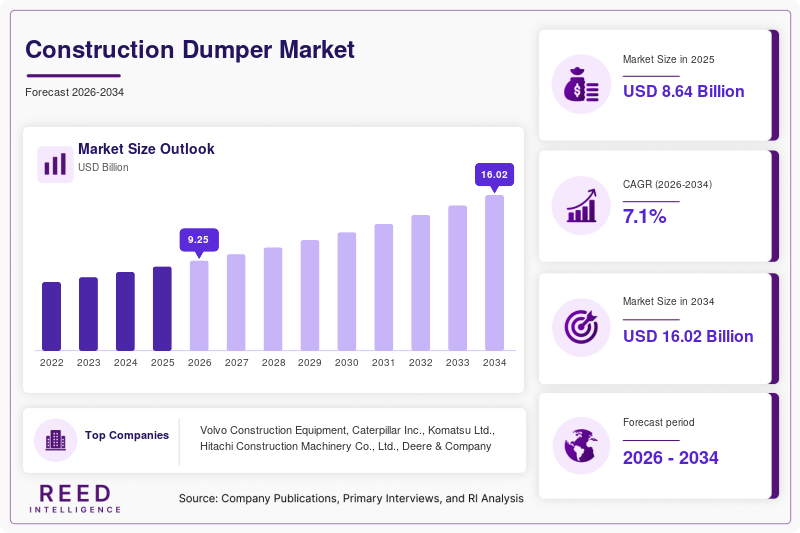
The global Construction Dumper Market size was valued at USD 8.64 billion in 2026 and is projected to reach USD 14.92 billion by 2034, expanding at a CAGR of 7.1% during 2026–2034. The market is experiencing stable expansion due to increasing investments in transportation infrastructure, urban development projects, mining operations, and large-scale commercial construction activities across both developed and emerging economies. Construction dumpers play a critical role in moving soil, aggregates, debris, and construction materials efficiently across project sites, making them essential equipment for contractors and infrastructure developers.
A major global factor supporting market growth is the continuous rise in public infrastructure spending. Governments are investing heavily in roads, bridges, rail networks, airports, industrial corridors, and smart city developments. These projects require efficient material transportation solutions, increasing demand for articulated dumpers, rigid dumpers, and site dumpers. Additionally, technological advancements such as telematics integration, fuel-efficient engines, automated fleet management, and electric-powered construction equipment are improving productivity and reducing operational costs.
Key Highlights
- North America dominated the market with a 35.1% share in 2025.
- while Asia Pacific is expected to grow at the fastest CAGR of 8.8% during 2026–2034.
- By product type, articulated dumpers accounted for the largest share of 46.3%.
- while electric dumpers are projected to grow at a CAGR of 10.6%.
- By payload capacity, 10–40 ton dumpers held the largest share of 42.7%.
- whereas above 40 ton dumpers are expected to expand at a CAGR of 8.5%.
- By end-use, infrastructure construction led with a 44.8% share.
- while mining and quarrying projects are anticipated to grow at a CAGR of 8.9%.
- The United States remained the dominant country, with market values of USD 1.84 billion in 2024 and USD 1.96 billion in 2025.
Market Trends
Electrification of Construction Equipment Fleets
The construction industry is increasingly adopting electric and hybrid equipment to meet environmental targets and reduce operating costs. Construction dumpers are becoming an important part of this transition as manufacturers introduce battery-powered models designed for urban construction projects, tunnels, and environmentally sensitive locations. Electric dumpers generate lower noise levels and eliminate direct emissions, making them suitable for projects with strict sustainability requirements. Improvements in battery technology and charging infrastructure are enhancing operational performance and encouraging wider adoption. Fleet operators are also recognizing the long-term cost benefits associated with reduced fuel consumption and lower maintenance requirements, supporting the growing presence of electric construction dumpers across global markets.
Integration of Telematics and Smart Fleet Management
Digitalization is transforming construction equipment management, and dumpers are increasingly equipped with telematics systems that provide real-time operational data. These technologies allow contractors to monitor equipment utilization, fuel consumption, maintenance schedules, and operator performance. Predictive maintenance capabilities help reduce downtime and extend equipment lifespan. Fleet managers can optimize machine deployment across multiple project sites, improving productivity and reducing costs. The integration of GPS tracking, remote diagnostics, and data analytics is becoming a standard feature in modern construction dumpers. As construction companies prioritize efficiency and project transparency, demand for intelligent and connected dumper solutions is expected to continue growing during the forecast period.
Market Drivers
Expanding Global Infrastructure Development Activities
Infrastructure development remains a primary growth driver for the Construction Dumper Market. Governments worldwide are allocating substantial budgets toward transportation networks, renewable energy facilities, industrial parks, ports, and urban development projects. These large-scale initiatives require extensive movement of construction materials and excavation waste, increasing demand for reliable dumper equipment. Developing economies are particularly focused on improving connectivity and supporting economic growth through infrastructure investments. Construction dumpers enhance material handling efficiency and reduce project completion times, making them indispensable for contractors. The consistent pipeline of infrastructure projects across regions is expected to generate sustained equipment demand throughout the forecast period.
Growth of Mining and Quarrying Operations
The expansion of mining and quarrying activities is creating significant opportunities for dumper manufacturers. Rising demand for minerals, aggregates, metals, and raw materials used in construction and industrial production is increasing excavation activity worldwide. Mining operators require high-capacity dumpers capable of handling heavy loads in challenging terrain conditions. Advanced dumpers improve operational productivity while reducing fuel consumption and maintenance costs. Growing investments in mineral exploration and resource extraction projects are further strengthening equipment demand. As global industrialization and urbanization continue, mining companies are expected to expand production capacity, contributing substantially to Construction Dumper Market growth.
Market Restraint
High Capital Investment and Maintenance Costs
One of the major challenges affecting the Construction Dumper Market is the substantial capital investment required for equipment acquisition and ownership. Advanced dumpers equipped with telematics systems, emission-compliant engines, and enhanced safety technologies often involve significant upfront costs. Small and medium-sized contractors may face financial constraints that limit equipment purchases, leading them to rely on rental fleets instead. In addition to acquisition expenses, ongoing maintenance, spare parts replacement, fuel costs, and operator training requirements can increase the total cost of ownership. Economic uncertainty and fluctuations in construction activity can further delay procurement decisions. For example, contractors working on short-duration projects may prefer renting equipment rather than purchasing new dumpers, which can affect sales growth for manufacturers. These cost-related challenges remain an important factor influencing market expansion despite positive long-term demand fundamentals.
Market Opportunities
Rising Demand for Rental Construction Equipment
The growing popularity of equipment rental services presents a significant opportunity for market participants. Construction companies increasingly prefer rental solutions to reduce capital expenditure and gain flexibility in fleet management. Rental providers are expanding their inventories with modern dumper models featuring advanced technologies and higher fuel efficiency. This trend enables contractors to access specialized equipment without making substantial investments. Seasonal projects, short-term contracts, and fluctuating workloads further support rental adoption. Manufacturers are also establishing partnerships with rental companies to increase product visibility and expand market reach. The continued growth of the rental equipment industry is expected to create new revenue opportunities across the construction dumper value chain.
Development of Smart and Autonomous Dumpers
Advancements in automation and artificial intelligence are opening new growth avenues for the Construction Dumper Market. Autonomous and semi-autonomous dumpers can improve operational efficiency, enhance safety, and reduce labor dependency on large construction and mining sites. These machines utilize sensors, GPS systems, and advanced software to navigate complex environments with minimal human intervention. Construction companies are increasingly exploring automation technologies to address skilled labor shortages and improve project productivity. As digital transformation accelerates across the heavy equipment sector, manufacturers investing in autonomous dumper development are likely to gain competitive advantages. The commercialization of intelligent dumper systems is expected to contribute significantly to future market growth.
Segmental Analysis
By Product Type
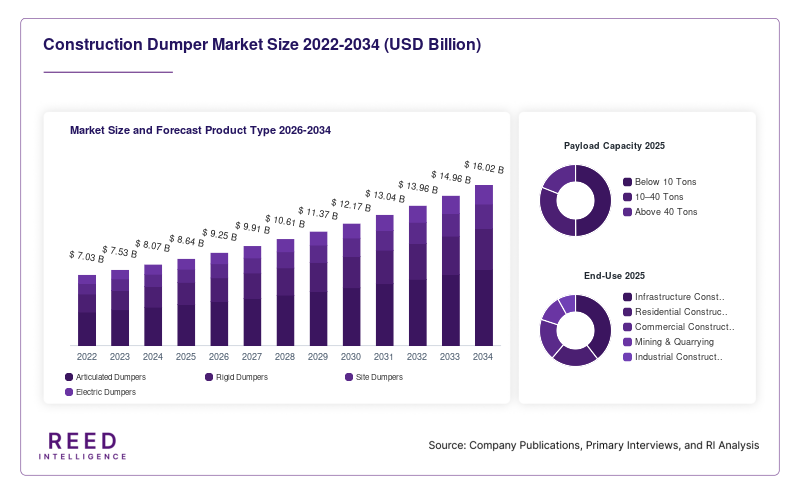
Articulated dumpers emerged as the dominant subsegment, accounting for approximately 46.3% of market share in 2024. Their popularity is primarily attributed to superior maneuverability, flexibility, and performance in challenging terrain conditions. Construction contractors frequently utilize articulated dumpers in infrastructure, road-building, and large-scale earthmoving projects where uneven surfaces and difficult operating environments are common. These machines offer enhanced traction and stability, making them suitable for demanding construction applications. Growing investments in transportation infrastructure and commercial development projects continue to support demand. Manufacturers are also introducing advanced articulated models with improved fuel efficiency, operator comfort, and digital monitoring systems, further strengthening their market position.
Electric dumpers are expected to witness the fastest growth, registering a CAGR of 10.6% during the forecast period. Rising environmental concerns and stricter emission regulations are encouraging construction companies to transition toward cleaner equipment alternatives. Electric dumpers provide lower operating costs, reduced maintenance requirements, and minimal environmental impact compared to conventional diesel-powered equipment. Their adoption is increasing in urban construction projects where noise and emission restrictions are more stringent. Improvements in battery technology, charging infrastructure, and operational performance are supporting wider deployment. Government incentives promoting sustainable construction practices are also contributing to strong demand growth across developed and emerging markets.
By Payload Capacity
The 10–40 ton dumpers segment held the largest market share of approximately 42.7% in 2024. These dumpers offer a balanced combination of capacity, versatility, and cost-effectiveness, making them suitable for a wide range of construction applications. Contractors frequently use them in road construction, residential developments, commercial projects, and infrastructure works. Their ability to transport substantial material volumes while maintaining operational flexibility contributes to widespread adoption. Equipment manufacturers continue enhancing machine durability, fuel efficiency, and safety features to meet evolving customer requirements. The segment benefits from consistent demand across both developed and developing economies.
The above 40 ton dumpers category is projected to grow at a CAGR of 8.5% through 2034. Increasing demand from mining operations, large infrastructure projects, and industrial developments is supporting market expansion. These high-capacity machines enable efficient transportation of heavy materials over long distances, improving productivity and reducing operational costs. Mining companies are particularly investing in larger dumpers to enhance material handling efficiency and optimize resource extraction activities. Technological advancements in engine performance, automation capabilities, and fleet management systems are further strengthening growth prospects for this segment.
By End-Use
Infrastructure construction dominated the market and accounted for approximately 44.8% of total revenue in 2024. The segment benefits from continuous investments in roads, bridges, railways, airports, ports, and utility projects worldwide. Construction dumpers play a crucial role in transporting soil, gravel, aggregates, and excavation materials across large project sites. Government spending on infrastructure modernization and urban development initiatives remains a key demand driver. Contractors increasingly prefer advanced dumper models equipped with telematics and fuel-efficient technologies to improve project productivity and reduce operating expenses. The segment is expected to maintain its leadership position throughout the forecast period.
Mining and quarrying applications are anticipated to record the fastest CAGR of 8.9% during 2026–2034. Rising demand for minerals, metals, and construction aggregates is driving expansion of extraction activities across multiple regions. Mining operators require high-capacity dumpers capable of operating under demanding conditions while maintaining reliability and productivity. Technological innovations such as autonomous operation, predictive maintenance systems, and enhanced safety features are improving equipment performance. Growing investments in resource exploration and mining infrastructure are expected to support strong demand for dumpers in this application segment over the coming years.
Regional Analysis
North America
North America accounted for approximately 35.1% of the global Construction Dumper Market in 2025 and continues to maintain a leading position within the industry. The region is expected to register a CAGR of 6.5% during 2026–2034. Strong infrastructure modernization initiatives, highway rehabilitation projects, and commercial construction investments support market expansion. Demand for technologically advanced dumpers remains high as contractors seek equipment capable of improving productivity and reducing operating costs. The presence of major equipment manufacturers also contributes to market stability.
The United States represents the dominant country within North America. A unique growth factor supporting demand is the large volume of federal infrastructure funding directed toward transportation and utility development projects. Ongoing investments in road construction, bridge replacement programs, renewable energy facilities, and logistics infrastructure are generating significant equipment demand. Contractors increasingly adopt high-capacity and fuel-efficient dumpers to meet project timelines and improve operational efficiency across large-scale developments.
Europe
Europe held approximately 24.8% market share in 2025 and is projected to grow at a CAGR of 6.3% through 2034. Construction activity across transportation networks, urban redevelopment projects, and renewable energy infrastructure continues to support equipment demand. Regulatory emphasis on reducing emissions is encouraging adoption of low-carbon construction equipment. Manufacturers operating in Europe are investing heavily in sustainable technologies, including electric and hybrid dumpers, to comply with evolving environmental standards and customer requirements.
Germany remains the dominant country within the European market. A unique growth factor is the country's extensive focus on industrial modernization and sustainable infrastructure projects. Investments in smart transportation systems, energy-efficient buildings, and railway upgrades are supporting demand for advanced material-handling equipment. Construction companies increasingly prefer dumpers equipped with telematics and fuel-saving technologies, contributing to the market's steady development throughout the forecast period.
Asia Pacific
Asia Pacific captured approximately 22.4% of global market revenue in 2025 and is expected to achieve the fastest CAGR of 8.8% during 2026–2034. Rapid urbanization, industrial expansion, and government-led infrastructure development programs are creating substantial demand for construction equipment. Large populations and growing economic activity continue to drive residential, commercial, and transportation construction projects. Equipment manufacturers are expanding production facilities and distribution networks across the region to capitalize on rising demand.
China dominates the regional market due to its extensive infrastructure investments and large construction sector. A unique growth factor is the country's ongoing development of industrial corridors, smart cities, and high-speed rail networks. These projects require efficient material transportation solutions, increasing utilization of articulated and rigid dumpers. The continued expansion of construction and mining activities is expected to strengthen regional market growth over the coming years.
Middle East & Africa
The Middle East & Africa region accounted for approximately 9.4% of market share in 2025 and is forecast to grow at a CAGR of 7.4% through 2034. Infrastructure diversification initiatives, urban expansion, and industrial construction activities are supporting equipment demand. Several countries are investing in transportation networks, tourism infrastructure, logistics hubs, and energy projects. These developments require reliable material transportation equipment capable of operating in demanding environmental conditions.
Saudi Arabia represents the dominant market within the region. A unique growth factor is the implementation of large-scale economic diversification projects involving smart cities, tourism developments, and industrial zones. Massive construction programs require substantial quantities of earthmoving and material transportation equipment. Contractors are increasingly adopting advanced dumpers to improve productivity and meet ambitious project deadlines, contributing to strong market growth.
Latin America
Latin America represented approximately 8.3% of the global market in 2025 and is anticipated to expand at a CAGR of 6.9% during the forecast period. The region benefits from infrastructure upgrades, mining sector investments, and increasing urban construction activity. Governments and private investors are allocating resources toward transportation projects, housing developments, and industrial facilities. Growing demand for aggregates and raw materials further supports utilization of construction dumpers across multiple applications.
Brazil remains the leading country in the regional market. A unique growth factor is the expansion of mining operations and related logistics infrastructure. Rising production of minerals and construction materials requires efficient transportation equipment capable of handling heavy payloads. Construction firms and mining operators continue investing in modern dumpers to improve operational efficiency and support long-term project requirements.

Competitive Landscape
The Construction Dumper Market is moderately consolidated, with global manufacturers competing through product innovation, technological advancement, distribution network expansion, and strategic partnerships. Leading companies focus on developing fuel-efficient, low-emission, and digitally connected equipment to address evolving customer requirements. The market is characterized by strong competition among established heavy equipment manufacturers and regional players serving specialized applications.
Volvo Construction Equipment remains a leading participant due to its extensive articulated dumper portfolio, global distribution capabilities, and emphasis on sustainable equipment development. The company recently expanded its focus on electrified construction equipment solutions to support decarbonization objectives. Other major manufacturers continue investing in automation technologies, telematics integration, and fleet optimization solutions to strengthen market competitiveness. Strategic collaborations with rental providers and infrastructure contractors are also becoming increasingly common as companies seek to expand market presence and improve customer accessibility.
Key Players
- Volvo Construction Equipment
- Caterpillar Inc.
- Komatsu Ltd.
- Hitachi Construction Machinery Co., Ltd.
- Deere & Company
- Bell Equipment Limited
- Liebherr Group
- XCMG Group
- SANY Group
- Doosan Bobcat
- Hyundai Construction Equipment
- JCB Ltd.
- Terex Corporation
- CNH Industrial N.V.
- Kubota Corporation
Recent Developments
- Volvo Construction Equipment introduced an upgraded articulated dumper platform featuring enhanced telematics and fuel-efficiency capabilities.
- Caterpillar expanded its connected fleet management solutions for construction and mining dumpers to improve equipment utilization and predictive maintenance.
- Komatsu launched new autonomous hauling technology enhancements designed to increase operational productivity in large-scale mining projects.
- Bell Equipment strengthened its production capacity to address increasing global demand for articulated dumpers.
- Liebherr introduced advanced operator-assistance systems focused on improving safety and efficiency across heavy-duty dumper
Construction Dumper Market Segments
Product Type
- Articulated Dumpers
- Rigid Dumpers
- Site Dumpers
- Electric Dumpers
Payload Capacity
- Below 10 Tons
- 10–40 Tons
- Above 40 Tons
End-Use
- Infrastructure Construction
- Residential Construction
- Commercial Construction
- Mining & Quarrying
- Industrial Construction
By Region
- North America
- Europe
- APAC
- Middle East and Africa
- LATAM