Contactless Biometrics Technology Market Size, Share & Trends Analysis Report By Biometric Modality (Facial Recognition, Iris Recognition, Contactless Fingerprint Recognition, Palm & Hand Recognition, Voice Recognition), By Component (Hardware, Software, Services), By Application (Border Control & Travel, Access Control & Physical Security, Banking & Financial Services, Consumer Electronics, Healthcare, Retail & Payments) and By Region (North America, Europe, APAC, Middle East and Africa, LATAM)
USD 3950
Contactless Biometrics Technology Market Size
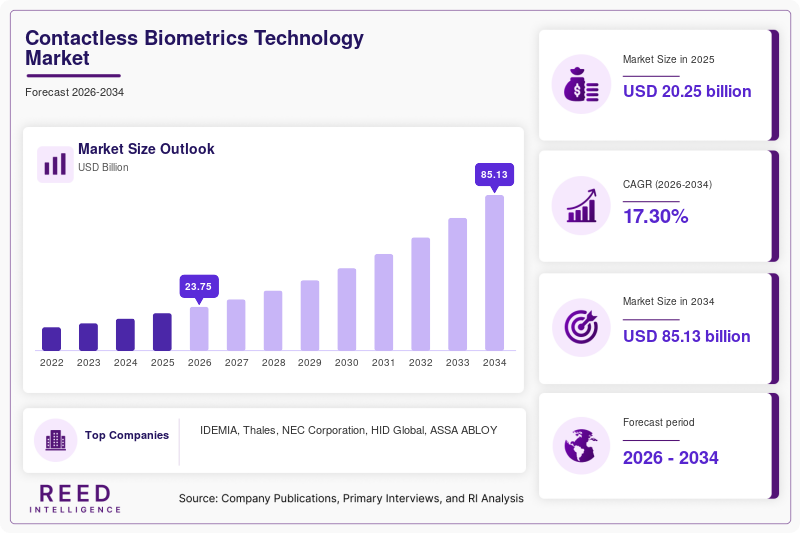
The global contactless biometrics technology market size was valued at USD 20.25 billion in 2025 and is projected to grow from USD 24.10 billion in 2026 to USD 85.13 billion by 2034, registering a CAGR of 17.30% during the forecast period from 2026 to 2034.
The market is moving from isolated biometric authentication toward continuous, touch-free identity infrastructure across airports, border crossings, smartphones, financial services, access control and retail. The shift is supported by the growing use of facial authentication, digital identity credentials and passkeys. FIDO Alliance reported in May 2026 that approximately 5 billion passkeys were in active use, with 75% of surveyed consumers having enabled a passkey on at least one account and 68% of surveyed organizations deploying or actively deploying passkeys for employee authentication.
Contactless biometrics refers to biometric technologies that identify or verify individuals without requiring physical contact with a scanning surface. Facial recognition is the most visible modality, but the market also includes iris, contactless fingerprint, palm, hand and voice-based systems. NIST identifies face, fingerprint and iris among the principal biometric characteristics used for identity establishment and verification, while its standards work increasingly addresses interoperability between different biometric systems.
The commercial case is increasingly based on removing friction from identity checks. U.S. Customs and Border Protection currently uses biometric facial comparison at 238 airports, including international entry, exit and TSA aviation-security applications. In Europe, the Entry/Exit System became fully operational across the Schengen area on April 10, 2026, recording facial images and fingerprints of covered non-EU short-stay travelers and enabling greater use of automated border-control and self-service systems.
Contactless Biometrics Technology Market Drivers
Expansion of touch-free identity verification across travel and borders
Airports and border authorities are becoming major deployment environments because biometric verification can replace repeated document presentation and manual identity checks. CBP's biometric facial comparison network now covers 238 U.S. airports, while its touchless Global Entry portals use automated cameras to process travelers with fewer physical touchpoints.
Europe's EES provides another large-scale demand mechanism. Since April 2026, the system has operated across all external Schengen border crossing points and records fingerprints and facial images for covered travelers. By July 2026, the European Commission reported more than 145 million entries and exits registered through the system.
India is following a similar path. The Ministry of Civil Aviation describes DigiYatra as a paperless and contactless airport process based on facial recognition, and reported in June 2026 that the program had surpassed 100 million journeys.
The commercial mechanism extends beyond cameras: airports need biometric readers, enrollment systems, identity-management software, liveness detection, APIs and secure data infrastructure. This creates demand across the full contactless biometric technology stack.
Passwordless authentication is expanding biometric use beyond physical security
Biometric authentication is increasingly embedded into everyday digital identity. FIDO's 2026 research found that 90% of surveyed consumers were familiar with passkeys, 75% had enabled at least one, and 49% used them regularly when available. Among organizations, 68% were deploying, piloting or rolling out passkeys for employee sign-in.
The commercial mechanism is important because passkeys commonly use a device's existing biometric capability to unlock a cryptographic credential. Apple supports Face ID and Touch ID as biometric authentication methods for applications, while Visa's Payment Passkey uses face, fingerprint or device PIN authentication.
This expands the addressable market from specialized biometric terminals into smartphones, banking applications, e-commerce and enterprise authentication. It also changes purchasing behavior: companies increasingly acquire identity infrastructure that connects physical and digital authentication instead of maintaining separate credential systems.
Contactless biometrics are becoming part of integrated identity platforms
The market is moving toward multimodal and integrated identity systems rather than standalone biometric readers. HID's 2026 research found that 45% of respondents considered biometrics strategic, with fingerprint and facial recognition the leading modalities. The same research found that organizations are increasingly trying to integrate physical and digital identity systems.
IDEMIA's airport portfolio illustrates this integration. Its PaXpress solutions combine facial, iris and contactless fingerprint technologies with identity-management software, while its February 2026 partnership with Elenium connects biometric passenger processing with airport self-service systems across check-in, baggage, security, lounges and boarding.
The resulting commercial opportunity is larger than hardware replacement. Customers require enrollment, identity proofing, liveness detection, biometric matching, credential management, cybersecurity, data governance and integration with existing access-control or travel systems. This supports recurring software and services revenue alongside device sales.
Contactless Biometrics Technology Market Restraints
Privacy and regulatory requirements increase deployment complexity
Biometric information is particularly sensitive because it is directly connected to a person's identity. The EU AI Act classifies several biometric applications as high-risk, including remote biometric identification, while biometric verification used solely to authenticate an individual for access to a service, device or premises is treated differently.
The regulatory distinction matters commercially. Organizations deploying contactless biometrics need to determine whether their application involves verification, identification, categorization or another regulated use. Systems may require data governance, transparency, documentation, human oversight, accuracy controls and security measures depending on the use case.
HID's 2026 research found that ethical and privacy concerns among respondents regarding biometrics had increased substantially, reaching 67% reporting moderate or high concern. These requirements can lengthen procurement cycles and favor vendors capable of demonstrating privacy-by-design architectures.
Accuracy, interoperability and integration remain technical barriers
Contactless biometric images differ from traditional contact-based biometric captures. NIST's contactless fingerprint standard notes that contactless images are sufficiently different from traditional contact-collected images that interoperability requires specific standards and system changes.
Integration is also a practical barrier. HID's 2026 research identified integration complexity as a leading obstacle in identity-system deployment, while the European Commission reported infrastructure and self-service capacity challenges during the EES rollout.
This creates additional spending on software integration, sensor calibration, databases, liveness detection, network infrastructure and testing. It can also slow replacement cycles where organizations already have legacy access-control or border systems.
Contactless Biometrics Technology Market Opportunities
Multimodal biometric identity
The strongest technology opportunity is the combination of facial, iris, fingerprint and other modalities into a single identity workflow. IDEMIA's current travel portfolio supports face, fingerprint and iris recognition, while its contactless ten-fingerprint solution is designed for traveler verification in less than one second.
Multimodal systems can be useful where environmental conditions make one modality less reliable. Airports, border agencies, critical infrastructure operators and high-security facilities can select different biometric methods depending on the operating environment.
This creates demand for orchestration software, multimodal matching engines and interoperable biometric databases rather than individual sensors alone.
Biometric payments and digital commerce
Payments provide another large commercial opportunity. Visa Payment Passkey enables online payment authentication through device biometrics, while Mastercard and Google Pay announced biometric card-payment authentication in September 2026.
The mechanism is straightforward: replacing passwords, manual card entry or SMS OTPs with device-based biometric authentication can reduce checkout friction while retaining a cryptographically protected credential. Visa also states that its payment passkey is based on FIDO standards and keeps the passkey on the consumer's device.
This expands contactless biometrics from physical access into online commerce, banking, digital wallets, utility payments and other high-frequency transactions.
Segmental Analysis
By Biometric Modality
Facial Recognition
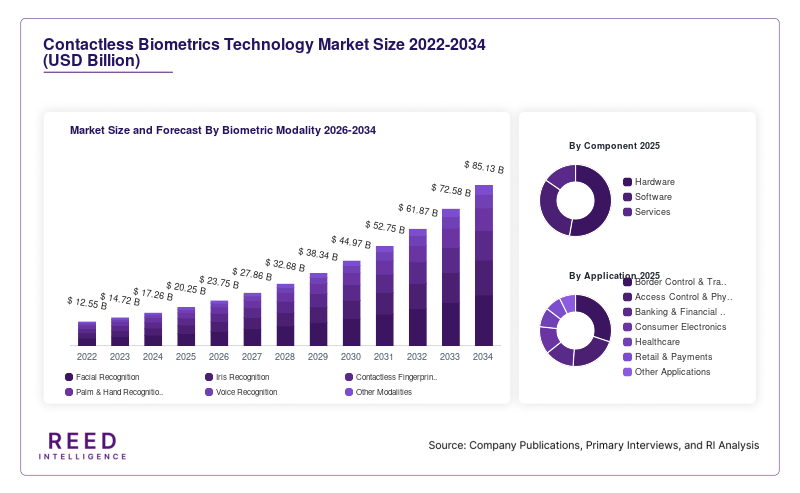
Facial Recognition represents approximately 48% of the global market in 2025, making it the dominant modality. Its advantage is that authentication can occur without requiring users to place a finger, hand or eye against a sensor. This is particularly useful in airports, border checkpoints, building entrances and smartphones.
CBP's biometric airport network is based primarily on facial comparison, while India’s DigiYatra uses facial recognition to create a contactless airport journey.
NEC reported in March 2026 that its facial-recognition algorithm ranked first in the latest NIST 1:N identification benchmark, with an authentication error rate of 0.06% in a test involving still images of 12 million people.
Iris Recognition
Iris Recognition accounts for approximately 18% and is the fastest-growing modality, registering approximately 19.6% CAGR. Iris recognition is attractive where organizations need a contactless biometric that can operate at controlled distances while providing an additional modality for high-assurance identification.
IDEMIA includes iris alongside face and fingerprint recognition in its passenger-processing portfolio, while its OneLook Gen2 solution is designed for walk-through biometric identity checks using face and iris capture.
The commercial opportunity is strongest in border management, high-security facilities, transportation and multimodal identity systems.
Contactless Fingerprint Recognition
Contactless Fingerprint Recognition represents approximately 15% of the market. The technology preserves the familiarity of fingerprint-based authentication while eliminating direct contact with a scanner.
NIST has established specific recommendations for contactless fingerprint capture and data interchange, reflecting the need to connect new contactless captures with existing biometric infrastructure.
Palm & Hand Recognition
Palm & Hand Recognition represents approximately 10% of the market. The modality is relevant to access control, payments and selected commercial environments where users can present a hand without touching a reader.
Mastercard's biometric-checkout framework supports palm, face and iris-based authentication, demonstrating how hand-based biometrics can move from physical security toward commercial payment use cases.
Voice Recognition
Voice Recognition accounts for approximately 5% of the market. It is primarily relevant to remote authentication, customer-service environments and digital access rather than high-throughput physical checkpoints.
By Component
Hardware
Hardware represents approximately 52% of the market, covering cameras, optical sensors, fingerprint readers, iris scanners, biometric terminals, edge-processing devices and specialized airport or access-control equipment.
Hardware remains important because contactless biometrics requires physical capture equipment capable of operating reliably at distance and under varying lighting, movement and environmental conditions.
Software
Software accounts for approximately 29% and is the fastest-growing component at approximately 19.1% CAGR. Software increasingly determines biometric accuracy, liveness detection, identity matching, orchestration, credential management and interoperability.
The shift is visible in airport systems where biometric hardware is combined with cloud platforms, mobile applications, identity-management systems and APIs. Thales' Fly to Gate, for example, combines facial capture, liveness detection, digital-wallet functionality and integration with airport systems.
Services
Services represent approximately 19% and include system integration, enrollment, consulting, cybersecurity, maintenance, managed identity services and regulatory compliance.
As deployments become larger and more integrated, service requirements increase because biometric systems need to operate within existing IT, security and identity environments.
By Application
Border Control & Travel
Border Control & Travel represents approximately 29% of the market, making it the largest application. Large-scale deployments in the U.S., Europe and India demonstrate how governments and airports are using facial and other biometrics to reduce manual identity checks.
Access Control & Physical Security
Access Control & Physical Security accounts for approximately 23%. Organizations are increasingly integrating biometrics into building, facility and critical-infrastructure access systems.
HID's 2026 research found that biometrics are moving beyond multifactor authentication into core access control, with 45% of respondents identifying biometrics as strategic.
Banking & Financial Services
Banking & Financial Services represents approximately 17%. Applications include customer onboarding, account authentication, fraud prevention and transaction authorization.
Visa's Payment Passkey and Mastercard's biometric payment initiatives demonstrate the migration of biometric authentication into payment transactions.
Consumer Electronics
Consumer Electronics represents approximately 13%. Smartphones, computers and applications use facial and fingerprint authentication to unlock devices and authorize sensitive actions.
The advantage is already embedded in the device ecosystem, reducing the need for users to adopt a separate biometric device.
Healthcare
Healthcare accounts for approximately 8% and is among the fastest-growing applications at approximately 19.0% CAGR. Hospitals and healthcare providers can use contactless biometrics for patient identification, staff access and secure digital authentication.
The main requirement is strong privacy governance because healthcare environments combine sensitive personal information with biometric identity data.
Retail & Payments
Retail & Payments represents approximately 6%, with biometric checkout and device-based biometric authentication providing the principal growth mechanisms. Mastercard's biometric checkout framework supports face, palm and iris-based payment experiences.
Regional Analysis
North America Contactless Biometrics Technology Market
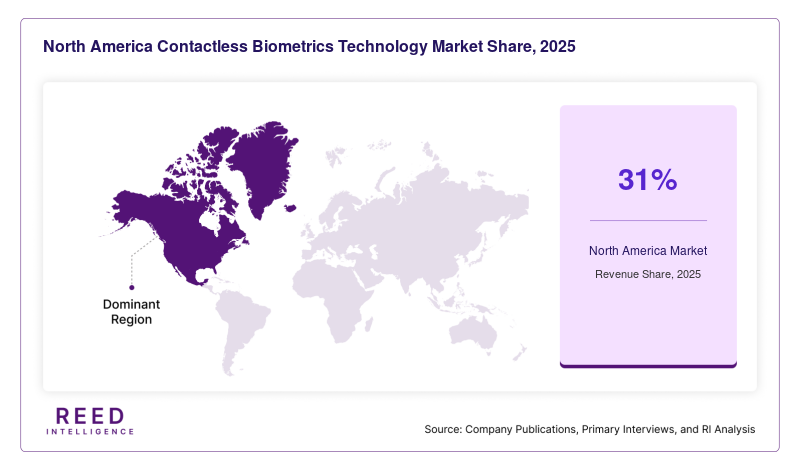
North America represents approximately 31% of the global contactless biometrics technology market in 2025, making it one of the largest regional markets, with approximately 16.2% CAGR.
The region has a strong installed base in government identity, aviation security, enterprise access control and consumer electronics. CBP uses biometric facial comparison at 238 airports, while TSA's biometric strategy includes touchless identity verification and self-service capabilities.
The financial sector is another demand source. Visa supports biometric payment authentication through Payment Passkey, and Mastercard and Google Pay announced expanded device-based biometric payment authentication in September 2026.
The enterprise market is also moving toward identity convergence. HID reported that 73% of respondents identified identity management as a top priority in its 2026 research, while 45% viewed biometrics as strategic.
The principal constraint is governance. U.S. deployments must manage privacy, consent, security, algorithmic performance and sector-specific requirements. Customers are therefore increasingly looking for vendors that can provide complete identity systems rather than individual biometric devices.
Europe Contactless Biometrics Technology Market
Europe accounts for approximately 21% of the global market in 2025, with approximately 15.3% CAGR.
The region's largest current deployment mechanism is border modernization. The EU Entry/Exit System became fully operational on April 10, 2026, across the external borders of the 29 Schengen countries, recording fingerprints and facial images for covered non-EU short-stay travelers.
By July 2026, more than 145 million entries and exits had been registered through EES. The system is also intended to support automated border control and self-service processing.
European regulation is simultaneously shaping technology design. The AI Act imposes specific requirements on permitted high-risk biometric applications and places restrictions on certain remote identification and biometric categorization practices.
This creates demand for privacy-preserving architectures, consent management, data minimization, accuracy testing and secure biometric storage. Vendors able to demonstrate interoperability with European identity and border standards have an advantage in large public-sector projects.
APAC Contactless Biometrics Technology Market
APAC represents approximately 32% of the global market in 2025 and is the fastest-growing region, registering approximately 20.1% CAGR.
The region's growth is supported by large-scale airport modernization, digital identity programs, mobile authentication and high smartphone penetration. India provides a clear example through DigiYatra, which uses facial authentication for contactless airport journeys. The Ministry of Civil Aviation reported in June 2026 that DigiYatra had crossed 100 million journeys.
Japan, Singapore, South Korea, China, India and Australia also have significant biometric and digital-identity activity, although regulatory approaches and deployment models differ between countries. FIDO's 2026 passkey research included Australia, Singapore, Japan, South Korea, China and India, demonstrating the relevance of the region to the wider passwordless authentication transition.
Vendors are also developing region-specific airport solutions. IDEMIA identifies APAC as an important market for contactless face, iris and fingerprint passenger processing, while its portfolio includes contactless ten-fingerprint and walk-through multimodal systems.
The main constraint is regional fragmentation. Different countries use different identity standards, privacy frameworks, government databases and procurement models. Suppliers therefore need flexible integration architectures rather than one standardized deployment model.
Middle East and Africa Contactless Biometrics Technology Market
Middle East and Africa accounts for approximately 8% of the global market in 2025, with approximately 18.4% CAGR.
The region is developing contactless biometrics through airport modernization, border management, smart-city programs, financial services and enterprise access control. High-throughput environments such as airports are particularly suited to contactless systems because the commercial value comes from processing more users with fewer manual identity checks.
The technology is also relevant to digital financial services. Mastercard has described biometric authentication as a potential mechanism for payment applications using face, palm and iris recognition, while newer device-based payment authentication is reducing dependence on manual passwords and OTPs.
The region's opportunity is strongest in digitally advanced Gulf markets, major airports and government identity programs. The main limitations are differences in national identity infrastructure, privacy regulation, procurement cycles and technology maturity between countries.
LATAM Contactless Biometrics Technology Market
LATAM represents approximately 8% of the global market in 2025, with approximately 18.0% CAGR.
Financial services and retail payments are important growth channels. Mastercard's biometric checkout program was piloted in Brazil with PayFace and St. Marche, using facial recognition for in-store payment authentication. Mastercard reported a 95% transaction approval rate during the pilot and a 10% increase in purchases among biometric-checkout customers.
The region also has established applications in airports, identity management and financial services. Brazil is particularly relevant because biometric payment and identity solutions have been tested in commercial environments rather than remaining limited to government deployments.
The main constraints include differences in financial infrastructure, privacy frameworks, consumer adoption and investment capacity between countries. Providers that combine biometric authentication with payment infrastructure and mobile platforms can address a broader range of use cases.
Competitive Landscape
The contactless biometrics technology market is becoming more competitive as specialist biometric companies, identity-security providers, semiconductor and device companies, payment networks and large technology groups converge around digital identity.
Competition increasingly depends on accuracy, liveness detection, interoperability, privacy, deployment scale and integration capability rather than sensor specifications alone. NEC, for example, reported in March 2026 that its facial-recognition algorithm ranked first in NIST's latest 1:N evaluation, illustrating how independent performance testing can influence technology positioning.
IDEMIA is building integrated travel systems spanning biometric capture, identity management, passenger processing and airport automation. Its February 2026 partnership with Elenium connects biometrics with self-service airport infrastructure and baggage identification.
Key Market Players
Recent Market Developments
September 2026 – Mastercard and Google Pay expand device biometric payment authentication
Mastercard and Google Pay announced a collaboration to introduce device-based biometric card-payment authentication through Google Pay. Eligible users will be able to authenticate transactions using fingerprints or facial recognition built into compatible smartphones. This extends contactless biometrics into everyday digital payments and reduces reliance on SMS-based OTP authentication.
August 2026 – EU Entry/Exit System exceeds 150 million entries and exits
The European Commission reported in August 2026 that EES had registered more than 150 million entries and exits since becoming fully operational, using facial images and fingerprints as part of border processing. The scale demonstrates how biometric infrastructure can move from pilot projects into continent-wide identity systems, supporting demand for sensors, biometric matching, databases and automated border-control equipment.
Contactless Biometrics Technology Market Segments
By Biometric Modality
- Facial Recognition
- Iris Recognition
- Contactless Fingerprint Recognition
- Palm & Hand Recognition
- Voice Recognition
- Other Modalities
By Component
- Hardware
- Software
- Services
By Application
- Border Control & Travel
- Access Control & Physical Security
- Banking & Financial Services
- Consumer Electronics
- Healthcare
- Retail & Payments
- Other Applications
By Region
- North America
- Europe
- APAC
- Middle East and Africa
- LATAM