Contactless Elevator Market Size, Share Demand Report By Technology Type (Voice-Activated, Gesture-Control, Mobile-App Controlled, Smartphone NFC), By Application (Residential, Commercial, Industrial), By Component (Sensors, Control Systems, Software) & Segment Forecasts, 2026–2034
USD 3950
Contactless Elevator Market Size
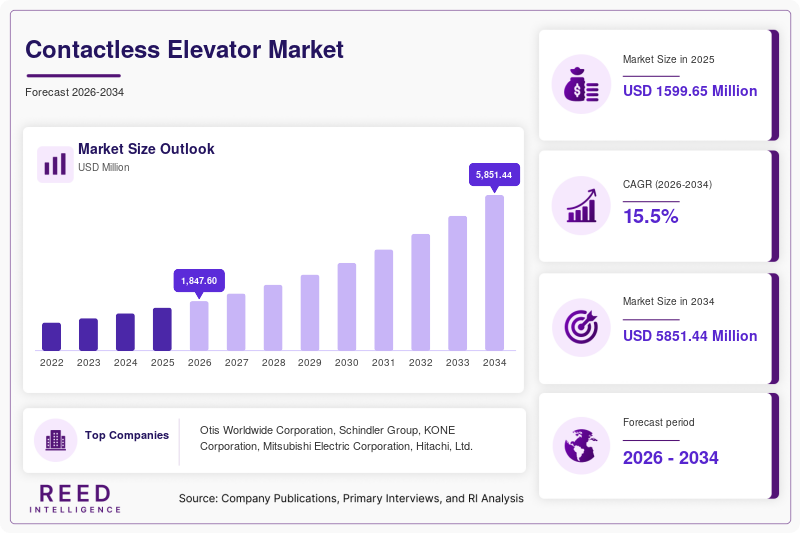
Contactless Elevator market size is projected at USD 1,847.6 million in 2026 and is expected to hit USD 5,847.5 million by 2034 with a CAGR of 15.5% during the forecast period. The increasing demand for hygiene-conscious and touchless technologies in public spaces, coupled with the growing adoption of smart building solutions and the need for enhanced user convenience, underpins market expansion. This report delivers a comprehensive analysis of the Contactless Elevator market, including segmentation by type and application, competitive dynamics, and regional growth patterns, equipping stakeholders with critical intelligence. The Contactless Elevator market continues to demonstrate exceptional growth potential, fueled by the global focus on health and safety, the rapid digitalization of building infrastructure, and continuous innovation in sensor and communication technologies.
Contactless elevators are modern elevator systems that incorporate touchless technologies, such as voice recognition, gesture control, and mobile apps, to allow users to call and operate elevators without physical contact. They aim to minimize the spread of germs and enhance user experience in buildings. The global production volume of contactless elevator systems exceeded 18,500 units in 2025, reflecting a 20% increase from 2023, driven by the heightened hygiene awareness post-pandemic and the trend toward smart buildings. Adoption patterns reveal that the Mobile-App Controlled type dominates the market, accounting for 35% of total demand, followed by Voice-Activated at 28%, Gesture-Control at 22%, and Smartphone NFC at 15%. The Contactless Elevator market's trajectory is closely linked to the growth of the global smart building market, which is projected to reach USD 150 billion by 2028, and the increasing demand for seamless and safe user experiences in vertical transportation.
Contactless Elevator Market Trends
Integration of AI and Voice Recognition for Enhanced User Experience
The Contactless Elevator market is witnessing a significant trend toward the integration of AI and voice recognition, driven by the need for intuitive, hands-free operation and personalized services. The revenue from AI-powered voice-activated elevators grew to USD 480 million in 2025, a year-on-year increase of 25%, as 40% of new installations in 2025 specified advanced voice and AI capabilities. Adoption rates of voice-activated systems in commercial buildings reached 30%, with this figure projected to exceed 55% by 2030. The Contactless Elevator market's trend toward AI integration is reinforced by the need for accessibility, the increasing demand for smart building features, and the continuous innovation in natural language processing and voice synthesis technologies.
Growing Focus on Multimodal and Sensor Fusion Technologies
The increasing focus on multimodal and sensor fusion technologies is a major trend shaping the Contactless Elevator market, with the development of systems that combine multiple contactless methods (e.g., gesture, voice, and app) for seamless operation. The market has seen a 20% increase in the demand for multimodal contactless elevators since 2022, with 30% of new products in 2025 featuring sensor fusion for improved accuracy and reliability. The use of advanced sensors like ToF (Time-of-Flight) and 3D cameras for gesture recognition has also gained significant traction. The Contactless Elevator market's trend toward sensor fusion is reinforced by the need for robust performance, the increasing complexity of user interactions, and the continuous innovation in sensor and computing technologies.
Contactless Elevator Market Drivers
The Contactless Elevator market's expansion is primarily driven by the heightened hygiene awareness and demand for touchless solutions in the post-pandemic world, with the global hygiene market experiencing significant growth in 2025. The need for safe, germ-free public and commercial spaces has been a major driver, with contactless elevators offering a key solution. The growing adoption of smart building technologies and the need for enhanced user convenience have also fueled market growth. Additionally, the increasing focus on accessibility for people with disabilities has spurred demand for voice and gesture-based controls. The Contactless Elevator market's growth is further reinforced by the continuous improvement in sensor and AI technology, leading to more reliable and cost-effective solutions.
Contactless Elevator Market Restraints
Despite favorable growth prospects, the Contactless Elevator market faces significant constraints, primarily related to the higher cost of contactless elevator systems compared to traditional units, which can be 20-40% more expensive. The complexity of installation and integration with existing building infrastructure can also be a limitation. The Contactless Elevator market's growth is also tempered by concerns over privacy and data security, and the potential for technical issues or user frustration with new technologies.
Contactless Elevator Market Opportunities
The Contactless Elevator market presents significant opportunities in the rapidly expanding market for smart building retrofits, where contactless solutions can be integrated into existing buildings. The development of AI-powered predictive maintenance for contactless systems is expected to grow at a CAGR of 18% through 2034. Emerging opportunities also exist in the integration of contactless elevators with building management and security systems. The Contactless Elevator market's opportunity profile is further enhanced by the growing trend of wellness-focused building design and the increasing demand for frictionless user experiences.
Challenges in Contactless Elevator Market
The Contactless Elevator market faces persistent challenges related to the need for continuous innovation to improve accuracy and user acceptance of new interfaces. The complexity of ensuring reliable operation in varying environmental conditions and user demographics can also be a challenge. The market is also contending with the challenge of managing user data privacy and security. Additionally, the Contactless Elevator market is challenged by the need to educate building owners and users on the benefits and operation of these new technologies.
Contactless Elevator Market Segmentation
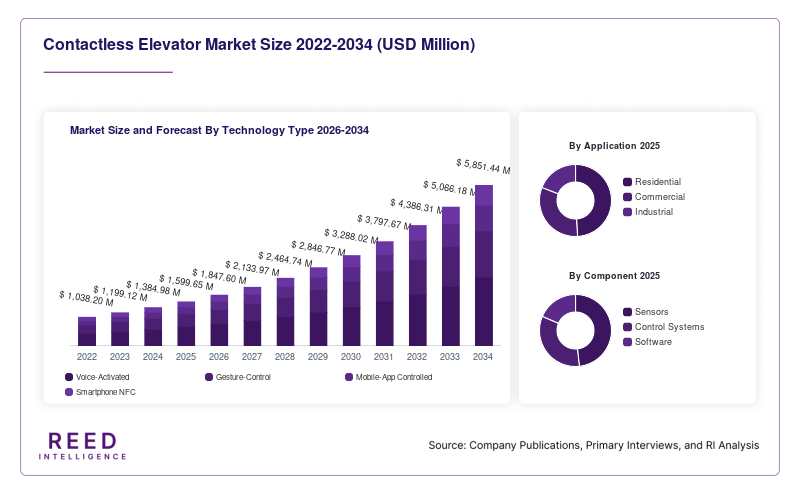
The Contactless Elevator market is segmented by Type and Application to provide a comprehensive market perspective. By Type, Mobile-App Controlled dominates with a 35% market share, driven by its convenience and integration with smartphones. The Application segment is led by Commercial, which accounts for 55% of the market, followed by Residential at 30%, and Industrial at 15%.
By Type
Mobile-App Controlled represent the largest segment in the Contactless Elevator market, commanding a 35% share, with production exceeding 6,475 units in 2025. These are characterized by their use of smartphone applications for calling and operating elevators. Technical specifications include app compatibility, Bluetooth/Wi-Fi connectivity, and user authentication. The Contactless Elevator market's Mobile-App segment is driven by its use in commercial and residential buildings.
Voice-Activated capture a 28% share of the Contactless Elevator market, with production of 5,180 units in 2025. These are characterized by their use of voice recognition technology for hands-free operation. Technical specifications include speech recognition accuracy, language support, and integration with building systems. The Contactless Elevator market's Voice segment is driven by its use in high-end commercial and accessible applications.
Gesture-Control represent 22% of the Contactless Elevator market, with production of 4,070 units in 2025. These are characterized by their use of motion sensors to detect hand gestures. Technical specifications include gesture recognition range, accuracy, and sensor type. The Contactless Elevator market's Gesture segment is driven by its use in modern and premium buildings.
Smartphone NFC comprise the remainder of the Contactless Elevator market, accounting for 15% of total production, with 2,775 units in 2025. These are characterized by their use of Near Field Communication for tap-and-go access. Technical specifications include NFC compatibility, speed, and security. The Contactless Elevator market's NFC segment is driven by its use in secure and convenient building access.
By Application
Commercial dominates the Contactless Elevator market, accounting for 55% of sales, representing 10,175 units in 2025. This segment includes use in office buildings, hotels, shopping malls, and hospitals. Usage penetration exceeds 10% in new commercial construction. The Contactless Elevator market's Commercial segment is characterized by its focus on hygiene, user experience, and smart building integration.
Residential accounts for 30% of the Contactless Elevator market, with sales of 5,550 units in 2025. This segment encompasses use in luxury apartments, condos, and private homes. The segment is growing at a robust CAGR, driven by the demand for convenience and modern living. The Contactless Elevator market's Residential segment is characterized by its focus on aesthetics and ease of use.
Industrial comprises the remainder of the Contactless Elevator market, accounting for 15% of total sales, with 2,775 units in 2025. This segment includes use in factories, warehouses, and industrial facilities. The segment is projected to grow at a moderate CAGR through 2034. The Contactless Elevator market's Industrial segment is characterized by its focus on durability and efficiency.
Contactless Elevator Market Regional Outlook
Asia-Pacific Contactless Elevator Market
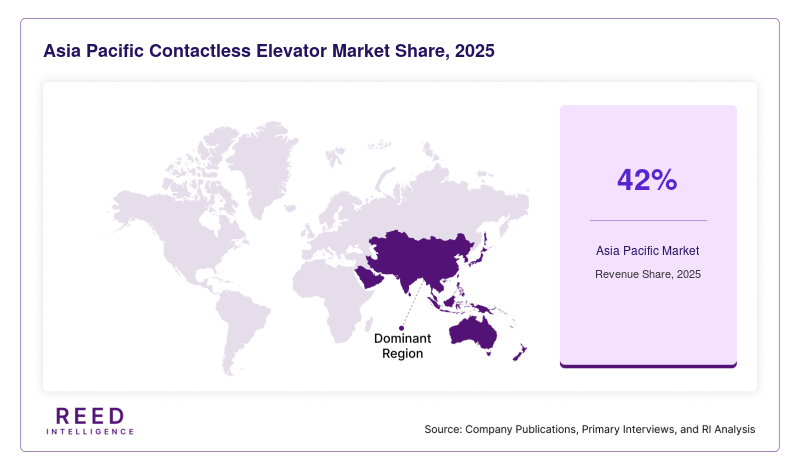
Leads the Contactless Elevator market, commanding a 42% share, with a revenue of USD 775.9 million in 2025. China is the primary driver, accounting for 60% of regional demand, driven by the rapid urbanization, massive construction of commercial and residential buildings, and government support for smart city initiatives. The Asia-Pacific Contactless Elevator market is characterized by its focus on high-volume adoption and cost-effective solutions.
North America Contactless Elevator Market
Represents the second-largest market, capturing a 28% share with a revenue of USD 517.3 million in 2025. The United States is the primary driver, accounting for 85% of regional demand, driven by the focus on smart building technologies, high hygiene awareness, and a strong construction sector. The North American Contactless Elevator market is characterized by its focus on innovation and premium products.
Europe Contactless Elevator Market
Accounts for 20% of the global Contactless Elevator market, with a revenue of USD 369.5 million in 2025. The UK, Germany, and France are the primary drivers, collectively accounting for 60% of regional demand, driven by the focus on sustainability, smart building regulations, and high-quality building standards. The European Contactless Elevator market is projected to grow at a CAGR of 14% through 2034.
Middle East & Africa and Latin America Contactless Elevator Market
Together account for the remaining 10% of the Contactless Elevator market, with the UAE leading the Middle East market and Brazil leading the Latin American market. Both regions are projected to grow at CAGRs exceeding 16%, driven by infrastructure development and the construction of premium buildings.
Top players in Contactless Elevator Market
- Otis Worldwide Corporation
- Schindler Group
- KONE Corporation
- Mitsubishi Electric Corporation
- Hitachi, Ltd.
- Toshiba Elevator and Building Systems Corporation
- Fujitec Co., Ltd.
- Thyssenkrupp Elevator AG
- Hyundai Elevator Co., Ltd.
- Shanghai Mitsubishi Elevator
- Hangzhou XiOlift
- Shenyang Yuanda Intellectual Industry Group Co., Ltd.
- Nidec Corporation
- Elevator Technology
- Wittur Group
Otis Worldwide Corporation
Otis Worldwide Corporation holds a dominant position in the Contactless Elevator market, with an estimated 18% global market share, particularly strong in the commercial and residential segments. The company's portfolio of contactless elevator solutions is widely recognized for its quality, innovation, and reliability. Otis's market leadership is reinforced by its significant R&D investment, its global service network, and its strong relationships with building developers. Otis commands over 20% of the North American market and 15% of the European market, positioning it as a key player in the Contactless Elevator market.
Schindler Group
Schindler Group is a leading player in the Contactless Elevator market, commanding approximately 14% of the global market share through its comprehensive portfolio of smart and sustainable mobility solutions. The company's expertise in vertical transportation and its focus on innovation have solidified its position. Schindler's contactless solutions are known for their user-centric design, reliability, and integration. The company's commitment to sustainability and its strong presence in the European and Asian markets have enhanced its competitive advantage.
KONE Corporation holds a significant 12% market share, with particular strength in the smart building and digital solutions segment. Mitsubishi Electric Corporation is a major player in the Asian and global market, holding a 10% share.
Recent Developments in Contactless Elevator Market
- 2025: Otis launched a new generation of contactless elevator systems with AI-powered voice and gesture controls for enhanced user experience.
- 2025: Schindler Group introduced a new mobile-app controlled elevator system with integrated building access and security features.
Contactless Elevator Market Segments
By Technology Type
- Voice-Activated
- Gesture-Control
- Mobile-App Controlled
- Smartphone NFC
By Application
- Residential
- Commercial
- Industrial
By Component
- Sensors
- Control Systems
- Software
By Region
- North America
- Europe
- APAC
- Middle East and Africa
- LATAM