Control Valves Market Size, Share & Demand Report By Valve Type (Globe Valves, Ball Valves, Butterfly Valves, Gate Valves, Plug Valves, Others), By Component (Actuators, Valve Bodies, Positioners, Sensors, Controllers), By End-Use Industry (Oil & Gas, Power Generation, Water & Wastewater Treatment, Chemicals, Pharmaceuticals, Food & Beverages, Metals & Mining, Others), By Region & Segment Forecasts, 2026–2034
USD 3950
Market Overview
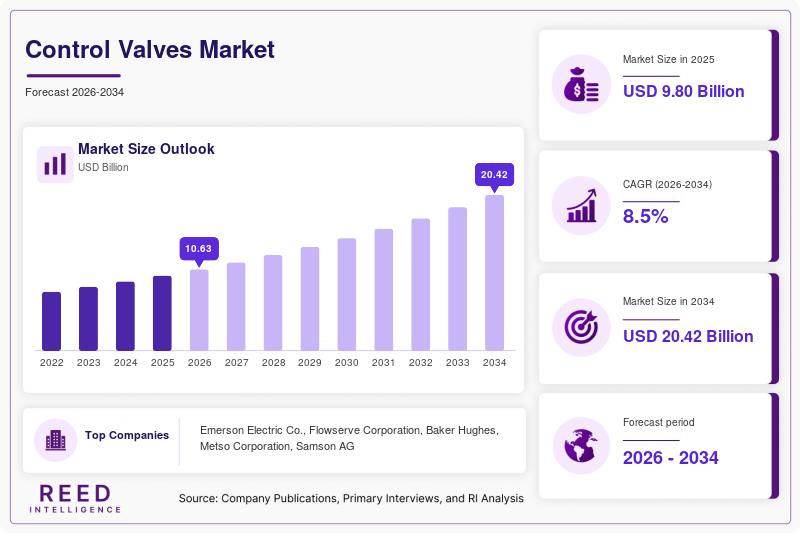
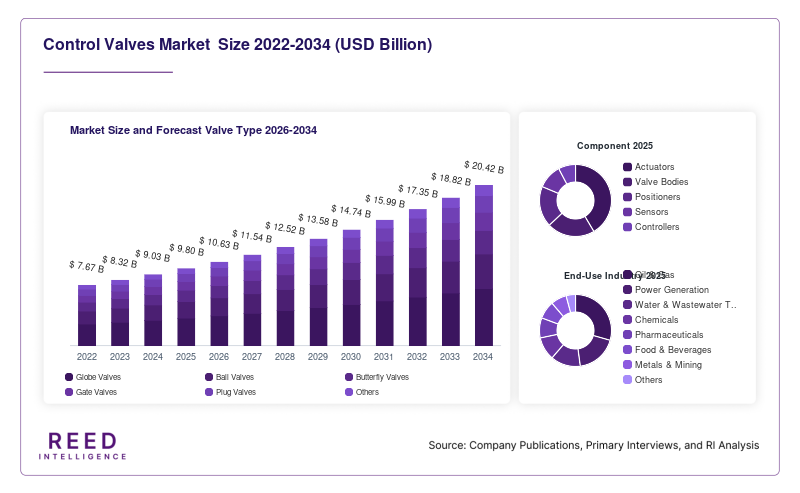
The Control Valves Market size was valued at approximately USD 9.8 billion in 2026 and is projected to reach USD 18.9 billion by 2034, expanding at a CAGR of 8.5% during the forecast period from 2026 to 2034. Control valves play a critical role in regulating fluid flow, pressure, temperature, and liquid levels across industrial processes. These valves are widely deployed in oil & gas, power generation, water treatment, chemicals, pharmaceuticals, food processing, and manufacturing facilities where process accuracy and operational reliability are essential.
A major factor supporting market growth is the increasing global emphasis on industrial automation and digital process control. Industries are investing in intelligent control systems to improve efficiency, reduce operational costs, enhance safety, and comply with environmental regulations. Modern control valves integrated with sensors, predictive maintenance software, and industrial communication technologies are becoming integral components of smart manufacturing environments.
Key Highlights
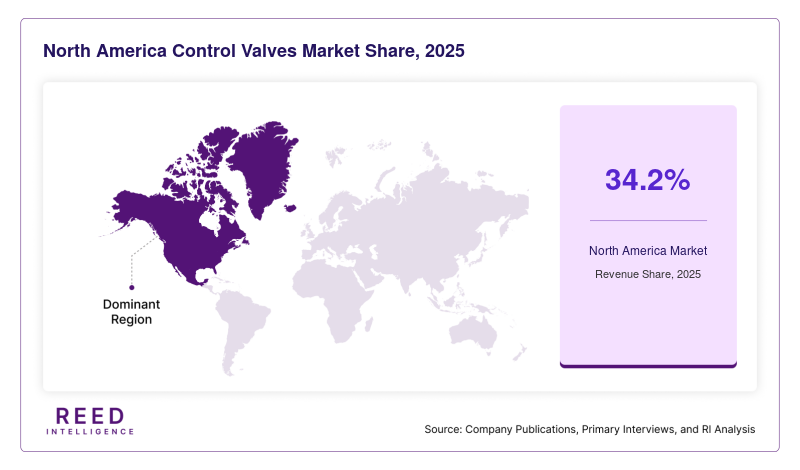
- North America dominated the market with a 34.2% share in 2025, while Asia Pacific is expected to grow at the fastest CAGR of 10.8% during 2026–2034.
- By valve type, globe valves accounted for the largest share of 36.4%, while ball valves are projected to grow at a CAGR of 10.9%.
- By component, actuators led with a 42.1% share, whereas digital positioners are expected to expand at a CAGR of 11.4%.
- By end-use industry, oil & gas held the largest share of 28.7%, while water & wastewater treatment is forecast to grow at a CAGR of 11.2%.
- The United States remained the dominant country, with market values of USD 2.85 billion in 2024 and USD 3.06 billion in 2025.
Market Trends
Rising Adoption of Smart and Connected Control Valves
The industrial sector is witnessing a notable shift toward intelligent valve systems equipped with digital communication capabilities, embedded diagnostics, and predictive maintenance functions. Companies are increasingly adopting smart control valves that provide real-time operating data and facilitate remote monitoring. These solutions help operators identify performance issues before equipment failure occurs, minimizing downtime and maintenance costs. The integration of Industrial Internet of Things technologies is further enhancing valve functionality by enabling seamless communication with centralized process control systems. Demand for connected valves is particularly strong in chemical processing, power generation, and oil & gas facilities where process continuity is critical. As industries continue their digital transformation initiatives, smart valve deployment is expected to accelerate throughout the forecast period.
Expansion of Sustainable Industrial Infrastructure
Governments and private organizations are increasing investments in sustainable industrial projects that require precise flow management systems. Water treatment plants, renewable energy facilities, hydrogen production projects, and carbon capture installations are creating substantial demand for advanced control valves. Environmental regulations are encouraging industries to optimize resource consumption and reduce emissions through accurate process control. Modern valve technologies support these objectives by improving operational efficiency and minimizing waste. Additionally, industries are replacing older equipment with energy-efficient systems that comply with stricter environmental standards. This trend is strengthening demand for high-performance control valves across both developed and emerging economies, contributing to long-term market growth.
Market Drivers
Increasing Industrial Automation Across Manufacturing Facilities
Industrial automation continues to be a major growth driver for the Control Valves Market. Manufacturers are investing heavily in automated production systems to enhance productivity, improve product quality, and reduce labor-intensive operations. Control valves serve as critical components within automated environments because they regulate fluid flow and process variables with high precision. Industries such as pharmaceuticals, chemicals, food processing, and electronics manufacturing are increasingly deploying advanced process control systems that require reliable valve technologies. The growing implementation of distributed control systems and supervisory control platforms is further increasing valve demand. As automation adoption expands globally, the requirement for technologically advanced control valves is expected to rise steadily.
Growing Investments in Energy and Utility Infrastructure
Large-scale investments in energy generation, transmission infrastructure, and utility modernization projects are supporting market expansion. Power plants, refineries, petrochemical facilities, and water distribution networks depend on control valves for safe and efficient operation. Emerging economies are expanding industrial infrastructure to meet rising energy demand and urbanization requirements. Simultaneously, developed countries are upgrading aging utility networks and industrial facilities to improve reliability and environmental performance. These projects involve extensive installation of control valves for fluid regulation and process optimization. Continued infrastructure spending is anticipated to create sustained demand across multiple industrial sectors over the forecast period.
Market Restraint
High Initial Installation and Maintenance Costs
Despite favorable growth prospects, high installation and maintenance costs remain a significant challenge for market participants. Advanced control valves equipped with intelligent diagnostics, actuators, and communication systems often require substantial capital investment. Small and medium-sized enterprises may face budget constraints that limit adoption of premium valve solutions. In addition to procurement expenses, installation often requires system integration, engineering expertise, and workforce training. Maintenance requirements can also be complex, particularly in harsh industrial environments where valves operate under extreme temperatures, pressures, or corrosive conditions. These cost-related factors can delay replacement cycles and reduce purchasing activity in price-sensitive markets. For example, manufacturing facilities operating with limited capital budgets may continue using conventional mechanical valves rather than upgrading to digitally connected systems. Such challenges may moderately affect market penetration in certain regions despite ongoing technological advancements.
Market Opportunities
Expansion of Water and Wastewater Treatment Facilities
Rapid urbanization and increasing concerns regarding water scarcity are creating substantial opportunities for control valve manufacturers. Governments worldwide are investing in water treatment, desalination, and wastewater recycling projects to ensure sustainable resource management. Control valves play an essential role in regulating flow rates, pressure levels, and treatment processes throughout these facilities. The growing need for efficient water infrastructure is encouraging adoption of automated valve systems capable of improving process reliability and reducing operating costs. Emerging economies are particularly active in expanding municipal water networks and treatment plants. As investments in water infrastructure continue to rise, demand for advanced control valves is expected to increase significantly.
Growth of Hydrogen and Clean Energy Projects
The emergence of hydrogen production, storage, and transportation infrastructure presents new growth avenues for the Control Valves Market. Governments and energy companies are investing in clean energy technologies to support decarbonization objectives and energy transition strategies. Hydrogen facilities require specialized valve solutions capable of handling high-pressure and demanding operating conditions. Similarly, carbon capture systems, biofuel plants, and renewable energy installations rely on accurate process control technologies. Manufacturers are developing advanced valve materials and designs tailored for these applications. As global investment in clean energy infrastructure accelerates, the market is expected to benefit from increasing demand for reliable and efficient control valve solutions.
Segmental Analysis
By Valve Type
Globe valves represented the dominant subsegment, accounting for approximately 36.4% of the market share in 2024. Their widespread adoption is attributed to excellent throttling performance and precise flow regulation capabilities. Globe valves are extensively utilized in power generation, chemical processing, and oil & gas applications where accurate control is essential. Their ability to handle varying pressure conditions and maintain operational stability makes them a preferred choice across many industrial environments. Manufacturers continue enhancing globe valve designs through advanced materials and improved sealing technologies, further supporting adoption. The segment also benefits from strong replacement demand as aging industrial infrastructure undergoes modernization and efficiency upgrades.
Ball valves are expected to emerge as the fastest-growing subsegment, registering a CAGR of 10.9% during the forecast period. Growth is driven by their compact design, durability, low maintenance requirements, and suitability for automated systems. Industries increasingly prefer ball valves because they provide reliable shutoff performance and support efficient flow control in demanding environments. The rising deployment of automated manufacturing systems and smart process control technologies is accelerating demand. Additionally, expanding investments in water treatment facilities, energy infrastructure, and chemical processing plants are creating new opportunities for ball valve manufacturers worldwide.
By Component
Actuators accounted for the largest market share of approximately 42.1% in 2024. These components are essential for automating valve operations and enabling accurate process control. Pneumatic, electric, and hydraulic actuators are widely used across industrial sectors due to their ability to improve operational efficiency and reduce manual intervention. The growing adoption of automation technologies has significantly increased demand for actuator-equipped valve systems. Industrial facilities are focusing on improving reliability, safety, and productivity through automated solutions, strengthening the position of actuators within the market. Continued advancements in actuator performance and energy efficiency are expected to support sustained segment growth.
Digital positioners are projected to be the fastest-growing component category, expanding at a CAGR of 11.4% through 2034. These devices enhance valve performance by providing accurate positioning, real-time diagnostics, and predictive maintenance capabilities. Industries are increasingly adopting digital positioners as part of broader digital transformation initiatives. The ability to monitor valve health remotely and optimize process efficiency is driving adoption across critical applications. Growing integration with industrial communication networks and smart manufacturing systems further supports demand. As companies prioritize operational visibility and data-driven maintenance strategies, digital positioners are expected to experience substantial growth.
By End-Use Industry
Oil & gas remained the dominant end-use industry, accounting for approximately 28.7% of market revenue in 2024. Control valves are extensively used throughout upstream, midstream, and downstream operations to regulate pressure, flow, and temperature. The industry's complex operating environments require robust and highly reliable valve solutions capable of maintaining process safety and efficiency. Continued investments in exploration, refining, and pipeline infrastructure support demand for advanced control technologies. Furthermore, modernization initiatives within existing facilities are encouraging replacement of conventional valves with automated and digitally enabled systems that improve operational performance and reduce maintenance requirements.
Water & wastewater treatment is expected to be the fastest-growing end-use segment, recording a CAGR of 11.2% during the forecast period. Increasing global concerns regarding water security and environmental sustainability are driving investments in treatment infrastructure. Municipal authorities and industrial operators are deploying advanced process control systems to improve efficiency and regulatory compliance. Control valves play a critical role in filtration, chemical dosing, and distribution processes. The growing adoption of smart water management technologies and expansion of wastewater recycling projects are creating significant opportunities. Rising urban populations and infrastructure development programs further strengthen long-term demand for control valve solutions within this sector.
Regional Analysis
North America
North America accounted for approximately 34.2% of the global Control Valves Market in 2025, maintaining its position as the largest regional market. The region benefits from extensive industrial automation adoption, mature manufacturing sectors, and strong investments in energy infrastructure. Market growth is projected at a CAGR of 7.8% through 2034 as industries continue upgrading process control systems and implementing digital technologies. Demand remains particularly strong across oil & gas, power generation, and chemical processing facilities.
The United States dominates the regional market due to its large industrial base and continuous modernization of manufacturing operations. A unique growth factor supporting the country is the ongoing deployment of advanced industrial digitalization initiatives across critical infrastructure sectors. Companies are increasingly investing in intelligent control systems that require smart valves equipped with predictive maintenance and diagnostic capabilities, creating sustained demand for technologically advanced products.
Europe
Europe represented approximately 27.1% of global market revenue in 2025 and is expected to expand at a CAGR of 7.6% during the forecast period. The region's strong industrial manufacturing ecosystem and stringent environmental regulations support the adoption of advanced process control technologies. Industries are focusing on operational efficiency, energy conservation, and emissions reduction, all of which contribute to growing demand for high-performance control valves.
Germany remains the dominant country within the European market due to its extensive manufacturing, chemical, and industrial engineering sectors. A unique growth factor is the country's leadership in industrial automation and smart factory implementation. German manufacturers continue investing in connected production environments, creating consistent demand for intelligent valve systems that support precise process control and operational optimization.
Asia Pacific
Asia Pacific held around 24.6% of the global market in 2025 and is projected to register the fastest CAGR of 10.8% through 2034. Rapid industrialization, urban development, and infrastructure expansion across major economies are driving market growth. Governments are supporting manufacturing investments and energy projects, increasing the deployment of process control equipment across various industries. The region is becoming a major production hub for chemicals, pharmaceuticals, and electronics.
China dominates the regional market owing to its vast manufacturing sector and large-scale infrastructure investments. A unique growth factor is the country's ongoing expansion of industrial automation initiatives aimed at improving productivity and competitiveness. Significant investments in smart manufacturing facilities and advanced process industries continue to stimulate demand for modern control valve technologies throughout the forecast period.
Middle East & Africa
The Middle East & Africa accounted for approximately 7.5% of global revenue in 2025 and is anticipated to grow at a CAGR of 8.2% through 2034. The region's strong dependence on oil & gas production and increasing investments in petrochemical facilities support demand for control valves. Governments are also diversifying their economies through industrial development programs that require advanced process control equipment.
Saudi Arabia leads the regional market due to its extensive energy infrastructure and industrial expansion projects. A unique growth factor is the country's focus on developing integrated petrochemical and downstream manufacturing complexes. These projects require sophisticated flow control systems capable of operating under demanding industrial conditions, thereby increasing adoption of advanced valve technologies.
Latin America
Latin America captured approximately 6.6% of the global Control Valves Market in 2025 and is forecast to grow at a CAGR of 8.0% through 2034. Industrial modernization, mining activities, and utility infrastructure investments are supporting regional demand. Governments and private organizations are upgrading water treatment facilities and industrial plants to improve efficiency and sustainability, creating opportunities for valve manufacturers.
Brazil remains the dominant country within the region due to its diversified industrial base and expanding infrastructure projects. A unique growth factor is the continued investment in water and wastewater treatment systems to support growing urban populations. These projects require precise fluid management technologies, increasing demand for automated and digitally controlled valve solutions across municipal and industrial applications.
Competitive Landscape
The Control Valves Market is moderately consolidated, with leading companies focusing on product innovation, strategic partnerships, digital technologies, and geographic expansion. Manufacturers are increasingly developing smart valve solutions that support predictive maintenance and industrial connectivity. Competitive differentiation is often based on product reliability, automation capabilities, material innovation, and industry-specific expertise.
Emerson Electric Co. remains a leading market participant due to its extensive portfolio of control valves, actuators, and digital automation solutions. The company continues investing in intelligent valve technologies designed to improve operational visibility and efficiency. Other major participants include Flowserve Corporation, Baker Hughes, Metso Corporation, and Samson AG, all of which maintain strong positions across industrial process industries.
Key Players
- Emerson Electric Co.
- Flowserve Corporation
- Baker Hughes
- Metso Corporation
- Samson AG
- Schlumberger Limited
- Crane Company
- AVK Holding A/S
- Spirax Group plc
- KSB SE & Co. KGaA
- Curtiss-Wright Corporation
- IMI plc
- Velan Inc.
- KITZ Corporation
- Rotork plc
Recent Developments
- In 2025, a leading industrial automation company introduced a new generation of smart control valves equipped with predictive diagnostics and real-time monitoring capabilities to improve operational efficiency across process industries.
- In 2025, a major valve manufacturer expanded its production facility to increase capacity for automated control valves, addressing growing demand from the oil & gas, chemical, and water treatment sectors.
- In 2024, a global flow control solutions provider launched an advanced digital valve positioner designed to enhance process accuracy, reduce maintenance requirements, and support Industry 4.0 integration.
- In 2024, a prominent engineering company entered a strategic partnership with an industrial software developer to integrate intelligent control valve systems with cloud-based asset management platforms.
- In 2025, a multinational flow control equipment supplier invested in advanced actuator technologies to improve valve performance, energy efficiency, and reliability in critical industrial applications.
Control Valves Market Segments
Valve Type
- Globe Valves
- Ball Valves
- Butterfly Valves
- Gate Valves
- Plug Valves
- Others
Component
- Actuators
- Valve Bodies
- Positioners
- Sensors
- Controllers
End-Use Industry
- Oil & Gas
- Power Generation
- Water & Wastewater Treatment
- Chemicals
- Pharmaceuticals
- Food & Beverages
- Metals & Mining
- Others
By Region
- North America
- Europe
- APAC
- Middle East and Africa
- LATAM