Controllable Pitch Marine Propeller Market Size, Share & Demand Report By Type (Hydraulic Controllable Pitch Propeller, Electric Controllable Pitch Propeller), By Application (Commercial Vessels, Naval Vessels, Offshore Support Vessels), By End-Use (Shipbuilding, Retrofit), By Region & Segment Forecasts, 2026–2034
USD 3950
Market Overview
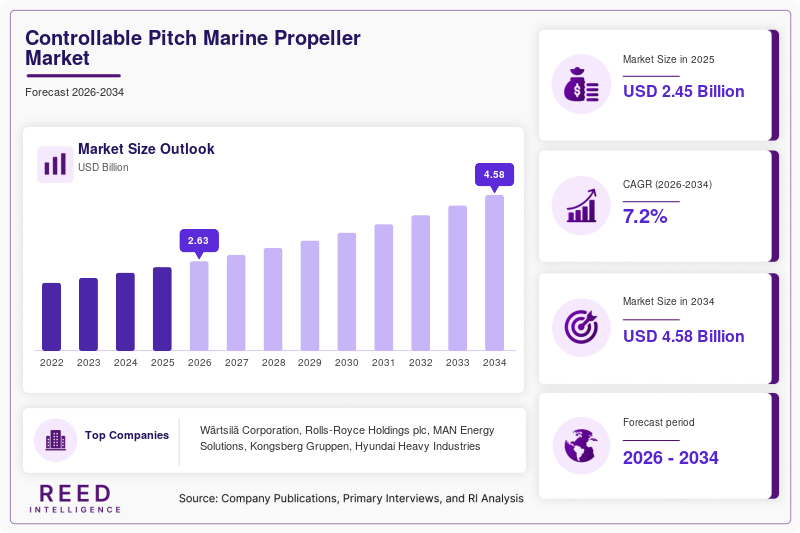
The Controllable Pitch Marine Propeller Market size was valued at approximately USD 2.45 billion in 2026 and is projected to reach USD 4.28 billion by 2034, expanding at a CAGR of 7.2% during the forecast period (2026–2034). The market is driven by the growing demand for fuel-efficient and maneuverable propulsion systems across commercial shipping, naval defense, and offshore vessels. Controllable pitch propellers (CPP) offer enhanced thrust control, improved vessel performance, and reduced fuel consumption compared to fixed pitch systems, making them increasingly preferred in modern marine engineering.
A key global factor supporting market growth is the rapid expansion of international maritime trade. Increasing cargo volumes and the need for operational efficiency have encouraged shipowners to invest in advanced propulsion technologies. CPP systems enable vessels to adjust blade angles in real time, optimizing performance under varying load and sea conditions. This flexibility contributes to reduced emissions and compliance with evolving environmental regulations, further boosting adoption.
Key Highlights
- North America dominated the market with a 32.8% share in 2025.
- Asia Pacific is expected to grow at the fastest CAGR of 8.4% during 2026–2034.
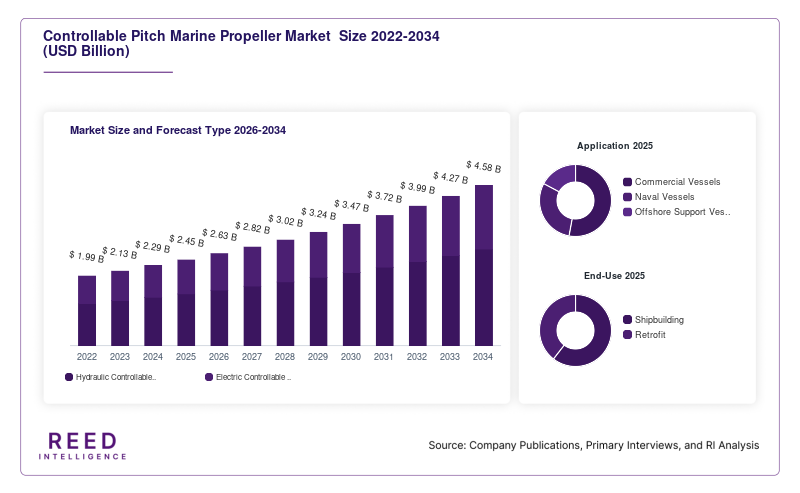
- By type, hydraulic controllable pitch propellers accounted for the largest share of 46.3%, while electric CPP systems are projected to grow at a CAGR of 8.9%.
- By application, commercial vessels led with a 52.1% share, whereas offshore support vessels are expected to expand at a CAGR of 8.1%.
- The United States remained the dominant country, with market values of USD 520 million in 2024 and USD 565 million in 2025.
Market Trends
Integration of Digital Monitoring and Smart Propulsion Systems
The market is witnessing a shift toward digitalization and smart propulsion technologies. Advanced sensors and monitoring systems are being integrated into controllable pitch propellers to enable real-time performance tracking and predictive maintenance. Ship operators are increasingly adopting these technologies to reduce downtime and optimize operational efficiency. Data analytics allows for better fuel consumption management and early detection of mechanical issues, improving lifecycle performance. Furthermore, the integration of automation systems with CPP units enhances vessel control, especially in complex marine operations such as dynamic positioning. This trend aligns with the broader maritime industry's movement toward smart shipping and autonomous vessel technologies.
Increasing Adoption of Hybrid and Electrified Marine Propulsion
Another prominent trend is the rising adoption of hybrid propulsion systems that combine CPP with electric drives. As environmental concerns intensify, shipbuilders are focusing on reducing emissions and improving energy efficiency. Electric CPP systems are gaining traction due to their ability to provide precise control and lower maintenance requirements. Hybrid propulsion setups, which integrate batteries and alternative fuels, benefit significantly from CPP systems due to their adaptability. This trend is particularly evident in ferries, offshore vessels, and naval ships, where operational flexibility is critical. The shift toward electrification is expected to accelerate as regulatory frameworks become stricter.
Market Drivers
Expansion of Global Maritime Trade and Fleet Modernization
The continuous growth in global trade has led to an increase in shipping activities, driving demand for efficient propulsion systems. Shipping companies are investing in fleet modernization to enhance operational efficiency and comply with international standards. Controllable pitch propellers provide superior maneuverability and fuel efficiency, making them a preferred choice for new vessels and retrofits. The ability to maintain optimal engine load under varying conditions reduces fuel consumption and operating costs. Additionally, modernization initiatives often involve replacing outdated propulsion systems with CPP technology, further supporting market growth across commercial and industrial marine sectors.
Stringent Environmental Regulations and Fuel Efficiency Requirements
Environmental regulations imposed by international maritime organizations are pushing shipowners to adopt cleaner and more efficient technologies. CPP systems play a crucial role in reducing fuel consumption and emissions by optimizing propulsion efficiency. These systems allow vessels to operate at optimal performance levels, minimizing energy waste. Compliance with emission standards such as sulfur limits and carbon intensity targets has accelerated the adoption of CPP technology. Furthermore, fuel cost volatility has encouraged operators to invest in systems that improve efficiency, making CPP a strategic solution for long-term operational sustainability.
Market Restraint
High Initial Investment and Maintenance Complexity
The high cost associated with the installation and maintenance of controllable pitch propeller systems remains a significant restraint. Compared to fixed pitch propellers, CPP systems involve complex mechanical and hydraulic components, leading to higher upfront investment. Small and medium-sized shipping companies often find it challenging to justify the cost, especially in price-sensitive markets. Additionally, maintenance requires specialized expertise and periodic inspections, increasing operational expenses. Any malfunction in the pitch control mechanism can impact vessel performance and safety, necessitating immediate repairs. This complexity limits adoption in cost-constrained segments and slows market penetration in developing regions.
Market Opportunities
Growth in Offshore Exploration and Renewable Marine Projects
The expansion of offshore oil and gas exploration, along with the rise of offshore wind energy projects, presents significant opportunities for the CPP market. Offshore support vessels require high maneuverability and precise positioning capabilities, which CPP systems effectively provide. As investments in offshore infrastructure increase, demand for advanced propulsion systems is expected to grow. Renewable energy projects, particularly offshore wind farms, rely on specialized vessels equipped with CPP for installation and maintenance operations. This creates a strong growth avenue for manufacturers targeting niche marine applications.
Increasing Demand for Naval and Defense Vessel Upgrades
Naval modernization programs across various countries are creating opportunities for CPP system providers. Defense vessels require advanced propulsion systems to ensure agility, stealth, and operational efficiency. CPP technology enables rapid speed adjustments and improved maneuverability, which are critical for military operations. Governments are investing in upgrading existing fleets as well as constructing new vessels equipped with modern propulsion systems. The focus on enhancing maritime security and defense capabilities is expected to drive demand for CPP solutions in the coming years.
Segmental Analysis
By Type
Hydraulic controllable pitch propellers dominated the market in 2024, accounting for approximately 46.3% of the total share. These systems are widely used due to their reliability and ability to handle high power loads in large vessels. Hydraulic CPP systems provide precise control over blade pitch, enabling efficient propulsion under varying conditions. Their robust design makes them suitable for commercial ships, naval vessels, and offshore platforms. The widespread adoption of hydraulic systems is also attributed to their proven performance and compatibility with existing marine engines.
Electric controllable pitch propellers are expected to be the fastest-growing subsegment, with a projected CAGR of 8.9%. The growth is driven by increasing demand for energy-efficient and environmentally friendly propulsion solutions. Electric CPP systems offer reduced maintenance requirements and improved control accuracy. They are particularly suitable for hybrid and electric vessels, where integration with battery systems is essential. The shift toward electrification in the maritime industry is a key factor supporting this segment’s growth.
By Application
Commercial vessels held the largest share of 52.1% in 2024, driven by the extensive use of CPP systems in cargo ships, tankers, and container vessels. These vessels require efficient propulsion systems to optimize fuel consumption and improve operational performance. CPP systems enable better maneuverability and speed control, which are critical for commercial shipping operations. The increasing volume of global trade further supports the dominance of this segment.
Offshore support vessels are projected to be the fastest-growing application segment, with a CAGR of 8.1%. The growth is fueled by the expansion of offshore oil and gas exploration and renewable energy projects. These vessels require precise positioning and maneuverability, which CPP systems provide effectively. The increasing complexity of offshore operations is driving demand for advanced propulsion technologies in this segment.
By End-Use
Shipbuilding companies accounted for the largest share in 2024, as CPP systems are widely installed in new vessels during construction. The growing demand for advanced ships with improved efficiency and compliance with environmental regulations drives this segment. Shipbuilders are increasingly integrating CPP systems into their designs to enhance vessel performance and meet customer requirements.
The retrofit segment is expected to grow at the fastest CAGR of 7.8%. The growth is driven by the need to upgrade existing vessels with modern propulsion systems. Retrofitting CPP systems helps improve fuel efficiency and extend the operational life of ships. This trend is particularly strong in regions with aging fleets, where operators seek cost-effective solutions to enhance performance.
Regional Analysis
North America
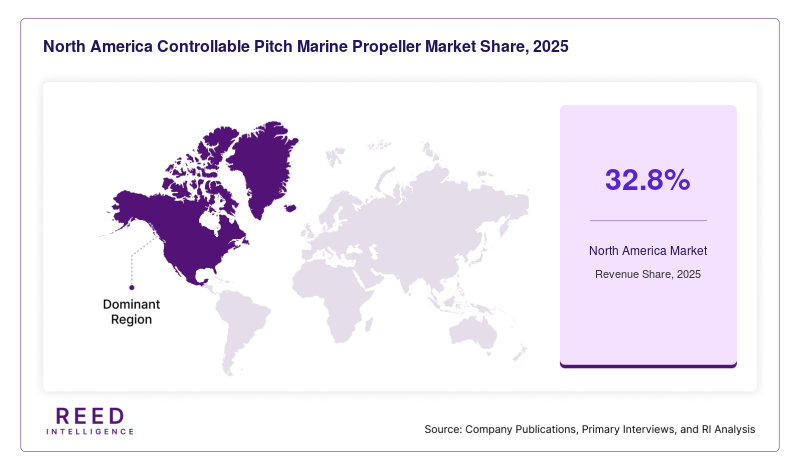
North America accounted for a significant market share of 32.8% in 2025 and is expected to grow at a CAGR of 6.5% during the forecast period. The region benefits from advanced shipbuilding infrastructure and strong demand from naval and commercial sectors. Technological innovation and early adoption of advanced propulsion systems contribute to steady growth. The presence of established marine equipment manufacturers further strengthens the regional market outlook.
The United States dominates the regional market, supported by extensive naval investments and fleet modernization programs. A key growth factor is the increasing focus on defense vessel upgrades and maritime security initiatives. The country continues to invest in advanced propulsion technologies to enhance operational capabilities, driving consistent demand for CPP systems.
Europe
Europe held a market share of 27.4% in 2025 and is projected to grow at a CAGR of 6.8% through 2034. The region’s strong maritime heritage and emphasis on sustainable shipping practices contribute to steady market expansion. European shipbuilders are increasingly adopting CPP systems to meet stringent environmental regulations and improve fuel efficiency.
Germany leads the European market due to its advanced engineering capabilities and strong presence of marine equipment manufacturers. A unique growth factor is the region’s focus on green shipping technologies, including hybrid propulsion systems. This emphasis drives the adoption of CPP systems in both commercial and specialized vessels.
Asia Pacific
Asia Pacific is the fastest-growing region, with a CAGR of 8.4% and a market share of 24.6% in 2025. Rapid industrialization and expansion of maritime trade are key contributors to growth. The region’s shipbuilding industry is experiencing significant development, particularly in countries with large export economies.
China dominates the Asia Pacific market, driven by its extensive shipbuilding capacity and growing maritime trade activities. A major growth factor is the increasing demand for commercial vessels, including cargo ships and tankers. Government initiatives supporting maritime infrastructure further boost the adoption of CPP systems.
Middle East & Africa
The Middle East & Africa region accounted for 8.1% of the market share in 2025 and is expected to grow at a CAGR of 7.0%. The region’s strategic location for global shipping routes and investments in offshore oil and gas projects support market growth. CPP systems are increasingly used in offshore support vessels operating in harsh marine environments.
Saudi Arabia leads the regional market, driven by significant investments in offshore exploration and maritime infrastructure. A key growth factor is the expansion of oil and gas activities, which require advanced propulsion systems for support vessels. This demand is expected to sustain market growth in the region.
Latin America
Latin America held a market share of 7.1% in 2025 and is projected to grow at a CAGR of 6.9%. The region is witnessing gradual growth in maritime trade and offshore activities. Investments in port infrastructure and shipping capabilities contribute to increased demand for efficient propulsion systems.
Brazil dominates the Latin American market due to its strong offshore oil and gas sector. A unique growth factor is the expansion of offshore exploration projects, which require specialized vessels equipped with CPP systems. This drives steady demand and supports regional market development.
Competitive Landscape
The competitive landscape of the controllable pitch marine propeller market is characterized by the presence of established global players and regional manufacturers. Companies focus on technological innovation, product development, and strategic partnerships to maintain their market position. The market leader, Wärtsilä Corporation, holds a strong position due to its extensive product portfolio and global presence. The company continues to invest in research and development to enhance propulsion efficiency and integrate digital solutions.
Other key players include Rolls-Royce Holdings plc, MAN Energy Solutions, Kongsberg Gruppen, and Hyundai Heavy Industries. These companies emphasize expanding their product offerings and strengthening their distribution networks. A recent development includes the introduction of advanced CPP systems with integrated monitoring technologies, enabling real-time performance optimization. The competitive environment is expected to remain dynamic, with companies focusing on innovation and sustainability.
Key Players List
- Wärtsilä Corporation
- Rolls-Royce Holdings plc
- MAN Energy Solutions
- Kongsberg Gruppen
- Hyundai Heavy Industries
- Nakskov Propeller A/S
- Schottel GmbH
- Brunvoll AS
- Berg Propulsion
- Veem Ltd
- Masson Marine
- Kawasaki Heavy Industries
- Mitsubishi Heavy Industries
- Mecklenburger Metallguss GmbH
- Thrustmaster of Texas
Recent Developments
- Wärtsilä Corporation introduced a new generation CPP system with enhanced digital monitoring capabilities to improve fuel efficiency and predictive maintenance.
- Kongsberg Gruppen expanded its propulsion solutions portfolio by integrating hybrid-compatible CPP systems for offshore vessels.
- Rolls-Royce Holdings plc announced the development of advanced electric CPP systems designed for next-generation hybrid marine vessels.
Controllable Pitch Marine Propeller Market Segments
Type
- Hydraulic Controllable Pitch Propeller
- Electric Controllable Pitch Propeller
Application
- Commercial Vessels
- Naval Vessels
- Offshore Support Vessels
End-Use
- Shipbuilding
- Retrofit
By Region
- North America
- Europe
- APAC
- Middle East and Africa
- LATAM