Controlled Release Fertilizers in Foliar Application Market Size, Share & Demand Report By Nutrient Type (Potassium-Based, Micronutrient Blends, Multi-Nutrient Formulations), By Crop Type (Cereals and Grains, Fruits and Vegetables, Oilseeds and Pulses), By Application Method (Liquid Spray Formulations, Suspension Concentrates, Water-Soluble Granules, Nano-Encapsulated Formulations), By Region & Segment Forecasts, 2026–2034
USD 3950
Market Overview
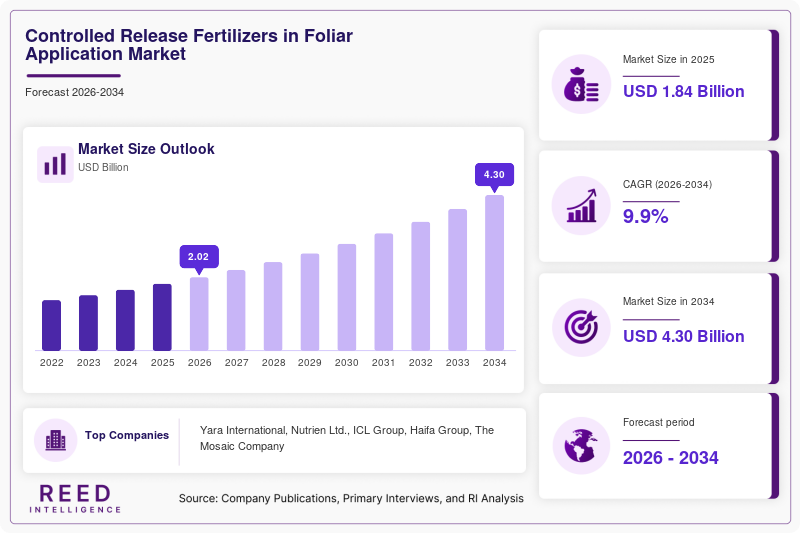
The global Controlled Release Fertilizers in Foliar Application Market size was valued at USD 1.84 billion in 2026 and is projected to reach USD 3.92 billion by 2034, expanding at a CAGR of 9.9% during the forecast period from 2026 to 2034. The market is gaining steady traction due to the increasing need for efficient nutrient delivery systems in commercial agriculture and horticulture. Controlled release fertilizers designed for foliar application are formulated to provide gradual nutrient absorption through plant leaves, reducing nutrient loss and improving crop productivity. The growing pressure on agricultural producers to maximize yield while minimizing environmental impact continues to support market expansion across developed and emerging economies.
One of the major global factors supporting market growth is the rising adoption of precision agriculture practices. Farmers are increasingly integrating smart nutrient management techniques to optimize fertilizer use efficiency and reduce wastage caused by conventional soil-based fertilization methods. Controlled release foliar fertilizers enable targeted nutrient delivery, faster plant uptake, and improved crop resilience under changing climatic conditions. Increasing concerns regarding soil degradation, declining arable land availability, and water scarcity are also accelerating demand for advanced foliar nutrient technologies. In addition, government initiatives promoting sustainable farming practices and balanced fertilizer consumption are creating favorable conditions for industry participants.
Key Highlights
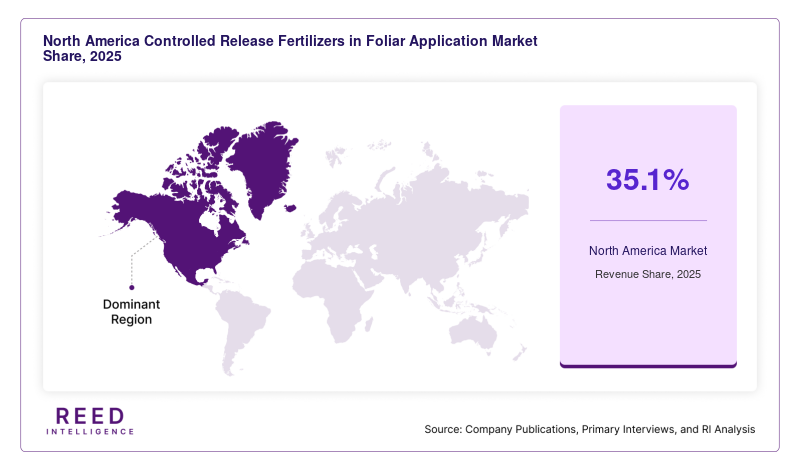
- North America dominated the market with a 35.1% share in 2025.
- Asia Pacific is expected to grow at the fastest CAGR of 11.6% during 2026–2034.
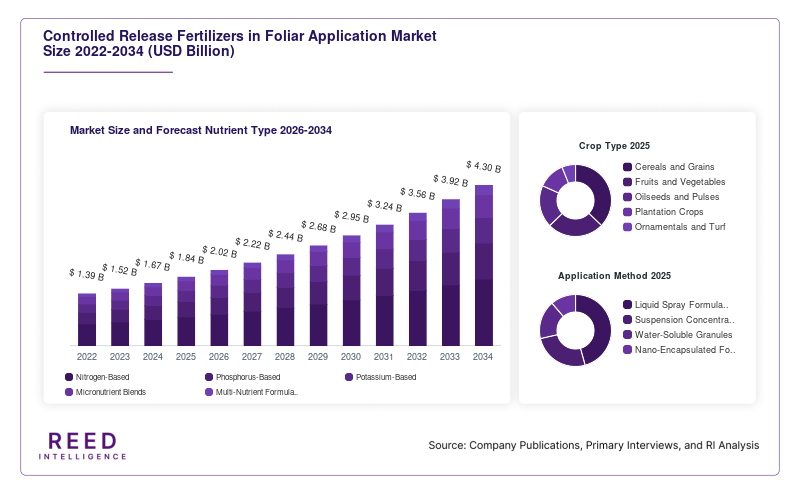
- By nutrient type, nitrogen-based controlled release foliar fertilizers accounted for the largest share of 39.4%.
- while micronutrient blends are projected to grow at a CAGR of 12.1%.
- By crop type, cereals and grains led with a 36.8% share.
- whereas fruits and vegetables are expected to expand at a CAGR of 12.5%.
- By application method, liquid spray formulations held the dominant share of 57.3%.
- while nano-encapsulated foliar formulations are projected to grow at a CAGR of 13.4%.
- The United States remained the dominant country, with market values of USD 465 million in 2024 and USD 512 million in 2025.
Market Trends
Increasing Adoption of Bio-Based Coating Technologies
Manufacturers operating in the Controlled Release Fertilizers in Foliar Application Market are increasingly focusing on bio-based coating technologies to improve sustainability and reduce environmental impact. Traditional polymer-coated fertilizers often raise concerns regarding residue accumulation and long-term soil contamination. As a result, agricultural input companies are introducing biodegradable coatings derived from natural polymers, starch compounds, and plant-based materials. These formulations improve nutrient release efficiency while aligning with global sustainability goals. The trend is gaining momentum in regions with strict agricultural regulations, particularly across Europe and North America, where environmental compliance standards continue to tighten.
Bio-based coatings also enhance compatibility with precision spraying systems and greenhouse cultivation methods. Farmers cultivating fruits, vegetables, and specialty crops are showing greater preference for sustainable foliar nutrient solutions that reduce nutrient volatilization and runoff losses. In addition, consumer demand for residue-free agricultural products is encouraging growers to shift toward environmentally safer fertilizer technologies. The expansion of organic farming and regenerative agriculture programs is expected to create additional opportunities for bio-based controlled release foliar fertilizers over the coming years.
Rising Integration of Precision Agriculture and Smart Spraying Systems
The growing adoption of precision agriculture technologies is becoming a major trend shaping the Controlled Release Fertilizers in Foliar Application Market. Farmers are increasingly utilizing sensor-based crop monitoring systems, drones, GPS-guided sprayers, and data-driven nutrient management platforms to optimize fertilizer application rates. Controlled release foliar fertilizers are compatible with these technologies because they allow precise nutrient delivery during critical crop growth stages. This trend is particularly visible in commercial farming operations focused on maximizing yield and reducing input costs.
Advanced smart spraying systems help agricultural producers reduce over-application of fertilizers while improving nutrient absorption efficiency. The use of real-time crop health monitoring and predictive analytics is enabling targeted foliar nutrient application according to plant requirements and weather conditions. Agricultural technology providers are also collaborating with fertilizer manufacturers to develop customized formulations compatible with automated spraying systems. The increasing digitalization of farming operations across Asia Pacific and Latin America is expected to further strengthen demand for controlled release foliar fertilizers throughout the forecast period.
Market Drivers
Growing Demand for High-Efficiency Fertilizers in Commercial Agriculture
The increasing need for high-efficiency fertilizers in commercial agriculture is a significant driver supporting the growth of the Controlled Release Fertilizers in Foliar Application Market. Farmers worldwide are facing mounting pressure to improve agricultural productivity while controlling input costs and environmental impact. Conventional fertilizers often lead to nutrient losses through leaching, evaporation, and runoff, reducing overall nutrient utilization efficiency. Controlled release foliar fertilizers address these concerns by delivering nutrients gradually through direct leaf absorption, resulting in improved nutrient uptake and reduced wastage.
Large-scale cultivation of cereals, fruits, vegetables, and plantation crops is accelerating adoption of advanced foliar nutrient products. Commercial growers are increasingly using controlled release fertilizers to improve crop quality, uniformity, and resistance to abiotic stress conditions such as drought and heat. The demand for higher crop yields from limited agricultural land is further encouraging investment in nutrient-efficient agricultural technologies. In addition, rising awareness among farmers regarding balanced nutrient management practices is supporting long-term market growth.
Expansion of Greenhouse Farming and Protected Cultivation
The rapid expansion of greenhouse farming and protected cultivation practices is another major factor driving market demand. Greenhouse growers require precise nutrient management systems to maintain consistent crop quality and maximize productivity in controlled environments. Controlled release fertilizers used in foliar applications provide uniform nutrient distribution and rapid plant response, making them suitable for greenhouse vegetables, ornamental plants, herbs, and fruits.
Protected cultivation systems are expanding rapidly across Asia Pacific, Europe, and the Middle East due to increasing demand for year-round crop production and water-efficient farming methods. Controlled release foliar fertilizers support intensive farming operations by reducing nutrient wastage and enabling accurate nutrient scheduling. The growing cultivation of export-oriented horticultural crops is also encouraging farmers to adopt advanced foliar nutrient formulations. Furthermore, technological advancements in greenhouse automation and climate-controlled agriculture are expected to increase the adoption of controlled release fertilizer products in high-value crop production systems.
Market Restraint
High Product Costs and Limited Adoption Among Small-Scale Farmers
The relatively high cost of controlled release fertilizers designed for foliar application remains a major restraint affecting overall market penetration. These fertilizers involve advanced coating technologies, specialized nutrient formulations, and controlled nutrient release mechanisms that increase manufacturing expenses compared to conventional fertilizers. Small-scale farmers in developing economies often prioritize lower-cost agricultural inputs due to limited financial resources and uncertain crop returns. As a result, adoption rates remain lower in price-sensitive agricultural markets across parts of Africa, South Asia, and Latin America.
Limited awareness regarding the long-term economic benefits of controlled release nutrient systems also restricts wider acceptance among traditional farming communities. Many growers continue to rely on bulk fertilizers because of established purchasing habits and easier product availability. In addition, inadequate rural distribution networks and inconsistent technical guidance reduce market accessibility in emerging agricultural regions. The higher upfront investment associated with precision spraying equipment and specialized foliar nutrient programs further challenges adoption among small agricultural producers. Although large commercial farms are increasingly integrating advanced fertilizer technologies, broader market expansion may remain constrained until product affordability improves and farmer education initiatives become more widespread.
Market Opportunities
Increasing Demand for Micronutrient-Enriched Foliar Fertilizers
The rising demand for micronutrient-enriched fertilizer formulations presents a major opportunity for companies operating in the Controlled Release Fertilizers in Foliar Application Market. Nutrient deficiencies involving zinc, boron, iron, manganese, and magnesium are becoming increasingly common due to intensive farming practices and declining soil fertility. Farmers are seeking foliar nutrient solutions capable of correcting deficiencies quickly while improving crop health and productivity. Controlled release micronutrient formulations provide gradual nutrient availability and reduce the risk of nutrient toxicity caused by excessive application.
The opportunity is particularly strong in high-value horticulture and specialty crop cultivation, where nutrient precision directly influences crop appearance, shelf life, and export quality. Agricultural producers are increasingly adopting multi-nutrient foliar blends that improve plant metabolism and stress resistance during critical growth stages. Fertilizer manufacturers are responding by introducing customized crop-specific micronutrient formulations designed for vegetables, fruits, vineyards, and greenhouse crops. The growing focus on nutritional quality and export-oriented agricultural production is expected to create sustained demand for advanced micronutrient foliar fertilizers.
Expansion Potential in Emerging Agricultural Economies
Emerging agricultural economies across Asia Pacific, Latin America, and Africa are creating substantial growth opportunities for controlled release foliar fertilizers. Rapid population growth and rising food demand are increasing pressure on governments and agricultural producers to improve crop productivity and resource efficiency. Several developing countries are introducing subsidy programs, precision farming initiatives, and agricultural modernization policies aimed at increasing farm output while reducing environmental degradation.
Growing investments in irrigation infrastructure, protected cultivation, and commercial farming operations are expected to support adoption of controlled release fertilizer technologies. Countries such as India, Brazil, Vietnam, and Indonesia are witnessing expanding cultivation of export-oriented fruits, vegetables, and plantation crops, creating favorable conditions for foliar nutrient products. In addition, increasing participation of agritech companies and agricultural cooperatives is improving farmer awareness regarding nutrient management practices. The gradual shift toward sustainable farming methods and efficient fertilizer utilization is likely to generate long-term growth opportunities for market participants targeting emerging economies.
Segmental Analysis
By Nutrient Type
Nitrogen-based controlled release foliar fertilizers accounted for the largest market share of 39.4% in 2024 due to their widespread use across cereals, grains, and commercial crop cultivation. Nitrogen plays a critical role in plant growth, chlorophyll formation, and overall biomass development, making nitrogen-enriched foliar formulations highly preferred among farmers seeking rapid crop response. Agricultural producers are increasingly utilizing controlled release nitrogen fertilizers to improve nutrient uptake efficiency while reducing volatilization and nutrient runoff losses associated with traditional fertilizers. Demand remains particularly strong in regions with intensive commercial agriculture and large-scale cereal production.
The dominance of nitrogen-based formulations is also supported by their compatibility with precision spraying systems and large-scale mechanized farming operations. Manufacturers are introducing polymer-coated nitrogen products capable of delivering nutrients gradually during critical crop growth stages. These formulations help reduce the frequency of fertilizer applications while improving crop uniformity and nutrient absorption efficiency. In addition, government initiatives promoting balanced nutrient management and sustainable fertilizer usage continue to support adoption of advanced nitrogen foliar fertilizers across major agricultural economies.
By Crop Type
Cereals and grains represented the dominant crop type segment with a market share of 36.8% in 2024 due to large-scale cultivation and increasing demand for efficient nutrient management practices. Farmers cultivating wheat, rice, corn, and barley are increasingly adopting controlled release foliar fertilizers to improve nutrient utilization efficiency and maximize productivity under changing climatic conditions. Foliar nutrient application enables faster nutrient absorption during key growth stages, helping improve grain quality and crop uniformity. The segment continues to benefit from rising food demand and expanding commercial farming operations across major agricultural economies.
Large cereal-producing countries such as the United States, China, India, and Brazil are witnessing increasing integration of precision agriculture technologies and advanced fertilizer application systems. Controlled release foliar fertilizers are particularly useful in minimizing nutrient losses caused by unpredictable rainfall and soil degradation. Agricultural producers are also focusing on sustainable farming practices aimed at reducing excessive fertilizer application while maintaining high crop productivity. Continued investments in modern farming equipment and nutrient-efficient agricultural inputs are expected to support long-term demand within the cereals and grains segment.
By Application Method
Liquid spray formulations accounted for the largest share of 57.3% in 2024 due to their ease of application, rapid nutrient absorption, and compatibility with existing spraying equipment. Farmers widely prefer liquid foliar fertilizers because they can be evenly distributed across crop surfaces and integrated with precision spraying systems. These formulations are extensively used in cereals, horticulture, plantation crops, and greenhouse farming operations. The segment benefits from increasing demand for efficient nutrient delivery methods capable of reducing fertilizer wastage and improving crop productivity.
Liquid spray formulations are also gaining popularity because they allow flexible nutrient customization according to crop growth stages and environmental conditions. Manufacturers are introducing multi-nutrient liquid blends with controlled release properties designed to improve nutrient stability and absorption efficiency. Commercial farming enterprises are increasingly adopting automated spraying technologies and drone-assisted fertilizer application systems, further supporting demand for liquid foliar products. The strong availability of liquid formulations across agricultural retail networks also contributes to their widespread market dominance.
Regional Analysis
North America
North America accounted for 35.1% of the global Controlled Release Fertilizers in Foliar Application Market in 2025 and is expected to maintain a stable growth trajectory with a CAGR of 8.7% through 2034. The region benefits from widespread adoption of precision agriculture technologies, advanced irrigation systems, and high-value crop cultivation practices. Commercial farming operations across the United States and Canada are increasingly investing in nutrient-efficient fertilizer solutions to optimize crop yield while complying with environmental sustainability standards. The strong presence of agricultural technology companies and fertilizer manufacturers further strengthens regional market expansion.
The United States remains the dominant country within the region due to extensive cultivation of cereals, vegetables, fruits, and greenhouse crops. One unique growth factor supporting the national market is the increasing adoption of drone-assisted foliar spraying systems in large-scale commercial farming operations. Agricultural producers are integrating automated spraying equipment and real-time crop monitoring systems to improve nutrient management precision. Government programs promoting sustainable agriculture and nutrient runoff reduction are also encouraging growers to adopt controlled release foliar fertilizers across major farming regions.
Europe
Europe represented 27.4% of the global market share in 2025 and is projected to grow at a CAGR of 8.9% during the forecast period. The region is characterized by strict environmental regulations regarding fertilizer application and nutrient runoff management. Agricultural producers across Western and Northern Europe are increasingly adopting controlled release foliar fertilizers to improve nutrient efficiency and reduce environmental impact. Growing demand for sustainable farming inputs and residue-free agricultural products is contributing to market development across both conventional and organic farming sectors.
Germany emerged as the dominant country within the European market due to strong investments in sustainable agriculture and greenhouse cultivation. A unique growth factor driving market expansion in Germany is the increasing adoption of climate-smart farming practices supported by advanced agricultural research institutions. Farmers are utilizing controlled release nutrient technologies to improve crop resilience against changing weather conditions and fluctuating rainfall patterns. The country’s emphasis on precision nutrient management and environmentally responsible farming continues to create favorable opportunities for fertilizer manufacturers.
Asia Pacific
Asia Pacific held a 23.8% share of the Controlled Release Fertilizers in Foliar Application Market in 2025 and is anticipated to register the fastest CAGR of 11.6% from 2026 to 2034. Rapid population growth, increasing food demand, and declining arable land availability are major factors supporting regional market growth. Governments across China, India, Japan, and Southeast Asian countries are promoting efficient fertilizer utilization practices to improve agricultural productivity and reduce environmental degradation. Rising adoption of greenhouse cultivation and protected farming systems is also contributing to increasing demand for advanced foliar nutrient solutions.
China remains the dominant country in the region due to large-scale agricultural production and significant investment in modern farming technologies. One unique growth factor driving the Chinese market is the expansion of high-value horticultural exports supported by intensive nutrient management programs. Agricultural producers are increasingly using controlled release foliar fertilizers to enhance crop quality and meet international export standards. In addition, government initiatives encouraging balanced fertilizer consumption and precision agriculture adoption are accelerating market penetration across commercial farming operations.
Middle East & Africa
The Middle East & Africa region accounted for 7.2% of the global market share in 2025 and is expected to grow at a CAGR of 9.4% through 2034. Increasing concerns regarding water scarcity and soil degradation are encouraging agricultural producers to adopt efficient nutrient management solutions. Controlled release foliar fertilizers are gaining traction in greenhouse farming and irrigated agriculture because they reduce nutrient losses and improve plant nutrient absorption. Several countries in the region are investing in agricultural modernization programs aimed at strengthening domestic food production and reducing import dependence.
Saudi Arabia dominates the regional market due to extensive investments in controlled environment agriculture and water-efficient farming technologies. A unique factor supporting market growth in the country is the rapid expansion of hydroponic and greenhouse vegetable cultivation projects. Controlled release foliar fertilizers are widely used to maintain nutrient precision and crop quality under harsh climatic conditions. Government support for sustainable agriculture and food security initiatives continues to encourage adoption of advanced fertilizer products across commercial agricultural enterprises.
Latin America
Latin America captured 6.5% of the global Controlled Release Fertilizers in Foliar Application Market in 2025 and is projected to expand at a CAGR of 10.1% during the forecast period. The region is experiencing increasing demand for efficient crop nutrition solutions due to expanding cultivation of soybeans, coffee, sugarcane, fruits, and vegetables. Agricultural exporters are focusing on improving crop quality and productivity while minimizing environmental impact associated with conventional fertilizer usage. Controlled release foliar fertilizers are gaining popularity among commercial growers seeking higher nutrient efficiency and improved crop resilience.
Brazil remains the dominant country within Latin America due to its extensive agricultural land base and strong export-oriented farming sector. One unique growth factor supporting the Brazilian market is the growing adoption of precision agriculture technologies in large soybean and sugarcane plantations. Farmers are integrating satellite-guided nutrient management systems and controlled release foliar fertilizers to reduce input costs and improve yield consistency. Rising investments in agricultural digitization and sustainable crop production practices are expected to support continued market expansion across the country.
Competitive Landscape
The Controlled Release Fertilizers in Foliar Application Market is moderately consolidated, with major participants focusing on product innovation, strategic partnerships, and regional expansion initiatives to strengthen their competitive positions. Companies are investing heavily in research and development activities aimed at improving nutrient release efficiency, biodegradable coating technologies, and crop-specific fertilizer formulations. The market is also witnessing increasing collaboration between fertilizer manufacturers and precision agriculture technology providers to develop integrated nutrient management solutions.
Yara International remains one of the leading companies in the market due to its extensive global distribution network, strong product portfolio, and continuous investment in sustainable crop nutrition technologies. The company recently expanded its specialty foliar fertilizer production capacity to address rising demand from greenhouse and horticulture growers. Other major players are also introducing advanced controlled release nutrient formulations compatible with precision spraying systems and automated farming equipment.
Key Players
- Yara International
- Nutrien Ltd.
- ICL Group
- Haifa Group
- The Mosaic Company
- SQM S.A.
- Koch Industries
- COMPO Expert
- EuroChem Group
- Coromandel International
- Deepak Fertilisers and Petrochemicals Corporation
- Nufarm Limited
- Helena Agri-Enterprises
- Valagro S.p.A.
- Aries Agro Limited
Recent Developments
- In February 2026, Yara International introduced a biodegradable controlled release foliar fertilizer range designed for greenhouse vegetable cultivation and precision spraying systems.
- In September 2025, ICL Group expanded its specialty fertilizer research facility focused on nano-encapsulated nutrient technologies for foliar crop applications.
- In June 2025, Nutrien Ltd. partnered with a digital agriculture platform provider to develop data-driven foliar nutrient recommendation systems for commercial farms.
- In January 2026, Coromandel International launched micronutrient-enriched foliar fertilizer products targeting fruit and vegetable growers across South Asia.
Controlled Release Fertilizers in Foliar Application Market Segments
Nutrient Type
- Nitrogen-Based
- Phosphorus-Based
- Potassium-Based
- Micronutrient Blends
- Multi-Nutrient Formulations
Crop Type
- Cereals and Grains
- Fruits and Vegetables
- Oilseeds and Pulses
- Plantation Crops
- Ornamentals and Turf
Application Method
- Liquid Spray Formulations
- Suspension Concentrates
- Water-Soluble Granules
- Nano-Encapsulated Formulations
By Region
- North America
- Europe
- APAC
- Middle East and Africa
- LATAM