Convection Ovens Market Size, Share & Demand Report By Product Type (Electric Convection Ovens, Gas Convection Ovens, Smart Connected Ovens, Countertop Convection Ovens), By Application (Commercial Foodservice, Residential Kitchens, Institutional Kitchens, Industrial Food Processing), By Distribution Channel (Offline Retail, Online Retail, Direct Sales), By Region & Segment Forecasts, 2026–2034
USD 3950
Market Overview
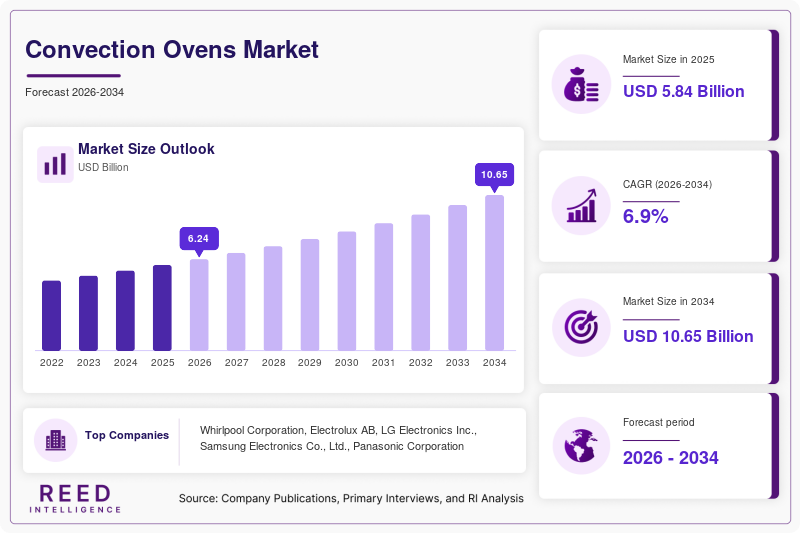
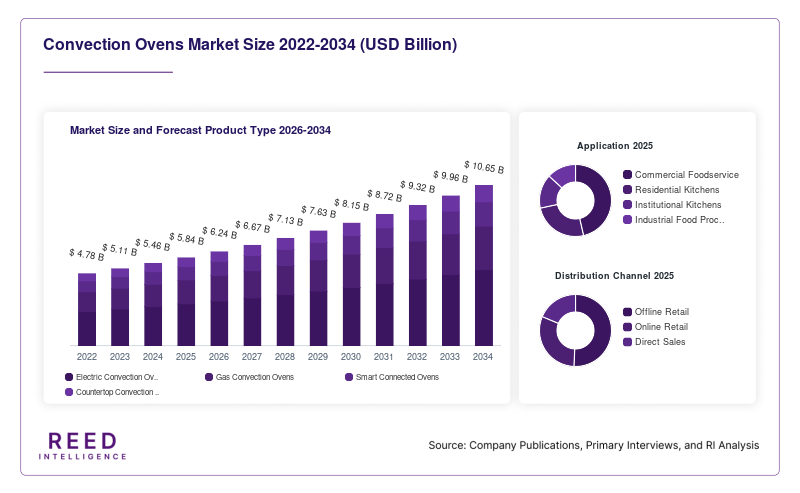
The global Convection Ovens Market size was valued at USD 5.84 billion in 2026 and is projected to reach USD 9.96 billion by 2034, expanding at a CAGR of 6.9% during the forecast period from 2026 to 2034. Market expansion is being shaped by increasing demand for energy-efficient commercial cooking systems, changing foodservice formats, and wider adoption of precision cooking technologies across residential and industrial kitchens. The growth of quick-service restaurants, bakery chains, cloud kitchens, and hospitality infrastructure has created sustained demand for convection ovens due to their faster cooking cycles, even heat distribution, and reduced operating costs. In addition, rising urbanization and disposable income levels are encouraging consumers to upgrade from traditional ovens to multifunctional convection systems. Manufacturers are also integrating digital controls, smart sensors, and programmable cooking settings to align with automation trends in modern kitchens. The commercial foodservice industry remains a central contributor, while residential applications continue to expand as consumers seek convenience and healthier cooking options. Global appliance replacement cycles, stricter energy standards, and innovations in countertop and built-in formats are further strengthening market momentum.
Key Highlights
- North America dominated the market with a 36.4% share in 2025.
- Asia Pacific is expected to grow at the fastest CAGR of 8.8% during 2026–2034.
- By product type, electric convection ovens accounted for the largest share of 44.1%, while smart connected ovens are projected to grow at a CAGR of 10.6%.
- By application, commercial foodservice led with a 48.7% share, whereas residential premium kitchens are expected to expand at a CAGR of 9.4%.
- The United States remained the dominant country, with market values of USD 1.42 billion in 2024 and USD 1.51 billion in 2025.
Market Trends
Smart kitchen integration reshaping oven functionality
The Convection Ovens Market is increasingly influenced by smart kitchen technology integration, particularly in developed urban markets where automation and convenience are becoming central purchasing factors. Modern convection ovens now feature Wi-Fi connectivity, touchscreen controls, app-based remote operation, voice assistant compatibility, and AI-powered cooking presets. These features are helping users optimize cooking consistency, reduce preparation time, and improve energy consumption. Commercial kitchens are also leveraging programmable systems to maintain operational efficiency during peak demand periods. This trend is particularly visible in premium residential construction and upscale hospitality projects where connected appliances are part of broader smart infrastructure ecosystems. As digital ecosystems mature, manufacturers are expanding software-driven functionality, transforming convection ovens from standalone appliances into integrated cooking platforms.
Expansion of compact and multifunctional product formats
Consumer preference is shifting toward multifunctional and space-saving kitchen appliances, especially in urban apartments, small restaurants, and convenience-focused retail food outlets. Countertop convection ovens with air frying, roasting, baking, grilling, and dehydrating capabilities are gaining stronger traction than single-function devices. This trend is encouraging manufacturers to develop versatile products that address multiple cooking requirements while minimizing kitchen footprint. Commercial operators are also investing in combi-convection systems that support varied menu offerings with lower capital investment. The rise of smaller-format foodservice outlets, mobile kitchens, and home-based culinary businesses is accelerating this transition. Product innovation in compact design is broadening the addressable customer base and creating new revenue channels across both developed and emerging economies.
Market Drivers
Rapid growth of commercial foodservice infrastructure
The expansion of quick-service restaurants, institutional kitchens, cafés, and bakery chains is a major force driving the Convection Ovens Market. Foodservice operators prioritize convection ovens because they provide faster cooking times, improved consistency, and lower utility costs compared to conventional alternatives. As urban food consumption patterns evolve and demand for standardized meal production increases, commercial kitchens require scalable and efficient cooking systems. Emerging markets are witnessing strong investment in organized food retail and hospitality infrastructure, further supporting product demand. Additionally, cloud kitchens and delivery-first food businesses rely heavily on high-performance cooking equipment to maintain output quality. This broad commercial adoption is significantly increasing replacement rates and first-time installations worldwide.
Rising consumer preference for energy-efficient cooking appliances
Growing awareness of electricity consumption and sustainable household practices is encouraging consumers to choose appliances that offer lower operational costs. Convection ovens circulate heated air more efficiently than conventional ovens, reducing cooking times and energy use. This advantage is particularly appealing amid rising global energy prices and stricter environmental regulations. Appliance manufacturers are responding by introducing ENERGY STAR-rated products and advanced insulation systems. Residential buyers increasingly view convection ovens as long-term investments due to their versatility and cost savings. In regions where smart homes and green building initiatives are growing, energy-efficient convection ovens are becoming a preferred kitchen upgrade, reinforcing broader market penetration.
Market Restraint
High upfront cost of advanced convection systems limiting adoption
Despite growing demand, the Convection Ovens Market faces challenges due to the relatively high initial cost of premium and commercial-grade models. Advanced convection ovens equipped with digital interfaces, smart controls, multiple cooking modes, and stainless-steel industrial designs often require significantly higher investment than traditional ovens. This pricing barrier can restrict adoption among small restaurants, budget-conscious households, and businesses in developing economies. In many price-sensitive markets, conventional ovens or gas-based alternatives remain preferred due to lower acquisition costs despite reduced efficiency. Maintenance expenses, replacement parts, and technical servicing requirements can also increase ownership costs. For small foodservice operators with limited capital budgets, these financial barriers may delay upgrades, particularly during periods of economic uncertainty or inflationary pressure.
Market Opportunities
Penetration into emerging residential markets
The growing middle-class population across Asia Pacific, Latin America, and parts of the Middle East presents a major opportunity for convection oven manufacturers. Rising disposable incomes, urban housing development, and changing culinary preferences are creating favorable conditions for premium kitchen appliance adoption. Consumers in these regions are increasingly experimenting with baking, grilling, and healthy meal preparation, supporting demand for multifunctional convection systems. Localization strategies, affordable pricing tiers, and e-commerce expansion can further strengthen brand access. As kitchen modernization becomes part of aspirational lifestyle trends, manufacturers have significant opportunities to capture untapped residential demand with region-specific product designs.
Growth of institutional and specialty food production
Institutional food environments such as hospitals, schools, corporate cafeterias, and specialty bakeries are expanding globally, creating substantial opportunities for convection oven deployment. These environments require consistent large-scale cooking with energy optimization and menu flexibility. Convection ovens offer operational reliability for batch cooking while supporting varied food preparation styles. The growth of artisanal bakeries, gourmet meal providers, and frozen food manufacturers also supports industrial-scale oven adoption. Manufacturers can capitalize on this opportunity by designing durable, high-capacity systems tailored for specialized cooking applications, strengthening long-term commercial contracts and recurring service revenues.
Segmental Analysis
By Product Type
Electric convection ovens held the dominant market position in 2024, accounting for 44.1% of total revenue. Their widespread use across residential and commercial kitchens is driven by consistent temperature control, ease of installation, and compatibility with energy regulations. Electric models are preferred in urban households and premium hospitality spaces due to reduced emissions and integrated smart capabilities. Commercial kitchens also favor electric systems for precision cooking and regulatory compliance. Product diversity across countertop, built-in, and industrial categories further supports segment leadership. Manufacturers continue to prioritize electric innovations due to scalability and consumer preference for sustainable cooking solutions.
Smart connected convection ovens are projected to grow at the fastest CAGR of 10.6% through 2034. These products integrate mobile app control, remote monitoring, AI cooking presets, and voice activation, aligning with connected lifestyle trends. Their expansion is driven by premium household adoption, hospitality modernization, and smart kitchen ecosystems. Rising consumer demand for convenience, automation, and personalized cooking experiences supports segment acceleration. Manufacturers are increasingly differentiating products through software functionality, making connectivity a competitive advantage.
By Application
Commercial foodservice emerged as the leading application segment, representing 48.7% market share in 2024. Restaurants, bakeries, hotels, institutional kitchens, and cloud kitchens rely heavily on convection ovens for operational efficiency, rapid cooking, and consistency. This segment benefits from restaurant chain expansion, food delivery growth, and menu diversification. Commercial buyers prioritize throughput, durability, and programmable functions, making convection ovens essential for scalable food operations. Replacement demand in developed markets and first-time installations in emerging economies are sustaining segment strength.
Residential premium kitchens are expected to witness the fastest CAGR of 9.4% during the forecast period. Rising home cooking interest, baking culture, and smart home adoption are increasing consumer investment in advanced kitchen appliances. Built-in and countertop premium convection ovens are particularly attractive among urban homeowners seeking multifunctionality. Lifestyle upgrades, influencer-driven culinary trends, and modular kitchen adoption are reinforcing segment growth globally.
By Distribution Channel
Offline retail channels dominated the market in 2024 with a 58.3% share due to consumer preference for physical product inspection, live demonstrations, and after-sales assurance. Specialty appliance stores, hypermarkets, and commercial equipment distributors remain important sales channels for both residential and industrial buyers. Commercial customers often rely on direct supplier relationships and showroom evaluations before purchase. Installation support and financing options also strengthen offline channel performance.
Online distribution channels are forecast to expand at the fastest CAGR of 11.1% through 2034. E-commerce platforms are improving product accessibility through broader assortments, price transparency, customer reviews, and financing flexibility. Growth in digital appliance retail, direct-to-consumer strategies, and cross-border product availability is driving this shift. Online channels are especially influential in emerging markets where digital commerce adoption is accelerating.
Regional Analysis
North America
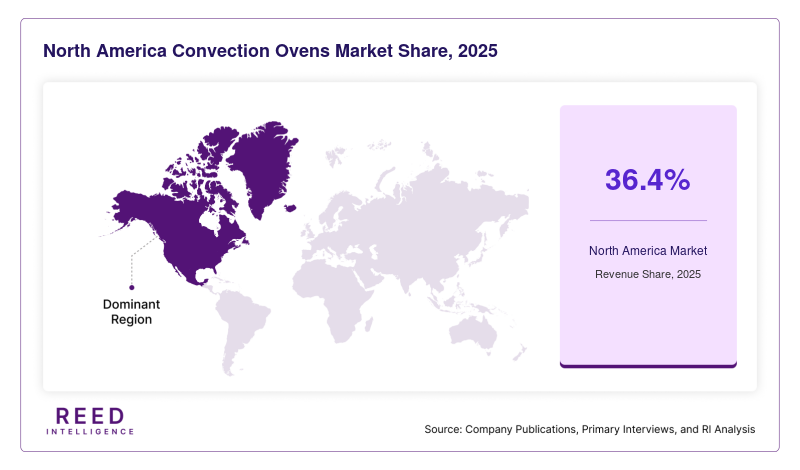
North America accounted for 36.4% of the global Convection Ovens Market share in 2025 and is expected to grow at a CAGR of 5.8% through 2034. The region benefits from mature foodservice infrastructure, strong replacement demand, and widespread adoption of premium residential kitchen appliances. High penetration of chain restaurants, institutional kitchens, and advanced home renovation projects continues to support market volume.
The United States remains the dominant regional contributor due to strong consumer spending, widespread smart appliance adoption, and extensive foodservice sector expansion. Commercial kitchen modernization, particularly among quick-service chains and bakery franchises, is a major growth factor. Rising demand for connected cooking systems is also strengthening premium product sales.
Europe
Europe represented 27.1% of global market share in 2025 and is projected to expand at a CAGR of 6.1% during the forecast period. Demand is supported by stringent energy-efficiency regulations, rising preference for multifunctional appliances, and strong culinary traditions that encourage baking and roasting. Product replacement and built-in kitchen renovations are key contributors.
Germany leads the European market due to its advanced appliance manufacturing ecosystem and strong demand for energy-certified products. Consumer preference for sustainable home appliances, combined with premium kitchen design trends, supports stable growth. Commercial bakery equipment demand is another distinct regional advantage.
Asia Pacific
Asia Pacific held 22.8% market share in 2025 and is forecast to grow at the fastest CAGR of 8.8% through 2034. Rapid urbanization, rising disposable incomes, and expanding foodservice chains are driving substantial demand. Increased exposure to Western cooking methods and home baking culture are also shaping residential adoption.
China dominates the region through large-scale urban housing development, strong e-commerce penetration, and expanding restaurant networks. Government support for manufacturing and growing consumer demand for smart appliances are accelerating market development. Domestic brands are also increasing affordability and market accessibility.
Middle East & Africa
Middle East & Africa captured 7.4% of market share in 2025 and is expected to register a CAGR of 6.7% by 2034. Hospitality expansion, tourism infrastructure, and premium retail development are supporting commercial oven demand. Urban residential modernization is also contributing to product penetration in affluent consumer segments.
The United Arab Emirates leads this region due to large-scale hospitality investments and luxury residential projects. Growth in international foodservice brands and tourism-driven dining establishments is increasing demand for advanced cooking systems. Premium kitchen appliance retail is a notable market accelerator.
Latin America
Latin America accounted for 6.3% of global share in 2025 and is projected to grow at a CAGR of 6.4% over the forecast period. Expanding food retail infrastructure, urban middle-class growth, and residential appliance modernization are contributing to demand. Commercial bakery and café expansion also supports market activity.
Brazil remains the largest country market due to strong foodservice sector development and increasing household appliance adoption. Growing café culture and organized restaurant expansion are major demand catalysts. E-commerce channels are also improving product accessibility across broader consumer groups.
Competitive Landscape
The Convection Ovens Market is moderately consolidated, with global appliance manufacturers and specialized foodservice equipment providers competing through innovation, energy efficiency, and digital functionality. Whirlpool Corporation remains a leading player due to broad residential product reach, strong brand recognition, and smart appliance integration. Recent developments include expanded AI-enabled cooking platforms in premium kitchen lines. Electrolux AB and LG Electronics continue to strengthen market share through connected appliance ecosystems and sustainable product engineering. Panasonic Corporation maintains a strong position in compact and multifunctional categories, while Middleby Corporation leads commercial-grade convection solutions for institutional and restaurant clients. Competitive differentiation increasingly centers on energy standards, smart interfaces, and regional pricing strategies.
Key Players
- Whirlpool Corporation
- Electrolux AB
- LG Electronics
- Samsung Electronics
- Panasonic Corporation
- Middleby Corporation
- GE Appliances
- Bosch Home Appliances
- Sharp Corporation
- Midea Group
- Haier Group
- Breville Group
- Alto-Shaam Inc.
- Rational AG
- Welbilt Inc.
Recent Developments
- Whirlpool introduced AI-assisted cooking features in its premium convection range to improve automation and meal customization.
- Electrolux expanded energy-efficient built-in convection oven lines across Europe to align with stricter appliance regulations.
- Middleby Corporation launched upgraded commercial convection platforms focused on cloud kitchen throughput and operational efficiency.
Convection Ovens Market Segments
Product Type
- Electric Convection Ovens
- Gas Convection Ovens
- Smart Connected Ovens
- Countertop Convection Ovens
Application
- Commercial Foodservice
- Residential Kitchens
- Institutional Kitchens
- Industrial Food Processing
Distribution Channel
- Offline Retail
- Online Retail
- Direct Sales
By Region
- North America
- Europe
- APAC
- Middle East and Africa
- LATAM