Conveyor Monitoring Market Size, Share, Growth & Industry Analysis Report By Component (Hardware, Software, Services), By Technology (IoT-Based Monitoring, AI-Based Monitoring, Traditional Monitoring), By Conveyor Type (Belt, Roller, Chain), By End-Use Industry (Mining, Manufacturing, Logistics & Warehousing, Food & Beverage, Others), By Region & Segment Forecasts, 2026–2034
USD 3950
Market Overview
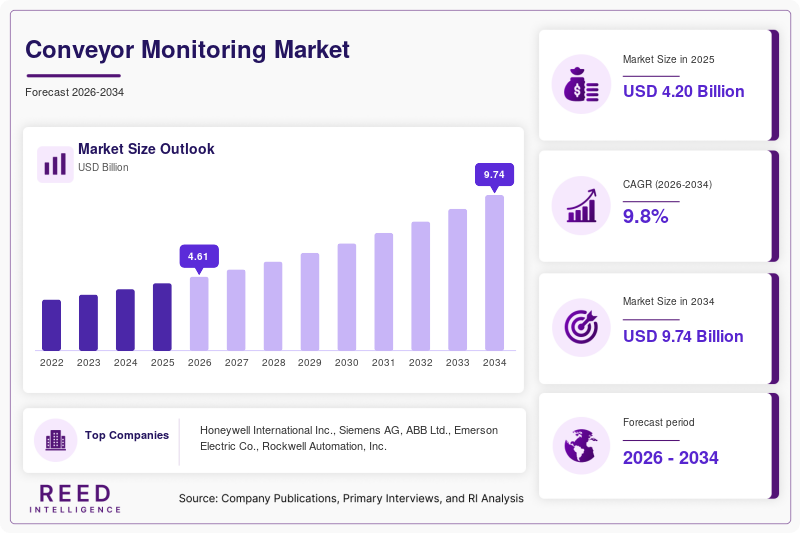
The Conveyor Monitoring Market size was valued at USD 4.2 billion in 2026 and is projected to reach USD 8.9 billion by 2034, expanding at a CAGR of 9.8% during the forecast period (2026–2034). The market has gained consistent traction due to the growing emphasis on operational efficiency and predictive maintenance across industrial sectors. A key global factor supporting market growth is the rapid adoption of industrial automation and Industry 4.0 technologies, which has increased the need for real-time monitoring systems in conveyor-based material handling operations.
Industries such as mining, manufacturing, logistics, and food processing are integrating advanced conveyor monitoring solutions to reduce downtime, enhance safety, and optimize throughput. The integration of IoT-enabled sensors and analytics platforms has transformed traditional conveyor systems into intelligent networks capable of predictive diagnostics and remote monitoring.
Key Highlights
- Dominant region: Asia Pacific held 38.5% market share in 2025, while North America is expected to register the fastest CAGR of 10.6% (2026–2034)
- Dominant country: China recorded USD 0.86 billion in 2024 and USD 0.93 billion in 2025, driven by large-scale industrial infrastructure investments
- Leading subsegments:
- By Component: Hardware dominated with 56.2% share (2025), while Software is projected to grow at a CAGR of 11.2%
- By Technology: IoT-based systems led with 48.7% share, while AI-based monitoring is expected to grow at 12.1% CAGR
- By End-Use: Mining accounted for 29.4% share, while Logistics is projected to expand at 11.5% CAGR
Market Trends
Integration of Predictive Analytics and AI in Conveyor Systems
A notable trend shaping the Conveyor Monitoring Market is the increasing use of predictive analytics powered by artificial intelligence. Advanced monitoring systems now leverage machine learning algorithms to detect anomalies, predict failures, and optimize maintenance schedules. This trend is particularly relevant in industries where unplanned downtime results in significant financial losses. Companies are deploying AI-driven dashboards that provide actionable insights, thereby enhancing system reliability and reducing maintenance costs.
Adoption of Wireless and Cloud-Based Monitoring Solutions
Another emerging trend is the shift toward wireless and cloud-based conveyor monitoring systems. These solutions eliminate the need for extensive wiring and enable remote access to real-time data. Cloud integration allows centralized monitoring across multiple facilities, improving scalability and operational visibility. This trend is especially prominent in logistics and warehousing sectors where distributed operations require seamless monitoring capabilities.
Market Drivers
Growing Demand for Operational Efficiency in Industrial Processes
Industries are increasingly focused on maximizing operational efficiency and minimizing downtime. Conveyor systems play a critical role in material handling, and any disruption can lead to production delays. Conveyor monitoring solutions provide real-time insights into system performance, enabling timely interventions and reducing operational risks. This demand for efficiency is driving the adoption of advanced monitoring technologies.
Rising Emphasis on Workplace Safety and Compliance
Safety regulations and compliance standards are becoming more stringent across industries. Conveyor monitoring systems help detect hazards such as belt misalignment, overheating, and mechanical failures, thereby preventing accidents. Organizations are investing in monitoring solutions to ensure compliance with safety standards and protect workforce well-being.
Market Restraint
High Initial Investment and Integration Complexity
One of the major restraints in the Conveyor Monitoring Market is the high upfront cost associated with implementing advanced monitoring systems. Integration with existing infrastructure can be complex and time-consuming, particularly for small and medium-sized enterprises. This factor may limit adoption in cost-sensitive markets.
Market Opportunities
Expansion of Smart Manufacturing Ecosystems
The growth of smart manufacturing presents significant opportunities for conveyor monitoring solutions. As factories become more connected, the demand for intelligent monitoring systems will increase. Integration with digital twins and smart factory platforms will enable enhanced process optimization and predictive maintenance capabilities.
Increasing Adoption in Emerging Economies
Emerging economies in Asia, Latin America, and Africa are witnessing rapid industrialization. Investments in infrastructure and manufacturing are creating new opportunities for conveyor monitoring systems. Local industries are adopting modern technologies to improve productivity, thereby driving market growth in these regions.
Segmental Analysis
By Component
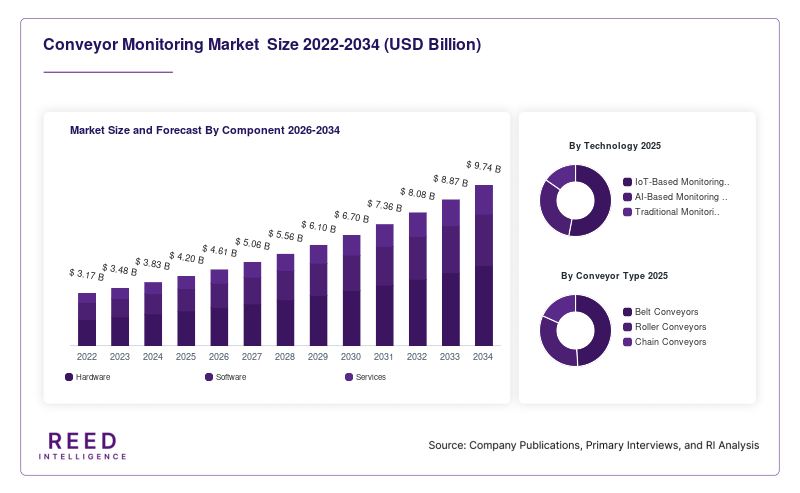
Hardware dominated the market with a 56.2% share in 2025, driven by the widespread use of sensors, cameras, and control devices in conveyor systems. These components are essential for real-time monitoring and data collection.
Software is expected to be the fastest-growing subsegment, with a CAGR of 11.2%. The growth will be driven by increasing demand for data analytics, predictive maintenance tools, and cloud-based platforms. Software solutions enable advanced insights and integration with enterprise systems, enhancing operational efficiency.
By Technology
IoT-based monitoring systems held a 48.7% share in 2025, as industries increasingly adopted connected devices for real-time monitoring. These systems provide continuous data streams and enable remote diagnostics.
AI-based monitoring is projected to grow at a CAGR of 12.1%, driven by its ability to analyze large datasets and predict system failures. The adoption of AI will enhance decision-making and reduce maintenance costs.
By Conveyor Type
Belt conveyors accounted for 61.3% share in 2025, due to their widespread use in industries such as mining and manufacturing. Their simplicity and efficiency make them the preferred choice for material handling.
Roller conveyors are expected to grow at a CAGR of 10.4%, driven by increasing demand in logistics and warehousing applications. Their flexibility and ability to handle diverse materials will support growth.
By End-Use Industry
The mining sector dominated with a 29.4% share in 2025, owing to extensive use of conveyor systems for bulk material handling. Monitoring systems are critical in ensuring operational continuity in harsh environments.
The logistics sector is projected to grow at a CAGR of 11.5%, driven by the expansion of e-commerce and warehousing operations. The need for efficient and reliable conveyor systems will boost demand for monitoring solutions.
Regional Analysis
North America
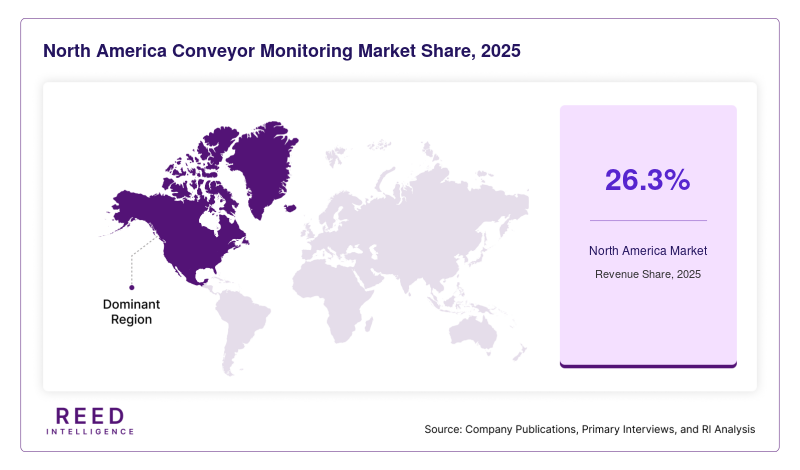
North America accounted for 26.3% of the Conveyor Monitoring Market share in 2025 and is expected to grow at a CAGR of 10.6% during 2026–2034. The United States remained the dominant country due to its strong focus on advanced manufacturing technologies. The presence of established industrial players and early adoption of IoT-based monitoring systems contributed to market expansion. The region’s emphasis on digital transformation and automation will further support growth.
Europe
Europe held 22.7% market share in 2025 and is projected to grow at a CAGR of 9.1%. Germany dominated the regional market due to its robust industrial base and adoption of Industry 4.0 initiatives. The country’s focus on precision engineering and automation has driven the demand for conveyor monitoring solutions. Environmental regulations and energy efficiency requirements also support market growth.
Asia Pacific
Asia Pacific led the market with 38.5% share in 2025 and will grow at a CAGR of 10.2%. China emerged as the dominant country, driven by large-scale industrialization and infrastructure development. The expansion of manufacturing and mining sectors has significantly increased the demand for conveyor monitoring systems. Government initiatives promoting smart manufacturing further boost market growth.
Middle East & Africa
The Middle East & Africa accounted for 6.8% share in 2025 and is expected to grow at a CAGR of 8.7%. Saudi Arabia dominated the region due to its investments in mining and industrial diversification. The adoption of conveyor monitoring systems in oil and gas and mining operations is driving regional growth.
Latin America
Latin America held 5.7% market share in 2025 and is projected to grow at a CAGR of 8.9%. Brazil led the regional market due to its strong mining and agricultural sectors. The need for efficient material handling solutions in these industries is fueling the adoption of conveyor monitoring systems.
Competitive Landscape
The Conveyor Monitoring Market is moderately fragmented, with key players focusing on technological innovation and strategic partnerships. Leading companies are investing in IoT and AI-based solutions to enhance their product offerings.
The market leader, Honeywell International Inc., has strengthened its position by launching advanced predictive maintenance solutions integrated with cloud analytics platforms. Siemens AG continues to expand its portfolio with smart automation solutions tailored for industrial applications. ABB Ltd. focuses on digital monitoring technologies that improve system efficiency and reliability. Emerson Electric Co. offers comprehensive monitoring solutions with strong analytics capabilities. Rockwell Automation, Inc. emphasizes integration with industrial control systems, enabling seamless monitoring and control. These companies are actively expanding their global presence through mergers, acquisitions, and collaborations, ensuring sustained market growth and innovation.
Key Players List
- Honeywell International Inc.
- Siemens AG
- ABB Ltd.
- Emerson Electric Co.
- Rockwell Automation, Inc.
- Schneider Electric SE
- SKF Group
- Banner Engineering Corp.
- SICK AG
- Phoenix Contact GmbH & Co. KG
- IFM Electronic GmbH
- Pepperl+Fuchs SE
- Eaton Corporation plc
- Bosch Rexroth AG
- Yokogawa Electric Corporation
Recent Developments
- In 2025, Honeywell introduced a cloud-based conveyor monitoring platform with enhanced predictive analytics capabilities.
- Siemens expanded its digital twin integration for conveyor systems, improving operational efficiency.
- ABB launched advanced sensor technologies for real-time conveyor belt monitoring.
- Rockwell Automation partnered with logistics firms to deploy smart conveyor monitoring solutions.
- SKF developed new vibration monitoring tools tailored for conveyor applications.
Conveyor Monitoring Market Segments
By Component
- Hardware
- Software
- Services
By Technology
- IoT-Based Monitoring Systems
- AI-Based Monitoring Systems
- Traditional Monitoring Systems
By Conveyor Type
- Belt Conveyors
- Roller Conveyors
- Chain Conveyors
By End-Use Industry
- Mining
- Manufacturing
- Logistics & Warehousing
- Food & Beverage
- Others
By Region
- North America
- Europe
- APAC
- Middle East and Africa
- LATAM