Copper Ammonium Carbonate Market Size, Share, Growth Analysis Report By Type (Industrial Grade, Agricultural Grade, High-Purity Grade), By Application (Catalysts, Pigments, Agriculture, Textiles, Others), By End-Use Industry (Chemicals, Agriculture, Textiles, Coatings & Pigments, Others) By Region Forecast, 2025–2034
USD 3950
Market Overview
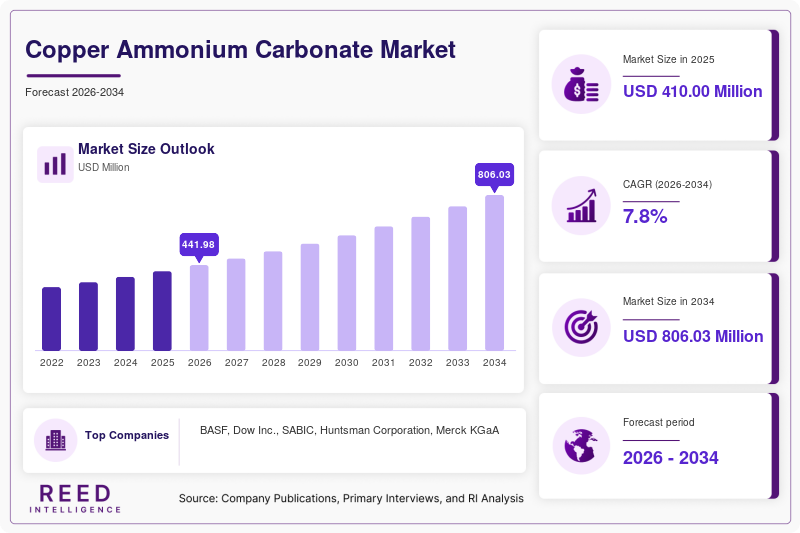
The Copper Ammonium Carbonate Market size is estimated at approximately USD 410 million, reflecting consistent industrial utilization of copper-based compounds in specialized formulations. By 2026, the market is projected to reach around USD 435 million as downstream industries continue to recover and expand production capacities. Looking ahead, the Copper Ammonium Carbonate Market is forecast to reach approximately USD 820 million by 2034, registering a compound annual growth rate (CAGR) of about 7.8% from 2025 to 2034. This growth trajectory highlights the compound’s relevance in niche chemical applications and its role as a precursor in various industrial processes.
Several growth factors are contributing to this market expansion. First, increasing demand for copper-based catalysts in chemical synthesis is supporting adoption, particularly in controlled reaction environments. Second, the agricultural sector is utilizing copper ammonium carbonate in micronutrient formulations and fungicidal applications, especially in regions with copper-deficient soils. Third, the expansion of the textile industry, where copper compounds are used in dyeing and finishing processes, is further enhancing market demand. Additionally, ongoing industrialization in emerging economies and the rising focus on specialty chemicals are reinforcing market growth.
Key Highlights
- Market size is estimated at USD 410 million in 2025, reflecting steady demand across industrial and specialty applications.
This valuation is supported by growing utilization in catalysts, pigments, agriculture, and textile processing industries. - Projected market size is expected to reach approximately USD 820 million by 2034, indicating sustained expansion over the forecast period.
The increase is driven by rising industrialization, technological advancements, and broader adoption of copper-based chemical compounds. - The market is anticipated to grow at a CAGR of around 7.8% during 2025–2034, showing consistent and stable growth momentum.
This growth rate is influenced by increasing investments in specialty chemicals and expanding end-use applications globally. - Growing demand from agriculture, chemicals, and textile industries continues to be a primary growth driver for the market.
These sectors rely on copper ammonium carbonate for fertilizers, catalysts, pigments, and dyeing processes, supporting overall market expansion.
Market Trends
Increasing Adoption in Sustainable Agricultural Inputs
The Copper Ammonium Carbonate Market is witnessing a notable trend toward its integration into sustainable agricultural practices. As farmers and agribusinesses seek environmentally responsible solutions, copper-based compounds are being utilized in controlled quantities to address micronutrient deficiencies in soil and enhance crop yields. Copper ammonium carbonate plays a role in fungicidal formulations and nutrient supplementation, particularly in crops that are sensitive to fungal infections. The growing emphasis on precision agriculture and soil health management is encouraging the adoption of such compounds in regulated doses. Additionally, governments and agricultural organizations are promoting balanced fertilizer use, which indirectly supports the demand for copper-based inputs. This trend is particularly evident in regions where soil degradation and nutrient depletion are significant concerns, leading to increased reliance on scientifically formulated chemical inputs.
Expansion of Specialty Chemical Manufacturing Applications
Another key trend shaping the Copper Ammonium Carbonate Market is its expanding use in specialty chemical manufacturing. The compound is increasingly being utilized as an intermediate in the production of pigments, catalysts, and electroplating solutions. Manufacturers are focusing on high-purity chemical formulations that meet stringent industrial standards, driving the demand for refined copper ammonium carbonate products. The growth of advanced manufacturing sectors, including electronics and coatings, is contributing to this trend. In addition, the need for consistent chemical performance in industrial processes is encouraging companies to adopt standardized compounds with controlled composition. This trend is further supported by innovation in chemical engineering, enabling more efficient synthesis methods and improved product stability. As industries continue to diversify their applications, copper ammonium carbonate is expected to maintain its relevance in specialized chemical production environments.
Market Drivers
Growing Demand from Chemical and Catalyst Industries
One of the primary drivers of the Copper Ammonium Carbonate Market is the increasing demand from the chemical and catalyst industries. Copper compounds are widely used as catalysts in various organic and inorganic reactions due to their ability to facilitate oxidation and reduction processes. Copper ammonium carbonate serves as a precursor in the preparation of catalysts and intermediate compounds, making it valuable in chemical synthesis operations. As industrial chemical production expands globally, particularly in emerging economies, the need for efficient catalytic systems is rising. Manufacturers are focusing on improving reaction efficiency, reducing energy consumption, and optimizing yields, all of which contribute to the demand for high-performance catalytic materials. The compound’s role in producing uniform and stable catalysts further enhances its adoption in industrial settings. Additionally, the growth of specialty chemicals and fine chemicals industries is reinforcing the use of copper-based compounds, supporting sustained market expansion.
Increasing Applications in Textile and Pigment Industries
Another significant driver is the growing utilization of copper ammonium carbonate in textile processing and pigment production. In the textile industry, copper compounds are used in dyeing processes to achieve specific color effects and improve fabric durability. The compound contributes to color fixation and enhances the overall quality of dyed materials. Similarly, in pigment manufacturing, copper-based compounds are used to produce vibrant and stable colors for coatings, plastics, and inks. The rising demand for high-quality pigments in automotive coatings, construction materials, and consumer goods is supporting market growth. Industrial expansion in developing regions, coupled with increasing consumer demand for aesthetically appealing products, is further strengthening this driver. Moreover, advancements in material science and the development of specialized pigments are creating new opportunities for copper ammonium carbonate usage in niche applications.
Market Restraint
Environmental and Regulatory Challenges Associated with Copper Compounds
A key restraint affecting the Copper Ammonium Carbonate Market is the environmental and regulatory scrutiny associated with copper-based chemicals. Copper compounds, when improperly handled or discharged, can pose environmental risks, including soil and water contamination. Regulatory authorities in various regions have implemented strict guidelines governing the production, storage, transport, and disposal of copper-containing substances. Compliance with these regulations often requires additional investment in safety systems, waste treatment facilities, and monitoring mechanisms, which can increase operational costs for manufacturers. Furthermore, concerns regarding toxicity and ecological impact have led to restrictions on the use of certain copper compounds in agricultural applications, limiting their widespread adoption. For example, excessive use in farming can lead to copper accumulation in soil, affecting microbial activity and long-term soil fertility. These regulatory constraints create barriers for market expansion and require companies to adopt sustainable production practices and alternative formulations. As a result, manufacturers must balance operational efficiency with environmental responsibility, which can impact profit margins and slow down market penetration in some regions.
Market Opportunities
Growth in Emerging Economies and Industrialization
Emerging economies present a significant opportunity for the Copper Ammonium Carbonate Market due to rapid industrialization and infrastructure development. Countries in Asia Pacific, Latin America, and parts of Africa are witnessing increased investments in manufacturing, agriculture, and chemical processing industries. This growth is driving demand for specialty chemicals, including copper ammonium carbonate, which is used in catalysts, pigments, and agricultural formulations. Expanding industrial bases in these regions are creating favorable conditions for market entry and expansion by global and regional manufacturers. Additionally, supportive government policies aimed at boosting domestic production and reducing import dependence are encouraging local manufacturing of chemical compounds. The rising adoption of modern agricultural practices in these regions further enhances demand for micronutrient solutions containing copper compounds. As industrial ecosystems continue to evolve, emerging markets are expected to play a crucial role in shaping future demand dynamics and offering long-term growth opportunities.
Advancements in Green Chemistry and Sustainable Production
The increasing focus on green chemistry and sustainable production methods is creating new opportunities in the Copper Ammonium Carbonate Market. Manufacturers are investing in cleaner production technologies that minimize waste generation, reduce emissions, and improve resource efficiency. The development of eco-friendly synthesis processes for copper ammonium carbonate is gaining traction, particularly in regions with strict environmental regulations. Companies are exploring alternative raw materials, closed-loop production systems, and recycling techniques to enhance sustainability. These advancements not only reduce environmental impact but also improve operational efficiency and cost-effectiveness over time. Furthermore, growing consumer awareness regarding environmentally responsible products is influencing industrial procurement decisions, encouraging the adoption of sustainably produced chemicals. This trend is expected to open new avenues for market participants that prioritize innovation in green manufacturing practices, thereby strengthening their competitive positioning in the global market.
Segmental Analysis
By Type
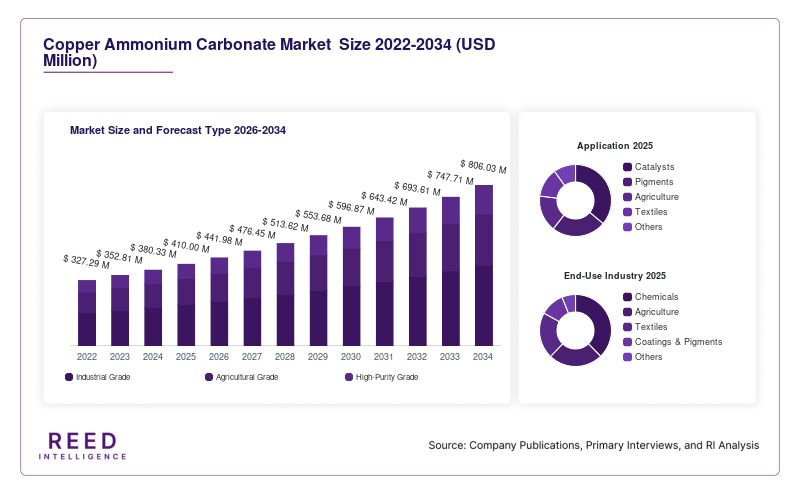
The Copper Ammonium Carbonate Market is segmented by type into industrial grade, agricultural grade, and high-purity grade. Among these, industrial grade holds the dominant share of approximately 48% in 2024 due to its widespread use in chemical synthesis, catalyst production, and pigment manufacturing. Industrial-grade variants are preferred for bulk applications where cost efficiency and consistent chemical properties are essential. Their availability in large quantities and compatibility with various industrial processes contribute to their leading position in the market.
The high-purity grade segment is expected to be the fastest-growing, with a CAGR of around 8.6% during the forecast period. This growth is driven by increasing demand from advanced manufacturing sectors such as electronics, pharmaceuticals, and specialty coatings. High-purity copper ammonium carbonate is required in applications where precision, consistency, and minimal impurities are critical. The rising emphasis on quality control and performance optimization in industrial processes is further supporting the adoption of high-purity variants, particularly in developed markets.
By Application
By application, the market is categorized into catalysts, pigments, agriculture, textiles, and others. The catalysts segment dominates with a share of approximately 42% in 2024, driven by the compound’s role as a precursor in catalytic systems used in chemical reactions. Its effectiveness in facilitating oxidation processes makes it valuable in industrial chemical production. The demand for efficient catalysts in large-scale manufacturing processes is a key factor sustaining this segment’s dominance.
The agriculture segment is projected to be the fastest-growing, with a CAGR of around 8.9%. This growth is attributed to the increasing use of copper ammonium carbonate in micronutrient fertilizers and fungicidal applications. As global agricultural practices shift toward improved soil management and crop yield optimization, the demand for copper-based nutrients is rising. Farmers are adopting scientifically formulated inputs to address nutrient deficiencies, which is contributing to the expansion of this segment.
By End-Use Industry
The end-use industry segmentation includes chemicals, agriculture, textiles, coatings & pigments, and others. The chemicals industry accounts for the largest share of approximately 40% in 2024, driven by the compound’s extensive use in chemical synthesis, intermediates, and catalyst production. The industry’s reliance on copper-based compounds for various processes ensures steady demand from this segment.
The agriculture end-use segment is expected to witness the fastest growth, with a CAGR of around 8.5% during the forecast period. The increasing adoption of advanced farming techniques and the need to enhance crop productivity are driving demand for copper ammonium carbonate in fertilizers and crop protection products. Rising global food demand and the need for efficient agricultural inputs are key factors contributing to the growth of this segment.
Regional Analysis
North America
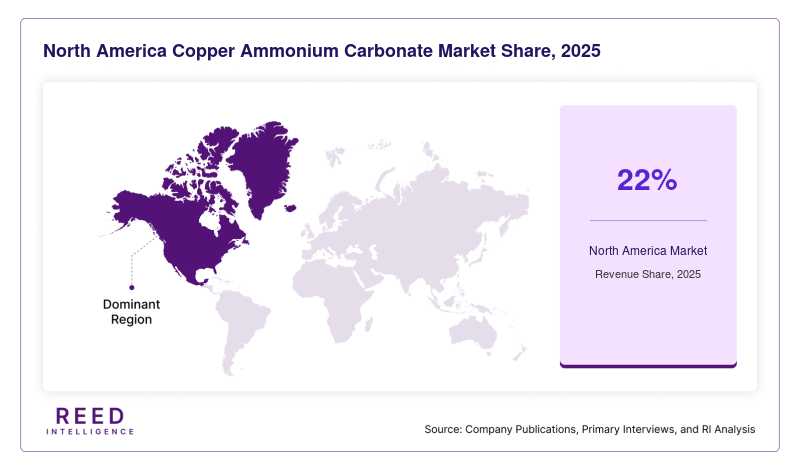
North America accounts for approximately 22% of the Copper Ammonium Carbonate Market share in 2025, with a projected CAGR of around 6.8% during the forecast period. The region benefits from a well-established chemical manufacturing base and strong demand from industrial and agricultural sectors. The presence of advanced processing facilities and high adoption of specialty chemicals contributes to steady market growth across the United States and Canada.
The United States dominates the regional market due to its large-scale chemical production infrastructure and extensive use of copper compounds in catalysts and industrial applications. A unique growth factor in this region is the increasing adoption of precision agriculture techniques, which is driving demand for micronutrient fertilizers containing copper ammonium carbonate to improve crop productivity and soil health.
Europe
Europe holds approximately 20% of the Copper Ammonium Carbonate Market share in 2025, with a CAGR of about 6.5% through 2034. The region’s growth is supported by strong regulatory frameworks, advanced industrial practices, and a focus on high-quality chemical production. Demand is driven by applications in pigments, coatings, and specialty chemicals.
Germany leads the European market due to its robust chemical industry and strong emphasis on innovation and sustainability. A key growth factor in this region is the implementation of strict environmental regulations that encourage the use of controlled and efficient chemical compounds, promoting the adoption of copper ammonium carbonate in compliant industrial applications.
Asia Pacific
Asia Pacific represents the largest regional market, accounting for approximately 35% of the global share in 2025, with a CAGR of around 9.2%. Rapid industrialization, expanding agricultural activities, and growing chemical manufacturing capabilities are driving demand across China, India, Japan, and Southeast Asia.
China dominates the regional market due to its extensive manufacturing base and high demand for industrial chemicals. A major growth factor is the rapid expansion of industrial infrastructure and increasing investments in chemical production facilities, which are boosting consumption of copper ammonium carbonate across multiple end-use industries.
Middle East & Africa
The Middle East & Africa region holds around 10% of the market share in 2025, with a CAGR of approximately 7.1%. Growth is supported by gradual industrial diversification, increasing agricultural investments, and infrastructure development initiatives across countries such as the UAE, Saudi Arabia, and South Africa.
South Africa leads the regional market due to its established mining and agricultural sectors. A unique growth factor is the increasing focus on improving agricultural productivity in arid regions, which is driving the adoption of micronutrient-based fertilizers containing copper compounds to enhance soil quality and crop yield.
Latin America
Latin America accounts for roughly 13% of the global Copper Ammonium Carbonate Market share in 2025, with a CAGR of about 7.4%. The region’s growth is driven by agricultural expansion, particularly in countries such as Brazil and Argentina, along with increasing industrial activity.
Brazil is the dominant country in this region due to its large agricultural base and growing chemical industry. A key growth factor is the rising demand for agricultural inputs to support large-scale crop production, which is encouraging the use of copper-based compounds in fertilizers and crop protection solutions.
Competitive Landscape
The Copper Ammonium Carbonate Market features a moderately fragmented competitive landscape, with several global and regional players engaged in production, distribution, and innovation. Key companies are focusing on product quality, process optimization, and expansion of production capacities to strengthen their market position. Competition is influenced by factors such as pricing, purity levels, supply chain efficiency, and regulatory compliance.
Leading companies include BASF SE, Merck KGaA, Thermo Fisher Scientific Inc., American Elements, and Avantor, Inc. Among these, BASF SE is considered a leading player due to its extensive chemical manufacturing capabilities and strong global distribution network. The company continues to invest in sustainable production methods and advanced chemical solutions to maintain its competitive advantage. Recent developments in the industry include capacity expansions, partnerships for supply chain optimization, and investments in environmentally friendly manufacturing technologies aimed at reducing emissions and improving operational efficiency.
Key Players List
- BASF SE
- Merck KGaA
- Thermo Fisher Scientific Inc.
- American Elements
- Avantor, Inc.
- Honeywell International Inc.
- Spectrum Chemical Manufacturing Corp.
- Alfa Aesar (Thermo Fisher Scientific brand)
- Tokyo Chemical Industry Co., Ltd.
- Santa Cruz Biotechnology, Inc.
- Central Drug House (P) Ltd.
- Loba Chemie Pvt. Ltd.
- Sisco Research Laboratories Pvt. Ltd.
- Jiangsu Huaihai Chemical Co., Ltd.
- Shanghai Aladdin Biochemical Technology Co., Ltd.
Recent Developments
- Expansion of production facilities by key chemical manufacturers to meet rising global demand for specialty copper compounds.
- Increasing investments in sustainable and eco-friendly chemical synthesis processes aimed at reducing environmental impact.
- Strategic collaborations between manufacturers and distributors to enhance supply chain efficiency and global market reach.
Copper Ammonium Carbonate Market Segments
Type
- Industrial Grade
- Agricultural Grade
- High-Purity Grade
Application
- Catalysts
- Pigments
- Agriculture
- Textiles
- Others
End-Use Industry
- Chemicals
- Agriculture
- Textiles
- Coatings & Pigments
- Others
By Region
- North America
- Europe
- APAC
- Middle East and Africa
- LATAM