Copper Azole Market Size, Share & Demand Report By Type (CA-A, CA-B, CA-C), By Application (Residential Construction, Commercial Construction, Industrial), By End-Use Industry (Construction, Agriculture, Marine, Utilities), By Formulation (Water-Based, Micronized), By Region & Segment Forecasts, 2026–2034
USD 3950
Market Overview
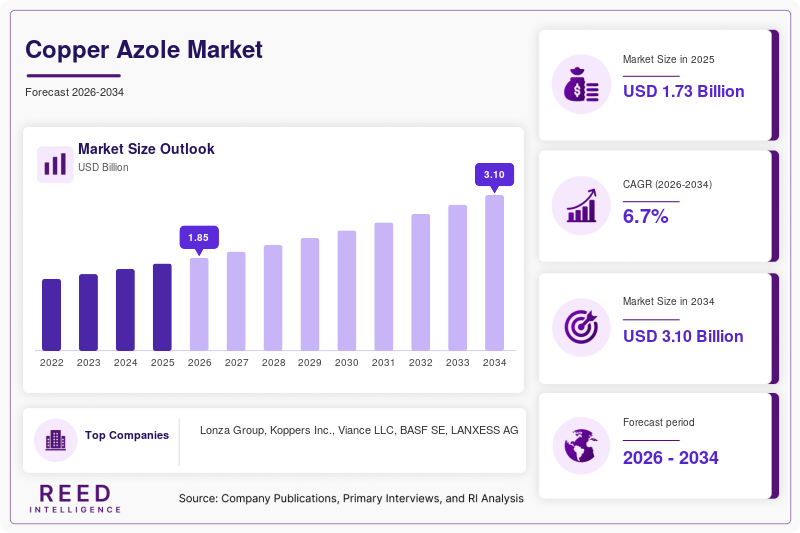
The global Copper Azole Market size was estimated at USD 1.85 billion in 2026 and is projected to reach approximately USD 3.12 billion by 2034, expanding at a CAGR of 6.7% during the forecast period (2026–2034). The market growth has been supported by the increasing demand for durable wood preservation solutions across construction, infrastructure, and outdoor applications. Copper azole, a widely used wood preservative, offers enhanced resistance against fungi, termites, and moisture, making it a preferred alternative to traditional chromated copper arsenate (CCA).
A key global factor driving the Copper Azole Market is the rising emphasis on environmentally compliant wood treatment chemicals. Regulatory shifts toward safer preservatives have accelerated the adoption of copper azole formulations, especially in residential decking, fencing, and landscaping projects. Additionally, increasing investments in sustainable construction materials have contributed to steady market expansion.
Key Highlights:
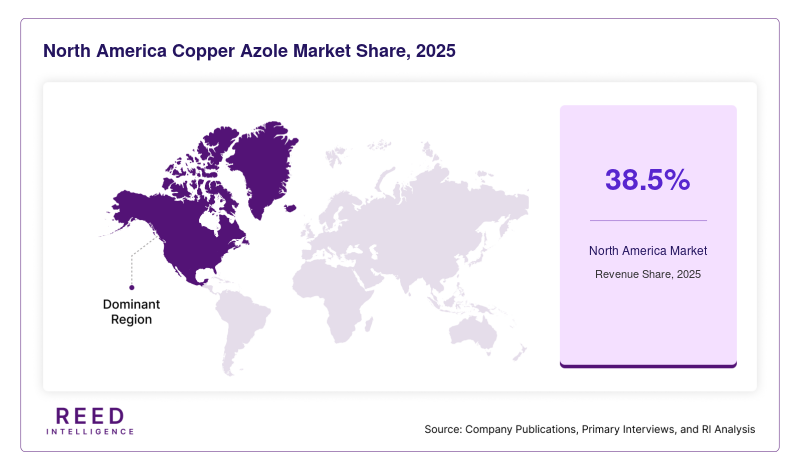
- North America dominated the Copper Azole Market with a share of 38.5% in 2025, while Asia Pacific is projected to be the fastest-growing region at a CAGR of 7.9%.
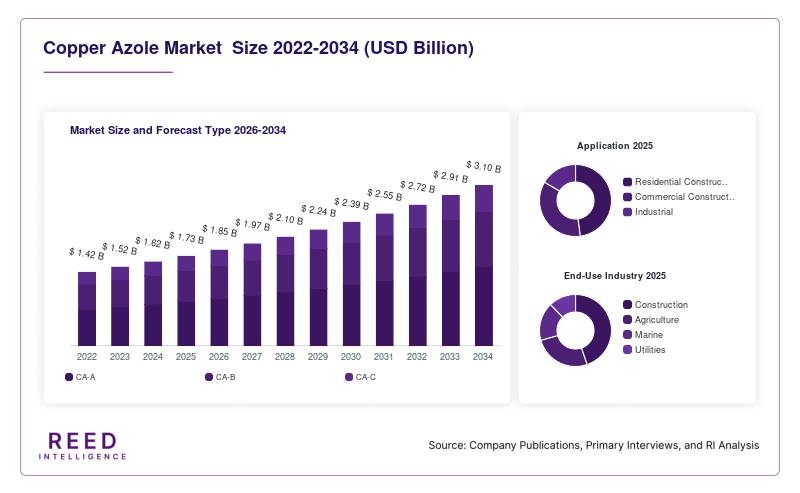
- Type A (CA-A) emerged as the leading subsegment with a 46.2% share, while Type C (CA-C) is expected to register the fastest CAGR of 7.5%.
- Residential construction was the dominant application segment, accounting for 41.8% share, whereas industrial applications are projected to grow fastest at a CAGR of 7.2%.
- The U.S. remained the dominant country, with market values of USD 620 million in 2024 and USD 655 million in 2025.
Market Trends
Shift Toward Eco-Friendly Wood Preservatives
The Copper Azole Market is experiencing a steady shift toward eco-friendly and arsenic-free wood preservation chemicals. As regulatory bodies enforce stricter environmental standards, manufacturers are increasingly focusing on developing formulations with reduced toxicity and improved biodegradability. Copper azole has gained traction due to its compliance with environmental safety norms, making it suitable for residential and commercial use. This trend is particularly visible in developed regions, where consumers prefer sustainable materials for outdoor construction and landscaping.
Expansion of Treated Wood Applications
Another notable trend shaping the Copper Azole Market is the expanding application scope of treated wood. Beyond traditional uses such as decking and fencing, copper azole-treated wood is being increasingly used in marine structures, utility poles, agricultural fencing, and highway infrastructure. This diversification is driven by the material’s durability and resistance to harsh environmental conditions. The rising popularity of outdoor living spaces and urban landscaping projects has further accelerated demand. As construction practices evolve, the Copper Azole Market continues to benefit from broader application integration across multiple industries.
Market Drivers
Growth in Construction and Infrastructure Development
The rapid expansion of construction and infrastructure projects globally has been a significant driver for the Copper Azole Market. Urbanization, population growth, and government investments in housing and public infrastructure have increased the demand for treated wood products. Copper azole-treated wood is widely used in decking, fencing, bridges, and utility poles due to its long-lasting performance. As emerging economies continue to invest in infrastructure modernization, the demand for wood preservation solutions is expected to rise steadily.
Increasing Demand for Durable and Low-Maintenance Materials
Consumers and industries are increasingly prioritizing materials that require minimal maintenance and offer long service life. Copper azole-treated wood meets these requirements by providing resistance against decay, insects, and moisture damage. This has led to its widespread adoption in outdoor construction projects, particularly in regions with high humidity and extreme weather conditions. The growing preference for cost-effective and durable building materials has further strengthened the growth trajectory of the Copper Azole Market.
Market Restraint
Fluctuations in Raw Material Prices
One of the major restraints affecting the Copper Azole Market is the volatility in raw material prices, particularly copper. Copper is a key component in copper azole formulations, and its price fluctuations directly impact production costs. Global supply chain disruptions, mining constraints, and geopolitical factors have contributed to inconsistent copper pricing. This creates challenges for manufacturers in maintaining stable profit margins and competitive pricing.
Additionally, the dependence on metal-based inputs increases the overall cost of wood treatment solutions compared to alternative preservatives. Small and medium-scale manufacturers often face difficulties in managing cost fluctuations, which may limit market entry and expansion. While demand for copper azole remains strong due to its performance benefits, pricing instability continues to pose a challenge for sustained market growth.
Market Opportunities
Rising Adoption in Emerging Economies
Emerging economies present significant growth opportunities for the Copper Azole Market. Rapid urbanization, increasing disposable income, and government initiatives to improve housing infrastructure are driving the demand for treated wood products. Countries in Asia Pacific, Latin America, and parts of Africa are witnessing increased adoption of wood preservation technologies. As awareness about the benefits of copper azole-treated wood grows, manufacturers have the opportunity to expand their presence in these regions.
Innovation in Advanced Formulations
Technological advancements in wood preservation chemicals offer promising opportunities for the Copper Azole Market. Manufacturers are investing in research and development to create advanced formulations with improved penetration, longer lifespan, and reduced environmental impact. Innovations such as micronized copper azole and hybrid preservative systems are gaining attention for their enhanced performance. These developments are expected to open new application areas and strengthen market competitiveness over the forecast period.
Segmental Analysis
By Type
Type A (CA-A) dominated the Copper Azole Market in 2025, accounting for 46.2% of the total market share. This subsegment’s dominance was attributed to its cost-effectiveness and widespread use in residential applications. CA-A formulations provide adequate protection against decay and insects, making them suitable for decking, fencing, and landscaping projects. The ease of application and availability further contributed to its leading position.
Type C (CA-C) is expected to be the fastest-growing subsegment, with a projected CAGR of 7.5% during the forecast period. Its superior performance in harsh environmental conditions and enhanced resistance to fungal decay will drive its adoption. The increasing demand for high-performance wood preservatives in industrial and infrastructure applications will further support its growth.
By Application
Residential construction emerged as the dominant application segment in 2025, holding a 41.8% share of the Copper Azole Market. The growing trend of outdoor living spaces, including decks and patios, significantly increased demand for treated wood products. Home renovation activities and consumer preference for durable materials also contributed to this segment’s dominance.
Industrial applications are projected to grow at the fastest CAGR of 7.2% during the forecast period. The increasing use of treated wood in utility poles, marine structures, and railway sleepers will drive this growth. The need for long-lasting materials in industrial environments will further boost demand for copper azole-treated wood.
By End-Use Industry
The construction industry dominated the Copper Azole Market in 2025, accounting for 52.6% of the total share. The extensive use of treated wood in residential and commercial construction projects supported this dominance. The demand for sustainable and durable building materials further strengthened the segment’s growth.
The agriculture sector is expected to be the fastest-growing end-use industry, with a CAGR of 7.1%. The increasing use of treated wood in fencing, barns, and rural infrastructure will drive this growth. The need for durable materials in agricultural environments will further enhance demand.
By Formulation Type
Water-based formulations dominated the Copper Azole Market in 2025, with a share of 58.4%. These formulations are widely preferred due to their lower environmental impact and ease of application. The growing emphasis on eco-friendly solutions has further supported their adoption.
Micronized copper azole formulations are expected to grow at the fastest CAGR of 7.6%. Their improved penetration and reduced leaching properties will drive demand. Technological advancements in formulation development will further enhance their adoption across various applications.
Regional Analysis
North America
North America accounted for 38.5% of the Copper Azole Market share in 2025 and is expected to grow at a CAGR of 6.2% during the forecast period. The region’s dominance was driven by strong demand for treated wood in residential construction and outdoor applications. Increasing renovation activities and the popularity of backyard decking contributed to market expansion. The presence of established wood treatment infrastructure further supported growth.
The United States remained the dominant country in the region due to its advanced construction sector and high adoption of treated wood products. The growing trend of outdoor living spaces and home improvement projects significantly boosted demand for copper azole-treated wood. Additionally, strict regulations promoting safer preservatives encouraged widespread adoption.
Europe
Europe held a 24.3% share of the Copper Azole Market in 2025 and is projected to grow at a CAGR of 6.0% through 2034. The region’s growth was supported by increasing environmental awareness and stringent regulations on wood preservatives. The demand for sustainable construction materials has driven the adoption of copper azole across various applications.
Germany emerged as the dominant country, driven by its strong construction industry and focus on eco-friendly building materials. The country’s emphasis on sustainable infrastructure development and green building standards contributed to increased usage of copper azole-treated wood. Continuous innovation in wood preservation technologies also supported market growth.
Asia Pacific
Asia Pacific accounted for 22.7% of the Copper Azole Market share in 2025 and is expected to register the fastest CAGR of 7.9% during the forecast period. Rapid urbanization, industrialization, and infrastructure development have been key factors driving regional growth. Increasing investments in residential and commercial construction projects have boosted demand for wood preservation solutions.
China dominated the regional market due to its large-scale construction activities and expanding infrastructure projects. The country’s growing focus on durable and cost-effective building materials has increased the adoption of copper azole-treated wood. Additionally, rising awareness about wood preservation techniques is expected to further accelerate market growth.
Middle East & Africa
The Middle East & Africa region held a 7.5% share of the Copper Azole Market in 2025 and is projected to grow at a CAGR of 6.5% during the forecast period. The region’s growth was supported by infrastructure development and increasing construction activities in urban areas. The demand for durable building materials has contributed to the adoption of copper azole-treated wood.
The United Arab Emirates emerged as the dominant country, driven by its expanding construction sector and investments in tourism infrastructure. The use of treated wood in outdoor structures, landscaping, and commercial projects has increased significantly. Harsh climatic conditions have further emphasized the need for durable wood preservation solutions.
Latin America
Latin America accounted for 7.0% of the Copper Azole Market share in 2025 and is expected to grow at a CAGR of 6.8% during the forecast period. The region’s growth was driven by increasing construction activities and the expansion of agricultural infrastructure. The demand for treated wood in fencing and outdoor applications has supported market development.
Brazil dominated the regional market due to its large agricultural sector and growing infrastructure investments. The use of copper azole-treated wood in fencing, utility poles, and rural construction projects has increased steadily. Government initiatives to improve infrastructure have further contributed to market growth.
Competitive Landscape
The Copper Azole Market is characterized by the presence of several global and regional players competing based on product innovation, pricing strategies, and distribution networks. The market leader, Lonza Group, has maintained a strong position through continuous investment in research and development and the introduction of advanced wood preservation solutions. The company recently expanded its production capacity to meet growing demand in North America.
Other key players focus on strategic partnerships, acquisitions, and product portfolio expansion to strengthen their market presence. Companies are also investing in sustainable and environmentally compliant formulations to align with regulatory requirements and consumer preferences.
Key Players List
- Lonza Group
- Koppers Inc.
- Viance LLC
- BASF SE
- LANXESS AG
- Troy Corporation
- Borax Inc.
- Kurt Obermeier GmbH
- Arxada
- Nisus Corporation
- Dolphin Bay Chemicals
- Jiangsu Champion Chemical Co., Ltd.
- Remmers Group
- Buckman Laboratories
- RÜTGERS Group
Recent Developments
- 2025: Lonza Group introduced an advanced micronized copper azole formulation designed for enhanced durability.
- 2024: Koppers Inc. expanded its wood treatment facilities in North America.
- 2025: BASF SE invested in sustainable preservative technologies to reduce environmental impact.
- 2024: Viance LLC launched a new product line targeting residential decking applications.
- 2025: LANXESS AG strengthened its distribution network in Asia Pacific to capture emerging demand.
Copper Azole Market Segments
Type
- CA-A
- CA-B
- CA-C
Application
- Residential Construction
- Commercial Construction
- Industrial
End-Use Industry
- Construction
- Agriculture
- Marine
- Utilities
Formulation
- Water-Based
- Micronized
By Region
- North America
- Europe
- APAC
- Middle East and Africa
- LATAM