Copra Meal Market Size, Share, Demand and Industry Analysis Report By Source Type (Solvent-Extracted Copra Meal, Mechanically Extracted Copra Meal), By Livestock Application (Ruminant Feed, Poultry Feed, Pet Food), By Distribution Channel (Direct Industrial Supply, Commodity Traders, Agricultural Distributors) By Regional Outlook and Segment Forecasts, 2026–2034
USD 3950
Market Overview
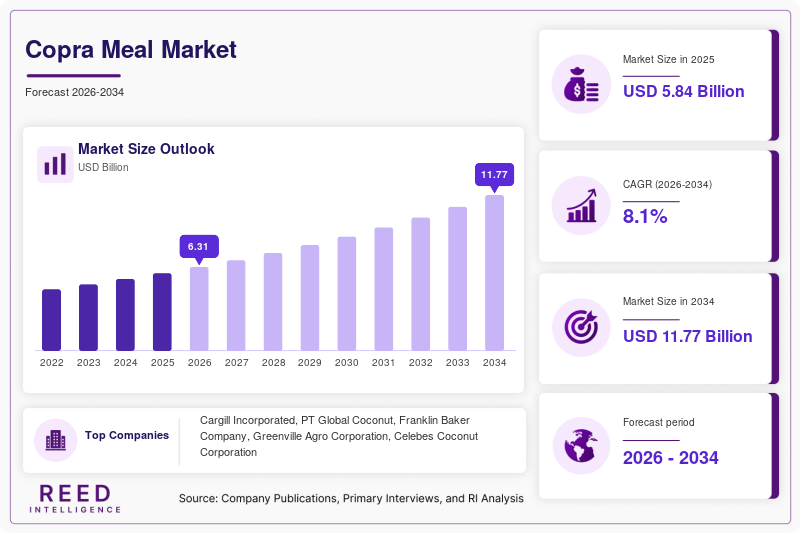
The global Copra Meal Market size was valued at USD 5.84 billion in 2026 and is projected to reach USD 10.92 billion by 2034, expanding at a CAGR of 8.1% during the forecast period from 2026 to 2034. Copra meal, a byproduct derived from coconut oil extraction, is widely used in animal feed formulations due to its high fiber content, moderate protein concentration, and cost efficiency. The market has gained steady momentum as livestock producers continue to search for economical feed ingredients that support digestive health and improve feed conversion efficiency. Rising demand for poultry, dairy, aquaculture, and cattle feed products across developing economies has created consistent demand for copra meal across commercial farming operations.
A major global factor supporting market growth is the increasing expansion of the animal nutrition industry in Asia Pacific, Latin America, and parts of Africa. Rapid urbanization and rising meat consumption have encouraged feed manufacturers to diversify feed ingredient sourcing, particularly for fiber-rich ingredients that can lower feed costs. In addition, growth in coconut processing activities across tropical economies has improved copra meal availability and export volumes. Manufacturers are also investing in improved drying, storage, and processing technologies to enhance product shelf life and nutritional consistency. The growing preference for sustainable agricultural byproducts in livestock feed formulations is further supporting market expansion.
Key Highlights
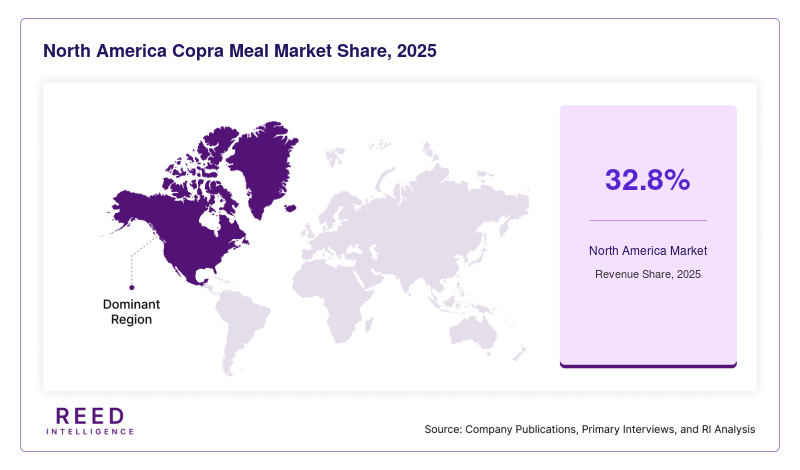
- North America dominated the market with a 32.8% share in 2025.
- Asia Pacific is expected to grow at the fastest CAGR of 10.9% during 2026–2034.
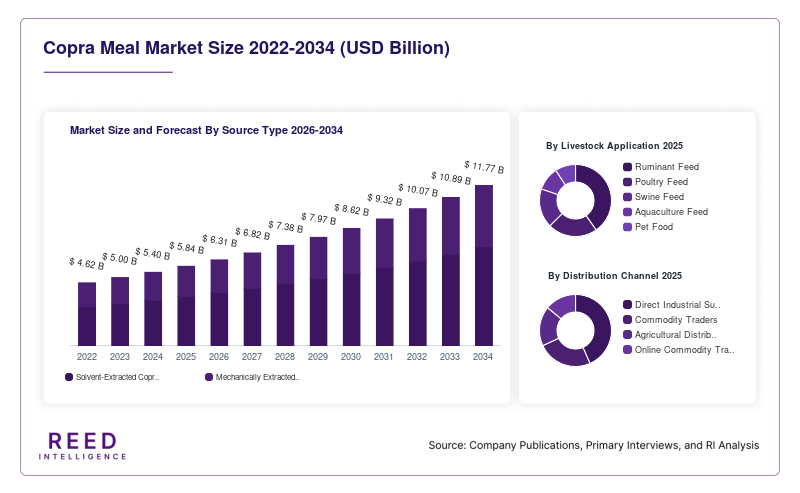
- By source type, solvent-extracted copra meal accounted for the largest share of 57.4%.
- while mechanically extracted copra meal is projected to grow at a CAGR of 9.7%.
- By livestock application, ruminant feed led with a 39.6% share.
- whereas aquaculture feed is expected to expand at a CAGR of 10.8%.
- By distribution channel, direct industrial supply accounted for the largest share of 61.2%.
- while online commodity trading platforms are projected to grow at a CAGR of 11.1%.
- The United States remained the dominant country, with market values of USD 1.41 billion in 2024 and USD 1.53 billion in 2025.
Market Trends
Rising Integration of Sustainable Feed Ingredients in Livestock Nutrition
Feed manufacturers are increasingly incorporating sustainable agricultural byproducts into commercial livestock formulations, creating favorable conditions for the Copra Meal Market. The livestock sector is under pressure to reduce feed waste, lower production costs, and improve environmental sustainability. Copra meal addresses these requirements by offering a cost-effective and recyclable feed ingredient derived from coconut processing. Large feed producers are expanding procurement agreements with coconut processors to ensure stable supply volumes. Demand has been particularly strong among dairy cattle and beef feed manufacturers seeking high-fiber ingredients that improve rumen function and digestion. Sustainability certifications and traceable agricultural sourcing are also becoming important across global feed supply chains, encouraging broader acceptance of copra meal among industrial feed manufacturers.
Expansion of Aquaculture Feed Production Across Emerging Economies
The rapid growth of aquaculture farming in Southeast Asia, South America, and Africa has become a significant trend supporting the Copra Meal Market. Fish and shrimp farming operators are increasingly searching for economical feed alternatives that can partially replace soybean meal and fishmeal. Copra meal has gained traction in aquaculture feed blends because of its affordability and availability in coconut-producing countries. Feed formulators are improving enzyme treatments and fermentation technologies to enhance nutrient digestibility and protein absorption. Growing seafood exports from countries such as Indonesia, Vietnam, India, and the Philippines are driving investment in commercial aquaculture feed production facilities. This transition toward diversified aquafeed ingredients is expected to create long-term growth opportunities for copra meal suppliers and exporters.
Market Drivers
Increasing Demand for Cost-Effective Livestock Feed Solutions
The rising cost of conventional feed ingredients such as soybean meal and corn has encouraged livestock producers to adopt lower-cost feed alternatives, significantly driving the Copra Meal Market. Commercial farms are under pressure to maintain profitability while meeting rising meat and dairy demand. Copra meal provides a comparatively economical ingredient that can reduce overall feed formulation costs without compromising fiber intake. Poultry and ruminant feed manufacturers are increasingly incorporating copra meal into mixed feed blends to stabilize production expenses. Growing livestock populations in Asia Pacific and Latin America are further contributing to higher demand. The increasing commercialization of animal farming operations has also accelerated the use of standardized feed formulations that include agricultural byproducts such as copra meal.
Expansion of Coconut Processing and Export Industries
The growth of coconut oil extraction and coconut processing industries has substantially increased the availability of copra meal across international markets. Countries including the Philippines, Indonesia, India, and Sri Lanka have expanded coconut cultivation and processing capacities to meet rising demand for coconut-based consumer products. As a result, the supply of copra meal has increased consistently, creating a stable raw material base for feed manufacturers. Export-oriented processing facilities are also investing in modern drying systems and quality control technologies to improve nutritional consistency and reduce contamination risks. Government support for agricultural exports and rural processing industries in coconut-producing countries has further strengthened supply chain efficiency, supporting sustained expansion of the Copra Meal Market.
Market Restraint
Fluctuating Raw Material Availability and Quality Challenges
One of the primary restraints affecting the Copra Meal Market is the fluctuation in coconut production caused by changing weather conditions, pest outbreaks, and inconsistent agricultural productivity. Tropical storms, drought conditions, and plant diseases can significantly affect coconut yields in major producing countries, leading to unstable raw material supply and price volatility. In addition, copra meal quality often varies depending on drying methods, oil extraction techniques, and storage conditions. Poor processing standards can increase moisture levels and contamination risks, reducing feed quality and limiting adoption among large-scale feed manufacturers.
These inconsistencies create operational challenges for international buyers seeking standardized nutritional profiles. Feed producers operating in highly regulated markets often require strict quality certifications and reliable protein consistency, which smaller suppliers may struggle to provide. For example, inconsistent aflatoxin control measures in certain export regions have occasionally disrupted shipments and increased inspection costs for importers. Such quality-related concerns may slow market penetration in premium feed markets and limit the adoption of copra meal in specialized animal nutrition applications.
Market Opportunities
Growing Adoption of Fermented Copra Meal in Specialty Feed Products
The increasing use of fermentation technologies in animal nutrition presents a significant opportunity for the Copra Meal Market. Fermented copra meal offers improved digestibility, enhanced nutrient absorption, and reduced anti-nutritional compounds compared to conventional variants. Feed manufacturers are investing in microbial fermentation techniques to increase protein availability and improve feed efficiency in poultry and aquaculture applications. This development is creating opportunities for premium-grade copra meal products targeting commercial farming operations. Rising awareness regarding gut health and livestock productivity is also encouraging the use of advanced feed ingredients. As commercial farms continue adopting scientifically optimized nutrition programs, demand for value-added copra meal formulations is expected to rise steadily.
Expansion of Export Trade Across Emerging Feed Markets
Emerging economies with expanding livestock sectors are creating new export opportunities for copra meal suppliers. Countries in the Middle East, Africa, and Latin America are increasingly dependent on imported feed ingredients due to limited domestic production capacities. This trend has encouraged exporters from Asia Pacific to strengthen distribution partnerships and invest in regional supply networks. Improvements in container shipping infrastructure and commodity trading platforms are also supporting cross-border trade efficiency. Rising investments in dairy and poultry farming in countries such as Saudi Arabia, Nigeria, Brazil, and Mexico are expected to generate higher feed demand over the forecast period. Export-oriented suppliers that can provide consistent quality and long-term supply contracts are likely to gain a competitive advantage.
Segmental Analysis
By Source Type
Solvent-extracted copra meal dominated the market in 2024 with a share of 57.4% due to its widespread commercial availability and cost efficiency. This segment is commonly produced during large-scale coconut oil extraction processes and offers relatively consistent nutritional composition suitable for industrial feed manufacturing. Feed producers prefer solvent-extracted variants because they contain lower residual oil content, making them easier to blend with other feed ingredients. The segment has experienced strong demand across dairy cattle and poultry feed industries, particularly in regions with high livestock populations. Large coconut processing facilities in Southeast Asia continue to expand production capacities, ensuring stable supply volumes for export markets. In addition, the lower production cost associated with solvent extraction technologies has strengthened the segment’s competitive position within global feed ingredient markets.
Mechanically extracted copra meal is expected to register the fastest CAGR of 9.7% during the forecast period due to increasing demand for minimally processed and nutrient-rich feed ingredients. This segment retains higher residual oil content, which can improve energy levels in animal feed formulations. Commercial livestock producers are increasingly exploring premium feed blends that support animal health and productivity, particularly within dairy and aquaculture applications. Growth in organic farming and specialty feed manufacturing has also contributed to rising demand for mechanically extracted variants. Smaller processing facilities are investing in advanced cold-press extraction systems to improve product quality and nutritional retention. As feed manufacturers continue emphasizing natural and sustainable feed ingredients, mechanically extracted copra meal is likely to witness strong adoption across high-value livestock nutrition segments.
By Livestock Application
Ruminant feed accounted for the largest share of the Copra Meal Market in 2024, representing 39.6% of global demand. Copra meal is widely used in cattle and dairy feed because of its high fiber content and ability to support rumen health. Dairy farms in North America, Europe, and Asia Pacific increasingly incorporate copra meal into feed formulations to improve digestion and maintain feed efficiency. The affordability of copra meal compared to conventional protein sources has also contributed to strong adoption among commercial cattle producers. Growing global demand for dairy products and beef consumption continues to increase livestock populations, supporting higher feed requirements. Additionally, feed manufacturers are developing customized ruminant nutrition blends that combine copra meal with vitamins, minerals, and protein supplements to improve livestock productivity.
Aquaculture feed is projected to witness the fastest CAGR of 10.8% from 2026 to 2034 due to expanding seafood production and rising demand for affordable feed alternatives. Fish and shrimp farming operations are increasingly incorporating copra meal into feed formulations to reduce reliance on fishmeal and soybean meal. Advances in feed processing technologies and enzyme supplementation have improved nutrient digestibility, making copra meal more suitable for aquaculture applications. Southeast Asia and Latin America are expected to remain major growth centers due to expanding shrimp and fish export industries. In addition, government initiatives supporting sustainable aquaculture production are encouraging feed manufacturers to diversify ingredient sourcing. These developments are likely to accelerate demand for copra meal across industrial aquaculture feed production facilities.
By Distribution Channel
Direct industrial supply emerged as the dominant distribution channel in 2024, accounting for 61.2% of the global market share. Large feed manufacturers typically purchase copra meal directly from processors and exporters through long-term supply agreements. This channel ensures stable pricing, consistent product quality, and reliable supply volumes for commercial feed production operations. Major livestock feed producers prefer direct procurement because it reduces intermediary costs and improves supply chain efficiency. International commodity traders and bulk distributors also play a significant role in facilitating shipments between coconut-producing countries and major livestock markets. Growing demand for standardized feed ingredients has encouraged suppliers to strengthen quality control systems and logistics capabilities, further supporting the dominance of direct industrial supply channels.
Online commodity trading platforms are anticipated to record the fastest CAGR of 11.1% during the forecast period due to digitalization within agricultural trade networks. Feed ingredient buyers are increasingly adopting online procurement systems that provide price transparency, supplier comparisons, and faster transaction processing. Small and medium-sized feed manufacturers particularly benefit from digital trading platforms because they gain access to international suppliers without requiring extensive distribution infrastructure. E-commerce integration within agricultural commodity markets is also improving shipment tracking and inventory management. In addition, growing smartphone penetration and internet accessibility across emerging economies are encouraging wider adoption of digital procurement solutions. These technological advancements are expected to transform copra meal trading practices and create new growth opportunities for suppliers and exporters.
Regional Analysis
North America
North America accounted for 32.8% of the global Copra Meal Market share in 2025 and continues to represent one of the largest regional markets. The region is projected to expand at a CAGR of 7.3% during the forecast period due to rising demand for alternative feed ingredients and increasing focus on cost optimization in livestock farming. Feed manufacturers across the United States and Canada are expanding the use of agricultural byproducts in commercial feed formulations. Strong demand from dairy and cattle industries has contributed to stable consumption volumes, while imports from Asia Pacific continue to support regional supply requirements.
The United States remained the dominant country in North America due to its extensive commercial livestock sector and advanced feed manufacturing industry. One unique growth factor supporting the market is the rising adoption of sustainable feed procurement strategies among large agricultural companies. Feed producers are increasingly incorporating low-waste and recyclable ingredients to align with environmental targets and improve operational efficiency. In addition, growing investments in precision livestock farming and nutritional optimization have encouraged feed formulators to diversify ingredient sourcing, supporting long-term demand for copra meal products.
Europe
Europe held a significant share of the Copra Meal Market in 2025 and is forecast to grow at a CAGR of 6.9% through 2034. The region has experienced increasing demand for high-fiber livestock feed ingredients, particularly in dairy and organic farming sectors. Feed manufacturers across Germany, France, and the Netherlands are actively incorporating alternative feed ingredients to reduce dependence on traditional soybean imports. Regulatory support for sustainable agriculture and reduced feed waste has also strengthened the use of agricultural byproducts in livestock nutrition. Import demand remains stable as regional feed producers continue diversifying ingredient portfolios.
Germany emerged as the dominant country within Europe due to its advanced livestock production infrastructure and strong feed processing industry. A unique factor driving growth in the German market is the increasing adoption of circular economy practices in agriculture. Livestock producers and feed manufacturers are emphasizing resource-efficient production systems that utilize agricultural byproducts effectively. Additionally, the region’s focus on reducing carbon emissions across farming operations has encouraged the use of lower-cost and sustainable feed alternatives, creating favorable market conditions for copra meal imports and distribution.
Asia Pacific
Asia Pacific represented a rapidly expanding region in the Copra Meal Market and is anticipated to register the fastest CAGR of 10.9% during the forecast period. The region benefits from extensive coconut cultivation, strong feed manufacturing capacity, and growing livestock production activities. Countries such as Indonesia, the Philippines, India, and Vietnam continue to increase copra processing volumes to support both domestic demand and exports. Rising meat consumption, urban population growth, and expanding poultry sectors are driving large-scale feed production across the region. The availability of raw materials and lower production costs provide additional advantages for regional manufacturers.
The Philippines remained the dominant country in Asia Pacific due to its established coconut processing industry and strong export network. One unique growth factor supporting the Philippine market is the integration of coconut cooperatives with commercial feed supply chains. Agricultural cooperatives are increasingly partnering with feed manufacturers to improve raw material collection and processing efficiency. Government support for coconut farming modernization and export promotion programs has also strengthened production capabilities. These initiatives are expected to improve product quality, stabilize supply availability, and support sustained expansion of the regional copra meal industry.
Middle East & Africa
The Middle East & Africa region accounted for a moderate share of the Copra Meal Market in 2025 and is expected to grow at a CAGR of 8.4% during the forecast period. Rising investments in poultry, dairy, and aquaculture farming across Gulf countries and Africa are supporting feed ingredient demand. The region depends heavily on imported feed materials due to limited domestic cultivation of protein-rich crops. Increasing awareness regarding balanced livestock nutrition and feed cost management has encouraged regional distributors to expand imports of copra meal from Asia Pacific suppliers.
Saudi Arabia emerged as the dominant country within the Middle East & Africa market due to its expanding commercial livestock and dairy sectors. A unique growth factor supporting the market is the government’s focus on food security and domestic agricultural productivity. Large-scale farming projects and investments in animal nutrition infrastructure are increasing demand for reliable feed ingredients. In addition, the expansion of aquaculture development initiatives along coastal regions has created new opportunities for feed manufacturers incorporating copra meal into fish and shrimp feed formulations.
Latin America
Latin America maintained a steady position in the Copra Meal Market in 2025 and is projected to grow at a CAGR of 7.8% through 2034. Expanding cattle, poultry, and swine industries across Brazil, Mexico, and Argentina continue to support regional feed demand. Feed manufacturers are increasingly using cost-effective agricultural byproducts to reduce dependence on imported feed ingredients. Rising exports of meat and poultry products from Latin American countries have also increased the need for efficient livestock nutrition solutions. Improved commodity trade routes with Asian exporters are supporting stable copra meal imports into the region.
Brazil remained the dominant country in the Latin American market due to its large livestock population and strong agribusiness sector. One unique growth factor driving market expansion is the rapid development of integrated farming systems combining livestock and agricultural production. These systems encourage efficient feed utilization and greater adoption of alternative feed ingredients. In addition, Brazil’s expanding dairy industry and growing investment in commercial poultry production have increased demand for nutritionally balanced feed products, supporting the use of copra meal across multiple livestock applications.
Competitive Landscape
The Copra Meal Market remains moderately fragmented, with competition centered on supply reliability, product quality, pricing strategies, and export capabilities. Major companies are focusing on strengthening processing infrastructure and improving international distribution networks to expand market share. Several manufacturers are also investing in advanced drying and storage technologies to enhance product consistency and reduce contamination risks. Strategic partnerships with feed manufacturers and agricultural cooperatives have become common across leading coconut-producing countries.
PT Global Coconut emerged as one of the leading companies in the market due to its strong export network and integrated coconut processing operations across Southeast Asia. The company recently expanded its processing facility capacity to support rising international feed ingredient demand. Other key participants, including Cargill Incorporated, Franklin Baker Company, and Greenville Agro Corporation, continue to invest in supply chain optimization and long-term sourcing partnerships. Companies are increasingly emphasizing sustainable sourcing and traceable agricultural procurement to meet evolving customer requirements. Competitive intensity is expected to increase further as demand for cost-effective livestock feed ingredients continues to rise across global markets.
Key Players
- Cargill Incorporated
- PT Global Coconut
- Franklin Baker Company
- Greenville Agro Corporation
- Celebes Coconut Corporation
- Primex Coco Products Inc.
- CIIF OMG Coconut Industry Investment Fund
- Naturoca Holdings
- Royce Food Corporation
- Peter Paul Philippine Corporation
- SC Global Coco Products Inc.
- Adamjee Lukmanjee & Sons
- Kerafed Industries
- Sumatera Baru Coconut
- Axelum Resources Corp.
Recent Developments
- In February 2026, PT Global Coconut announced the expansion of its copra meal processing facility in Indonesia to increase annual export capacity for livestock feed applications.
- In August 2025, Cargill Incorporated entered a strategic sourcing partnership with coconut processors in the Philippines to strengthen its alternative feed ingredient portfolio.
- In November 2025, Axelum Resources Corp. introduced upgraded drying and storage systems designed to improve copra meal quality consistency and reduce moisture-related spoilage during exports.
- In March 2026, Silvermill Group launched a new fermented copra meal product line targeting premium aquaculture feed manufacturers across Asia Pacific.
Copra Meal Market Segments
By Source Type
- Solvent-Extracted Copra Meal
- Mechanically Extracted Copra Meal
By Livestock Application
- Ruminant Feed
- Poultry Feed
- Swine Feed
- Aquaculture Feed
- Pet Food
By Distribution Channel
- Direct Industrial Supply
- Commodity Traders
- Agricultural Distributors
- Online Commodity Trading Platforms
By Region
- North America
- Europe
- APAC
- Middle East and Africa
- LATAM