Cordierite Ceramic Market Size, Share & Demand Report By Product Type (Honeycomb Cordierite Ceramics, Porous Cordierite Ceramics, Dense Cordierite Ceramics, Cordierite Kiln Furniture), By Application (Automotive Emission Control, Electronic Insulation, Industrial Kilns and Furnaces, Filtration Systems, Thermal Insulation Components), By End-Use Industry (Automotive Manufacturing, Electronics and Semiconductor, Metallurgy, Chemical Processing, Energy and Power, Industrial Manufacturing) By Region
USD 3950
Market Overview
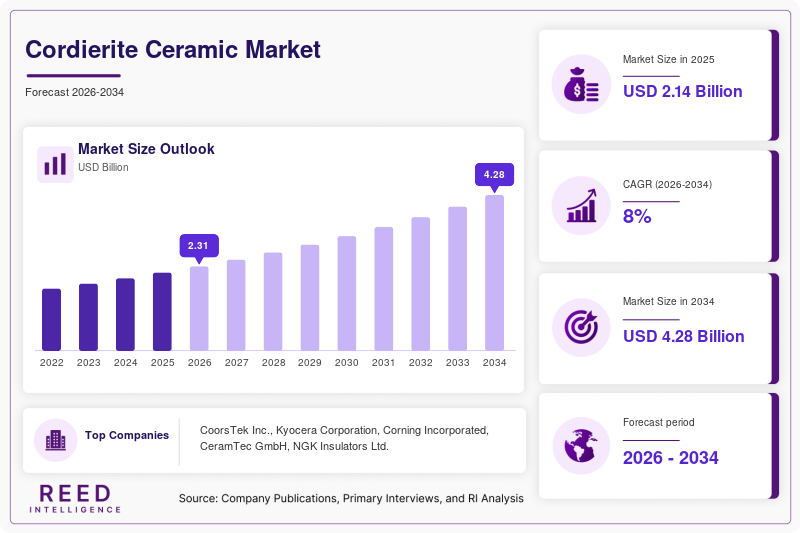
The global Cordierite Ceramic Market size was valued at USD 2.14 billion in 2026 and is projected to reach USD 3.96 billion by 2034, expanding at a CAGR of 8.0% during the forecast period from 2026 to 2034. The market is gaining momentum due to the increasing use of cordierite ceramic materials across automotive, electronics, metallurgy, and industrial processing industries. Cordierite ceramics are widely preferred because of their low thermal expansion, high thermal shock resistance, lightweight structure, and chemical durability. These performance characteristics make them suitable for catalytic converter substrates, kiln furniture, diesel particulate filters, and advanced insulation systems.
One of the primary global factors supporting market expansion is the increasing emphasis on energy-efficient industrial systems and emission reduction technologies. Governments and manufacturing industries across major economies are investing in cleaner industrial operations and low-emission automotive technologies. Cordierite ceramic components are increasingly integrated into emission control systems, particularly in automotive exhaust treatment applications. In addition, the rapid expansion of electric manufacturing equipment and high-temperature industrial processes has accelerated demand for lightweight ceramic solutions capable of maintaining dimensional stability under extreme thermal conditions.
Key Highlights
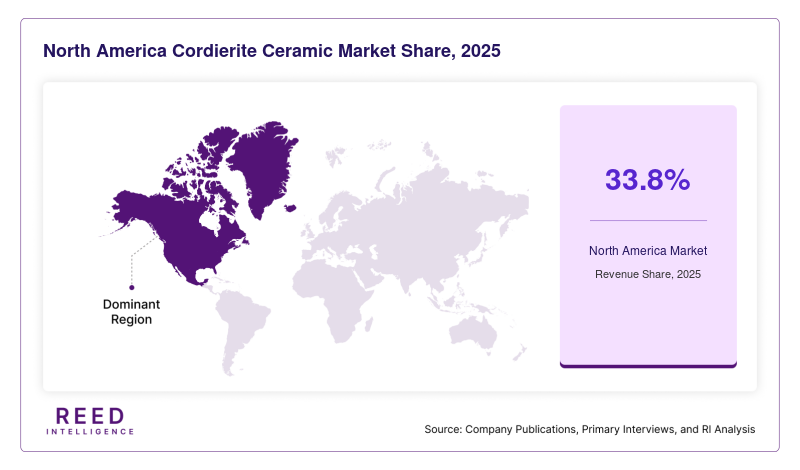
- North America dominated the market with a 33.8% share in 2025, while Asia Pacific is expected to grow at the fastest CAGR of 10.9% during 2026–2034.
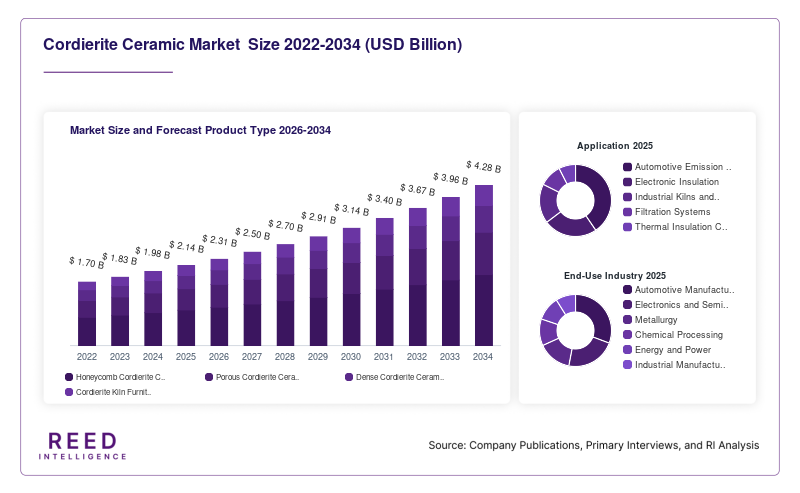
- By product type, honeycomb cordierite ceramics accounted for the largest share of 39.4%, while porous cordierite ceramics are projected to grow at a CAGR of 11.3%.
- By application, automotive emission control led with a 42.1% share, whereas electronic insulation applications are expected to expand at a CAGR of 10.8%.
- By end-use industry, automotive manufacturing held the dominant share of 36.7%, while electronics and semiconductor manufacturing is anticipated to register a CAGR of 11.1% during the forecast period.
- The United States remained the dominant country, with market values of USD 468 million in 2024 and USD 512 million in 2025.
Market Trends
Rising Integration of Cordierite Ceramics in Electric Mobility Infrastructure
The increasing development of electric mobility infrastructure is creating new opportunities for the Cordierite Ceramic Market. Manufacturers of electric vehicle charging systems, battery production equipment, and thermal insulation assemblies are integrating cordierite ceramic materials due to their excellent thermal stability and low expansion coefficient. Industrial equipment used in battery manufacturing often operates under high-temperature conditions, which has increased the need for durable ceramic components capable of maintaining structural integrity over long operating cycles. In addition, several automotive component suppliers are investing in lightweight ceramic structures to improve operational efficiency in next-generation mobility systems. The trend is further supported by expanding electric vehicle production capacities across China, Germany, South Korea, and the United States.
Increasing Adoption of Advanced Kiln Furniture in Industrial Processing
Industrial manufacturers are increasingly adopting advanced kiln furniture solutions made from cordierite ceramics to improve production efficiency and reduce thermal losses. Ceramic kiln shelves, setters, beams, and supports manufactured using cordierite materials offer improved thermal shock resistance and reduced maintenance requirements compared to traditional refractory products. This trend is particularly visible in glass manufacturing, sanitaryware production, technical ceramics, and metallurgy industries. Growing investments in automated furnace systems and energy-efficient processing plants are also supporting market demand. Manufacturers are introducing customized cordierite ceramic components with improved load-bearing capacity and optimized thermal conductivity, enabling industrial facilities to reduce downtime and improve throughput in high-temperature processing environments.
Market Drivers
Expanding Automotive Emission Control Applications
The growing implementation of stringent vehicle emission regulations across developed and developing economies is a major driver for the Cordierite Ceramic Market. Cordierite ceramic substrates are widely used in catalytic converters and diesel particulate filters because of their ability to withstand repeated thermal cycling and maintain structural stability. Governments in North America, Europe, and Asia Pacific are introducing tighter emission standards for passenger vehicles, commercial trucks, and industrial transportation fleets. Automotive manufacturers are therefore increasing the adoption of high-performance ceramic substrates that improve filtration efficiency and reduce exhaust emissions. In addition, rising global vehicle production and replacement demand for emission control components are contributing to sustained market expansion for cordierite ceramic materials.
Growing Demand for Thermal Management Materials in Electronics
The rapid expansion of the electronics and semiconductor industries is driving the demand for advanced thermal management materials, including cordierite ceramics. Electronic devices and semiconductor processing systems require materials capable of handling high operating temperatures while maintaining electrical insulation and dimensional stability. Cordierite ceramics are increasingly used in circuit protection systems, semiconductor processing trays, electronic substrates, and industrial insulation assemblies. The expansion of data centers, consumer electronics manufacturing, and industrial automation systems is supporting this demand. Furthermore, the miniaturization of electronic devices has increased the need for lightweight and thermally efficient ceramic materials that can improve operational reliability and reduce heat-related component failures.
Market Restraint
High Production Costs and Raw Material Processing Challenges
The Cordierite Ceramic Market faces limitations associated with high production costs and complex manufacturing processes. Producing high-quality cordierite ceramic materials requires precise control over mineral composition, firing temperatures, porosity levels, and dimensional tolerances. The manufacturing process often involves energy-intensive kiln operations and advanced processing equipment, resulting in elevated operational expenses for producers. In addition, fluctuations in the prices of alumina, silica, and magnesium-based raw materials can affect production profitability and pricing stability. Small and medium-sized manufacturers frequently encounter difficulties in maintaining consistent product quality while controlling manufacturing costs.
The industry also faces challenges related to machining and shaping advanced ceramic components for specialized industrial applications. Defects during sintering or thermal processing may lead to product rejection and increased material waste. For example, automotive exhaust system manufacturers require highly uniform ceramic honeycomb structures with minimal thermal expansion variation, making production precision essential. These factors may limit market penetration in price-sensitive industrial sectors and create barriers for new entrants attempting to establish large-scale manufacturing operations.
Market Opportunities
Expansion of Semiconductor Manufacturing Facilities
The rapid growth of global semiconductor manufacturing capacity presents a major opportunity for the Cordierite Ceramic Market. Semiconductor fabrication plants require thermally stable and chemically resistant ceramic components for wafer processing, thermal insulation, and high-temperature handling systems. Countries including Taiwan, South Korea, the United States, and India are investing heavily in domestic semiconductor manufacturing infrastructure to strengthen supply chain resilience. This expansion is creating substantial demand for advanced ceramics capable of maintaining purity and stability under highly controlled operating conditions. Cordierite ceramics are increasingly selected for furnace linings, support structures, and specialized processing assemblies due to their resistance to thermal deformation and chemical degradation.
The rising production of advanced chips for artificial intelligence systems, electric vehicles, industrial robotics, and communication devices is also increasing the need for durable ceramic materials. Manufacturers that focus on high-purity cordierite ceramic formulations and customized semiconductor-grade products are expected to gain new revenue opportunities. In addition, collaborations between ceramic manufacturers and semiconductor equipment suppliers may support product innovation and improve long-term market competitiveness.
Rising Infrastructure Development in Emerging Economies
Infrastructure expansion across emerging economies is creating strong growth opportunities for industrial ceramic manufacturers. Countries in Asia Pacific, Latin America, and the Middle East are investing in steel manufacturing, construction materials, glass production, and industrial processing facilities. These industries require durable kiln furniture, insulation systems, and refractory components that can operate under elevated temperatures. Cordierite ceramic materials are increasingly preferred because they improve energy efficiency and reduce maintenance frequency in industrial operations.
Growing urbanization and industrialization are also encouraging the establishment of new manufacturing facilities that rely on advanced thermal processing equipment. Government support for industrial modernization projects and export-oriented manufacturing clusters is further strengthening demand for high-performance ceramic solutions. In addition, the transition toward energy-efficient industrial systems is encouraging manufacturers to replace conventional refractory materials with lightweight ceramic alternatives that offer improved thermal shock resistance and longer service life.
Segmental Analysis
By Product Type
Honeycomb cordierite ceramics accounted for the largest share of the global Cordierite Ceramic Market in 2024, representing 39.4% of total revenue. These materials are extensively used in automotive catalytic converters, diesel particulate filters, and industrial filtration systems because of their low thermal expansion and excellent thermal shock resistance. Honeycomb structures offer a large surface area while maintaining lightweight characteristics, making them highly efficient for emission control and heat management applications. Automotive manufacturers continue to increase the integration of honeycomb cordierite ceramic substrates into exhaust treatment systems to comply with tightening environmental regulations. In addition, industrial processing facilities are utilizing honeycomb structures for filtration and thermal insulation purposes, contributing to segment dominance.
Porous cordierite ceramics are expected to witness the fastest growth, expanding at a CAGR of 11.3% during the forecast period. Increasing use of porous ceramic structures in filtration systems, catalyst supports, and advanced insulation products is driving segment growth. These materials provide excellent permeability, thermal resistance, and chemical stability, making them suitable for demanding industrial environments. The expansion of wastewater treatment systems, industrial gas filtration, and high-temperature separation technologies is further supporting demand. Manufacturers are also developing customized porous structures with improved pore distribution and mechanical strength to meet specialized application requirements across semiconductor, chemical processing, and environmental engineering industries.
By Application
Automotive emission control represented the dominant application segment in 2024, accounting for 42.1% of the global Cordierite Ceramic Market. Cordierite ceramic substrates are widely utilized in catalytic converters and diesel particulate filters because they can tolerate rapid temperature changes while maintaining structural integrity. Increasing global vehicle production and implementation of stricter emission standards have significantly increased the demand for advanced ceramic exhaust treatment systems. Commercial vehicle fleets and passenger vehicle manufacturers are focusing on reducing particulate emissions and improving fuel efficiency, which has accelerated the use of cordierite ceramic technologies. In addition, replacement demand for automotive exhaust filtration systems continues to support consistent segment growth across developed and emerging economies.
Electronic insulation applications are projected to register the fastest CAGR of 10.8% during the forecast period. The growth is supported by rising demand for thermally stable ceramic materials in semiconductor fabrication equipment, industrial electronics, and power distribution systems. Cordierite ceramics are increasingly used in insulation assemblies, circuit protection systems, and thermal management components due to their low dielectric constant and high thermal resistance. The rapid expansion of consumer electronics production, data centers, and industrial automation systems is contributing to market demand. In addition, semiconductor manufacturers are adopting advanced ceramic components to improve process stability and minimize thermal deformation during high-temperature operations.
By End-Use Industry
Automotive manufacturing emerged as the leading end-use industry in 2024, holding 36.7% of the global Cordierite Ceramic Market. The segment’s dominance is closely linked to increasing use of cordierite ceramic substrates in emission control systems and exhaust filtration technologies. Automotive manufacturers require materials capable of maintaining durability under repeated thermal cycling and high-temperature operating conditions. Cordierite ceramics provide a combination of lightweight performance, thermal stability, and structural reliability, making them suitable for catalytic converters and diesel filtration systems. Growing production of passenger vehicles and commercial transportation fleets across Asia Pacific and North America continues to support demand for advanced ceramic components in the automotive industry.
Electronics and semiconductor manufacturing is expected to record the fastest CAGR of 11.1% through 2034. The segment is benefiting from rising investments in semiconductor fabrication facilities, advanced electronics production, and industrial automation infrastructure. Cordierite ceramic materials are increasingly integrated into thermal processing equipment, wafer handling systems, and electronic insulation assemblies because they offer strong resistance to thermal deformation and chemical exposure. Expanding production of artificial intelligence chips, communication devices, and electric vehicle electronics is generating new demand for advanced ceramic solutions. In addition, government initiatives supporting domestic semiconductor manufacturing are expected to create long-term opportunities for specialized ceramic component suppliers.
Regional Analysis
North America
North America accounted for 33.8% of the global Cordierite Ceramic Market in 2025 and is expected to maintain stable growth at a CAGR of 7.4% during the forecast period. The region benefits from strong automotive manufacturing capabilities, increasing adoption of industrial emission control systems, and rising investments in advanced ceramics research. Demand for cordierite ceramic substrates in catalytic converters and diesel particulate filters remains high across the United States and Canada. Industrial furnace modernization projects and growing semiconductor production activities are also contributing to market expansion. In addition, manufacturers are focusing on lightweight and thermally efficient ceramic materials to improve energy efficiency in industrial processing systems.
The United States remains the dominant country within North America due to its extensive automotive production network and advanced industrial manufacturing base. The country is witnessing increasing demand for ceramic materials in semiconductor fabrication, aerospace insulation systems, and industrial kiln applications. Government support for domestic semiconductor manufacturing and clean transportation initiatives has accelerated investments in advanced ceramic technologies. Several manufacturers are also expanding production facilities to meet rising demand for emission control components and industrial thermal management systems.
Europe
Europe represented 27.6% of the global Cordierite Ceramic Market in 2025 and is projected to grow at a CAGR of 7.1% through 2034. The regional market is supported by strict environmental regulations and widespread adoption of low-emission automotive technologies. Germany, France, Italy, and the United Kingdom continue to invest in advanced ceramic materials for industrial and automotive applications. Demand for cordierite ceramic products is particularly strong in catalytic converter manufacturing, glass processing, and technical ceramics production. European manufacturers are also emphasizing sustainable industrial practices and energy-efficient furnace systems, which is increasing the use of lightweight ceramic insulation materials.
Germany continues to dominate the European market because of its strong automotive engineering sector and extensive industrial manufacturing ecosystem. The country has a well-established network of ceramic component suppliers supporting automotive exhaust treatment systems and industrial processing equipment. Rising investments in hydrogen infrastructure, industrial automation, and precision manufacturing technologies are creating additional demand for advanced ceramic components. German manufacturers are also focusing on improving ceramic durability and thermal performance to meet changing industrial efficiency requirements.
Asia Pacific
Asia Pacific held 24.9% of the global Cordierite Ceramic Market in 2025 and is expected to record the fastest CAGR of 10.9% during the forecast period. Rapid industrialization, expanding automotive manufacturing, and growing electronics production are driving regional market growth. China, Japan, South Korea, and India are investing heavily in industrial processing facilities, semiconductor production, and clean transportation systems. The region also benefits from the presence of major ceramic raw material suppliers and cost-effective manufacturing operations. Rising demand for industrial kiln furniture, automotive emission control systems, and electronic insulation materials is contributing significantly to market expansion.
China remains the dominant country in Asia Pacific due to its large-scale manufacturing capabilities and strong automotive production output. The country is witnessing rising demand for advanced ceramics across electronics, metallurgy, and renewable energy industries. Government initiatives supporting industrial modernization and electric vehicle manufacturing are accelerating the adoption of high-performance ceramic materials. Chinese manufacturers are also expanding exports of industrial ceramic products, strengthening the country’s position in the global market. In addition, growing investments in semiconductor fabrication facilities are creating long-term opportunities for specialized cordierite ceramic applications.
Middle East & Africa
The Middle East & Africa region accounted for 7.1% of the global Cordierite Ceramic Market in 2025 and is expected to grow at a CAGR of 6.8% through 2034. Industrial diversification initiatives and infrastructure development projects are supporting market demand across the region. Countries including Saudi Arabia, the United Arab Emirates, and South Africa are investing in steel production, glass manufacturing, and industrial processing facilities that require advanced ceramic insulation systems and kiln furniture. Demand for thermally resistant materials is also increasing in petrochemical processing and energy-intensive manufacturing operations.
Saudi Arabia represents the leading market within the region due to its industrial expansion strategy and increasing investments in non-oil manufacturing sectors. The country is focusing on developing domestic industrial capabilities in construction materials, metallurgy, and advanced manufacturing. Industrial processing plants are increasingly adopting cordierite ceramic materials to improve energy efficiency and reduce operational downtime. In addition, rising investments in industrial infrastructure under national economic diversification programs are expected to support long-term demand for advanced ceramic products.
Latin America
Latin America captured 6.6% of the global Cordierite Ceramic Market in 2025 and is projected to grow at a CAGR of 6.5% during the forecast period. The region is experiencing gradual expansion in automotive manufacturing, industrial processing, and construction material production. Brazil, Mexico, and Argentina are investing in manufacturing modernization projects that require durable thermal processing equipment and advanced refractory materials. Demand for cordierite ceramics is increasing in kiln furniture applications, emission control systems, and industrial insulation products. Regional manufacturers are also adopting energy-efficient processing technologies to improve productivity and reduce fuel consumption.
Brazil remains the dominant country in Latin America due to its large industrial manufacturing base and growing automotive production sector. The country is witnessing increasing use of cordierite ceramic materials in industrial furnaces, metallurgy operations, and automotive exhaust treatment systems. Government support for industrial expansion and infrastructure modernization is encouraging investments in high-temperature processing equipment. Brazilian manufacturers are also focusing on improving production efficiency and reducing maintenance costs through the adoption of advanced ceramic technologies.
Competitive Landscape
The Cordierite Ceramic Market is moderately consolidated, with several international and regional manufacturers competing through product innovation, manufacturing expansion, and strategic partnerships. Leading companies are focusing on improving thermal performance, material purity, and mechanical durability to strengthen their positions across automotive, industrial processing, and electronics applications. Manufacturers are also investing in advanced production technologies to improve product consistency and reduce manufacturing defects.
CoorsTek remains one of the leading participants in the market due to its diversified advanced ceramics portfolio and strong presence across industrial and automotive sectors. The company has expanded its research capabilities for high-temperature ceramic materials to support growing demand from semiconductor and emission control applications. Other key companies are focusing on geographic expansion and customized ceramic solutions for specialized industrial requirements.
Key Players
- CoorsTek Inc.
- Kyocera Corporation
- Corning Incorporated
- CeramTec GmbH
- NGK Insulators Ltd.
- Morgan Advanced Materials
- Saint-Gobain Ceramics
- Ibiden Co., Ltd.
- Blasch Precision Ceramics
- Rauschert GmbH
- McDanel Advanced Ceramic Technologies
- Unifrax LLC
- Ceradyne Inc.
- Ortech Advanced Ceramics
- Carborundum Universal Limited
Recent Developments
- In February 2026, CoorsTek announced the expansion of its advanced ceramic manufacturing facility to increase production capacity for semiconductor-grade cordierite ceramic components.
- In July 2025, NGK Insulators Ltd. introduced a new lightweight honeycomb cordierite ceramic substrate designed for high-efficiency automotive emission control systems.
- In October 2025, Morgan Advanced Materials partnered with an industrial furnace manufacturer to develop customized cordierite ceramic insulation systems for energy-efficient thermal processing applications.
- In March 2026, Kyocera Corporation invested in research related to porous ceramic structures aimed at improving industrial gas filtration performance and thermal stability.
- In December 2025, Corning Incorporated expanded its automotive ceramic component supply network to support increasing demand for exhaust treatment systems across Asia Pacific and Europe.
Cordierite Ceramic Market Segments
Product Type
- Honeycomb Cordierite Ceramics
- Porous Cordierite Ceramics
- Dense Cordierite Ceramics
- Cordierite Kiln Furniture
Application
- Automotive Emission Control
- Electronic Insulation
- Industrial Kilns and Furnaces
- Filtration Systems
- Thermal Insulation Components
End-Use Industry
- Automotive Manufacturing
- Electronics and Semiconductor
- Metallurgy
- Chemical Processing
- Energy and Power
- Industrial Manufacturing
By Region
- North America
- Europe
- APAC
- Middle East and Africa
- LATAM