Cosmetic Fragrance Retail Chain Market Size, Share Demand Report By Product Type (Luxury Fragrance Retail, Mass Fragrance Retail, Niche Fragrance Retail), By Application (Online Retail, Offline Retail), By Store Format (Standalone Stores, Store-in-Store, Shop-in-Shop) & Segment Forecasts, 2026–2034
USD 3950
Cosmetic Fragrance Retail Chain Market Size
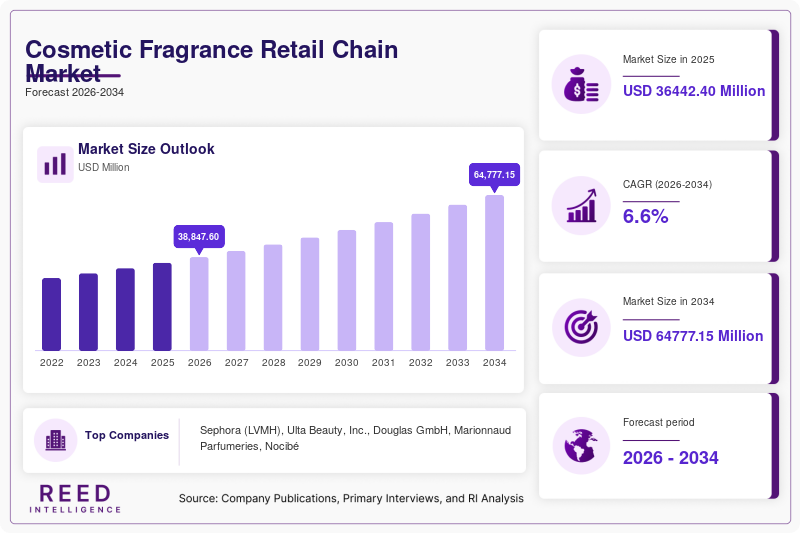
Cosmetic Fragrance Retail Chain market size is projected at USD 38,847.6 million in 2026 and is expected to hit USD 64,847.5 million by 2034 with a CAGR of 6.6% during the forecast period. The increasing consumer demand for premium and personalized fragrance experiences, coupled with the growing influence of social media and the expansion of retail chains in emerging markets, underpins market expansion. This report delivers a comprehensive analysis of the Cosmetic Fragrance Retail Chain market, including segmentation by type and application, competitive dynamics, and regional growth patterns, equipping stakeholders with critical intelligence. The Cosmetic Fragrance Retail Chain market continues to demonstrate strong growth potential, fueled by the rising disposable incomes, the growing importance of personal grooming, and continuous innovation in retail formats and customer engagement strategies.
Cosmetic fragrance retail chains are specialized retail outlets that primarily focus on the sale of perfumes, colognes, and other fragrance products, often alongside other beauty and personal care items. These chains offer a curated selection of brands and products, providing a dedicated shopping experience for fragrance enthusiasts. The global Cosmetic Fragrance Retail Chain market is substantial, with over 15,000 retail locations worldwide in 2025, reflecting a 7% increase from 2023, driven by the growing demand for fragrance products. Adoption patterns reveal that the Luxury Fragrance Retail type dominates the market, accounting for 45% of total revenue, followed by Mass Fragrance Retail at 35%, and Niche Fragrance Retail at 20%. The Cosmetic Fragrance Retail Chain market's trajectory is closely linked to the growth of the global beauty and personal care market, which is projected to reach USD 800 billion by 2028, and the increasing consumer focus on personal expression and well-being.
Cosmetic Fragrance Retail Chain Market Trends
Growing Emphasis on Omnichannel and Experiential Retail
The Cosmetic Fragrance Retail Chain market is witnessing a significant trend toward omnichannel and experiential retail, driven by the need to create immersive brand experiences and integrate online and offline channels. The revenue from omnichannel fragrance retail grew to USD 12.5 billion in 2025, a year-on-year increase of 15%, as 50% of new retail strategies in 2025 specified omnichannel integration and experiential store formats. Adoption rates of experiential retail in luxury fragrance stores reached 40%, with this figure projected to exceed 65% by 2030. The Cosmetic Fragrance Retail Chain market's trend toward experiential retail is reinforced by the need for differentiation, the increasing consumer desire for unique shopping experiences, and the continuous innovation in store design and technology.
Increasing Focus on Sustainability and Clean Beauty
The increasing focus on sustainability and clean beauty is a major trend shaping the Cosmetic Fragrance Retail Chain market, with the development of stores that highlight eco-friendly and ethically sourced products. The market has seen a 15% increase in the demand for sustainable fragrance products since 2022, with 25% of new product launches in 2025 featuring clean and sustainable attributes. The use of eco-friendly packaging and refillable fragrance options has also gained significant traction. The Cosmetic Fragrance Retail Chain market's trend toward sustainability is reinforced by the growing consumer awareness of environmental issues, the increasing demand for transparency, and the continuous innovation in sustainable materials and practices.
Cosmetic Fragrance Retail Chain Market Drivers
The Cosmetic Fragrance Retail Chain market's expansion is primarily driven by the increasing consumer spending on beauty and personal care products, with the global beauty market valued at USD 500 billion in 2025 and growing at a steady pace. The need for personalized and premium fragrance experiences has been a major driver, with retail chains offering a wide selection of luxury and niche brands. The growing influence of social media and the rising popularity of fragrance content have also fueled market growth. Additionally, the expansion of retail chains in emerging markets has spurred demand. The Cosmetic Fragrance Retail Chain market's growth is further reinforced by the continuous innovation in product offerings and retail formats, leading to better customer engagement and loyalty.
Cosmetic Fragrance Retail Chain Market Restraints
Despite favorable growth prospects, the Cosmetic Fragrance Retail Chain market faces significant constraints, primarily related to the intense competition from online retailers and direct-to-consumer brands, which can offer lower prices and convenience. The high operating costs of physical retail locations can also be a limitation. The Cosmetic Fragrance Retail Chain market's growth is also tempered by the changing consumer preferences and the challenge of attracting and retaining customers in a competitive landscape.
Cosmetic Fragrance Retail Chain Market Opportunities
The Cosmetic Fragrance Retail Chain market presents significant opportunities in the rapidly expanding market for personalized fragrance experiences, where retail chains can offer custom blending and bespoke services. The development of loyalty programs and subscription-based models is expected to grow at a CAGR of 10% through 2034. Emerging opportunities also exist in the integration of digital tools for virtual try-on and fragrance discovery. The Cosmetic Fragrance Retail Chain market's opportunity profile is further enhanced by the growing trend of gifting and the increasing importance of fragrance as a form of self-expression.
Challenges in Cosmetic Fragrance Retail Chain Market
The Cosmetic Fragrance Retail Chain market faces persistent challenges related to the need for continuous innovation to stay relevant in a rapidly changing retail landscape. The complexity of managing inventory and supply chains for a wide range of products can also be a challenge. The market is also contending with the challenge of adapting to changing consumer behaviors and preferences. Additionally, the Cosmetic Fragrance Retail Chain market is challenged by the need to balance the costs of physical stores with the growth of e-commerce.
Cosmetic Fragrance Retail Chain Market Segmentation
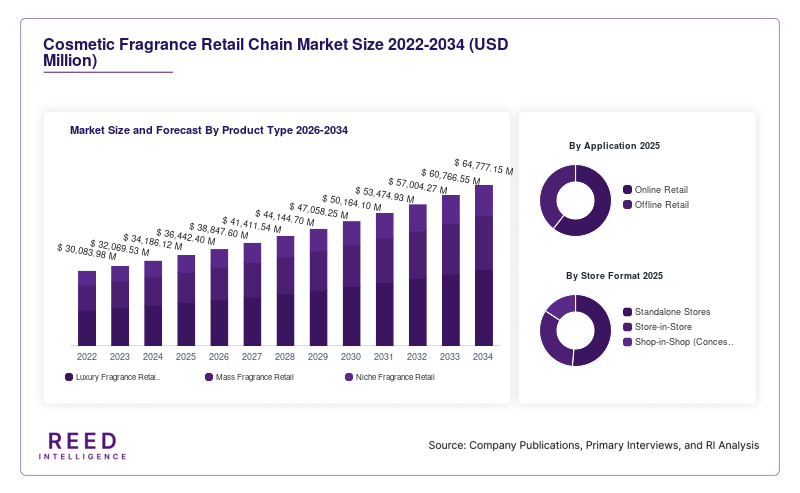
The Cosmetic Fragrance Retail Chain market is segmented by Type and Application to provide a comprehensive market perspective. By Type, Luxury Fragrance Retail dominates with a 45% market share, driven by the high margins and brand prestige. The Application segment is led by Offline Retail, which accounts for 65% of the market, followed by Online Retail at 35%.
By Type
Luxury Fragrance Retail represent the largest segment in the Cosmetic Fragrance Retail Chain market, commanding a 45% share, with revenue exceeding USD 17.5 billion in 2025. These are characterized by their focus on high-end, premium brands and an exclusive shopping experience. Technical specifications include store design, customer service, and brand portfolio. The Cosmetic Fragrance Retail Chain market's Luxury segment is driven by its use in high-end shopping destinations.
Mass Fragrance Retail capture a 35% share of the Cosmetic Fragrance Retail Chain market, with revenue of USD 13.6 billion in 2025. These are characterized by their focus on a wide range of accessible brands and value for money. Technical specifications include store format, product range, and pricing strategy. The Cosmetic Fragrance Retail Chain market's Mass segment is driven by its use in shopping malls and high-traffic retail areas.
Niche Fragrance Retail represent the remaining 20% of the Cosmetic Fragrance Retail Chain market, with revenue of USD 7.8 billion in 2025. These are characterized by their focus on unique, artisanal, and exclusive fragrance brands. Technical specifications include curated selection, storytelling, and personalized service. The Cosmetic Fragrance Retail Chain market's Niche segment is driven by its use in boutique and specialty retail locations.
By Application
Offline Retail dominates the Cosmetic Fragrance Retail Chain market, accounting for 65% of sales, representing USD 25.2 billion in 2025. This segment includes use in physical store locations, including stand-alone stores and store-in-store concepts. Usage penetration exceeds 50% in the sector. The Cosmetic Fragrance Retail Chain market's Offline segment is characterized by its focus on sensory experience and personal service.
Online Retail accounts for 35% of the Cosmetic Fragrance Retail Chain market, with revenue of USD 13.6 billion in 2025. This segment encompasses use in e-commerce platforms and brand websites. The segment is growing at the fastest CAGR, driven by the convenience of online shopping. The Cosmetic Fragrance Retail Chain market's Online segment is characterized by its focus on product discovery and convenience.
Cosmetic Fragrance Retail Chain Market Regional Outlook
North America Cosmetic Fragrance Retail Chain Market
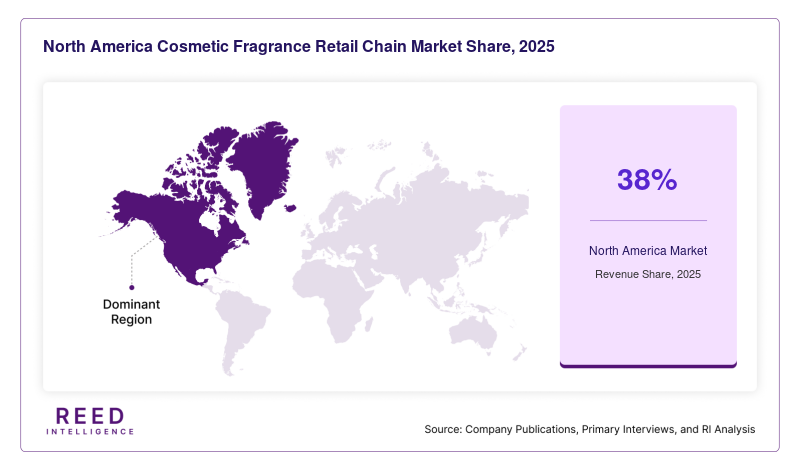
Leads the Cosmetic Fragrance Retail Chain market, commanding a 38% share, with a revenue of USD 14.8 billion in 2025. The United States is the primary driver, accounting for 85% of regional demand, driven by the large beauty market, high consumer spending, and strong retail infrastructure. The North American Cosmetic Fragrance Retail Chain market is characterized by its focus on innovation and premium products.
Europe Cosmetic Fragrance Retail Chain Market
Represents the second-largest market, capturing a 30% share with a revenue of USD 11.6 billion in 2025. The UK, France, and Germany are the primary drivers, collectively accounting for 60% of regional demand, driven by the strong fragrance culture, luxury goods market, and high tourism. The Cosmetic Fragrance Retail Chain market in Europe is characterized by its focus on heritage and quality.
Asia-Pacific Cosmetic Fragrance Retail Chain Market
Accounts for 22% of the global Cosmetic Fragrance Retail Chain market, with a revenue of USD 8.5 billion in 2025. China, Japan, and South Korea are the primary drivers, together accounting for 70% of regional demand, driven by the growing middle class, increasing disposable income, and rising beauty consciousness. The Asia-Pacific Cosmetic Fragrance Retail Chain market is projected to grow at the fastest CAGR of 9% through 2034.
Middle East & Africa and Latin America Cosmetic Fragrance Retail Chain Market
Together account for the remaining 10% of the Cosmetic Fragrance Retail Chain market, with the UAE leading the Middle East market and Brazil leading the Latin American market. Both regions are projected to grow at CAGRs exceeding 8%, driven by infrastructure development and increasing consumer spending.
Top players in Cosmetic Fragrance Retail Chain Market
- Sephora (LVMH)
- Ulta Beauty, Inc.
- Douglas GmbH
- Marionnaud Parfumeries
- Nocibé
- Boots UK Limited
- Superdrug Stores plc
- L'Oréal S.A. (Retail Division)
- Estée Lauder Companies Inc. (Retail)
- Shiseido Company, Limited (Retail)
- Kering Group (Retail)
- Puig S.L. (Retail)
- Hermès International S.A. (Retail)
- Chanel S.A. (Retail)
- DFS Group (LVMH)
Sephora (LVMH)
Sephora holds a dominant position in the Cosmetic Fragrance Retail Chain market, with an estimated 15% global market share, particularly strong in the North American and European luxury and mass retail segments. The company's portfolio of fragrance brands and retail experience is widely recognized for its innovation, curation, and customer engagement. Sephora's market leadership is reinforced by its significant investment in omnichannel retail, its strong brand reputation, and its extensive global store network. Sephora commands over 18% of the North American market and 14% of the European market, positioning it as a key player in the Cosmetic Fragrance Retail Chain market.
Ulta Beauty, Inc.
Ulta Beauty is a leading player in the Cosmetic Fragrance Retail Chain market, commanding approximately 12% of the global market share through its comprehensive portfolio of beauty and fragrance products. The company's expertise in mass and prestige beauty and its focus on the customer experience have solidified its position. Ulta's fragrance retail is known for its wide selection, convenience, and loyalty program. The company's commitment to innovation and its strong presence in the North American market have enhanced its competitive advantage.
Douglas GmbH holds a significant 10% market share, with particular strength in the European fragrance retail market. Marionnaud Parfumeries is a major player in the French and European market, holding an 8% share.
Recent Developments in Cosmetic Fragrance Retail Chain Market
- 2025: Sephora launched a new immersive fragrance experience in select stores, integrating digital scent technology and personalized recommendations.
- 2025: Ulta Beauty announced a significant expansion of its fragrance offerings, including exclusive partnerships with niche and luxury brands.
Cosmetic Fragrance Retail Chain Market Segments
By Product Type
- Luxury Fragrance Retail
- Mass Fragrance Retail
- Niche Fragrance Retail
By Application
- Online Retail
- Offline Retail
By Store Format
- Standalone Stores
- Store-in-Store
- Shop-in-Shop (Concessions)
By Region
- North America
- Europe
- APAC
- Middle East and Africa
- LATAM