Cosmetic Jar Market Size, Share & Demand Report By Material Type (Plastic, Glass, Acrylic, Metal, Others), By Capacity (Less than 50 ml, 50 ml to 200 ml, Above 200 ml), By Application (Skincare Products, Haircare Products, Makeup Products, Organic Beauty Products, Others), By Region & Segment Forecasts, 2026–2034
USD 3950
Market Overview
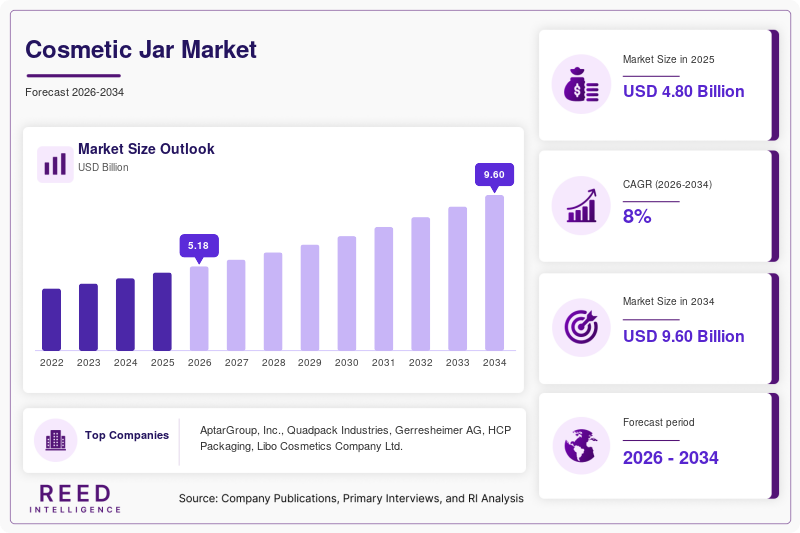
The global Cosmetic Jar Market size was valued at approximately USD 4.8 billion in 2026 and is projected to reach nearly USD 8.9 billion by 2034, expanding at a CAGR of 8.0% during the forecast period from 2026 to 2034. Cosmetic jars continue to play a critical role in the packaging industry due to their wide application across skincare creams, body butter, face masks, scrubs, hair products, and premium beauty formulations. Rising consumer spending on skincare products, combined with the growing influence of beauty and wellness trends, has significantly increased the demand for durable, aesthetic, and sustainable cosmetic packaging solutions. Manufacturers are focusing on lightweight materials, refillable formats, and recyclable packaging structures to align with changing consumer preferences and regulatory expectations.
The increasing popularity of premium skincare brands and direct-to-consumer beauty companies has created strong demand for customized cosmetic jars with advanced sealing properties and premium visual appeal. Glass and PET cosmetic jars are witnessing increased adoption due to their durability, product protection capabilities, and compatibility with luxury branding strategies. In addition, rapid expansion of e-commerce beauty sales has encouraged brands to adopt leak-resistant and travel-friendly packaging solutions that improve product safety during transportation. Technological improvements in digital printing, decoration techniques, and material engineering are further supporting product innovation across the Cosmetic Jar Market.
Key Highlights
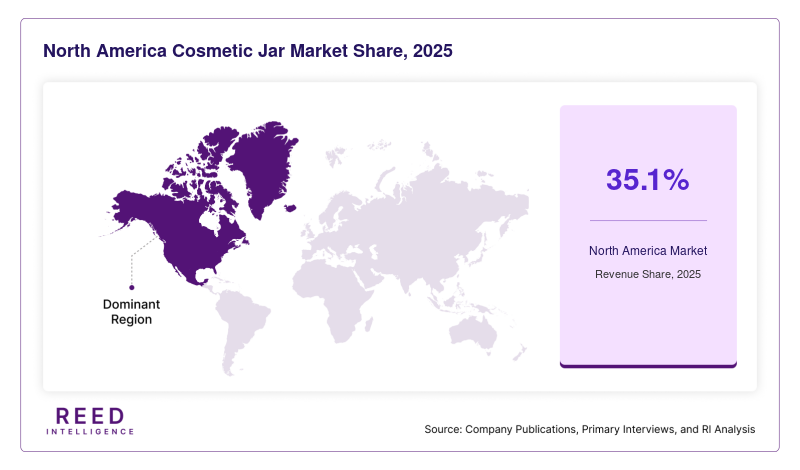
- North America dominated the market with a 35.1% share in 2025.
- Asia Pacific is expected to grow at the fastest CAGR of 10.9% during 2026–2034. By material type, plastic cosmetic jars accounted for the largest share of 46.8%, while glass cosmetic jars are projected to grow at a CAGR of 10.7%.
- By capacity, 50 ml to 200 ml jars led with a 42.6% share, whereas less than 50 ml jars are expected to expand at a CAGR of 9.8%. By application, skincare products held the dominant share of 51.4%, while organic beauty products are anticipated to grow at a CAGR of 11.3%.
- The United States remained the dominant country, with market values of USD 820 million in 2024 and USD 890 million in 2025.
Market Trends
Rising Demand for Sustainable and Refillable Cosmetic Packaging
Sustainability has become a defining trend across the Cosmetic Jar Market as beauty brands increasingly shift toward recyclable, reusable, and refillable packaging solutions. Consumers are showing stronger interest in environmentally responsible packaging that minimizes plastic waste and supports circular economy initiatives. As a result, cosmetic companies are investing in glass jars, post-consumer recycled plastic containers, biodegradable materials, and refill systems that reduce packaging consumption. Luxury skincare brands are also introducing reusable outer jars paired with refill pods to improve long-term customer engagement while reducing material costs.
Government regulations related to packaging waste reduction are further accelerating the adoption of sustainable cosmetic jars across developed economies. Packaging manufacturers are responding by incorporating lightweight designs and mono-material structures that simplify recycling processes. Digital printing technologies are also supporting eco-friendly branding by reducing label waste and improving customization flexibility. The combination of consumer awareness, regulatory support, and sustainability-focused brand positioning is expected to maintain strong momentum for eco-conscious cosmetic jar packaging throughout the forecast period.
Growth of Premium Skincare and Personalized Beauty Products
The expanding premium skincare sector is creating substantial opportunities for advanced cosmetic jar packaging solutions with improved aesthetics and functionality. Consumers increasingly associate premium packaging with product quality, leading cosmetic brands to adopt elegant jar designs, textured finishes, metallic closures, frosted glass containers, and customized labeling formats. This trend is especially visible in anti-aging creams, serums, herbal formulations, and dermatologist-recommended skincare products. Cosmetic jars with air-tight and UV-protective features are also gaining traction because they improve product shelf life and maintain ingredient stability.
Personalized beauty and small-batch skincare products are further influencing packaging innovation across the market. Beauty brands are launching limited-edition collections and customized formulations that require shorter production runs and flexible packaging designs. This has increased the use of digital printing and low-volume manufacturing technologies in cosmetic jar production. E-commerce growth has additionally encouraged packaging companies to develop durable yet visually attractive jars suitable for shipping and online brand presentation. The continued rise of premium beauty experiences is expected to strengthen demand for sophisticated cosmetic jar solutions globally.
Market Drivers
Expansion of the Global Skincare and Beauty Industry
The rapid growth of the skincare and beauty industry remains one of the primary factors driving the Cosmetic Jar Market. Rising disposable income, changing lifestyle patterns, and increased awareness regarding personal grooming have encouraged consumers to spend more on skincare and cosmetic products. Demand for moisturizers, face creams, exfoliators, body lotions, and specialty beauty products has expanded significantly across both developed and emerging economies. Cosmetic jars are widely preferred for these applications because they provide convenient product access, strong sealing performance, and premium shelf appeal.
The growth of online beauty platforms and influencer-driven marketing strategies has further accelerated product consumption. Beauty companies are introducing diverse skincare lines targeting specific skin conditions, age groups, and consumer preferences, resulting in higher packaging demand. In addition, male grooming products and gender-neutral beauty categories are expanding rapidly, creating additional opportunities for cosmetic jar manufacturers. The continuous launch of innovative skincare products by global and regional beauty brands is expected to maintain healthy demand growth across the Cosmetic Jar Market during the forecast period.
Increasing Preference for Attractive and Functional Packaging Designs
Packaging aesthetics and functionality have become essential purchasing factors in the cosmetics industry, contributing significantly to market growth. Consumers increasingly prefer cosmetic products packaged in visually appealing jars that offer convenience, portability, and enhanced product protection. Manufacturers are therefore investing in innovative jar shapes, decorative finishes, embossed branding, and advanced closure systems to improve shelf differentiation and customer engagement. Airless cosmetic jars and double-wall packaging formats are also gaining popularity because they enhance product preservation and deliver a premium user experience.
Brand competition within the beauty sector is encouraging companies to use packaging as a marketing tool. Cosmetic jars with luxury finishes and unique structural designs help brands establish a stronger identity in retail stores and digital platforms. Furthermore, packaging innovations focused on hygiene and ease of application have gained importance following increased consumer attention toward safe and convenient beauty products. Advanced manufacturing technologies such as injection molding and precision decoration are enabling cost-effective production of highly customized cosmetic jars, supporting broader market expansion.
Market Restraint
Volatility in Raw Material Prices and Environmental Compliance Costs
Fluctuations in raw material prices represent a major challenge for manufacturers operating in the Cosmetic Jar Market. Materials such as PET, polypropylene, acrylic, aluminum, and glass are subject to changing global supply conditions, transportation costs, and energy prices, creating uncertainty in production expenses. Rising inflation and disruptions in international supply chains have increased packaging material costs for cosmetic brands and packaging suppliers. Smaller manufacturers often face greater financial pressure because they have limited purchasing power and lower operational flexibility compared to large multinational companies.
Environmental regulations associated with plastic packaging are also increasing compliance costs across the industry. Governments in North America and Europe are implementing stricter policies related to recycling targets, single-use plastic reduction, and sustainable packaging standards. Cosmetic jar manufacturers are therefore required to invest in recyclable materials, cleaner production technologies, and waste management systems to remain compliant. These investments can raise operational costs and reduce profit margins, particularly for companies transitioning away from conventional plastic packaging formats. In addition, changing sustainability expectations may force businesses to redesign packaging structures more frequently, adding complexity to manufacturing operations and product development cycles.
Market Opportunities
Emerging Demand for Organic and Clean Beauty Products
The growing popularity of organic and clean beauty products is creating substantial opportunities within the Cosmetic Jar Market. Consumers are increasingly seeking skincare products made with natural ingredients, plant-based formulations, and chemical-free compositions. These products are often positioned as premium offerings and require packaging that reflects their natural and sustainable brand image. Cosmetic jar manufacturers are responding by developing eco-friendly packaging solutions using recyclable glass, bamboo closures, biodegradable plastics, and refillable systems.
Clean beauty brands also prioritize transparent labeling and aesthetically pleasing packaging to attract environmentally conscious consumers. As organic skincare categories expand globally, packaging suppliers capable of offering sustainable and visually distinctive cosmetic jars are expected to gain competitive advantages. The rise of wellness-oriented consumer behavior in Asia Pacific, Europe, and North America is further supporting demand for premium packaging solutions tailored to natural cosmetics. Continued expansion of organic beauty retail channels and e-commerce platforms is anticipated to strengthen long-term growth opportunities for cosmetic jar manufacturers.
Technological Advancements in Smart and Customized Packaging
Advancements in packaging technology are opening new growth opportunities for cosmetic jar manufacturers worldwide. Smart packaging solutions incorporating QR codes, NFC tags, and augmented reality features are helping beauty brands improve customer engagement and product authentication. Cosmetic jars integrated with digital tracking capabilities enable consumers to access product information, usage instructions, and sustainability details directly through smartphones. This trend is particularly attractive among premium skincare and luxury cosmetic brands seeking stronger digital interaction with consumers.
Customization technologies are also expanding rapidly across the Cosmetic Jar Market. Manufacturers are using advanced digital printing, laser engraving, and automated decoration systems to produce highly personalized cosmetic jars for limited-edition launches and influencer-driven campaigns. Smaller production runs have become more economically viable, allowing emerging beauty brands to compete effectively in the market. In addition, technological innovations focused on lightweight packaging and enhanced barrier protection are improving product safety and reducing transportation costs. These developments are expected to create long-term opportunities for packaging suppliers focused on innovation and value-added solutions.
Segmental Analysis
By Material Type
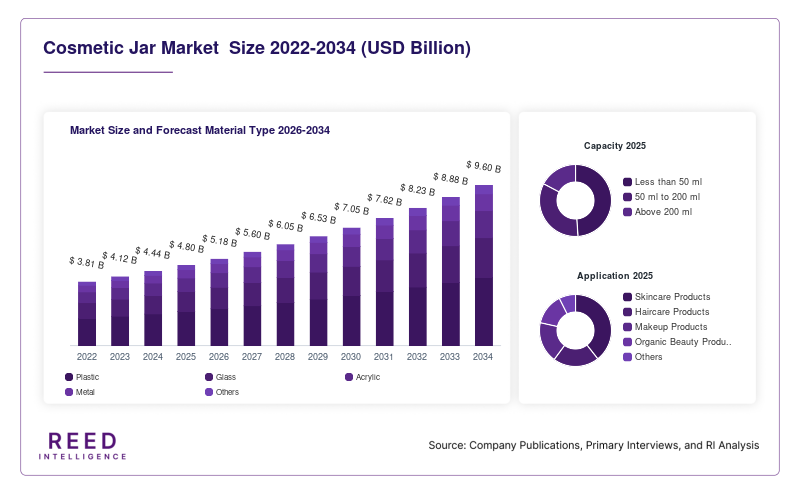
Plastic cosmetic jars accounted for the largest share of the Cosmetic Jar Market in 2024, representing approximately 46.8% of total revenue. The dominance of this segment is primarily linked to the lightweight nature, affordability, and design flexibility of plastic packaging materials such as PET, polypropylene, and acrylic. Cosmetic brands widely use plastic jars for creams, lotions, scrubs, and travel-size products because they provide excellent durability and lower transportation costs compared to heavier alternatives. In addition, plastic jars support mass production and can be manufactured in diverse shapes, colors, and decorative styles that improve shelf appeal. Their compatibility with advanced molding and printing technologies further strengthens their position across mainstream and premium cosmetic product categories.
Glass cosmetic jars are projected to witness the fastest CAGR of 10.7% during the forecast period due to increasing consumer preference for sustainable and luxury packaging solutions. Glass jars are highly favored in premium skincare and organic beauty applications because they provide superior chemical resistance and preserve product integrity more effectively than many plastic materials. Beauty brands are increasingly positioning glass packaging as environmentally responsible and visually premium, particularly for anti-aging creams, herbal formulations, and high-end skincare collections. Growing awareness regarding plastic waste reduction and stricter sustainability regulations are also encouraging cosmetic manufacturers to shift toward recyclable glass packaging. Furthermore, advancements in lightweight glass manufacturing are reducing transportation concerns and supporting wider adoption across global markets.
By Capacity
The 50 ml to 200 ml capacity segment held the dominant share of 42.6% in the Cosmetic Jar Market in 2024. This segment is widely preferred because it balances product volume, portability, and consumer convenience across multiple cosmetic categories. Medium-capacity cosmetic jars are commonly used for moisturizers, body creams, facial masks, hair treatments, and exfoliating products. Their popularity is supported by strong demand from both retail consumers and professional salon applications. Cosmetic brands also favor this size range because it offers sufficient space for branding, labeling, and decorative packaging elements while remaining practical for retail shelves and e-commerce shipping. The segment continues to benefit from high product turnover and broad compatibility with mainstream skincare formulations.
Less than 50 ml cosmetic jars are expected to expand at the fastest CAGR of 9.8% during the forecast period due to growing demand for travel-size and premium skincare products. Consumers increasingly prefer compact packaging for convenience, portability, and trial purchases, especially within online retail channels and subscription beauty boxes. Luxury skincare companies are also using smaller cosmetic jars for serums, eye creams, and concentrated formulations with higher product value. The rapid growth of travel retail and mini beauty kits is further contributing to demand for compact jar packaging. In addition, smaller cosmetic jars support product sampling strategies that help brands attract new consumers and improve customer retention in highly competitive beauty markets.
By Application
Skincare products represented the largest application segment in the Cosmetic Jar Market in 2024, accounting for approximately 51.4% of total market revenue. The segment’s dominance is closely associated with increasing consumer investment in facial creams, moisturizers, anti-aging products, night treatments, and body care solutions. Cosmetic jars are extensively used for skincare products because they provide convenient access to thicker formulations and support premium visual presentation. Rising awareness regarding skincare routines and preventive beauty care has significantly increased demand for specialized packaging solutions. In addition, the rapid expansion of dermatologist-recommended and scientifically formulated skincare products has encouraged packaging manufacturers to develop cosmetic jars with enhanced barrier protection, UV resistance, and air-tight sealing features.
Organic beauty products are anticipated to register the fastest CAGR of 11.3% during the forecast period due to rising consumer preference for natural and chemical-free cosmetic formulations. Brands operating in this category increasingly prioritize sustainable packaging designs that align with eco-conscious consumer expectations. Cosmetic jars made from recyclable glass, biodegradable plastics, and refillable structures are gaining popularity among organic beauty manufacturers seeking stronger environmental positioning. Growth in vegan skincare products and herbal cosmetics is also contributing to packaging innovation within the segment. Furthermore, online beauty influencers and wellness-focused marketing campaigns are accelerating awareness regarding clean beauty products, creating favorable conditions for cosmetic jar suppliers serving the organic cosmetics industry.
Regional Analysis
North America
North America accounted for approximately 35.1% of the global Cosmetic Jar Market share in 2025 and continues to maintain a leading position due to strong consumer spending on skincare and premium beauty products. The region is projected to register a CAGR of 7.4% during the forecast period. High penetration of luxury cosmetics, strong retail infrastructure, and the presence of major global beauty brands are supporting consistent demand for advanced cosmetic packaging solutions. Sustainability initiatives across the United States and Canada are also encouraging the adoption of recyclable and refillable cosmetic jars.
The United States remains the dominant country within the North American market due to its large cosmetics manufacturing base and strong consumer preference for premium skincare products. One unique growth factor driving the market is the rapid expansion of direct-to-consumer beauty brands utilizing digital marketing and subscription-based skincare services. These brands require customized cosmetic jars with strong visual appeal and durable shipping performance. Increasing demand for dermatologist-approved skincare products and anti-aging creams is also contributing to higher packaging consumption across the country.
Europe
Europe represented nearly 27.4% of the global Cosmetic Jar Market in 2025 and is expected to expand at a CAGR of 7.1% through 2034. The region benefits from strong demand for luxury beauty products, advanced packaging technologies, and strict sustainability regulations. Countries across Western Europe are actively promoting recyclable packaging materials and circular economy practices, encouraging cosmetic brands to transition toward refillable and reusable jar solutions. Growing consumer awareness regarding sustainable beauty products continues to influence packaging preferences throughout the region.
Germany remains the dominant country in the European Cosmetic Jar Market due to its advanced manufacturing capabilities and strong presence of premium skincare brands. A unique growth factor supporting the German market is the increasing investment in eco-friendly packaging innovation by cosmetic and packaging companies. Manufacturers are focusing on lightweight glass jars, biodegradable packaging materials, and energy-efficient production processes to meet evolving environmental standards. The country’s strong export network for cosmetics and personal care products further strengthens demand for high-quality cosmetic jars.
Asia Pacific
Asia Pacific held approximately 23.6% of the global Cosmetic Jar Market share in 2025 and is projected to witness the fastest CAGR of 10.9% during the forecast period. Rapid urbanization, rising disposable income, and growing beauty consciousness among younger consumers are fueling market expansion across the region. Demand for skincare products, herbal cosmetics, and multifunctional beauty solutions has increased substantially in countries such as China, India, South Korea, and Japan. Local beauty brands are also introducing affordable and premium skincare lines, driving significant packaging demand.
China dominates the Asia Pacific market due to its extensive cosmetics manufacturing industry and rapidly expanding e-commerce beauty sector. One unique growth factor contributing to market expansion is the influence of social commerce and live-stream shopping platforms on beauty product sales. Cosmetic brands are increasingly adopting visually attractive cosmetic jars to improve digital product presentation and consumer engagement. In addition, the popularity of Korean beauty trends and natural skincare formulations is encouraging continuous innovation in cosmetic jar packaging designs across the region.
Middle East & Africa
The Middle East & Africa region accounted for around 7.2% of the global Cosmetic Jar Market in 2025 and is expected to grow at a CAGR of 6.8% through 2034. The market is gradually expanding due to rising consumer interest in premium beauty products and increasing urbanization across major economies. Demand for luxury skincare products and fragrances remains strong in Gulf countries, supporting the adoption of decorative and premium cosmetic jar packaging solutions. International cosmetic brands are also increasing their regional presence through retail expansion and digital sales channels.
The United Arab Emirates represents the dominant country in the regional market because of its strong luxury retail sector and high consumer spending on beauty products. A unique growth factor supporting market growth is the increasing demand for halal-certified and premium organic cosmetic products. Beauty brands are adopting sophisticated cosmetic jar designs to appeal to affluent consumers seeking high-quality skincare and wellness products. The expansion of tourism and premium shopping destinations in Dubai and Abu Dhabi is also contributing to stronger cosmetics consumption and packaging demand.
Latin America
Latin America captured nearly 6.7% of the global Cosmetic Jar Market share in 2025 and is anticipated to register a CAGR of 7.0% during the forecast period. Growing awareness regarding skincare routines, increasing female workforce participation, and expanding middle-class populations are supporting market development throughout the region. Demand for affordable beauty products and locally manufactured skincare formulations has increased significantly in countries such as Brazil, Mexico, and Argentina. Cosmetic brands are introducing compact and cost-effective jar packaging formats to address price-sensitive consumer segments.
Brazil remains the leading country in the Latin American Cosmetic Jar Market due to its large beauty and personal care industry. One unique growth factor driving the market is the strong consumer preference for botanical and naturally derived cosmetic products inspired by regional biodiversity. Packaging manufacturers are developing colorful and sustainable cosmetic jars tailored to herbal skincare and body care products. The increasing popularity of social media beauty campaigns and local influencer marketing is also encouraging higher consumption of cosmetic products and related packaging solutions across Brazil.
Competitive Landscape
The Cosmetic Jar Market is characterized by intense competition among global packaging manufacturers and regional suppliers focused on innovation, sustainability, and customization capabilities. Major companies are investing heavily in recyclable materials, premium packaging aesthetics, lightweight designs, and advanced manufacturing technologies to strengthen market positioning. Strategic collaborations between cosmetic brands and packaging companies are becoming increasingly common as businesses seek differentiated packaging solutions that improve brand visibility and customer engagement.
AptarGroup, Inc. remains one of the leading participants in the global Cosmetic Jar Market due to its strong product portfolio, extensive international presence, and continued investment in sustainable packaging technologies. The company has expanded its eco-friendly cosmetic packaging offerings through increased use of recyclable and post-consumer recycled materials. Other major companies are focusing on mergers, production expansion, and smart packaging innovations to improve competitive performance. The market is also witnessing rising participation from specialized packaging firms serving premium skincare and organic beauty brands. Continuous product innovation and sustainability-focused strategies are expected to remain critical competitive factors during the forecast period.
Key Players
- AptarGroup, Inc.
- Quadpack Industries
- Gerresheimer AG
- HCP Packaging
- Libo Cosmetics Company Ltd.
- RPC Group Plc
- Berlin Packaging
- Fusion Packaging
- Albéa Group
- Silgan Holdings Inc.
- Berry Global Inc.
- Stoelzle Glass Group
- Raepak Ltd.
- Lumson S.p.A.
- Cosmopak Corporation
Recent Developments
- AptarGroup, Inc. introduced a new refillable cosmetic jar platform in 2025 designed for premium skincare applications using recyclable materials and lightweight construction.
- Quadpack Industries expanded its sustainable packaging production capabilities in Europe in 2024 to meet increasing demand for eco-friendly cosmetic jars from skincare brands.
- Berry Global Inc. launched a post-consumer recycled plastic cosmetic jar series in 2025 aimed at reducing packaging waste and supporting circular economy initiatives within the beauty industry.
- Gerresheimer AG invested in advanced glass packaging technologies in 2024 to improve lightweight cosmetic jar production for luxury beauty and organic skincare brands.
- Albéa Group partnered with several beauty companies in 2025 to develop digitally customized cosmetic jar packaging solutions for limited-edition skincare product launches.
Cosmetic Jar Market Segments
Material Type
- Plastic
- Glass
- Acrylic
- Metal
- Others
Capacity
- Less than 50 ml
- 50 ml to 200 ml
- Above 200 ml
Application
- Skincare Products
- Haircare Products
- Makeup Products
- Organic Beauty Products
- Others
Region
- North America
- Europe
- Asia Pacific
- Middle East & Africa
- Latin America
By Region
- North America
- Europe
- APAC
- Middle East and Africa
- LATAM