Cosmetic Market Size, Share & Trends Analysis Report By Product Type (Skin Care, Hair Care, Makeup, Fragrance, Personal Hygiene & Body Care, Other Cosmetics), By Gender (Women, Men, Unisex), By Distribution Channel (Offline, Online), By Price Range (Mass, Premium) and By Region (North America, Europe, APAC, Middle East and Africa, LATAM) Forecasts, 2026-2034
USD 3950
Cosmetic Market Size
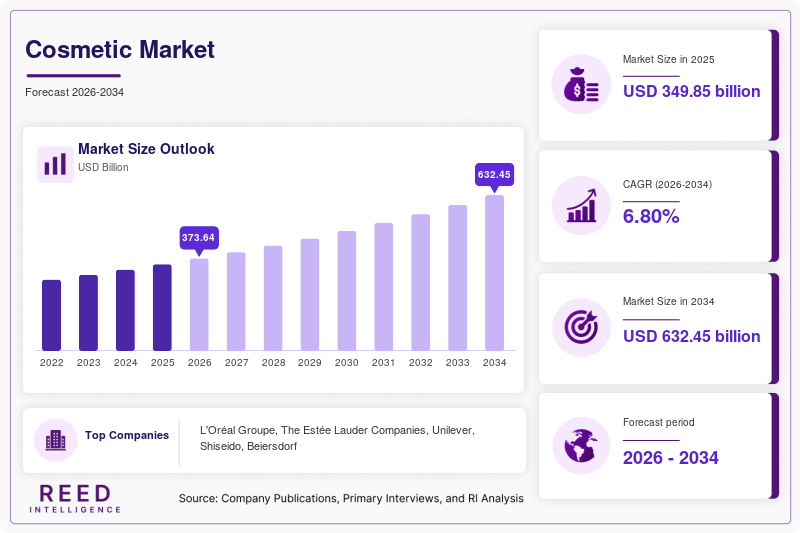
The global Cosmetic Market was valued at USD 349.85 billion in 2025 and is estimated at USD 373.64 billion in 2026. Based on the supplied market model, the market is projected to reach USD 632.45 billion by 2034, representing a 6.80% CAGR during 2026–2034.
The market trajectory reflects continued spending on skincare, haircare, makeup and fragrance, but the growth mechanism is increasingly tied to product innovation, premiumisation, dermatological positioning, digital commerce and expansion into emerging markets. L'Oréal reported €44.05 billion in 2025 sales, with skincare accounting for 37% of its category mix, followed by makeup at 19%, haircare at 18% and fragrances at 15%.
The cosmetic industry is moving toward a more segmented product model in which consumers increasingly purchase products based on specific skin, hair, fragrance and appearance needs rather than relying only on broad beauty categories. This is visible in the strategies of major companies. In 2025, L'Oréal's dermatological beauty division grew 5.5% like-for-like, while professional products grew 7.5%; in the first quarter of 2026, dermatological beauty grew 10.2% on an adjusted like-for-like basis.
Digital commerce is also changing how cosmetic brands reach consumers. L'Oréal reported that e-commerce exceeded 30% of group sales in 2025 and continued to grow at double-digit rates in the first quarter of 2026. Emerging markets were particularly important to this channel expansion.
Cosmetic Market Drivers
Product Innovation Is Shifting Growth Toward Targeted Beauty Solutions
Product innovation is increasingly focused on specific consumer problems such as skin hydration, acne, pigmentation, hair damage, scalp health and aging-related concerns. L'Oréal's 2025 results showed that haircare was its largest growth contributor within Consumer Products, while its dermatological brands also performed strongly. In the first quarter of 2026, the company reported double-digit growth in dermatological beauty and continued strong momentum in haircare and fragrance.
The commercial mechanism is straightforward: targeted products create more opportunities for consumers to trade across multiple routines and price points. This supports higher product frequency and allows companies to use scientific or ingredient-based positioning to differentiate products in crowded categories.
Premiumisation Is Increasing the Value of Beauty Purchases
Premiumisation is changing the value mix of the market. Unilever identified premium, digital commerce, beauty and India among its seven strategic growth priorities and reported that Beauty & Wellbeing generated 4.3% underlying sales growth in 2025. The company also continued investing in premium product capacity and innovation.
The effect is not limited to luxury cosmetics. Premiumisation also appears in mass-market products through higher-performance formulations, dermatologist-led positioning, specialized ingredients and premium packaging. This creates room for value growth even where unit volumes are more moderate.
E-Commerce Is Expanding Product Discovery and Market Access
Online channels are becoming more important because cosmetics are well suited to digital product discovery, influencer-led marketing, social commerce and direct-to-consumer models. L'Oréal reported double-digit e-commerce growth in 2025 and again in the first quarter of 2026, with particularly strong online momentum in emerging markets.
The mechanism extends beyond the transaction itself: online channels allow brands to launch products rapidly, test consumer response, personalize recommendations and reach consumers outside established retail networks. However, intense digital competition also raises customer-acquisition and advertising costs.
Cosmetic Market Restraints
Regulatory Compliance Is Increasing Product Development and Documentation Requirements
Cosmetic manufacturers face more detailed requirements concerning facility registration, product listing, safety information and regulatory documentation. In February 2026, the FDA updated its Cosmetics Direct portal to support biennial facility registration renewal, while in September 2026 it clarified that facility registration or product listing does not constitute FDA approval of a cosmetic product.
For manufacturers, this creates additional compliance work across product portfolios and supply chains. Smaller brands can face a greater proportional burden because regulatory and documentation costs are spread across fewer products.
Restrictions on Certain Cosmetic Ingredients Increase Reformulation Requirements
The European Union's REACH restriction on intentionally added synthetic polymer microparticles introduces different transition periods for cosmetic applications. For example, the European Commission states that the restriction applies to rinse-off cosmetics from October 17, 2027, leave-on cosmetics from October 17, 2029, and certain makeup, lip and nail cosmetics from October 17, 2035, subject to the regulation's specific conditions.
The commercial effect is increased formulation and packaging complexity. Companies must identify affected ingredients, develop alternatives where required and manage different regulatory requirements across markets.
High Marketing Costs Create Pressure on Smaller Brands
Beauty brands compete heavily through advertising, influencer partnerships, retail placement and digital acquisition. L'Oréal's 2025 advertising and promotion expenses were €14.18 billion, equivalent to 32.2% of sales.
This illustrates the scale of brand-building expenditure at the multinational level. For smaller companies, the same competitive environment can make customer acquisition expensive and increase dependence on social platforms, marketplaces or specialist retailers.
Cosmetic Market Opportunities
Dermatological and Skin-Health Products Offer Higher-Value Product Positions
The convergence of cosmetics and skin health is creating opportunities for products positioned around clinically supported ingredients and specific skin concerns. L'Oréal's Dermatological Beauty division generated €7.20 billion in 2025 sales and grew 5.5% like-for-like. In the first quarter of 2026, the division recorded 10.2% adjusted like-for-like growth.
This creates opportunities for brands that can combine cosmetic appeal with stronger scientific substantiation, dermatologist relationships and targeted formulations.
Emerging Markets Provide Additional Distribution Space
Emerging markets are becoming important sources of incremental sales. L'Oréal reported strong 2025 growth in markets including Brazil, Mexico, India, Vietnam and the GCC, while its SAPMENA-SSA region grew 15.4% on an adjusted like-for-like basis in the first quarter of 2026.
The opportunity is linked to expanding retail networks, increasing online access and localized product development. Brands that adapt pricing, formulation and marketing to local consumer preferences can reach consumers without relying exclusively on mature Western markets.
Refill and Lower-Waste Packaging Can Create Product Differentiation
Packaging sustainability is becoming a product-development issue rather than only a corporate reporting topic. In June 2025, L'Oréal launched a global refill-focused campaign covering multiple brands, categories and channels. Unilever similarly identifies plastics as one of its sustainability priorities.
The opportunity lies in creating refillable formats that reduce packaging use without making products inconvenient to purchase or use. The main limitation is that sustainability claims need to be supported by credible product and lifecycle evidence.
Segmental Analysis
By Product Type
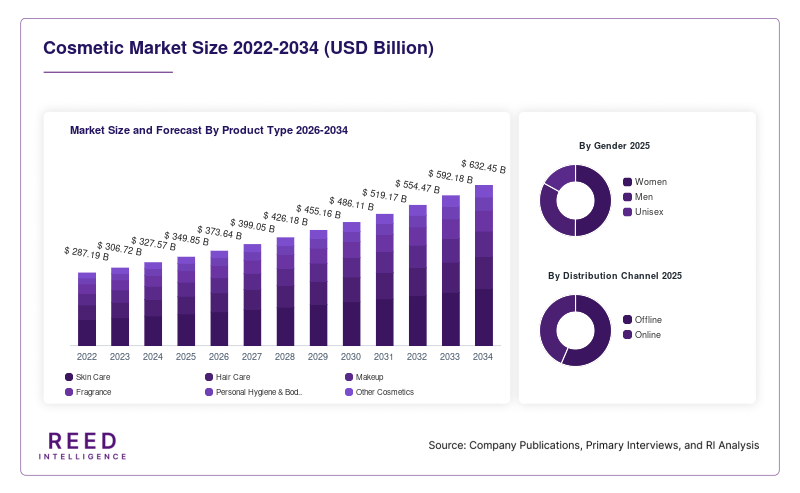
Skin Care represents approximately 32% of the 2025 Cosmetic Market, equivalent to about USD 111.95 billion under the internal analytical allocation. It is modeled at approximately 7.28% CAGR through 2034, producing an indicative 2034 value of about USD 210.63 billion. The segment covers skincare products such as facial care, moisturizers, cleansers, serums, masks and sun-care products. Its market position is supported by increasing consumer focus on targeted skincare routines, active ingredients and products addressing specific skin concerns.
Hair Care accounts for approximately 18%, or USD 62.97 billion, of the 2025 market under the internal allocation. It is modeled at approximately 6.80% CAGR through 2034, reaching an indicative USD 114.28 billion. The segment includes shampoos, conditioners, hair treatments, styling products, hair color and scalp-care products. Growth is supported by demand for specialized solutions addressing hair damage, scalp health, hair fall and other specific hair concerns.
Makeup represents approximately 16%, equivalent to USD 55.98 billion in 2025 under the internal analytical allocation. It is modeled at approximately 6.90% CAGR through 2034, resulting in an indicative 2034 value of about USD 101.98 billion. The segment includes face, eye, lip and nail makeup products. Product launches, social-media-driven beauty trends and premium as well as mass-market innovation continue to influence purchasing patterns.
By Gender
Women represent approximately 68% of the 2025 Cosmetic Market, equivalent to about USD 237.90 billion under the internal analytical allocation. The segment is modeled at approximately 6.60% CAGR through 2034, producing an indicative value of about USD 421.62 billion. Women's cosmetics span skincare, makeup, haircare and fragrance, creating a broad product mix and high frequency of product purchases.
Men account for approximately 20%, or USD 69.97 billion, of the 2025 market under the internal allocation. The segment is modeled at approximately 7.20% CAGR through 2034, reaching an indicative USD 131.07 billion. Demand is expanding across men's skincare, haircare, fragrances, grooming and personal-care products as cosmetic companies develop more targeted male-oriented and gender-neutral product positioning.
By Distribution Channel
Offline represents approximately 63% of the 2025 Cosmetic Market, equivalent to about USD 220.41 billion under the internal allocation. It is modeled at approximately 5.70% CAGR through 2034, producing an indicative value of about USD 361.01 billion. The channel includes department stores, supermarkets, specialty beauty stores, pharmacies, salons and other physical retail outlets. Physical stores remain important because consumers can test products, receive advice and experience fragrances and cosmetic formulations before purchase.
Online accounts for approximately 37%, or USD 129.44 billion, of the 2025 market under the internal analytical allocation. It is modeled at approximately 8.60% CAGR through 2034, reaching an indicative USD 276.39 billion. Online sales benefit from wider product selection, direct-to-consumer models, social commerce, influencer marketing and convenience. Major beauty companies are also reporting continued double-digit e-commerce expansion, supporting the increasing role of digital channels.
Regional Analysis
North America
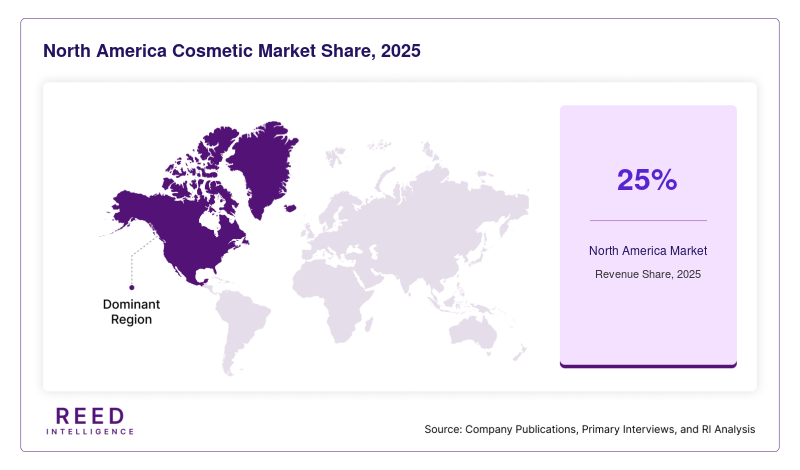
North America represents approximately 25% of the 2025 market, equivalent to USD 87.46 billion in the internal allocation, and is modeled at approximately 6.30% CAGR through 2034. The region combines a large established consumer base with strong premium beauty, dermatological skincare and online retail activity.
Regulatory compliance is also becoming more important. Under MoCRA, applicable cosmetic facilities must register with FDA and renew registration every two years, while responsible persons must maintain product listings. The FDA updated its Cosmetics Direct system in February 2026 and issued further clarification in September 2026.
Europe
Europe accounts for approximately 24%, or USD 83.96 billion, of the 2025 market under the internal allocation. The region is modeled at approximately 5.80% CAGR through 2034.
Europe's market structure is strongly influenced by ingredient and sustainability regulation. The EU restriction on synthetic polymer microparticles creates different compliance deadlines for rinse-off, leave-on, makeup, lip and nail cosmetic products. This encourages reformulation and alternative-material development across affected product categories.
Asia-Pacific
APAC represents approximately 36% of the 2025 market, equal to about USD 125.95 billion in the internal allocation, and is modeled at approximately 7.63% CAGR through 2034. The region's growth model is supported by the scale of China, Japan, South Korea, India and Southeast Asian markets, as well as the internationalization of Korean and Japanese beauty brands.
L'Oréal reported strong performance across emerging Asian markets in 2025 and early 2026, including India, Vietnam and Southeast Asia. Its acquisition and integration of Korean skincare brand Dr.G also demonstrates the strategic importance of Asian beauty innovation to global portfolios.
Middle East and Africa
The Middle East and Africa represents approximately 7%, or USD 24.49 billion, of the 2025 market under the internal allocation. The segment is modeled at approximately 7.00% CAGR through 2034.
Demand is supported by premium fragrance, skincare, haircare and digitally enabled beauty retail. L'Oréal reported strong performance in the GCC and continued growth across its SAPMENA-SSA region in 2025 and early 2026, although geopolitical conditions created localized disruption in parts of the Middle East.
Latin America
Latin America accounts for approximately 8%, or USD 27.99 billion, of the 2025 market under the internal allocation and is modeled at approximately 6.90% CAGR through 2034.
Brazil and Mexico are important markets for beauty companies because of their established cosmetics consumption and large consumer bases. L'Oréal identified Brazil and Mexico among its key emerging-market contributors during 2025, while Latin America continued to grow in the first quarter of 2026.
Competitive Landscape
The Cosmetic Market is highly fragmented across mass-market, premium, luxury, dermatological and specialist brands. Competition is increasingly based on formulation performance, brand strength, product launches, digital distribution, influencer engagement and geographic expansion.
Large companies are also using acquisitions to add specialized brands and technologies. L'Oréal's acquisition of Dr.G strengthened its skincare portfolio, while its 2025 agreement to acquire Color Wow expanded its professional haircare portfolio. In March 2026, L'Oréal completed its acquisition of Kering Beauté, including Creed and long-term beauty and fragrance licenses for Bottega Veneta and Balenciaga.
Unilever is pursuing a related portfolio strategy centered on Beauty & Wellbeing, Personal Care, premium products and digital commerce. Its 2025 report states that Beauty & Wellbeing generated 4.3% underlying sales growth, while Power Brands represented 78% of group turnover.
Key Market Players
Recent Market Developments
- In September 2026, the U.S. FDA clarified that it does not issue certificates or other documents proving compliance with cosmetic facility registration or product listing requirements. The clarification is relevant to cosmetics sold through e-commerce platforms, some of which had been requesting registration evidence from sellers.
- In April 2026, L'Oréal reported first-quarter sales of €12.15 billion, with adjusted like-for-like growth of 6.7%. Haircare and fragrances were major growth contributors, while dermatological beauty grew 10.2% on an adjusted like-for-like basis. E-commerce continued to grow at double-digit rates.
Cosmetic Market Segments
By Product Type
- Skin Care
- Hair Care
- Makeup
- Fragrance
- Personal Hygiene & Body Care
- Other Cosmetics
By Gender
- Women
- Men
- Unisex
By Distribution Channel
- Offline
- Online
By Price Range
- Mass
- Premium
By Region
- North America
- Europe
- APAC
- Middle East and Africa
- LATAM