Cosmetics OEM And ODM Market Size, Share & Demand Report By Service Type (OEM Services, ODM Services), By Product Category (Skincare, Haircare, Color Cosmetics, Personal Care, Fragrances), By End User (Large Enterprises, Small and Medium-Sized Brands, Direct-to-Consumer Beauty Brands), By Distribution Channel (Online Retail, Specialty Beauty Stores, Supermarkets and Hypermarkets, Department Stores, Pharmacy and Drug Stores) By Region & Segment Forecasts, 2026–2034
USD 3950
Market Overview
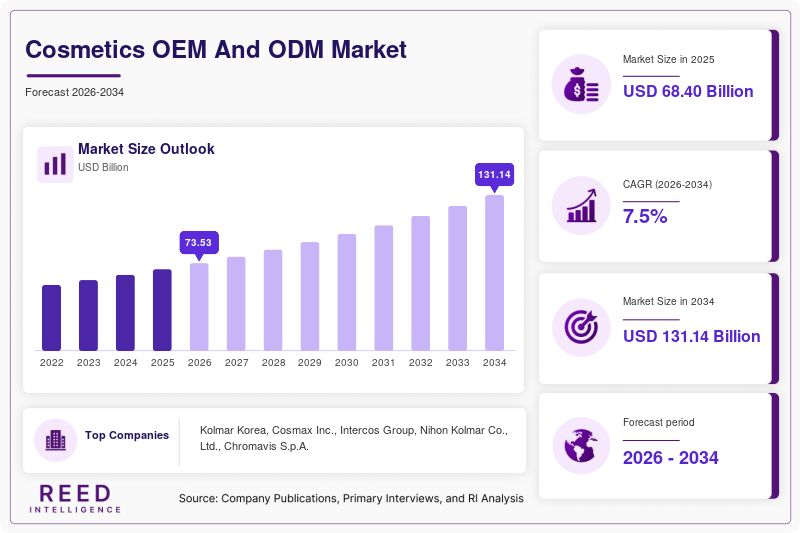
The global Cosmetics OEM And ODM Market size was valued at USD 68.4 billion in 2026 and is projected to reach USD 121.7 billion by 2034, expanding at a CAGR of 7.5% during the forecast period from 2026 to 2034. The market is witnessing stable expansion due to the increasing outsourcing activities among beauty and personal care brands that seek cost-efficient manufacturing, rapid product development, and flexible production capabilities. Cosmetics OEM and ODM providers are increasingly supporting both established multinational companies and emerging independent beauty labels through customized product formulation, packaging design, and regulatory compliance services.
A major factor supporting market growth is the rising global demand for clean-label cosmetics and personalized beauty products. Beauty companies are focusing on faster product launches to capture evolving consumer preferences related to vegan ingredients, cruelty-free formulations, sustainable packaging, and multifunctional skincare products. OEM and ODM manufacturers are enabling brands to shorten product development cycles by offering advanced research facilities, ready-to-market formulations, and scalable manufacturing infrastructure. The expansion of e-commerce beauty retailing and social media-driven product launches has further accelerated the need for agile third-party manufacturing solutions.
Key Highlights
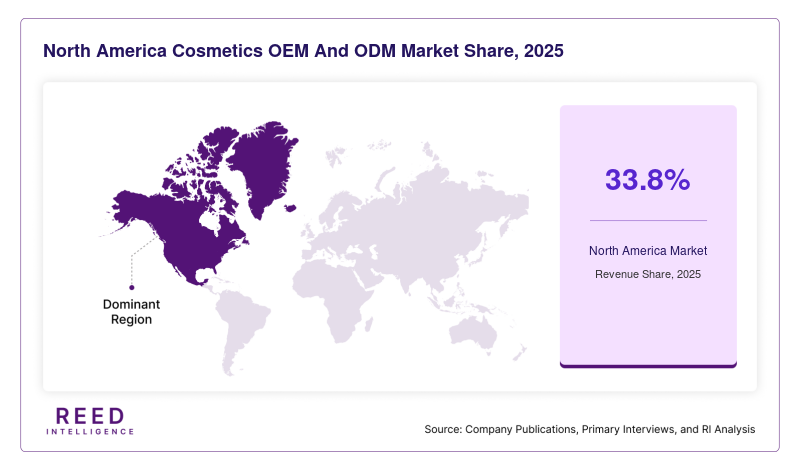
- North America dominated the market with a 33.8% share in 2025.
- Asia Pacific is expected to grow at the fastest CAGR of 9.4% during 2026–2034.
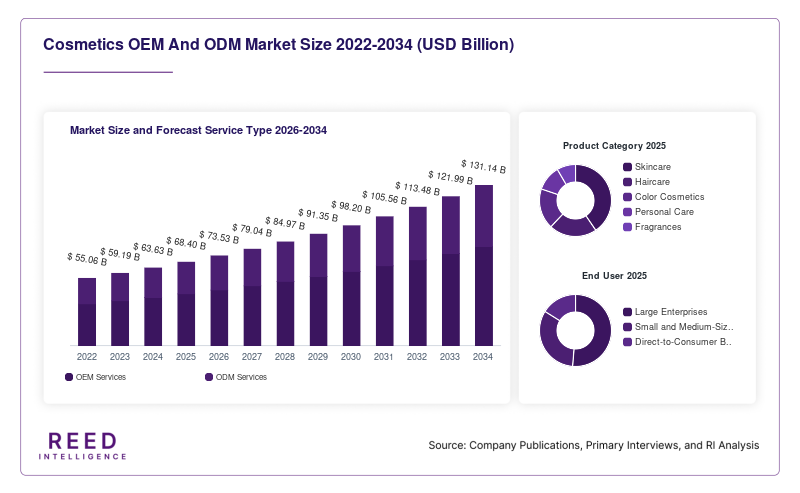
- By service type, OEM services accounted for the largest share of 57.1%, while ODM services are projected to grow at a CAGR of 8.8%.
- By product category, skincare led with a 39.6% share, whereas color cosmetics are expected to expand at a CAGR of 8.9%.
- The United States remained the dominant country, with market values of USD 11.4 billion in 2024 and USD 12.2 billion in 2025.
Market Trends
Expansion of Clean Beauty and Sustainable Formulations
The Cosmetics OEM And ODM Market is experiencing a notable shift toward sustainable and clean beauty formulations as consumers increasingly prioritize ingredient transparency and environmentally responsible manufacturing. OEM and ODM companies are investing in plant-based ingredients, biodegradable packaging materials, and water-efficient manufacturing technologies to meet evolving brand expectations. Beauty brands are requesting contract manufacturers to develop sulfate-free, paraben-free, and vegan-certified formulations that comply with stricter international cosmetic regulations. This transition is encouraging manufacturers to strengthen sourcing partnerships with organic ingredient suppliers and establish dedicated research facilities for green chemistry applications.
Sustainability initiatives are also influencing packaging innovation within the market. Manufacturers are introducing refillable containers, lightweight packaging solutions, and recycled plastic materials to reduce environmental impact. Demand for carbon-conscious manufacturing is particularly strong among premium skincare and personal care brands targeting younger consumers. OEM and ODM providers that can deliver certified sustainable production processes are gaining long-term supply contracts from international cosmetic companies. As environmental standards continue to evolve across North America and Europe, sustainable formulation capabilities are expected to remain a core competitive trend within the market.
Increasing Demand for Fast-Turnaround Product Development
Rapid product launch cycles are becoming an important trend across the Cosmetics OEM And ODM Market as beauty brands attempt to respond quickly to changing consumer preferences and social media-driven demand patterns. Cosmetic companies increasingly rely on contract manufacturers that can reduce formulation, testing, and commercialization timelines while maintaining product quality standards. OEM and ODM providers are introducing modular manufacturing systems, digital formulation tools, and integrated packaging operations to improve production speed and operational flexibility.
The growth of influencer-led beauty brands and direct-to-consumer cosmetic businesses has accelerated demand for low minimum order quantities and faster turnaround times. ODM manufacturers are offering pre-developed product templates that allow emerging brands to customize packaging and fragrances without investing heavily in research and development infrastructure. In addition, artificial intelligence and predictive analytics are helping manufacturers identify trending ingredients and consumer preferences more efficiently. This operational agility is enabling OEM and ODM providers to support limited-edition product launches, seasonal cosmetic collections, and region-specific formulations across multiple international markets.
Market Drivers
Rising Outsourcing Activities Among Cosmetic Brands
The increasing preference for outsourced manufacturing among global beauty brands is a major driver supporting the growth of the Cosmetics OEM And ODM Market. Cosmetic companies are focusing on brand development, digital marketing, and customer engagement while relying on specialized manufacturers for formulation, production, packaging, and compliance management. Outsourcing helps brands reduce operational costs, minimize capital investment requirements, and improve manufacturing scalability during periods of fluctuating demand.
Many emerging beauty startups lack the infrastructure needed for large-scale production and therefore depend on OEM and ODM providers for technical expertise and market-ready solutions. Established multinational brands are also expanding outsourcing partnerships to improve supply chain flexibility and accelerate product launches across multiple regions. Contract manufacturers with strong formulation capabilities and regulatory certifications are increasingly becoming strategic partners rather than simple production vendors. This shift toward collaborative manufacturing models is expected to strengthen long-term demand for OEM and ODM services throughout the forecast period.
Growth of E-Commerce and Digital Beauty Retail Channels
The rapid expansion of online beauty retail platforms is significantly contributing to the growth of the Cosmetics OEM And ODM Market. E-commerce channels allow beauty brands to reach wider consumer audiences without depending heavily on traditional retail infrastructure. Digital platforms have enabled faster product experimentation, niche brand launches, and personalized marketing strategies, creating sustained demand for agile manufacturing support.
Social media platforms and influencer marketing campaigns are accelerating consumer interest in new cosmetic products, particularly within skincare, haircare, and hybrid beauty categories. OEM and ODM companies are helping brands manage smaller production batches, customized formulations, and rapid inventory replenishment required for online retailing. Additionally, digital analytics tools are enabling manufacturers to identify regional product demand patterns and adjust production strategies accordingly. The growth of subscription beauty services and direct-to-consumer sales models is further supporting demand for flexible manufacturing partnerships capable of delivering high product variety and consistent quality standards.
Market Restraint
Regulatory Complexity and Quality Compliance Challenges
Stringent cosmetic regulations and varying international compliance standards remain a significant restraint for the Cosmetics OEM And ODM Market. Manufacturers operating across multiple countries must comply with diverse ingredient restrictions, labeling requirements, safety testing standards, and environmental regulations. Regulatory frameworks in regions such as Europe and North America are becoming increasingly detailed regarding ingredient transparency, animal testing limitations, and sustainability disclosures. These evolving standards increase operational complexity and compliance costs for OEM and ODM providers.
Smaller manufacturers often face difficulties in maintaining consistent regulatory documentation, laboratory testing capabilities, and certification processes required by international beauty brands. Delays in regulatory approvals can extend product commercialization timelines and reduce the ability of manufacturers to respond quickly to market trends. In addition, product recalls linked to formulation inconsistencies or packaging contamination can negatively affect manufacturer credibility and client retention. For example, several cosmetic companies have recently increased supplier audits and quality verification processes following heightened consumer scrutiny regarding ingredient safety and product authenticity. These factors continue to create operational pressure for contract manufacturers, particularly those serving multiple global markets simultaneously.
Market Opportunities
Expansion of Men’s Grooming and Hybrid Beauty Categories
The growing popularity of men’s grooming products and multifunctional beauty solutions is creating new opportunities within the Cosmetics OEM And ODM Market. Consumer preferences are shifting toward skincare-infused makeup, multifunctional serums, anti-pollution creams, and personalized grooming products designed for specific skin concerns. OEM and ODM manufacturers are developing innovative formulations that combine cosmetic and wellness benefits while addressing evolving lifestyle trends.
Men’s grooming products, including beard care oils, scalp treatments, and premium skincare formulations, are witnessing increasing demand across both developed and emerging economies. Cosmetic brands are partnering with contract manufacturers to create differentiated product lines targeting younger male consumers seeking advanced skincare solutions. In addition, hybrid beauty products that combine sun protection, hydration, and anti-aging functions are gaining traction among urban consumers. Manufacturers with expertise in multifunctional formulations and dermatologically tested ingredients are expected to benefit from expanding product diversification opportunities during the forecast period.
Increasing Investments in Regional Manufacturing Facilities
Rising investments in localized manufacturing infrastructure are creating favorable growth opportunities for OEM and ODM companies across the global cosmetics industry. Many beauty brands are diversifying production networks to reduce supply chain disruptions, shorten delivery timelines, and comply with regional sourcing preferences. Contract manufacturers are expanding production facilities in Asia Pacific, Latin America, and the Middle East to improve proximity to emerging consumer markets and reduce logistics costs.
Regional manufacturing expansion also supports better customization of cosmetic products according to local consumer preferences, climate conditions, and regulatory standards. For instance, manufacturers in Asia Pacific are increasingly developing lightweight skincare formulations and sun protection products designed for humid environments, while Middle Eastern facilities are focusing on halal-certified beauty products. Investments in automated production systems and digital supply chain management are further improving manufacturing efficiency. Companies capable of establishing region-specific production capabilities are expected to secure stronger partnerships with multinational cosmetic brands seeking operational flexibility and faster market access.
Segmental Analysis
By Service Type
OEM services accounted for the largest share of the Cosmetics OEM And ODM Market in 2024 due to the increasing preference among established beauty brands for outsourced manufacturing support while maintaining control over product design and branding strategies. OEM providers offer formulation manufacturing, packaging, filling, and quality assurance services based on client specifications. Large cosmetic companies increasingly utilize OEM partnerships to optimize production costs, improve operational scalability, and expand product availability across international markets. The segment is also supported by rising demand for private-label beauty products among retailers and e-commerce companies seeking differentiated cosmetic offerings. Manufacturers providing flexible production volumes and advanced packaging solutions continue to strengthen their market position across skincare, haircare, and personal hygiene categories.
ODM services are projected to register the fastest CAGR of 8.8% during the forecast period due to the growing number of independent beauty startups and influencer-led cosmetic brands entering the market. ODM manufacturers provide ready-to-market formulations, packaging design, and product development expertise, enabling emerging companies to reduce research and commercialization timelines. This model is becoming increasingly attractive for small and medium-sized beauty brands with limited internal formulation capabilities. In addition, ODM providers are expanding their product libraries to include vegan cosmetics, multifunctional skincare products, and biotechnology-based formulations aligned with current consumer trends. The rising need for rapid product launches and lower initial investment requirements is expected to support sustained growth across the ODM segment.
By Product Category
Skincare represented the dominant product category within the Cosmetics OEM And ODM Market in 2024, accounting for the highest revenue share due to increasing consumer focus on preventive skincare, hydration solutions, and anti-aging formulations. Contract manufacturers are developing a wide range of serums, moisturizers, facial masks, and sun protection products to meet changing consumer expectations regarding ingredient safety and product effectiveness. Rising demand for dermatologist-tested and clean-label skincare products has encouraged OEM and ODM providers to invest in advanced formulation technologies and clinical testing capabilities. In addition, the popularity of personalized skincare regimens and wellness-oriented beauty products continues to strengthen demand for specialized manufacturing services. Premium skincare brands are increasingly relying on contract manufacturers for innovative textures, active ingredient combinations, and sustainable packaging solutions.
Color cosmetics are expected to witness the fastest CAGR of 8.9% through 2034 due to increasing consumer demand for multifunctional makeup products and digitally influenced beauty trends. The segment is benefiting from rising social media engagement, influencer marketing campaigns, and rapid product innovation cycles across foundations, lip products, and eye cosmetics. OEM and ODM manufacturers are supporting brands through fast-turnaround production capabilities and customizable product formulations tailored to regional beauty preferences. The expansion of hybrid beauty products combining skincare and cosmetic functions is also supporting segment growth. In addition, increasing consumer demand for inclusive shade ranges and long-lasting formulations is encouraging manufacturers to strengthen research and development activities within the color cosmetics category.
By End User
Large cosmetic enterprises accounted for the dominant share of the Cosmetics OEM And ODM Market in 2024 due to their extensive outsourcing requirements and large-scale production volumes. Major multinational beauty companies increasingly collaborate with contract manufacturers to improve operational efficiency, manage regional production networks, and accelerate product launches across global markets. These enterprises often rely on OEM and ODM providers for specialized formulations, seasonal product collections, and packaging customization services. In addition, large brands benefit from outsourcing partnerships that reduce capital expenditure associated with manufacturing facility expansion and equipment modernization. Contract manufacturers serving multinational clients are investing heavily in automated production technologies, sustainability certifications, and supply chain traceability systems to maintain long-term business relationships.
Small and medium-sized beauty brands are expected to grow at the fastest CAGR during the forecast period due to increasing entrepreneurial activity and the expansion of digital beauty retail channels. Independent cosmetic brands are leveraging OEM and ODM partnerships to access advanced manufacturing capabilities without significant upfront investment. The segment is further supported by the popularity of niche skincare products, influencer-backed cosmetic lines, and direct-to-consumer beauty startups targeting specific consumer demographics. Contract manufacturers are increasingly offering low minimum order quantities, rapid formulation development, and customized packaging services tailored to emerging brands. The growth of social commerce and online subscription beauty platforms is also enabling smaller companies to expand product visibility and market reach more effectively.
Regional Analysis
North America
North America accounted for 33.8% of the global Cosmetics OEM And ODM Market share in 2025 and is expected to maintain stable growth at a CAGR of 6.8% during the forecast period. The regional market benefits from strong demand for premium skincare products, clean-label cosmetics, and personalized beauty solutions. Beauty brands across the United States and Canada increasingly rely on contract manufacturers for rapid product development and regulatory compliance management. In addition, the presence of advanced research facilities and automated manufacturing technologies supports higher production efficiency and innovation across the region.
The United States remains the dominant country within the regional market due to its large consumer base, established beauty industry infrastructure, and strong e-commerce penetration. One unique growth factor supporting the country’s market expansion is the increasing demand for dermatologist-backed skincare products and science-driven cosmetic formulations. Contract manufacturers are collaborating with biotechnology firms and ingredient suppliers to develop clinically tested beauty products targeting aging concerns, sensitive skin conditions, and wellness-oriented skincare applications.
Europe
Europe represented a significant share of the Cosmetics OEM And ODM Market in 2025 and is projected to grow at a CAGR of 6.5% through 2034. The region benefits from strong consumer awareness regarding sustainable beauty products and strict cosmetic safety standards. European beauty companies are increasingly outsourcing production to specialized manufacturers capable of meeting advanced formulation requirements and environmental compliance guidelines. Countries across the region are also witnessing growing demand for organic skincare products, vegan cosmetics, and refillable packaging solutions.
Germany remains the dominant country in the European market due to its advanced manufacturing infrastructure and strong cosmetic export industry. A unique growth factor supporting Germany’s expansion is the country’s focus on precision manufacturing and ingredient traceability systems. Contract manufacturers are investing in digital quality monitoring technologies and sustainable sourcing programs to strengthen partnerships with premium beauty brands. In addition, increasing collaboration between cosmetic laboratories and biotechnology companies is supporting innovation in active skincare ingredients.
Asia Pacific
Asia Pacific is expected to register the fastest CAGR of 9.4% during the forecast period, supported by expanding beauty consumption and rising disposable incomes across major economies. The Cosmetics OEM And ODM Market in the region is driven by strong demand for skincare products, color cosmetics, and K-beauty inspired formulations. Regional manufacturers are benefiting from cost-efficient production capabilities, large-scale manufacturing infrastructure, and increasing investments from international cosmetic brands seeking diversified supply chains.
China dominates the regional market due to its extensive manufacturing ecosystem and growing domestic beauty industry. One unique growth factor supporting market growth in China is the rapid expansion of livestream commerce and social commerce beauty sales. Cosmetic brands are launching products at faster rates to respond to digital retail trends, increasing reliance on ODM providers capable of delivering quick formulation and packaging customization. In addition, rising consumer interest in herbal skincare and biotechnology-based ingredients continues to support manufacturing innovation across the country.
Middle East & Africa
The Middle East & Africa Cosmetics OEM And ODM Market is experiencing gradual expansion and is projected to grow at a CAGR of 7.1% through 2034. Rising urbanization, improving retail infrastructure, and increasing consumer spending on personal care products are supporting regional demand. Beauty brands operating in the region are increasingly partnering with OEM and ODM providers to develop localized cosmetic products suited to climate conditions and cultural preferences. The growth of halal-certified cosmetics and premium fragrance products is also contributing to market development.
Saudi Arabia represents the dominant country within the regional market due to strong consumer demand for luxury beauty and personal care products. A unique factor supporting market expansion is the rising popularity of halal-certified skincare and cosmetic formulations among regional consumers. Contract manufacturers are increasingly investing in ingredient transparency, halal certification processes, and localized packaging solutions to strengthen their presence in the Middle Eastern beauty industry. Growing digital beauty retailing is also supporting product accessibility across urban markets.
Latin America
Latin America accounted for a moderate share of the Cosmetics OEM And ODM Market in 2025 and is expected to expand at a CAGR of 6.9% during the forecast period. The market is supported by growing consumer interest in affordable skincare products, natural cosmetics, and haircare formulations designed for diverse climatic conditions. Regional beauty brands are increasingly outsourcing production to contract manufacturers to improve cost efficiency and accelerate product commercialization. Expanding retail distribution networks and online beauty sales are also supporting regional growth.
Brazil remains the leading country within the Latin American market due to its strong beauty culture and large domestic cosmetics industry. One unique growth factor driving market growth in Brazil is the increasing consumer preference for botanical and naturally derived cosmetic ingredients sourced from regional biodiversity. OEM and ODM companies are collaborating with local ingredient suppliers to develop plant-based formulations that appeal to environmentally conscious consumers. In addition, rising investments in sustainable packaging technologies are contributing to long-term market development.
Competitive Landscape
The Cosmetics OEM And ODM Market is characterized by strong competition among global contract manufacturers focusing on formulation innovation, production scalability, and sustainable manufacturing capabilities. Companies are increasingly investing in automated production systems, biotechnology-based ingredients, and regional expansion strategies to strengthen market presence. Strategic partnerships with beauty brands, ingredient suppliers, and packaging companies are also supporting product diversification and operational efficiency.
Kolmar Korea remains one of the leading companies in the market due to its broad formulation portfolio, advanced research infrastructure, and extensive global manufacturing network. The company continues to expand its skincare and functional cosmetic manufacturing capabilities to support growing international demand. Other major companies are focusing on mergers, production facility expansions, and sustainable packaging innovations to enhance competitive positioning.
Key Players
- Kolmar Korea
- Cosmax Inc.
- Intercos Group
- Nihon Kolmar Co., Ltd.
- Chromavis S.p.A.
- Toyo Beauty Co., Ltd.
- Ancorotti Cosmetics
- Mana Products Inc.
- PICASO Cosmetic Laboratory
- COSMECCA Korea
- BioTruly Group
- HCT Group
- Nox Bellow Cosmetics
- Albea Group
- Fareva Group
Recent Developments
- In February 2026, Cosmax Inc. announced the expansion of its automated skincare manufacturing facility in Southeast Asia to support growing regional demand for clean-label beauty products.
- In September 2025, Intercos Group introduced a new biodegradable cosmetic packaging initiative focused on reducing plastic usage across premium skincare and makeup product lines.
- In June 2025, Kolmar Korea partnered with a biotechnology ingredient supplier to develop microbiome-based skincare formulations designed for sensitive skin applications.
- In January 2026, Mana Products Inc. expanded its rapid formulation development services for influencer-led cosmetic brands targeting North American online beauty retail channels.
Cosmetics OEM And ODM Market Segments
Service Type
- OEM Services
- ODM Services
Product Category
- Skincare
- Haircare
- Color Cosmetics
- Personal Care
- Fragrances
End User
- Large Enterprises
- Small and Medium-Sized Brands
- Direct-to-Consumer Beauty Brands
By Region
- North America
- Europe
- APAC
- Middle East and Africa
- LATAM