CPAP Masks Industry Market Size, Share & Demand Report By Product Type (Nasal Masks, Full Face Masks, Nasal Pillow Masks, Oral Masks, Hybrid Masks), By End User (Hospitals, Sleep Clinics, Homecare Settings, Ambulatory Care Centers), By Distribution Channel (Hospital Pharmacies, Retail Pharmacies, Online Stores, Medical Device Distributors), By Region & Segment Forecasts, 2026–2034
USD 3950
Market Overview
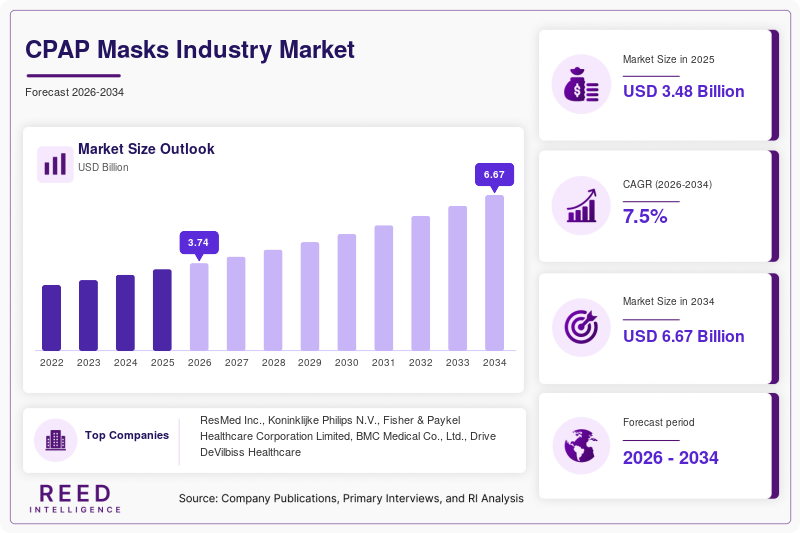
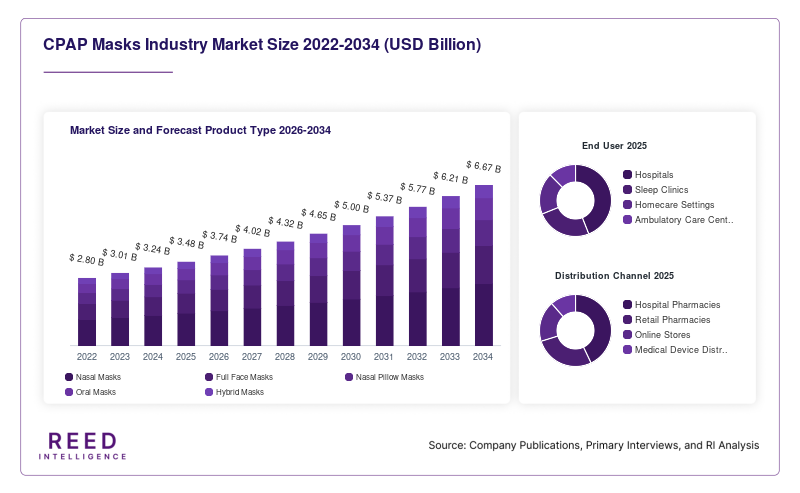
The global CPAP Masks Industry Market size was valued at USD 3.48 billion in 2026 and is projected to reach USD 6.21 billion by 2034, expanding at a CAGR of 7.5% during 2026–2034. The market continues to experience steady growth as awareness of sleep-related breathing disorders increases globally. Continuous Positive Airway Pressure (CPAP) masks are essential components of sleep apnea therapy, providing a secure interface between patients and CPAP devices to maintain consistent airflow during sleep. Rising diagnosis rates of obstructive sleep apnea (OSA), expanding healthcare access, and technological advancements in respiratory care equipment are contributing to market expansion.
A major global factor supporting market growth has been the increasing prevalence of sleep disorders associated with aging populations, obesity, sedentary lifestyles, and chronic respiratory conditions. Healthcare providers are actively promoting early diagnosis and long-term treatment compliance, resulting in higher adoption of CPAP therapy solutions. In addition, reimbursement support, telemedicine integration, and home healthcare expansion have made CPAP treatment more accessible to patients worldwide.
Key Highlights
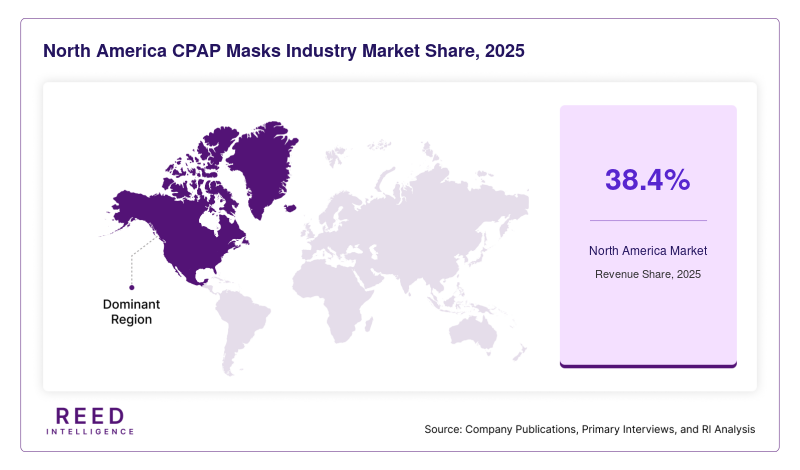
- North America dominated the market with a 38.4% share in 2025.
- Asia Pacific is expected to be the fastest-growing region, registering a CAGR of 9.2% during 2026–2034.
- By Product Type, Nasal Masks held the leading 41.8% market share in 2025.
- By Product Type, Nasal Pillow Masks are projected to grow at the fastest 9.4% CAGR through 2034.
- By Material Type, Silicone Masks accounted for 57.2% market share in 2025.
- By Material Type, Gel-Based Masks are forecast to expand at a 8.7% CAGR.
- By End User, Homecare Settings represented 64.5% share in 2025.
- By End User, Sleep Clinics are expected to register a 8.5% CAGR during the forecast period.
- The United States remained the dominant country market, valued at USD 921 million in 2024 and USD 978 million in 2025.
Market Trends
Growing Preference for Minimal-Contact Mask Designs
A significant trend shaping the CPAP Masks Industry Market is the increasing demand for minimal-contact mask solutions. Patients are seeking products that reduce facial pressure, skin irritation, and discomfort while maintaining effective airflow delivery.
Manufacturers are introducing compact nasal pillow masks and lightweight nasal interfaces designed to improve sleep quality and therapy adherence. These products offer enhanced freedom of movement, reduced facial contact, and improved user convenience. The trend is expected to continue as patient-centered product development becomes a priority across the respiratory care industry.
Integration of Digital Monitoring and Personalized Therapy Solutions
Digital healthcare technologies are transforming CPAP therapy management. Modern CPAP systems increasingly incorporate wireless connectivity, mobile applications, cloud-based monitoring platforms, and patient engagement tools.
Healthcare providers can remotely monitor treatment compliance, airflow performance, and therapy effectiveness. Personalized data analytics help optimize therapy settings and improve patient outcomes. This trend is encouraging greater adoption of connected respiratory care ecosystems and supporting long-term treatment adherence.
Market Drivers
Rising Diagnosis Rates of Obstructive Sleep Apnea
Increasing awareness and diagnosis of obstructive sleep apnea remain key growth drivers for the CPAP Masks Industry Market. Healthcare organizations are conducting screening initiatives and educational campaigns that encourage patients to seek medical evaluation for sleep-related symptoms.
Advancements in diagnostic technologies, including home sleep testing solutions, have improved access to diagnosis and treatment. As more patients receive confirmed diagnoses, demand for CPAP therapy equipment and compatible masks continues to increase.
Expansion of Home-Based Respiratory Care
Healthcare providers are increasingly promoting home-based treatment models for chronic respiratory conditions. Homecare settings provide convenience, cost efficiency, and improved patient comfort compared to institutional care environments.
CPAP therapy is well suited for home use, allowing patients to manage treatment independently while maintaining consistent clinical oversight. The expansion of home healthcare services continues to create favorable conditions for market growth.
Market Restraint
Patient Compliance and Therapy Discomfort Challenges
One of the primary restraints affecting the CPAP Masks Industry Market is inconsistent patient compliance. Some users experience discomfort, claustrophobia, air leakage, skin irritation, or difficulty adapting to long-term CPAP therapy.
These challenges may lead to treatment discontinuation and reduced therapy effectiveness. Manufacturers continue investing in ergonomic design improvements to address compliance-related concerns, but adaptation barriers remain a market challenge.
Market Opportunities
Expansion of Telehealth-Based Sleep Therapy Programs
The growing adoption of telehealth services presents substantial opportunities for CPAP mask manufacturers. Remote consultations, digital prescription services, and virtual follow-up programs simplify access to sleep disorder treatment.
Telehealth-enabled CPAP management platforms improve patient engagement and support continuous therapy monitoring. These developments are expected to increase product adoption across underserved and remote populations.
Growth of Customized and 3D-Fitted Mask Solutions
Advancements in digital scanning and additive manufacturing technologies are creating opportunities for personalized CPAP masks. Customized fit solutions improve comfort, reduce air leakage, and enhance therapy compliance.
Healthcare providers are increasingly exploring individualized respiratory care approaches that optimize treatment effectiveness. The development of patient-specific mask designs is expected to support future market expansion.
Segmental Analysis
By Product Type
Nasal Masks
Nasal masks dominated the market and accounted for 41.8% of revenue in 2025. These masks provided a balance between comfort, stability, and therapy effectiveness, making them suitable for a broad patient population.
Nasal Pillow Masks
Nasal pillow masks are projected to grow at a 9.4% CAGR through 2034. Their compact design, minimal facial contact, and enhanced comfort will support increasing adoption among patients seeking less intrusive therapy solutions.
By Material Type
Silicone Masks
Silicone masks represented 57.2% market share in 2025. The material offered flexibility, durability, comfort, and effective sealing performance, supporting widespread utilization across product categories.
Gel-Based Masks
Gel-based masks will register a 8.7% CAGR during the forecast period. Their ability to provide customized facial conformity and enhanced pressure distribution will contribute to future market growth.
By End User
Homecare Settings
Homecare settings accounted for 64.5% market revenue in 2025. The segment benefited from increasing patient preference for convenient treatment environments and growing adoption of home-based healthcare solutions.
Sleep Clinics
Sleep clinics are expected to expand at a 8.5% CAGR through 2034. Rising demand for specialized diagnosis, therapy optimization, and professional patient support services will strengthen segment growth.
By Distribution Channel
Direct Sales & Medical Equipment Providers
Direct sales and medical equipment providers captured 52.7% market share in 2025. Patients and healthcare institutions preferred these channels due to product availability, technical support, and professional guidance.
E-Commerce Platforms
E-commerce platforms are forecast to register a 9.1% CAGR through 2034. Growing digital healthcare purchasing behavior and increasing availability of replacement accessories online will support segment expansion.
By Application
Obstructive Sleep Apnea Therapy
Obstructive sleep apnea therapy held 72.4% of market revenue in 2025. High prevalence rates and increasing diagnosis volumes supported continued dominance within the application segment.
Chronic Respiratory Support
Chronic respiratory support applications are projected to grow at a 8.3% CAGR. Increasing management of respiratory disorders and expansion of home respiratory care programs will contribute to future demand.
Regional Analysis
North America
North America accounted for 38.4% of the global CPAP Masks Industry Market share in 2025. The region benefited from advanced healthcare infrastructure, high awareness of sleep disorders, and widespread adoption of respiratory care technologies. The market will expand at a CAGR of 6.8% during 2026–2034.
The United States remained the dominant country market due to strong diagnostic capabilities and increasing utilization of home sleep testing services. Growing patient awareness and established reimbursement systems continue to support market growth.
Europe
Europe held 28.2% market share in 2025. The region benefited from strong healthcare systems, increasing diagnosis rates, and expanding sleep medicine programs. The market will grow at a CAGR of 6.7% through 2034.
Germany emerged as the leading country due to its advanced respiratory care infrastructure and widespread availability of sleep disorder treatment services. Continued investments in chronic disease management support market expansion.
Asia Pacific
Asia Pacific represented 22.5% of global revenue in 2025. The region is expected to register the fastest growth, with a projected CAGR of 9.2% between 2026 and 2034.
China dominated regional revenue generation owing to increasing healthcare investments, expanding diagnostic capabilities, and rising awareness of sleep-related disorders. Rapid urbanization and growing healthcare accessibility continue to contribute to market development.
Middle East & Africa
The Middle East & Africa accounted for 5.8% market share in 2025. The region will grow at a CAGR of 8.1% during the forecast period.
The United Arab Emirates remained the dominant country market due to increasing healthcare modernization initiatives and investments in specialized respiratory care services. Expanding private healthcare facilities continue to support market growth.
Latin America
Latin America captured 5.1% of global revenue in 2025 and is forecast to expand at a CAGR of 7.3% through 2034.
Brazil led the regional market as healthcare providers expanded access to sleep disorder diagnostics and respiratory care treatments. Increasing awareness campaigns and improving healthcare access continue to drive demand.
Competitive Landscape
The CPAP Masks Industry Market is moderately consolidated, with leading manufacturers focusing on product innovation, patient comfort, digital connectivity, and global distribution expansion. Competition is driven by mask ergonomics, therapy compliance performance, material quality, and integration with advanced CPAP systems.
ResMed Inc. maintained a leading position in the market through its extensive portfolio of CPAP therapy solutions and continuous investment in patient-focused product development. The company recently introduced enhanced mask cushion technologies designed to improve comfort and reduce air leakage while supporting long-term therapy adherence.
Koninklijke Philips N.V. continues to strengthen its respiratory care portfolio through advanced sleep therapy solutions and connected healthcare platforms.
Fisher & Paykel Healthcare Corporation Limited focuses on innovative mask designs and humidification technologies that enhance patient comfort and treatment effectiveness.
Drive DeVilbiss Healthcare remains active in home respiratory care equipment and sleep therapy product development.
BMC Medical Co., Ltd. continues expanding its international presence through affordable and technologically advanced CPAP therapy solutions.
Key Players List
- ResMed Inc.
- Koninklijke Philips N.V.
- Fisher & Paykel Healthcare Corporation Limited
- Drive DeVilbiss Healthcare
- BMC Medical Co., Ltd.
- React Health
- Somnetics International Inc.
- Apex Medical Corp.
- Curative Medical Inc.
- Hans Rudolph Inc.
- Circadiance LLC
- Löwenstein Medical Technology
- Vyaire Medical Inc.
- Armstrong Medical Ltd.
- Compumedics Limited
Recent Developments
- Major manufacturers introduced lightweight CPAP mask designs with improved seal technology and enhanced patient comfort features.
- Several companies launched connected therapy platforms integrating mobile applications and cloud-based patient monitoring tools.
- Healthcare providers expanded telehealth-based sleep apnea management programs to improve patient access and treatment adherence.
- Advanced gel cushion technologies were introduced to reduce pressure points and improve long-term therapy comfort.
- Manufacturers increased investment in personalized mask fitting solutions using digital facial scanning technologies.
- E-commerce distribution networks expanded product availability and replacement accessory accessibility for homecare users.
- Strategic collaborations between respiratory care providers and healthcare systems strengthened patient education and therapy support initiatives.
CPAP Masks Industry Market Segments
Product Type
- Nasal Masks
- Full Face Masks
- Nasal Pillow Masks
- Oral Masks
- Hybrid Masks
End User
- Hospitals
- Sleep Clinics
- Homecare Settings
- Ambulatory Care Centers
Distribution Channel
- Hospital Pharmacies
- Retail Pharmacies
- Online Stores
- Medical Device Distributors
By Region
- North America
- Europe
- APAC
- Middle East and Africa
- LATAM