Cranberries Market Size, Share & Demand Report By Product Type (Fresh Cranberries, Dried Cranberries, Cranberry Juice, Cranberry Extracts), By Application (Food & Beverages, Nutraceuticals, Pharmaceuticals, Cosmetics), By Distribution Channel (Supermarkets/Hypermarkets, Convenience Stores, Online Retail, Specialty Stores), By Form (Whole, Powder, Concentrate) & Segment Forecasts, 2025–2034
USD 3950
Market Overview
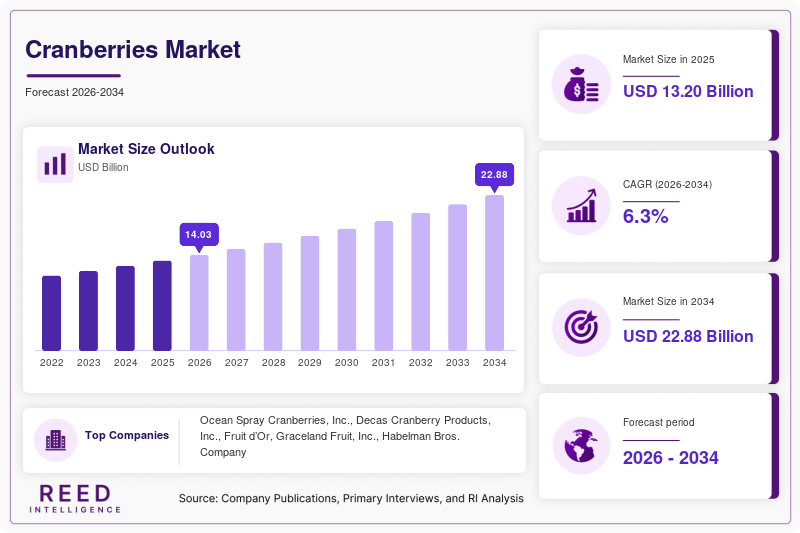
The global Cranberries Market size was valued at USD 13.2 billion in 2025 and is projected to reach USD 22.8 billion by 2034, expanding at a CAGR of 6.3% during the forecast period (2025–2034). The market has demonstrated steady expansion driven by rising consumer awareness regarding functional foods and the increasing incorporation of cranberries into processed food, beverages, and nutraceutical products. The growing demand for natural ingredients across food and beverage formulations has significantly supported the market’s expansion globally.
A key global factor supporting growth is the rising preference for antioxidant-rich superfoods. Cranberries are widely recognized for their high polyphenol and vitamin content, which has boosted their adoption across health-conscious consumer segments. This trend has led to increasing product diversification, including dried cranberries, juices, extracts, and dietary supplements.
Key Highlights
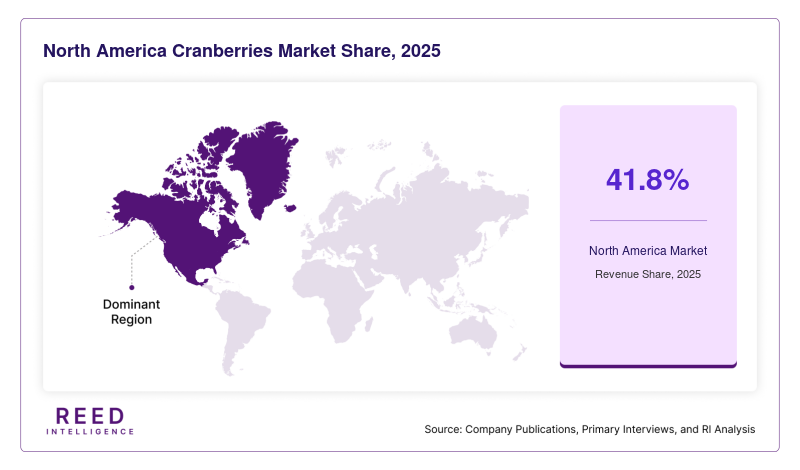
- North America dominated the Cranberries Market with a share of 41.8% in 2025, while Asia Pacific is projected to register the fastest CAGR of 7.4% during the forecast period.
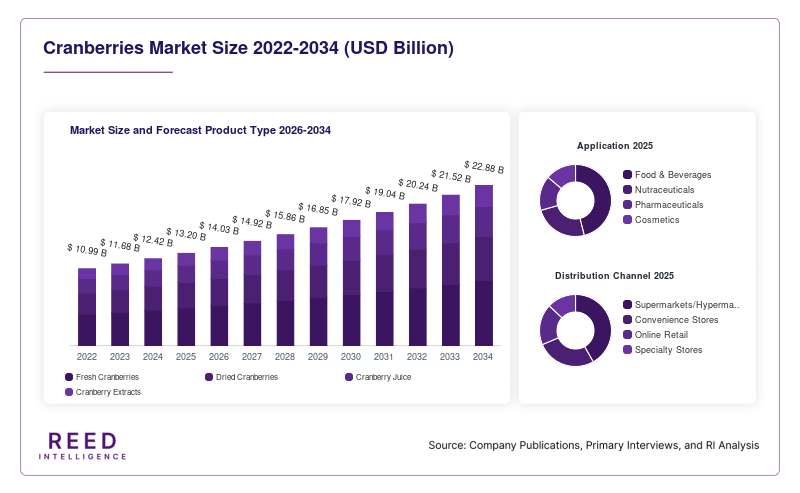
- By product type, dried cranberries held the largest share at 38.6% in 2025, whereas cranberry extracts are expected to grow at the fastest CAGR of 8.1%.
- By application, food & beverages dominated with 52.3% share, while nutraceuticals are projected to grow at a CAGR of 7.9%.
- The United States led the market with a value of USD 5.1 billion in 2025 and is estimated to reach USD 5.4 billion in 2026.
Market Trends
Expansion of Functional Food Applications
The Cranberries Market is witnessing increasing integration into functional food products. Manufacturers are incorporating cranberries into cereals, snack bars, dairy items, and plant-based alternatives due to their perceived health benefits. The demand for clean-label and minimally processed ingredients is further encouraging the use of cranberries in premium food formulations. This trend is particularly evident in developed markets, where consumers actively seek food products that offer additional health benefits beyond basic nutrition.
Rising Popularity of Plant-Based and Natural Ingredients
The shift toward plant-based diets has significantly influenced the Cranberries Market. Cranberries are increasingly used as natural flavoring agents, colorants, and preservatives in plant-based food and beverage products. Additionally, the demand for organic cranberries is growing due to rising concerns regarding pesticide use and environmental sustainability. This trend is encouraging producers to adopt organic farming practices and develop certified organic cranberry products, thereby expanding the market’s scope across health-conscious and environmentally aware consumer segments.
Market Drivers
Increasing Demand for Nutrient-Rich Foods
The growing focus on preventive healthcare has led consumers to include nutrient-dense foods in their daily diets. Cranberries, known for their high antioxidant content and potential health benefits, are increasingly consumed in various forms. This demand is driving manufacturers to expand their product offerings, including juices, supplements, and fortified foods, thereby supporting the growth of the Cranberries Market.
Growth of the Processed Food and Beverage Industry
The rapid expansion of the global processed food and beverage sector is significantly contributing to the Cranberries Market. Cranberries are widely used in bakery products, confectionery, beverages, and sauces, making them a valuable ingredient in large-scale food production. The increasing demand for convenience foods has further amplified their usage, as they enhance both flavor and nutritional value. This driver is particularly strong in urban markets, where busy lifestyles are boosting the consumption of ready-to-eat and packaged food products.
Market Restraint
Seasonal Production and Supply Chain Limitations
One of the major challenges in the Cranberries Market is the seasonal nature of cranberry cultivation. Cranberries are typically harvested once a year, leading to fluctuations in supply and pricing. This seasonal dependency creates challenges for manufacturers that require a consistent supply of raw materials throughout the year. Additionally, adverse weather conditions and climate variability can impact crop yields, further affecting market stability.
Supply chain complexities, including storage and transportation requirements, also add to the cost burden. Cranberries require specific preservation methods such as freezing or drying to maintain quality, which increases operational costs for producers and distributors. These factors can limit market growth, particularly in regions with less developed agricultural infrastructure.
Market Opportunities
Expansion into Emerging Markets
Emerging economies in Asia Pacific and Latin America present significant growth opportunities for the Cranberries Market. Rising disposable incomes, urbanization, and increasing awareness of health and wellness are driving demand for premium food products, including cranberries. Market players are focusing on expanding their distribution networks and introducing affordable product variants to capture these untapped markets.
Innovation in Product Formats
Product innovation is creating new avenues for growth in the Cranberries Market. The development of new formats such as cranberry powders, concentrates, and ready-to-drink beverages is attracting a broader consumer base. Additionally, advancements in food processing technologies are enabling manufacturers to enhance the shelf life and nutritional profile of cranberry products. These innovations are expected to support market expansion by catering to evolving consumer preferences.
Segmental Analysis
By Product Type
Dried cranberries dominated the Cranberries Market in 2025, accounting for 38.6% of the total share. This dominance was attributed to their extended shelf life, convenience, and wide usage in bakery products, snacks, and cereals.
Cranberry extracts are expected to grow at the fastest CAGR of 8.1% during the forecast period. The increasing use of extracts in dietary supplements and pharmaceuticals will drive growth, supported by their concentrated nutritional properties.
By Application
Food & beverages held the largest share of 52.3% in 2025. The extensive use of cranberries in juices, sauces, and processed foods contributed to this dominance.
The nutraceutical segment is projected to grow at a CAGR of 7.9%, driven by increasing consumer focus on preventive healthcare and the rising popularity of dietary supplements.
By Distribution Channel
Supermarkets and hypermarkets accounted for 46.7% of the Cranberries Market share in 2025. Their wide product availability and consumer trust contributed to their dominance.
Online retail is expected to grow at the fastest CAGR of 9.2%, driven by the increasing adoption of e-commerce platforms and the convenience of home delivery services.
By Form
Whole cranberries dominated the market with a share of 34.5% in 2025, owing to their direct consumption and use in cooking.
Powdered cranberries are anticipated to grow at a CAGR of 7.8%, supported by their application in health supplements and functional beverages.
Regional Analysis
North America
North America accounted for 41.8% of the Cranberries Market share in 2025 and is expected to grow at a CAGR of 5.8% during the forecast period. The region’s dominance was attributed to high cranberry production levels and strong consumer awareness regarding health benefits.
The United States dominated the regional market due to its well-established cranberry farming industry and advanced processing capabilities. The presence of large-scale producers and extensive distribution networks has supported market growth. Additionally, increasing demand for functional beverages has driven the consumption of cranberry-based juices and supplements.
Europe
Europe held a 23.6% share of the Cranberries Market in 2025 and is projected to expand at a CAGR of 6.1% through 2034. The region’s growth is driven by increasing demand for organic and natural food products.
Germany emerged as the leading country in the region, supported by a strong preference for clean-label and organic food items. The growing adoption of cranberries in bakery and confectionery products has contributed to market expansion. Additionally, increasing health awareness among consumers is encouraging the consumption of cranberry-based products.
Asia Pacific
Asia Pacific represented 18.9% of the Cranberries Market share in 2025 and is expected to grow at the fastest CAGR of 7.4% during the forecast period. The region’s growth is driven by rising urbanization and changing dietary patterns.
China dominated the regional market due to increasing consumer awareness regarding health and wellness. The expansion of retail channels and e-commerce platforms has improved product accessibility. Additionally, the growing middle-class population is driving demand for premium imported food products, including cranberries.
Middle East & Africa
The Middle East & Africa accounted for 8.1% of the Cranberries Market share in 2025 and is projected to grow at a CAGR of 6.0% over the forecast period. The market growth is supported by increasing demand for packaged and convenience foods.
The United Arab Emirates led the regional market, driven by a high demand for imported food products and a growing expatriate population. The expansion of modern retail infrastructure has further supported the availability of cranberry products across the region.
Latin America
Latin America held a 7.6% share of the Cranberries Market in 2025 and is expected to grow at a CAGR of 6.5% during the forecast period. The region is witnessing increasing demand for healthy food products.
Brazil dominated the regional market due to rising health awareness and the growing popularity of functional foods. The expansion of the food processing industry has further supported the adoption of cranberries in various applications, including beverages and snacks.
Competitive Landscape
The Cranberries Market is moderately fragmented, with several global and regional players competing based on product quality, pricing, and distribution networks. Leading companies are focusing on product innovation, strategic partnerships, and expansion into emerging markets to strengthen their market presence.
Ocean Spray Cranberries, Inc. is a key market leader, benefiting from its extensive product portfolio and strong brand recognition. The company recently introduced new flavored cranberry beverages to cater to evolving consumer preferences. Other players are investing in organic product lines and advanced processing technologies to enhance product quality and shelf life.
Key Players
- Ocean Spray Cranberries, Inc.
- Decas Cranberry Products, Inc.
- Cape Cod Select
- Fruit d’Or
- Graceland Fruit, Inc.
- Habelman Bros. Company
- Badger State Fruit Processing
- Shoreline Fruit
- Honestly Cranberry
- Meduri Farms
- Northland Cranberries
- Wisconsin Cranberry Cooperative
- Atlantic Quench Cranberries
- Del Monte Foods, Inc.
- SunOpta Inc.
Recent Developments
- 2024: Ocean Spray expanded its product portfolio with low-sugar cranberry beverages.
- 2024: Fruit d’Or increased investment in organic cranberry farming.
- 2023: Decas Cranberry Products launched new dried cranberry snack variants.
- 2023: Graceland Fruit introduced enhanced processing technologies for improved shelf life.
- 2023: SunOpta Inc. expanded its distribution network in Asia Pacific.
Cranberries Market Segments
Product Type
- Fresh Cranberries
- Dried Cranberries
- Cranberry Juice
- Cranberry Extracts
Application
- Food & Beverages
- Nutraceuticals
- Pharmaceuticals
- Cosmetics
Distribution Channel
- Supermarkets/Hypermarkets
- Convenience Stores
- Online Retail
- Specialty Stores
Form
- Whole
- Powder
- Concentrate
By Region
- North America
- Europe
- APAC
- Middle East and Africa
- LATAM