Cranberry Extract Market Size, Share & Demand Report By Form (Powder Extract, Liquid Extract, Capsule Extract, Soft Gel Extract), By Application (Dietary Supplements, Functional Beverages, Pharmaceuticals, Cosmetics and Personal Care, Functional Foods), By End Use (Nutraceutical Industry, Food and Beverage Industry, Pharmaceutical Industry, Cosmetic Industry), By Region & Segment Forecasts, 2026–2034
USD 3950
Market Overview
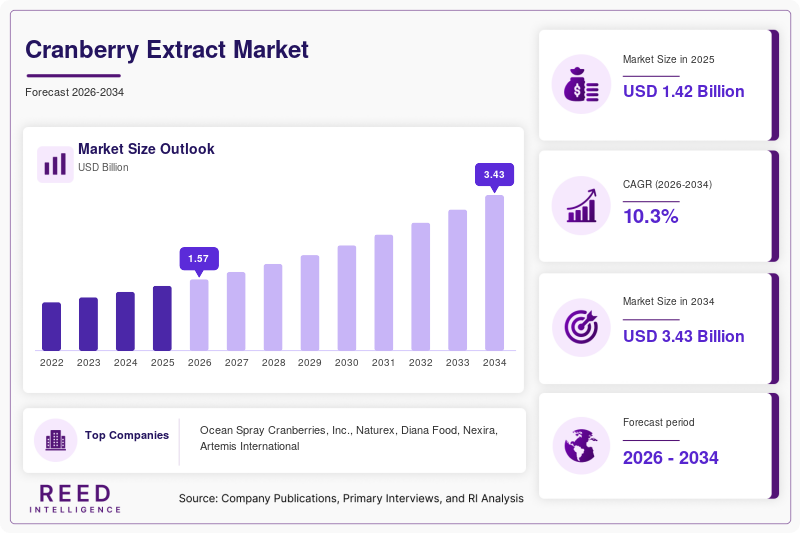
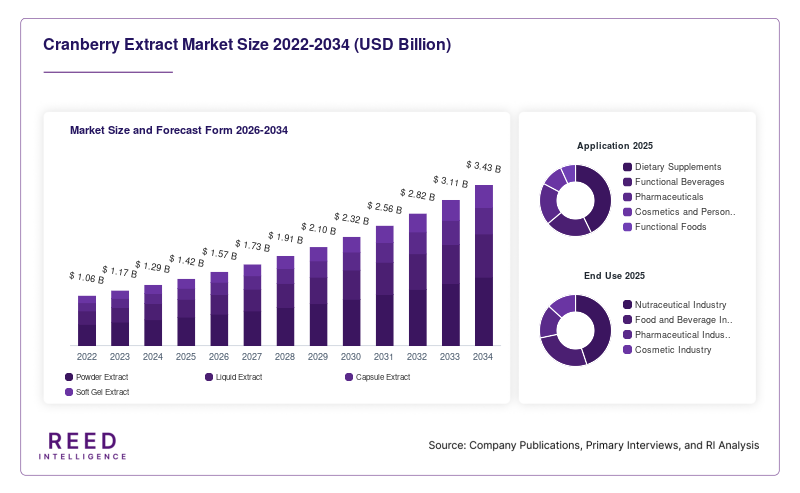
The global Cranberry Extract Market size was valued at USD 1.42 billion in 2026 and is projected to reach USD 3.11 billion by 2034, expanding at a CAGR of 10.3% during the forecast period from 2026 to 2034. Rising consumer awareness regarding preventive healthcare, functional nutrition, and plant-based ingredients continues to support demand for cranberry extract across dietary supplements, pharmaceuticals, food processing, and cosmetic formulations. Manufacturers are increasing investments in standardized botanical extracts to address growing consumer demand for clean-label and naturally sourced wellness products. The market is also benefiting from the rising popularity of antioxidant-rich ingredients in nutraceutical applications.
One major global factor supporting market growth is the increasing preference for immunity-supporting and urinary tract health supplements. Consumers in developed and emerging economies are actively purchasing cranberry-based capsules, powders, gummies, and beverages due to the perception that these products contribute to digestive wellness and urinary tract support. E-commerce expansion has further improved access to cranberry extract products, especially among younger consumers seeking preventive health solutions. In addition, food and beverage companies are integrating cranberry-derived ingredients into fortified drinks, snack bars, and wellness products to diversify functional product portfolios.
Key Highlights
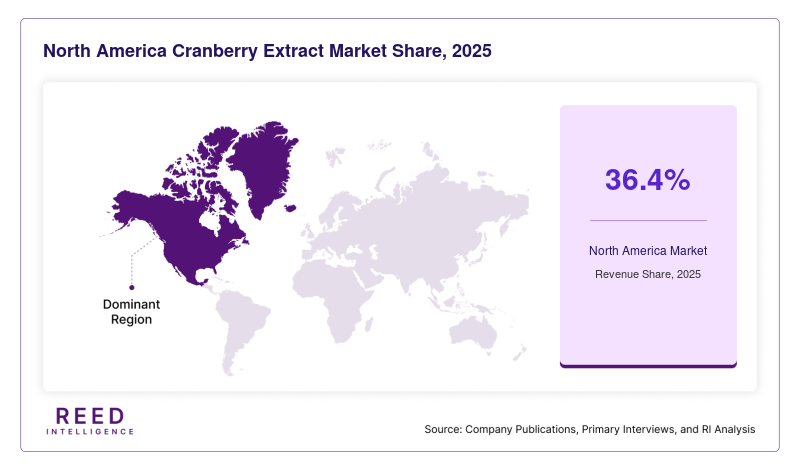
- North America dominated the market with a 36.4% share in 2025.
- Asia Pacific is expected to grow at the fastest CAGR of 11.8% during 2026–2034.
- By form, powder extract accounted for the largest share of 42.7%.
- while liquid extract is projected to grow at a CAGR of 12.1%.
- By application, dietary supplements led with a 39.8% share.
- whereas functional beverages are expected to expand at a CAGR of 11.9%.
- The United States remained the dominant country, with market values of USD 420 million in 2024 and USD 468 million in 2025.
Market Trends
Expansion of Functional Beverage Applications
The integration of cranberry extract into functional beverages is becoming an important trend within the Cranberry Extract Market. Beverage manufacturers are increasingly introducing antioxidant-rich juices, flavored water, probiotic drinks, and wellness beverages containing cranberry-derived ingredients. Consumers are seeking beverages that provide nutritional value beyond hydration, creating favorable conditions for cranberry extract adoption. Product developers are also combining cranberry extract with ingredients such as elderberry, turmeric, and probiotics to create multi-functional health drinks targeting immunity, digestive health, and energy support. This trend is particularly visible in North America and Europe, where demand for fortified beverages has increased among health-conscious urban consumers.
Companies are investing in advanced extraction technologies to preserve the bioactive compounds found in cranberries while improving flavor consistency and shelf stability. Clean-label positioning has become a major competitive factor, encouraging manufacturers to reduce artificial additives in beverage formulations. Retail chains and online grocery platforms are also expanding shelf space for wellness beverages, supporting higher product visibility. As consumers continue to prioritize convenient nutrition products, beverage applications are expected to remain an important revenue contributor for cranberry extract suppliers during the forecast period.
Rising Demand for Standardized Botanical Supplements
The increasing preference for standardized botanical ingredients in nutraceutical products is shaping product innovation across the Cranberry Extract Market. Consumers are becoming more informed about ingredient sourcing, dosage consistency, and clinical validation, leading supplement manufacturers to emphasize standardized cranberry extract formulations. Companies are marketing products based on proanthocyanidin concentration levels to improve transparency and support consumer confidence. This trend is encouraging suppliers to adopt quality assurance practices and invest in certification programs for organic and non-GMO cranberry extracts.
The expansion of personalized nutrition is also influencing the demand for cranberry-based dietary supplements. Brands are launching capsules, gummies, chewable tablets, and powder mixes targeting specific demographic groups such as women, older adults, and fitness consumers. Online wellness platforms are increasingly recommending cranberry extract products as part of broader preventive health routines. In addition, collaborations between nutraceutical companies and healthcare professionals are supporting greater acceptance of botanical ingredients in mainstream wellness products. The trend toward preventive healthcare and natural supplementation is expected to continue supporting long-term market growth.
Market Drivers
Growing Consumer Preference for Preventive Healthcare Products
The growing focus on preventive healthcare is one of the primary drivers supporting expansion of the Cranberry Extract Market. Consumers are increasingly purchasing natural health supplements to maintain wellness and reduce dependence on synthetic products. Cranberry extract is widely used in supplements associated with urinary tract support, antioxidant intake, and immune health, making it attractive to consumers seeking everyday preventive nutrition solutions. The shift toward proactive healthcare spending has increased sales of dietary supplements through pharmacies, supermarkets, specialty wellness stores, and e-commerce platforms.
Healthcare awareness campaigns and digital wellness content are further influencing consumer behavior. Social media platforms, nutrition blogs, and wellness influencers are promoting plant-based ingredients and functional nutrition products, increasing visibility for cranberry extract supplements. Manufacturers are responding by introducing innovative product formats, including gummies, stick packs, and flavored chewables that improve convenience and consumer acceptance. The rising prevalence of lifestyle-related health concerns and the growing aging population are expected to sustain demand for natural wellness ingredients throughout the forecast period.
Increasing Adoption of Natural Ingredients in Personal Care Products
The use of cranberry extract in cosmetics and personal care formulations is contributing significantly to market growth. Cosmetic manufacturers are incorporating cranberry-derived antioxidants into skincare products, facial creams, serums, shampoos, and anti-aging formulations due to the ingredient’s perceived ability to support skin hydration and protection from environmental stress. Consumer demand for plant-based and clean-label beauty products has encouraged personal care brands to reformulate product lines using naturally sourced botanical ingredients.
Premium skincare brands are increasingly emphasizing ingredient transparency and sustainable sourcing practices, creating additional demand for cranberry extract suppliers. In addition, the growth of organic beauty products and herbal cosmetic formulations across Europe and Asia Pacific is strengthening market expansion. Product innovation in multifunctional beauty products containing vitamins, antioxidants, and fruit extracts is further supporting industry growth. As consumers continue shifting toward wellness-oriented beauty products, cranberry extract applications in the cosmetic sector are expected to increase steadily during the coming years.
Market Restraint
High Raw Material Price Volatility and Seasonal Dependency
Price volatility associated with cranberry cultivation and raw material sourcing remains a major restraint affecting the Cranberry Extract Market. Cranberry production is highly dependent on climatic conditions, agricultural yield fluctuations, and seasonal harvesting cycles. Extreme weather events, including droughts, floods, and unexpected frost conditions, can significantly impact cranberry supply levels and production costs. This volatility creates operational challenges for extract manufacturers that rely on stable raw material availability for large-scale production.
Smaller manufacturers often face difficulties in maintaining profit margins when raw cranberry prices increase sharply. In addition, transportation expenses and storage requirements for fresh cranberries can add to overall production costs, particularly for suppliers operating in regions with limited domestic cranberry cultivation. The market also faces competition from alternative botanical extracts used in dietary supplements and functional foods, including blueberry, pomegranate, and elderberry extracts. Some consumers may switch to lower-cost alternatives when cranberry-based products become more expensive.
Quality consistency is another challenge linked to seasonal variability. Variations in active compound concentration levels can affect standardization processes and increase production complexity for nutraceutical manufacturers. Companies are attempting to reduce these risks through long-term supply agreements, controlled cultivation practices, and investment in advanced extraction technologies. However, cost pressure and agricultural dependency continue to remain significant barriers for market participants.
Market Opportunities
Expansion of E-Commerce Distribution Channels
The rapid growth of e-commerce platforms presents a major opportunity for companies operating in the Cranberry Extract Market. Online retail channels allow manufacturers to reach a wider consumer base while reducing dependence on traditional retail networks. Consumers increasingly prefer purchasing dietary supplements and wellness products through digital platforms due to convenience, product variety, and access to customer reviews. Subscription-based supplement delivery services are also contributing to recurring product sales and improving brand loyalty.
Digital marketing strategies are enabling smaller cranberry extract brands to compete more effectively with established nutraceutical companies. Social media advertising, influencer partnerships, and educational wellness campaigns are improving consumer awareness regarding cranberry-based products. In addition, e-commerce channels provide access to international markets where demand for natural supplements is growing rapidly. Companies are also leveraging data analytics and personalized recommendations to target consumers seeking preventive healthcare products. The increasing penetration of smartphones and digital payment systems in emerging economies is expected to create additional long-term growth opportunities for online cranberry extract sales.
Rising Demand for Functional Foods in Emerging Economies
Emerging economies across Asia Pacific, Latin America, and the Middle East are creating substantial growth opportunities for the Cranberry Extract Market. Rising urbanization, increasing disposable incomes, and changing dietary habits are encouraging consumers to adopt functional food and beverage products containing botanical ingredients. Food manufacturers are incorporating cranberry extract into breakfast cereals, nutrition bars, yogurt products, confectionery items, and wellness snacks to meet evolving consumer preferences.
Governments and healthcare organizations in several developing countries are also promoting nutritional awareness programs that encourage healthier dietary choices. Younger consumers are particularly interested in fortified food products that combine convenience with perceived health benefits. The expansion of modern retail infrastructure and international food chains is improving product availability across emerging regions. Furthermore, multinational nutraceutical companies are increasing investments in regional manufacturing and distribution facilities to strengthen market presence. These developments are expected to support sustained demand for cranberry extract ingredients in food and beverage applications over the forecast period.
Segmental Analysis
By Form
Powder extract represented the dominant subsegment within the Cranberry Extract Market in 2024, accounting for approximately 42.7% of total revenue. Powder formulations are widely preferred across dietary supplements, pharmaceuticals, and functional food manufacturing due to their longer shelf life, formulation flexibility, and ease of transportation. Nutraceutical companies extensively utilize powdered cranberry extract in capsules, tablets, gummies, and nutritional drink mixes. The segment also benefits from improved dosage accuracy and easier standardization of active compounds such as proanthocyanidins and flavonoids.
Manufacturers are increasingly investing in spray-drying and freeze-drying technologies to improve powder stability and preserve antioxidant content. Powder extract is also favored by food manufacturers because it can be blended into cereals, snack bars, bakery products, and sports nutrition formulations without significantly affecting texture. The growing popularity of plant-based dietary supplements and convenience nutrition products has strengthened demand for powder cranberry extract across developed and emerging markets. Additionally, rising consumer preference for clean-label ingredients and naturally sourced wellness products continues to support long-term segment expansion.
By Application
Dietary supplements accounted for the largest share of the Cranberry Extract Market in 2024, representing nearly 39.8% of global revenue. Consumers increasingly purchase cranberry-based capsules, tablets, powders, and gummies as part of preventive wellness routines focused on urinary tract support, immunity enhancement, and antioxidant intake. The growing aging population and rising awareness regarding natural health solutions continue to strengthen supplement demand globally. Pharmaceutical and nutraceutical companies are also introducing combination formulations containing cranberry extract alongside probiotics, vitamins, and herbal ingredients.
Retail pharmacies, online marketplaces, and health specialty stores are expanding product availability, improving accessibility for consumers across different age groups. Product innovation in sugar-free gummies, vegan capsules, and organic supplement lines is further supporting segment growth. In addition, healthcare professionals and wellness practitioners are increasingly recommending plant-based supplements to consumers seeking preventive healthcare solutions. Strong marketing campaigns and growing awareness regarding botanical ingredients are expected to maintain dietary supplements as the dominant application segment during the forecast period.
By End Use
The nutraceutical industry represented the dominant end-use segment in the Cranberry Extract Market in 2024, accounting for approximately 44.3% of total revenue. Nutraceutical manufacturers rely heavily on cranberry extract for the production of capsules, chewables, powders, and combination wellness products targeting urinary tract support and antioxidant intake. Rising demand for plant-based supplements and preventive healthcare solutions has strengthened the position of nutraceutical applications globally. Companies are increasingly promoting clinically supported botanical formulations to improve consumer confidence and strengthen brand differentiation.
The segment is also benefiting from increasing investment in research and development activities related to functional ingredients and standardized extracts. Nutraceutical brands are expanding product portfolios with organic, vegan, and non-GMO cranberry formulations to meet evolving consumer expectations. In addition, the rapid growth of direct-to-consumer supplement companies and online wellness retailers is improving product accessibility worldwide. The continued shift toward preventive healthcare spending and natural supplementation is expected to sustain strong demand from the nutraceutical sector over the forecast period.
Regional Analysis
North America
North America accounted for the largest share of the Cranberry Extract Market in 2025, representing 36.4% of global revenue. The region is expected to maintain steady expansion at a CAGR of 9.7% during the forecast period due to strong consumer awareness regarding preventive healthcare products and dietary supplements. High adoption of botanical ingredients in nutraceutical and functional food applications continues to support regional demand. The presence of established cranberry cultivation infrastructure and advanced extraction technology providers also contributes to market leadership across the region.
The United States remained the dominant country in North America due to strong demand for urinary tract health supplements and antioxidant-rich wellness products. The country benefits from well-developed distribution networks and widespread consumer familiarity with cranberry-based products. Growing investment in clean-label functional beverages and organic nutraceutical formulations is supporting market expansion. In addition, healthcare professionals increasingly recommend botanical supplements as part of preventive wellness programs, further improving demand for cranberry extract products.
Europe
Europe held a considerable share of the Cranberry Extract Market in 2025 and is projected to expand at a CAGR of 9.5% between 2026 and 2034. The region benefits from strong consumer preference for natural and plant-derived ingredients across food, cosmetics, and healthcare industries. Regulatory emphasis on ingredient transparency and sustainable sourcing practices is encouraging companies to invest in high-quality cranberry extract formulations. Functional foods and botanical dietary supplements continue to experience strong demand across Western European countries.
Germany emerged as the leading country within the European market due to growing demand for herbal healthcare products and organic wellness supplements. Consumers in Germany are increasingly purchasing botanical formulations through pharmacies and online wellness platforms. The country’s strong nutraceutical manufacturing sector and advanced research activities related to functional ingredients are supporting market growth. Rising interest in clean beauty products containing natural antioxidants is also contributing to higher demand for cranberry extract in cosmetic applications.
Asia Pacific
Asia Pacific is expected to register the fastest CAGR of 11.8% in the Cranberry Extract Market during the forecast period. Rising urbanization, increasing disposable income, and growing awareness regarding nutritional supplements are major factors supporting regional growth. Consumers in countries such as China, Japan, South Korea, and India are increasingly adopting preventive healthcare products containing botanical extracts. Expanding e-commerce infrastructure and rising demand for functional beverages are also improving market penetration across the region.
China remained the dominant country within Asia Pacific due to its large consumer population and expanding nutraceutical manufacturing industry. The increasing popularity of imported wellness products and plant-based supplements is driving cranberry extract demand across urban centers. Chinese food and beverage manufacturers are introducing fortified drinks and nutritional snacks containing fruit extracts to meet evolving consumer preferences. Government initiatives promoting health awareness and rising middle-class spending on premium wellness products are further supporting market expansion.
Middle East & Africa
The Middle East & Africa region represented a developing but steadily expanding segment of the Cranberry Extract Market in 2025. The market is projected to grow at a CAGR of 8.9% from 2026 to 2034 due to rising consumer interest in immunity-supporting products and herbal wellness ingredients. Increasing penetration of international nutraceutical brands and the expansion of modern retail channels are improving product accessibility across major urban centers. Demand for functional beverages and natural skincare products is also increasing steadily.
Saudi Arabia emerged as the dominant country within the regional market due to rising healthcare spending and growing interest in premium dietary supplements. Consumers are increasingly adopting wellness-focused lifestyles and purchasing imported botanical products through pharmacies and online platforms. The country is also witnessing higher demand for natural cosmetic formulations containing antioxidant-rich ingredients. Expanding investments in retail infrastructure and health-focused consumer campaigns are expected to support cranberry extract adoption during the forecast period.
Latin America
Latin America accounted for a moderate share of the Cranberry Extract Market in 2025 and is anticipated to expand at a CAGR of 9.1% over the forecast period. Growing awareness regarding preventive nutrition and the increasing popularity of functional foods are supporting market growth across the region. Food manufacturers are introducing fruit-based health products and fortified beverages to attract younger consumers interested in wellness-oriented lifestyles. Expansion of organized retail networks is also improving access to dietary supplements and nutraceutical products.
Brazil remained the leading country within Latin America due to its expanding health supplement industry and increasing consumer spending on wellness products. Rising demand for natural ingredients in beauty and personal care formulations is also contributing to cranberry extract adoption. Brazilian consumers are increasingly purchasing nutritional products through digital retail channels, encouraging companies to strengthen online distribution strategies. Growing investment in functional food manufacturing and product innovation is expected to support regional market development.
Competitive Landscape
The Cranberry Extract Market is moderately fragmented, with established nutraceutical ingredient manufacturers and regional botanical extract suppliers competing across multiple application categories. Companies are focusing on product standardization, organic certifications, clean-label positioning, and strategic partnerships to strengthen market presence. Investments in advanced extraction technologies and sustainable sourcing practices are becoming important competitive factors as consumers increasingly prioritize ingredient transparency and product quality.
Ocean Spray Cranberries, Inc. remains one of the leading participants in the market due to its strong cranberry sourcing capabilities, extensive product portfolio, and established distribution network. The company continues to expand its functional ingredient offerings for dietary supplement and beverage applications. Other major participants are emphasizing innovation in concentrated extracts, powder formulations, and personalized nutrition products to capture evolving consumer demand.
Manufacturers are also expanding e-commerce distribution channels and direct-to-consumer sales strategies to improve global market reach. Partnerships between nutraceutical companies and healthcare distributors are supporting higher product visibility across pharmacies and wellness retail chains. In 2025, Naturex introduced a new standardized cranberry extract formulation designed for functional beverage applications, focusing on improved flavor stability and antioxidant retention. Increasing mergers, product launches, and regional expansion strategies are expected to intensify competition throughout the forecast period.
Key Players
- Ocean Spray Cranberries, Inc.
- Naturex
- Diana Food
- Nexira
- Artemis International
- Fruit d'Or Nutraceuticals
- Nutra Green Biotechnology Co., Ltd.
- Ethical Naturals, Inc.
- Indena S.p.A.
- Bio-Botanica Inc.
- Zhejiang Jianfeng Health Co., Ltd.
- Hunan Nutramax Inc.
- Herbal Creations
- Xi'an Greena Biotech Co., Ltd.
- FutureCeuticals Inc.
Recent Developments
- In February 2025, Ocean Spray Cranberries, Inc. expanded its botanical ingredient division with a new cranberry extract processing facility aimed at increasing production efficiency and export capacity.
- In August 2025, Fruit d'Or Nutraceuticals launched an organic cranberry extract line targeting clean-label dietary supplement manufacturers across Europe and North America.
- In January 2026, Nexira announced a partnership with a functional beverage company to develop cranberry-based antioxidant drink formulations for the Asia Pacific market.
- In October 2025, Naturex introduced a standardized cranberry extract ingredient designed for ready-to-drink wellness beverages and powdered supplement applications.
Cranberry Extract Market Segments
Form
- Powder Extract
- Liquid Extract
- Capsule Extract
- Soft Gel Extract
Application
- Dietary Supplements
- Functional Beverages
- Pharmaceuticals
- Cosmetics and Personal Care
- Functional Foods
End Use
- Nutraceutical Industry
- Food and Beverage Industry
- Pharmaceutical Industry
- Cosmetic Industry
By Region
- North America
- Europe
- APAC
- Middle East and Africa
- LATAM