Cranial Implants Market Size, Share & Demand Report By Product Type (Customized Cranial Implants, Non-Customized Cranial Implants), By Material Type (Titanium, Polyetheretherketone (PEEK), Polymethyl Methacrylate (PMMA), Porous Polyethylene), By Application (Traumatic Brain Injury Reconstruction, Congenital Defect Repair, Neurosurgical Reconstruction), By End-Use (Hospitals, Specialty Neurosurgical Centers), By Region & Segment Forecasts, 2026–2034
USD 3950
Market Overview
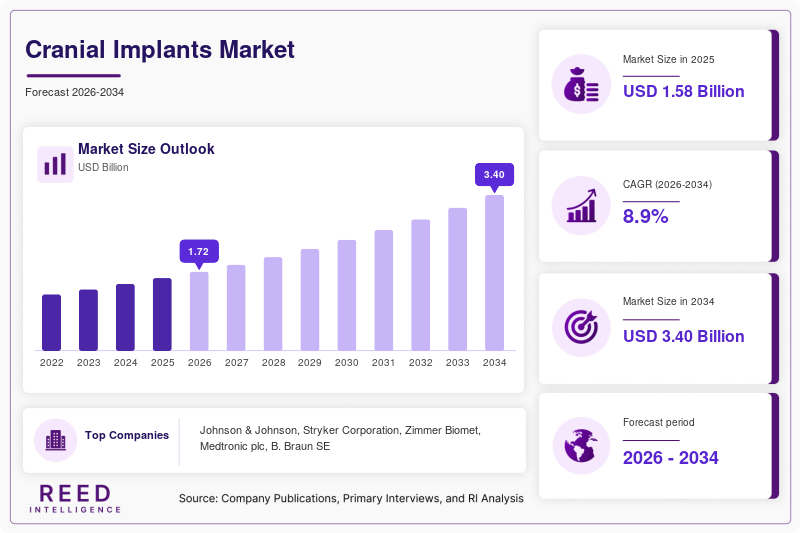
The Cranial Implants Market size was valued at USD 1.58 billion in 2026 and is projected to reach USD 3.12 billion by 2034, expanding at a CAGR of 8.9% during the forecast period from 2026 to 2034. The global Cranial Implants Market growth has been supported by the increasing incidence of traumatic brain injuries, rising neurosurgical procedures, and growing adoption of patient-specific cranial reconstruction technologies across healthcare systems worldwide. Continuous advancements in biomaterials and additive manufacturing have further strengthened product adoption in both developed and emerging economies.
The increasing focus on personalized healthcare solutions has contributed significantly to the expansion of the Cranial Implants Market. Hospitals and neurosurgical centers are increasingly adopting customized implants manufactured using 3D printing technologies to improve surgical precision and post-operative outcomes. In addition, rising healthcare expenditure and expanding access to advanced surgical procedures have improved the penetration of cranial reconstruction procedures globally.
Key Highlights
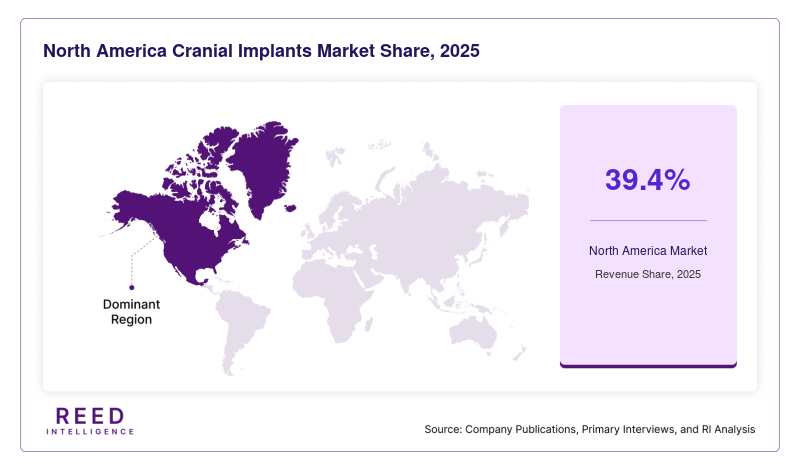
- North America dominated the Cranial Implants Market with 39.4% share in 2025, while Asia Pacific is projected to register the fastest CAGR of 10.7% during 2026–2034.
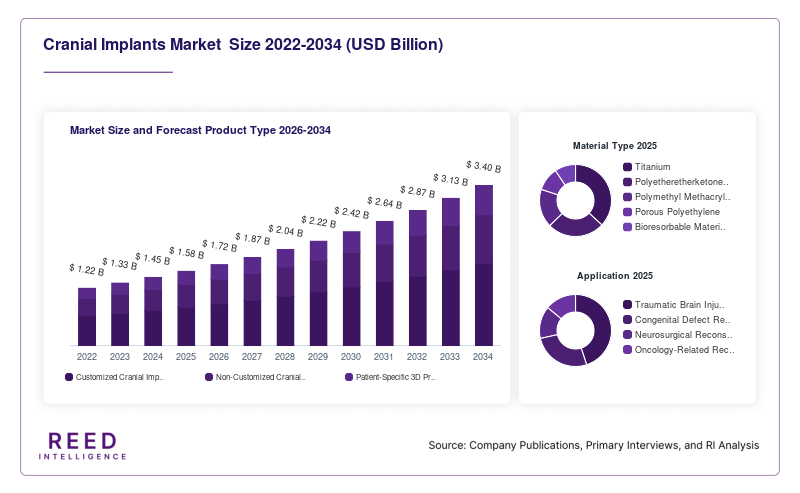
- By product type, customized cranial implants accounted for the largest market share of 56.2% in 2025, while patient-specific 3D printed implants are anticipated to witness the fastest CAGR of 11.4% during the forecast period.
- By material type, titanium cranial implants remained the leading segment with 41.8% share in 2025, while PEEK cranial implants are expected to grow at a CAGR of 10.9%.
- By application, traumatic brain injury reconstruction held the dominant share of 37.5% in 2025, whereas oncology-related reconstruction is forecast to grow at a CAGR of 9.7% through 2034.
- By end-use, hospitals held the dominant share of 62.5% in 2025, while specialty neurosurgical centers are forecast to grow at a CAGR of 9.8% during the forecast period.
- The U.S. Cranial Implants Market was valued at USD 428 million in 2024 and reached USD 463 million in 2025.
Market Trends
Adoption of 3D Printed Cranial Implant Technologies
One of the major trends shaping the Cranial Implants Market is the increasing adoption of 3D printed cranial implant technologies. Healthcare institutions are increasingly utilizing additive manufacturing to develop patient-specific implants that match individual anatomical structures. These implants provide improved surgical fitting, reduced operating time, and better post-operative recovery outcomes.
Manufacturers are also investing in advanced digital imaging software and rapid prototyping technologies to streamline implant production processes. The combination of AI-assisted surgical planning and customized implant fabrication is expected to transform reconstructive neurosurgery procedures during the forecast period.
Increasing Preference for Biocompatible and Lightweight Materials
Another notable trend in the Cranial Implants Market is the rising demand for lightweight and highly biocompatible implant materials. Materials such as polyetheretherketone (PEEK), porous polyethylene, and ceramic composites are gaining popularity due to their compatibility with human tissue and imaging systems.
These materials also reduce infection risks and improve long-term implant durability. The growing preference for minimally invasive neurosurgical procedures is further supporting the development of flexible and lightweight cranial implant solutions.
Market Drivers
Rising Incidence of Traumatic Brain Injuries
The increasing number of traumatic brain injuries worldwide is a major driver of the Cranial Implants Market. Road accidents, sports injuries, military trauma, and workplace incidents continue to increase the demand for skull reconstruction procedures. Patients undergoing decompressive craniectomy surgeries frequently require cranial implants for structural restoration and neurological protection.
Healthcare systems are also strengthening trauma care infrastructure and emergency neurosurgical services, which is improving access to advanced reconstructive treatments and supporting market growth.
Growing Demand for Personalized Surgical Solutions
The rising preference for patient-specific cranial implants is accelerating innovation in the Cranial Implants Market. Customized implants provide improved anatomical accuracy and enhanced cosmetic outcomes compared to conventional implant systems. Hospitals and specialty neurosurgical centers are increasingly integrating digital surgical planning and advanced manufacturing technologies into clinical workflows.
The growing use of customized implants in tumor-related reconstruction and congenital skull deformity correction is expected to continue driving demand during the forecast period.
Market Restraint
High Cost of Customized Implant Procedures
One major restraint affecting the Cranial Implants Market is the high cost associated with customized implant manufacturing and advanced neurosurgical procedures. Personalized implants often involve expensive imaging technologies, biomaterials, and manufacturing processes, limiting affordability in price-sensitive healthcare systems.
Limited reimbursement coverage and unequal access to specialized neurosurgical care in developing regions may also restrict broader market penetration.
Market Opportunities
Expansion of Neurosurgical Infrastructure in Emerging Economies
Rapid healthcare infrastructure development across emerging economies is creating strong opportunities for the Cranial Implants Market. Governments and private healthcare providers are investing in specialized trauma care facilities and advanced surgical centers, improving access to reconstructive neurosurgery procedures.
Countries across Asia Pacific, Latin America, and the Middle East are witnessing rising demand for modern medical technologies and patient-specific implant solutions.
Development of Smart and Regenerative Implant Technologies
Manufacturers are increasingly focusing on bioengineered and regenerative cranial implant technologies that support tissue integration and reduce post-surgical complications. Advanced antimicrobial coatings, porous implant structures, and regenerative biomaterials are creating new growth opportunities in the Cranial Implants Market.
The integration of smart monitoring technologies into implant systems is also expected to support future innovation and product differentiation.
Segmental Analysis
By Product Type
Based on product type, the Cranial Implants Market is segmented into customized cranial implants, non-customized cranial implants, and patient-specific 3D printed implants.
Customized cranial implants dominated the market with 56.2% share in 2025 due to increasing preference for anatomically accurate reconstruction solutions and improved cosmetic outcomes. Hospitals and neurosurgical centers increasingly adopted customized implants to reduce surgical complications and improve procedural efficiency.
Patient-specific 3D printed implants are projected to witness the fastest CAGR of 11.4% during the forecast period. Increasing adoption of additive manufacturing technologies and AI-assisted surgical planning systems will support segment growth. The growing demand for highly precise implant fitting in complex reconstruction procedures is expected to accelerate adoption.
By Material Type
Based on material type, the market is categorized into titanium, polyetheretherketone (PEEK), polymethyl methacrylate (PMMA), porous polyethylene, and bioresorbable materials.
Titanium cranial implants accounted for the largest market share of 41.8% in 2025 due to their high durability, structural strength, and long-term clinical reliability. Surgeons widely preferred titanium implants for trauma reconstruction and complex cranial repair procedures because of their mechanical stability and biocompatibility.
PEEK cranial implants are anticipated to grow at the fastest CAGR of 10.9% during 2026–2034. The increasing demand for lightweight implants with improved imaging compatibility and reduced thermal conductivity will support segment growth. Expanding utilization in cosmetic and neurological reconstruction procedures is expected to increase adoption.
By Application
Based on application, the market includes traumatic brain injury reconstruction, congenital defect repair, neurosurgical reconstruction, and oncology-related reconstruction.
Traumatic brain injury reconstruction held the dominant market share of 37.5% in 2025 due to the increasing incidence of road accidents, sports injuries, and emergency cranial surgeries worldwide. Healthcare facilities increasingly utilized cranial implants to restore skull integrity and protect neurological function following trauma procedures.
Oncology-related reconstruction is expected to register the fastest CAGR of 9.7% during the forecast period. Rising diagnosis rates of brain tumors and increasing surgical intervention volumes will support segment growth. Advanced implant customization technologies are expected to improve adoption in complex tumor reconstruction procedures.
By End-Use
Based on end-use, the market is segmented into hospitals, specialty neurosurgical centers, and ambulatory surgical centers.
Hospitals dominated the market in 2025 with 62.5% share due to higher procedural volumes, advanced surgical infrastructure, and availability of multidisciplinary neurological treatment services. Major healthcare institutions increasingly adopted customized cranial implant systems to improve patient recovery outcomes.
Specialty neurosurgical centers are expected to witness the fastest CAGR of 9.8% during the forecast period. Increasing patient preference for specialized neurological care and shorter surgical turnaround times will support segment growth. Expanding investments in dedicated neurosurgical treatment facilities are expected to accelerate demand.
Regional Analysis
North America
North America accounted for 39.4% of the Cranial Implants Market share in 2025 and is expected to grow at a CAGR of 8.2% during 2026–2034. The region maintained strong market demand due to established healthcare infrastructure, increasing adoption of customized cranial implants, and rising neurosurgical procedure volumes. Healthcare providers increasingly utilized advanced reconstructive technologies to improve clinical efficiency and patient recovery outcomes.
The U.S. remained the dominant country in the region due to the growing adoption of patient-specific cranial implants and expanding investments in neurological healthcare infrastructure. Increasing integration of AI-assisted imaging and digital surgical planning systems significantly supported market growth across hospitals and trauma centers.
Europe
Europe held 27.1% of the global Cranial Implants Market share in 2025 and is projected to expand at a CAGR of 8.4% during the forecast period. The region experienced steady growth due to increasing healthcare expenditure and rising utilization of advanced biomaterials in reconstructive neurosurgery procedures. Public healthcare systems increasingly supported access to specialized neurological treatments and customized cranial reconstruction technologies.
Germany dominated the regional market owing to its strong medical technology sector and continuous focus on surgical innovation. The increasing use of digital manufacturing technologies and advanced implant systems contributed significantly to regional market expansion.
Asia Pacific
Asia Pacific represented 21.6% of the global market share in 2025 and is anticipated to witness the fastest CAGR of 10.7% during 2026–2034. Rapid urbanization, rising healthcare investments, and increasing access to neurosurgical treatment services supported regional growth. Governments across China, India, Japan, and Southeast Asia expanded investments in specialized neurological healthcare infrastructure and trauma care facilities.
China emerged as the leading country in the region due to extensive hospital modernization initiatives and increasing adoption of advanced medical manufacturing technologies. Rising trauma-related surgeries and improvements in healthcare accessibility created strong demand for cranial implant procedures.
Middle East & Africa
The Middle East & Africa accounted for 6.3% of the Cranial Implants Market share in 2025 and is forecast to grow at a CAGR of 7.1% through 2034. The region witnessed increasing adoption of reconstructive neurosurgical procedures and rising investments in specialized healthcare infrastructure. Governments continued expanding neurological treatment facilities to improve patient access to advanced surgical services.
Saudi Arabia led the regional market due to healthcare modernization initiatives and increasing investments in tertiary care hospitals. The growing availability of advanced reconstructive surgery technologies supported regional market development.
Latin America
Latin America captured 5.6% of the global market share in 2025 and is expected to expand at a CAGR of 7.6% during the forecast period. Increasing healthcare investments and expanding trauma care services supported regional growth. Public and private healthcare institutions increasingly adopted advanced reconstructive technologies to improve surgical outcomes and patient rehabilitation.
Brazil remained the dominant country in Latin America owing to rising neurosurgical procedure volumes and increasing investments in specialized healthcare infrastructure. The growing availability of cranial reconstruction procedures further contributed to market expansion.
Competitive Landscape
The Cranial Implants Market remains moderately consolidated with the presence of global medical device manufacturers and specialized craniofacial implant providers. Market participants are focusing on customized implant development, biomaterial innovation, and strategic collaborations to strengthen their competitive position.
Johnson & Johnson remained a leading player in the market due to its extensive neurosurgical product portfolio and strong global healthcare presence. The company recently expanded its patient-specific cranial reconstruction solutions with advanced digital surgical planning technologies.
Stryker Corporation continued focusing on customized cranial implant manufacturing and 3D printing integration for neurosurgical applications. Zimmer Biomet increased investments in lightweight biomaterial development and craniofacial fixation systems. Medtronic strengthened its neurological surgery portfolio through advanced surgical navigation technologies. B. Braun focused on expanding its reconstructive implant product offerings and neurosurgical partnerships.
Key Players List
- Johnson & Johnson
- Stryker Corporation
- Zimmer Biomet
- Medtronic
- B. Braun
- KLS Martin Group
- OsteoMed
- DePuy Synthes
- Biomet Microfixation
- Matrix Surgical USA
- Medartis
- Renishaw plc
- Xilloc Medical
- Anatomics Pty Ltd.
- Materialise NV
Cranial Implants Market Segments
Product Type
- Customized Cranial Implants
- Non-Customized Cranial Implants
- Patient-Specific 3D Printed Implants
Material Type
- Titanium
- Polyetheretherketone (PEEK)
- Polymethyl Methacrylate (PMMA)
- Porous Polyethylene
- Bioresorbable Materials
Application
- Traumatic Brain Injury Reconstruction
- Congenital Defect Repair
- Neurosurgical Reconstruction
- Oncology-Related Reconstruction
End-Use
- Hospitals
- Specialty Neurosurgical Centers
- Ambulatory Surgical Centers
By Region
- North America
- Europe
- APAC
- Middle East and Africa
- LATAM