Critical Incident Monitoring UAV Market Size, Share & Demand Report By Type (Fixed-Wing UAVs, Rotary-Wing UAVs, Hybrid UAVs), By Application (Disaster Management, Law Enforcement Surveillance, Firefighting Operations, Search and Rescue), By End-Use (Government & Defense, Commercial, Industrial), By Component (Hardware, Software, Services) & By Region – Segment Forecasts, 2025–2034
USD 3950
Market Overview
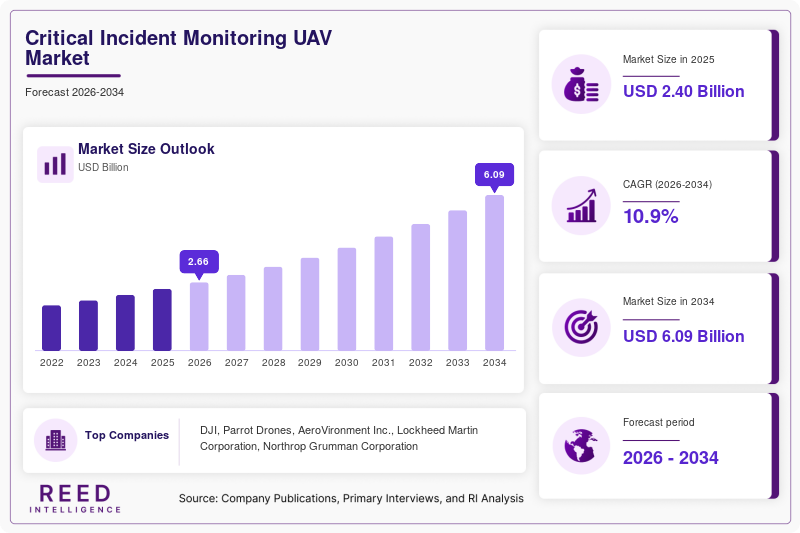
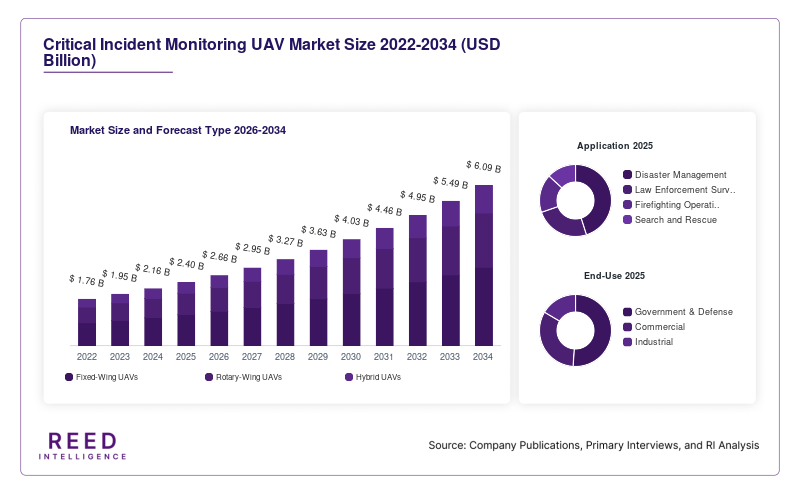
The Critical Incident Monitoring UAV Market size was valued at USD 2.4 billion in 2025 and is projected to reach USD 6.1 billion by 2034, expanding at a CAGR of 10.9% during the forecast period (2025–2034). The market growth is driven by the increasing demand for real-time situational awareness in emergency response, law enforcement, and disaster management operations. Unmanned aerial vehicles (UAVs) equipped with advanced imaging and communication technologies are becoming essential tools for monitoring critical incidents such as natural disasters, industrial accidents, and security threats.
A key global factor supporting the growth of the Critical Incident Monitoring UAV Market is the rising frequency of climate-related disasters and urban emergencies. Governments and emergency agencies are investing in UAV-based monitoring systems to enhance response efficiency, reduce human risk, and improve decision-making during crises. These systems provide rapid aerial surveillance, enabling responders to assess damage, locate victims, and coordinate rescue efforts more effectively.
Key Highlights:
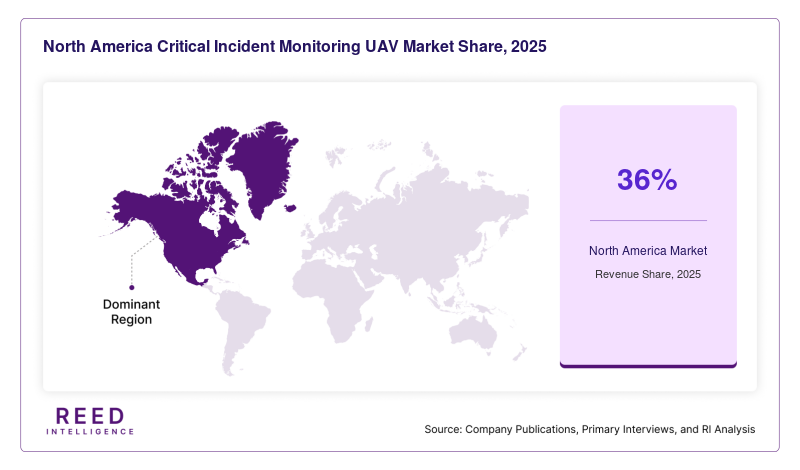
- North America dominated the market with a share of 36% in 2025, while Asia Pacific is expected to register the fastest CAGR of 12.3% during the forecast period.
- By type, fixed-wing UAVs accounted for the largest share, whereas hybrid UAVs are anticipated to witness the fastest growth at a CAGR of 12.8%.
- By application, disaster management led the segment, while law enforcement surveillance is projected to grow rapidly at a CAGR of 11.7%.
- The United States remained the dominant country, with market values of USD 910 million in 2025 and USD 1.01 billion in 2026.
Market Trends
Integration of AI and Real-Time Analytics in UAV Systems
The Critical Incident Monitoring UAV Market is witnessing strong adoption of artificial intelligence and real-time analytics capabilities. UAVs are increasingly equipped with AI-powered image recognition and data processing tools that enable faster identification of threats, anomalies, and affected areas. This trend enhances operational efficiency by reducing manual analysis and improving response accuracy during emergencies. As AI technology evolves, UAV systems are becoming more autonomous and capable of delivering actionable insights in real time.
Expansion of BVLOS (Beyond Visual Line of Sight) Operations
Another significant trend shaping the Critical Incident Monitoring UAV Market is the expansion of beyond visual line of sight (BVLOS) operations. Regulatory advancements in several countries are enabling UAV operators to conduct long-range missions without direct visual contact. This capability is crucial for large-scale disaster monitoring, border surveillance, and remote infrastructure inspection. BVLOS operations increase coverage area and operational flexibility, making UAVs more effective in critical incident monitoring scenarios.
Market Drivers
Increasing Demand for Advanced Emergency Response Solutions
The need for efficient emergency response systems is a primary driver of the Critical Incident Monitoring UAV Market. UAVs provide rapid deployment and real-time data collection, enabling authorities to respond quickly to incidents such as fires, floods, and accidents. Their ability to access hard-to-reach areas reduces risks for human responders and improves overall operational efficiency.
Growing Adoption in Law Enforcement and Public Safety
The expanding use of UAVs in law enforcement and public safety operations is another key growth driver. Agencies are increasingly deploying UAVs for crowd monitoring, traffic management, and surveillance during large events. These applications enhance situational awareness and help prevent potential threats, contributing to the steady growth of the market.
Market Restraint
Regulatory and Privacy Concerns
A major restraint affecting the Critical Incident Monitoring UAV Market is the presence of strict regulatory frameworks and privacy concerns. Governments across various regions impose limitations on UAV operations, particularly in urban and sensitive areas. These regulations often require special permissions, certifications, and compliance with safety standards, which can slow down market adoption.
Additionally, concerns related to data privacy and surveillance misuse pose challenges for widespread deployment. Public apprehension regarding unauthorized monitoring and data collection has led to increased scrutiny of UAV usage. These factors create barriers for market expansion, particularly in regions with stringent regulatory environments.
Market Opportunities
Development of Smart City Infrastructure
The growing adoption of smart city initiatives presents a strong opportunity for the Critical Incident Monitoring UAV Market. UAVs can play a vital role in urban monitoring, traffic management, and emergency response systems. Integration with smart city platforms allows real-time data sharing and coordinated responses, enhancing overall urban safety.
Advancements in UAV Sensor Technologies
Technological advancements in sensor systems, including thermal imaging and LiDAR, are creating new opportunities in the market. These sensors enable UAVs to operate effectively in low-visibility conditions and complex environments. As sensor technologies continue to improve, UAVs will offer enhanced capabilities for critical incident monitoring, driving market growth.
Segmental Analysis
By Type
Fixed-wing UAVs dominated the Critical Incident Monitoring UAV Market in 2025, accounting for 52% of the total share. Their ability to cover large areas and longer flight endurance made them suitable for disaster monitoring and border surveillance applications.
Hybrid UAVs are projected to grow at the fastest CAGR of 12.8% during the forecast period. Their combination of vertical takeoff and long-range capabilities will drive adoption, particularly in complex urban environments.
By Application
Disaster management applications held the largest share of 44% in 2025, driven by increasing natural disasters and the need for efficient response systems. UAVs provide real-time data that helps authorities coordinate rescue operations effectively.
Law enforcement surveillance is expected to grow at a CAGR of 11.7%. The increasing use of UAVs for crowd control and crime monitoring will support segment growth.
By End-Use
Government and defense sectors dominated the Critical Incident Monitoring UAV Market with a 48% share in 2025. These sectors rely heavily on UAVs for surveillance, security, and emergency response operations.
The commercial sector is anticipated to grow at a CAGR of 11.5%. Rising adoption in industries such as infrastructure and utilities will drive demand.
By Component
Hardware components accounted for 61% of the market share in 2025, including UAV platforms, sensors, and communication systems. These components are essential for UAV functionality and performance.
Software solutions are expected to grow at a CAGR of 12.1%. Increasing demand for data analytics and mission planning tools will support segment growth.
Regional Analysis
North America
North America accounted for 36% of the Critical Incident Monitoring UAV Market share in 2025 and will grow at a CAGR of 10.4% during the forecast period. The region benefits from strong government investments in defense and public safety technologies.
The United States leads the regional market due to its advanced technological infrastructure and high adoption of UAVs in emergency response. Federal agencies and local authorities are increasingly deploying UAV systems for disaster monitoring and law enforcement applications.
Europe
Europe held a 24% share of the Critical Incident Monitoring UAV Market in 2025 and is expected to grow at a CAGR of 10.1% through 2034. The region is characterized by increasing investments in security and surveillance technologies.
Germany dominates the European market due to its strong industrial base and focus on innovation. The country’s emphasis on public safety and infrastructure monitoring supports the adoption of UAV-based solutions.
Asia Pacific
Asia Pacific represented 28% of the market in 2025 and is projected to grow at the fastest CAGR of 12.3% during the forecast period. Rapid urbanization and increasing disaster risks drive regional growth.
China leads the market due to its large-scale UAV manufacturing capabilities and growing investments in smart city initiatives. The country’s focus on technological advancements supports widespread adoption of UAV monitoring systems.
Middle East & Africa
The Middle East & Africa accounted for 6% of the Critical Incident Monitoring UAV Market in 2025 and will grow at a CAGR of 9.8%. Increasing investments in security infrastructure drive demand in the region.
The United Arab Emirates is a key contributor, supported by its focus on smart technologies and urban safety. The adoption of UAVs for surveillance and emergency response is steadily increasing.
Latin America
Latin America held a 6% share of the market in 2025 and is expected to grow at a CAGR of 10.0% through 2034. Growth is driven by rising investments in disaster management and public safety.
Brazil dominates the regional market due to its expanding urban infrastructure and increasing need for monitoring solutions. The country’s focus on improving emergency response capabilities supports market growth.
Competitive Landscape
The Critical Incident Monitoring UAV Market is competitive, with key players focusing on innovation, product development, and strategic partnerships. Companies are investing in advanced UAV technologies to enhance performance and reliability.
DJI is a leading player in the market, known for its wide range of UAV solutions for commercial and emergency applications. The company recently introduced advanced UAV systems with improved imaging and real-time data capabilities, strengthening its position in the market. Other major players include Parrot Drones, AeroVironment, and Lockheed Martin, which emphasize technological advancements and expansion into new markets. These companies continue to invest in research and development to meet evolving industry requirements and maintain competitiveness.
Key Players List
- DJI
- Parrot Drones
- AeroVironment Inc.
- Lockheed Martin Corporation
- Northrop Grumman Corporation
- Elbit Systems Ltd.
- Israel Aerospace Industries Ltd.
- General Atomics Aeronautical Systems
- Teledyne FLIR LLC
- Saab AB
- Thales Group
- BAE Systems plc
- Skydio Inc.
- Yuneec International
- Insitu Inc.
Recent Developments
- DJI launched advanced UAVs with enhanced thermal imaging capabilities for emergency response.
- Parrot Drones introduced AI-enabled UAV systems for public safety applications.
- AeroVironment expanded its UAV portfolio for defense and surveillance missions.
- Teledyne FLIR developed improved sensor systems for UAV-based monitoring.
- Skydio introduced autonomous UAVs with advanced navigation capabilities.
Critical Incident Monitoring UAV Market Segments
Type
- Fixed-Wing UAVs
- Rotary-Wing UAVs
- Hybrid UAVs
Application
- Disaster Management
- Law Enforcement Surveillance
- Firefighting Operations
- Search and Rescue
End-Use
- Government & Defense
- Commercial
- Industrial
Component
- Hardware
- Software
- Services
By Region
- North America
- Europe
- APAC
- Middle East and Africa
- LATAM