Crotonaldehyde Market Size, Share, Demand & Growth Report By Type (Alpha-Crotonaldehyde, Beta-Crotonaldehyde), By Application (Sorbic Acid Production, Agrochemical Intermediates, Chemical Intermediates, Others), By End-Use Industry (Chemical Manufacturing, Food & Beverage, Agriculture, Pharmaceuticals, Others) & Regional Forecasts, 2025–2034
USD 3950
Market Overview
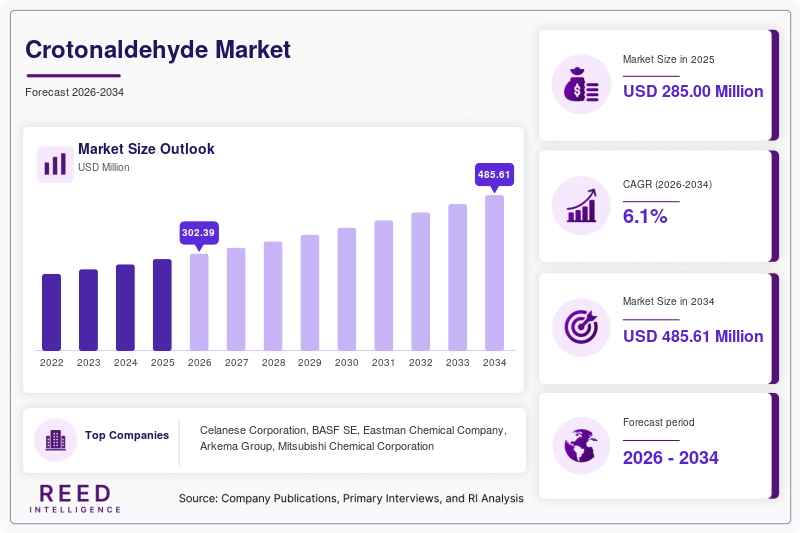
The Crotonaldehyde Market size is estimated to reach approximately USD 285 million, with projections indicating growth to USD 305 million in 2026. By 2034, the market is expected to attain a valuation of around USD 520 million, registering a compound annual growth rate (CAGR) of 6.1% during the forecast period from 2025 to 2034.
The expansion of the crotonaldehyde market is supported by several structural and demand-side factors. First, the increasing demand for preservatives and food additives, particularly sorbic acid, is creating a stable consumption base. Crotonaldehyde acts as a key intermediate in sorbic acid production, which is widely used in packaged food and beverage applications. Second, the rising demand for agrochemicals, including herbicides and pesticides, is contributing to the steady growth of crotonaldehyde consumption. Third, industrial growth in emerging economies, especially in Asia Pacific, is enhancing the production and application of specialty chemicals, further boosting market demand.
Key Highlights
- Asia Pacific dominated the global Crotonaldehyde Market in 2025, accounting for the largest regional share due to strong chemical manufacturing and agrochemical demand.
- Asia Pacific is also the fastest-growing region, expected to register a CAGR of 7.2% from 2025 to 2034, driven by rapid industrialization and expanding agricultural output.
- By application, sorbic acid production remained the dominant segment in 2025, holding the largest market share owing to its extensive use in food preservation.
- The agrochemical intermediates segment is emerging as the fastest-growing application segment, supported by rising global demand for crop protection chemicals.
- By end-use industry, chemical manufacturing dominated the market share in 2025 due to high consumption of crotonaldehyde in industrial synthesis processes.
- The pharmaceutical segment is witnessing strong growth momentum, driven by increasing utilization of crotonaldehyde in the production of active intermediates and specialty compounds.
Market Trends
Rising Demand for Food Preservatives and Additives
The growing consumption of packaged and processed food products is significantly influencing the crotonaldehyde market. As consumer lifestyles shift toward convenience foods, the need for effective preservation solutions has increased. Crotonaldehyde plays a critical role in the synthesis of sorbic acid, a widely used food preservative known for its antimicrobial properties. Food manufacturers are increasingly adopting sorbic acid due to its safety profile and effectiveness in extending shelf life. This trend is particularly prominent in urban regions where processed food consumption is rising steadily. Additionally, regulatory approvals for sorbic acid in multiple regions are supporting its adoption, thereby indirectly driving crotonaldehyde demand.
Expansion of Specialty Chemical Applications
Another notable trend in the crotonaldehyde market is the increasing use of this compound in specialty chemical production. Crotonaldehyde is used in the synthesis of various intermediates such as butanol derivatives, resins, and plasticizers. These compounds find applications in coatings, adhesives, and industrial solvents. As industries demand high-performance materials with enhanced durability and chemical resistance, the role of crotonaldehyde-based intermediates is becoming more prominent. Moreover, advancements in chemical engineering are enabling the development of customized formulations, expanding the scope of crotonaldehyde applications across niche industrial segments.
Market Drivers
Growth in Agrochemical Industry
The increasing demand for agricultural productivity is driving the growth of the agrochemical industry, which in turn supports the crotonaldehyde market. Crotonaldehyde is used in the synthesis of various pesticides and herbicides that help improve crop yield and protect against pests. As global food demand continues to rise, farmers are increasingly relying on chemical solutions to enhance productivity. Emerging economies with expanding agricultural sectors are contributing significantly to this demand. Additionally, government initiatives promoting modern farming techniques are encouraging the use of advanced agrochemicals, thereby boosting the consumption of crotonaldehyde as a key intermediate.
Industrialization and Chemical Manufacturing Expansion
Rapid industrialization, particularly in developing regions, is fueling the expansion of chemical manufacturing industries. Crotonaldehyde serves as a crucial intermediate in the production of several industrial chemicals, including solvents and resins. As industries such as automotive, construction, and packaging grow, the demand for these chemicals is increasing. This, in turn, is driving the need for crotonaldehyde. Furthermore, the integration of advanced manufacturing processes is improving production efficiency, making crotonaldehyde more accessible and cost-effective for industrial applications.
Market Restraint
Health and Environmental Concerns
One of the primary restraints affecting the crotonaldehyde market is the potential health and environmental risks associated with its production and use. Crotonaldehyde is a reactive and toxic compound that requires careful handling and storage. Exposure to this chemical can cause irritation to the skin, eyes, and respiratory system, leading to stringent safety regulations governing its use. Environmental concerns related to emissions and waste disposal further complicate production processes. Regulatory authorities in several regions have implemented strict guidelines to control the handling and transportation of hazardous chemicals, increasing compliance costs for manufacturers. For example, chemical plants must invest in advanced safety systems and emission control technologies, which can raise operational expenses and limit market expansion.
Market Opportunities
Development of Sustainable Production Methods
The growing emphasis on sustainability presents a significant opportunity for the crotonaldehyde market. Manufacturers are exploring eco-friendly production processes that reduce emissions and improve energy efficiency. The adoption of green chemistry principles, such as the use of renewable feedstocks and catalytic processes, can enhance the environmental profile of crotonaldehyde production. Companies investing in sustainable technologies are likely to gain a competitive advantage, as regulatory frameworks increasingly favor environmentally responsible practices. This shift toward sustainability also aligns with the broader trend of reducing the carbon footprint of chemical manufacturing.
Expansion in Emerging Markets
Emerging markets in Asia Pacific, Latin America, and the Middle East offer substantial growth opportunities for the crotonaldehyde market. Rapid industrialization, urbanization, and economic development in these regions are driving demand for chemicals used in agriculture, construction, and manufacturing. The expansion of local production facilities and the availability of cost-effective labor are encouraging multinational companies to invest in these markets. Additionally, increasing consumer demand for processed food and improved agricultural productivity is supporting the growth of crotonaldehyde applications. These factors collectively create a favorable environment for market expansion in developing economies.
Segmental Analysis
By Type
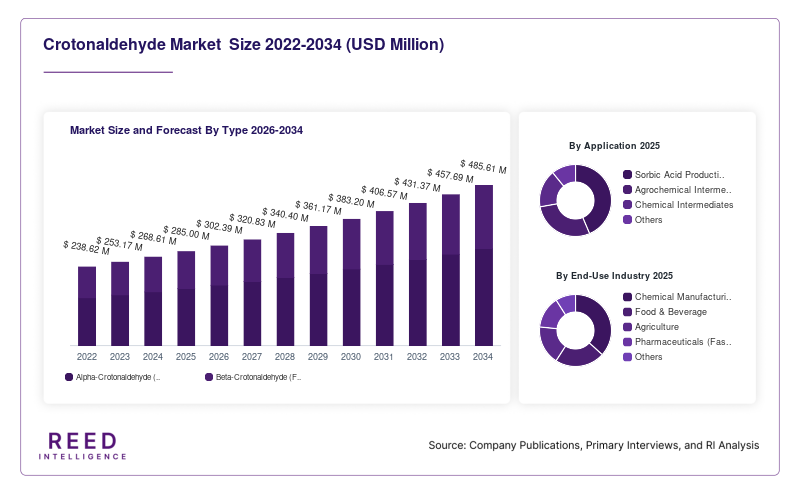
The alpha-crotonaldehyde segment dominated the market in 2024, accounting for approximately 68% of the total share. This dominance is attributed to its widespread use as an intermediate in chemical synthesis, particularly in the production of sorbic acid and other derivatives. Its favorable chemical properties, including high reactivity and stability under controlled conditions, make it suitable for various industrial applications. Manufacturers prefer alpha-crotonaldehyde due to its compatibility with existing production processes and its ability to deliver consistent performance in end-use applications.
The beta-crotonaldehyde segment is expected to be the fastest-growing, registering a CAGR of 6.8% during the forecast period. This growth is driven by increasing research and development activities aimed at exploring new applications for beta isomers in specialty chemicals. The segment is gaining traction due to its potential use in advanced materials and high-value chemical formulations. Additionally, improvements in production technologies are enabling more efficient synthesis of beta-crotonaldehyde, making it increasingly viable for commercial applications.
By Application
The sorbic acid production segment held the largest market share in 2024, accounting for around 52%. This dominance is driven by the widespread use of sorbic acid as a food preservative in processed foods and beverages. Crotonaldehyde serves as a critical precursor in sorbic acid synthesis, making it an essential component of this value chain. The increasing demand for packaged food products and the need for extended shelf life are key factors supporting this segment’s growth.
The agrochemical intermediates segment is projected to grow at the fastest CAGR of 6.9% during the forecast period. This growth is fueled by the rising demand for pesticides and herbicides to enhance agricultural productivity. Crotonaldehyde is used in the synthesis of various agrochemical compounds, making it a valuable intermediate in this sector. The expansion of agricultural activities and the adoption of modern farming techniques are further driving demand in this segment.
By End-Use Industry
The chemical manufacturing industry dominated the crotonaldehyde market in 2024, accounting for approximately 60% of the total share. This segment’s leadership is due to the extensive use of crotonaldehyde as an intermediate in the production of various chemicals, including solvents, resins, and plasticizers. The versatility of crotonaldehyde and its compatibility with multiple synthesis processes make it a preferred choice in the chemical industry.
The pharmaceutical industry is expected to be the fastest-growing end-use segment, with a CAGR of 6.7% during the forecast period. This growth is driven by the increasing use of crotonaldehyde in the synthesis of pharmaceutical intermediates. The rising demand for healthcare products and the expansion of pharmaceutical manufacturing are key factors supporting this segment’s growth. Additionally, advancements in drug development are creating new opportunities for crotonaldehyde-based compounds.
Regional Analysis
North America
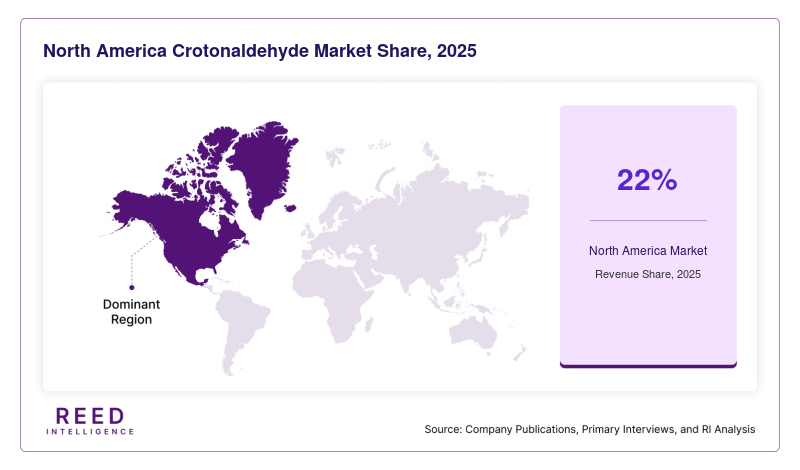
North America accounted for approximately 22% of the crotonaldehyde market share in 2025 and is expected to grow at a CAGR of 5.4% during the forecast period. The region’s growth is driven by well-established chemical manufacturing infrastructure and strong demand from the food and pharmaceutical industries. The presence of advanced research facilities and technological innovation is further supporting market development.
The United States dominates the North American market due to its robust industrial base and high demand for specialty chemicals. A unique growth factor in this region is the increasing focus on sustainable chemical production, with companies investing in cleaner technologies and environmentally friendly processes to comply with regulatory standards.
Europe
Europe held around 20% of the global crotonaldehyde market share in 2025 and is projected to expand at a CAGR of 5.2%. The region benefits from a strong presence of chemical manufacturers and stringent quality standards that drive the adoption of high-performance intermediates. The demand for food preservatives and industrial chemicals continues to support market growth.
Germany leads the European market, supported by its advanced chemical industry and strong export capabilities. A key growth factor is the region’s emphasis on regulatory compliance and innovation, encouraging the development of safer and more efficient production processes for crotonaldehyde and related compounds.
Asia Pacific
Asia Pacific is the largest regional market, accounting for nearly 38% of the global share in 2025, with a projected CAGR of 7.2%. The region’s dominance is attributed to rapid industrialization, expanding chemical production, and increasing demand from agriculture and food industries. The availability of raw materials and cost-effective manufacturing further supports growth.
China is the dominant country in this region, driven by its large-scale chemical production capacity. A unique growth factor is the country’s focus on expanding agrochemical production to meet rising food demand, which significantly increases the consumption of crotonaldehyde as a key intermediate.
Middle East & Africa
The Middle East & Africa region captured approximately 10% of the market share in 2025 and is expected to grow at a CAGR of 5.8%. The region’s growth is supported by increasing investments in chemical manufacturing and infrastructure development. Expanding industrial activities are creating demand for specialty chemicals.
Saudi Arabia leads the market in this region, benefiting from its strong petrochemical industry. A notable growth factor is the diversification of economies beyond oil, which is encouraging investments in downstream chemical industries, including crotonaldehyde production.
Latin America
Latin America accounted for about 10% of the crotonaldehyde market share in 2025 and is projected to grow at a CAGR of 5.6%. The region is experiencing steady growth due to increasing agricultural activities and demand for agrochemicals. Industrial expansion is also contributing to market development.
Brazil dominates the Latin American market, supported by its large agricultural sector. A key growth factor is the rising need for crop protection chemicals, which drives the demand for crotonaldehyde as an intermediate in pesticide production.
Competitive Landscape
The crotonaldehyde market is moderately consolidated, with several global and regional players competing based on product quality, pricing, and technological capabilities. Key companies are focusing on expanding their production capacities and improving process efficiency to maintain competitiveness. Strategic collaborations, mergers, and investments in research and development are common approaches adopted by market participants.
One of the leading players in the market is Celanese Corporation, known for its strong product portfolio and advanced chemical manufacturing capabilities. The company has recently invested in process optimization technologies to enhance production efficiency and reduce environmental impact. Other companies are also focusing on developing sustainable production methods to align with regulatory requirements and customer preferences.
The competitive landscape is characterized by continuous innovation and efforts to improve supply chain efficiency. Companies are exploring new applications for crotonaldehyde to diversify their revenue streams and strengthen their market position.
Key Players
- Celanese Corporation
- Eastman Chemical Company
- BASF SE
- Arkema Group
- Mitsubishi Chemical Corporation
- Sumitomo Chemical Co., Ltd.
- LG Chem Ltd.
- Sinopec Corporation
- Merck KGaA
- Tokyo Chemical Industry Co., Ltd.
- Alfa Aesar
- Thermo Fisher Scientific Inc.
- Lanxess AG
- Solvay S.A.
- SABIC
Recent Developments
- In 2024, a major chemical manufacturer expanded its crotonaldehyde production capacity in Asia Pacific to meet growing regional demand.
- In 2023, a leading company introduced a new eco-friendly production process aimed at reducing emissions and improving efficiency.
- In 2024, strategic partnerships were formed between chemical producers and agrochemical companies to strengthen supply chains and enhance product availability.
Crotonaldehyde Market Segments
By Type
- Alpha-Crotonaldehyde (Dominant Segment)
- Beta-Crotonaldehyde (Fastest Growing Segment)
By Application
- Sorbic Acid Production (Dominant Segment)
- Agrochemical Intermediates (Fastest Growing Segment)
- Chemical Intermediates
- Others
By End-Use Industry
- Chemical Manufacturing (Dominant Segment)
- Food & Beverage
- Agriculture
- Pharmaceuticals (Fastest Growing Segment)
- Others
By Region
- North America
- Europe
- APAC
- Middle East and Africa
- LATAM