Crowdfunding Market Size, Share & Demand Report By Type (Reward-Based Crowdfunding, Equity-Based Crowdfunding, Donation-Based Crowdfunding, Debt-Based Crowdfunding), By Application (Startups, Social Causes, Creative Projects, Real Estate), By End-Use (Individuals, Small & Medium Enterprises (SMEs), Enterprises), By Region & Segment Forecasts, 2026–2034
USD 3950
Market Overview
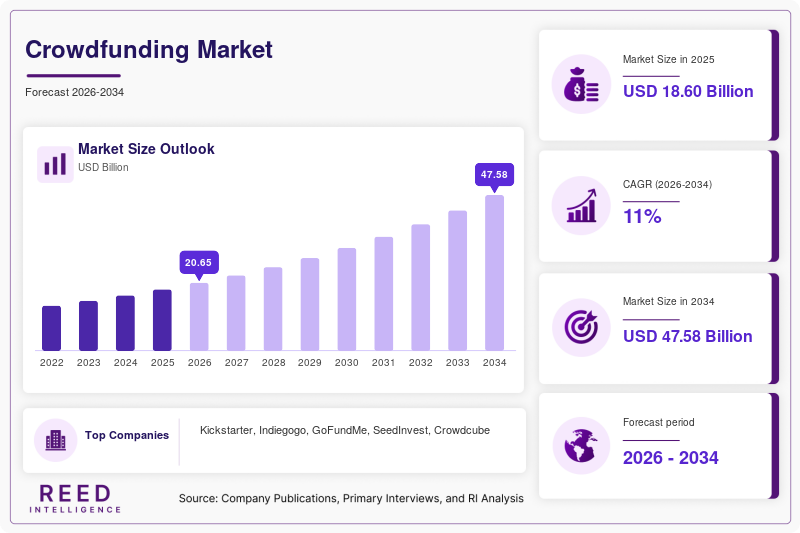
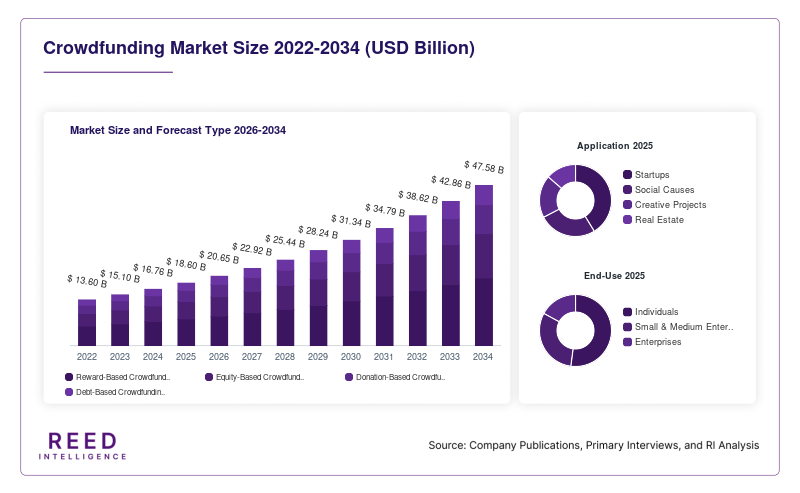
The global Crowdfunding Market was valued at approximately USD 18.6 billion in 2026 and is projected to reach USD 42.8 billion by 2034, expanding at a CAGR of 11.0% during the forecast period (2026–2034). The market has witnessed steady expansion due to the growing acceptance of alternative financing mechanisms across startups, small businesses, and social initiatives. Crowdfunding platforms have evolved into structured digital ecosystems that connect fundraisers with a diverse pool of investors, donors, and contributors, reducing dependency on traditional financial institutions.
A major global factor supporting market growth is the increasing digital penetration and adoption of fintech solutions. As internet accessibility improves and digital payment systems become more secure and widespread, crowdfunding platforms are able to reach a broader audience. This democratization of funding has enabled individuals and organizations to raise capital efficiently while offering investors new asset classes and engagement models. Furthermore, the rise of social media integration has significantly enhanced campaign visibility and success rates, further accelerating market expansion.
Key Highlights
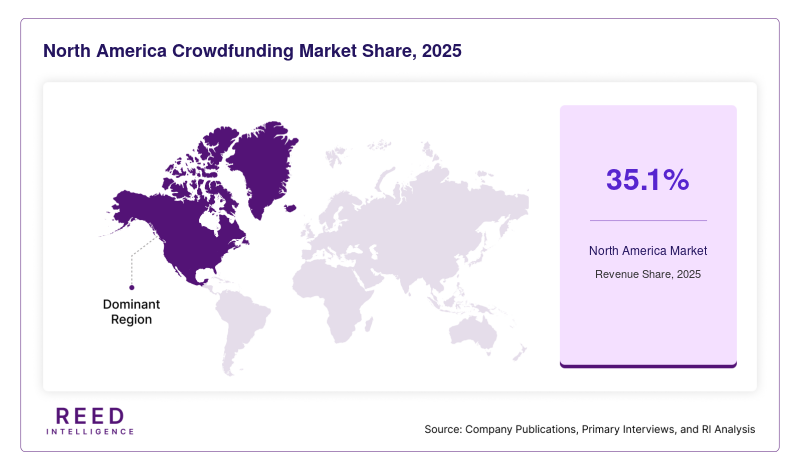
- North America dominated the market with a 35.1% share in 2025.
- Asia Pacific is expected to grow at the fastest CAGR of 12.3% during 2026–2034.
- By type, reward-based crowdfunding accounted for the largest share of 39.4%.
- while equity-based crowdfunding is projected to grow at a CAGR of 13.1%.
- By application, startups led with a 44.6% share, whereas social causes are expected to expand at a CAGR of 12.7%.
- The United States remained the dominant country, with market values of USD 6.8 billion in 2024 and USD 7.5 billion in 2025.
Market Trends
Integration of Blockchain and Tokenization in Crowdfunding Platforms
The integration of blockchain technology and tokenization is emerging as a key trend in the crowdfunding market. Platforms are increasingly leveraging decentralized ledger systems to enhance transparency, security, and traceability of transactions. Tokenization allows fundraisers to issue digital tokens representing ownership or utility, thereby expanding the appeal of crowdfunding to investors seeking diversified digital assets. This trend is particularly prominent in equity-based crowdfunding, where blockchain simplifies shareholder management and compliance processes. Additionally, smart contracts are being used to automate fund distribution and enforce conditions, reducing administrative overhead. As regulatory clarity improves in several regions, blockchain-enabled crowdfunding is expected to gain traction among both institutional and retail investors, creating a more efficient and trust-driven funding environment.
Expansion of Niche and Industry-Specific Crowdfunding Platforms
Another notable trend is the emergence of niche crowdfunding platforms tailored to specific industries such as healthcare, real estate, renewable energy, and creative arts. These specialized platforms cater to targeted investor communities and provide domain-specific expertise, increasing campaign success rates. For instance, real estate crowdfunding platforms offer structured investment opportunities with defined returns, attracting investors seeking stable income streams. Similarly, platforms focused on medical crowdfunding address urgent healthcare financing needs, particularly in regions with limited insurance coverage. This segmentation allows platforms to differentiate themselves in a competitive market while offering customized features and risk assessment tools. As investor preferences become more sophisticated, the demand for specialized crowdfunding ecosystems is expected to continue growing.
Market Drivers
Rising Demand for Alternative Financing Among Startups and SMEs
The increasing need for alternative financing solutions among startups and small and medium enterprises (SMEs) is a primary driver of the crowdfunding market. Traditional funding channels such as bank loans and venture capital often involve stringent eligibility criteria and lengthy approval processes. Crowdfunding offers a more accessible and flexible option, enabling entrepreneurs to raise capital directly from a large pool of individual investors. This approach not only provides funding but also validates business ideas through public interest and engagement. Moreover, crowdfunding campaigns often serve as marketing tools, helping startups build brand awareness and customer loyalty. As entrepreneurial activity continues to rise globally, the reliance on crowdfunding as a viable financing method is expected to increase significantly.
Growth of Digital Payment Infrastructure and Online Platforms
The rapid development of digital payment systems and online platforms has significantly contributed to the growth of the crowdfunding market. Secure and efficient payment gateways enable seamless transactions across borders, making it easier for contributors to support campaigns. The proliferation of smartphones and internet connectivity has further expanded the reach of crowdfunding platforms, allowing users to participate from virtually anywhere. Additionally, advancements in user interface design and data analytics have improved platform usability and campaign management. These technological enhancements have increased user confidence and participation rates, thereby driving market growth. As digital ecosystems continue to evolve, crowdfunding platforms are likely to benefit from enhanced scalability and operational efficiency.
Market Restraint
Regulatory Uncertainty and Risk of Fraudulent Campaigns
Regulatory uncertainty remains a significant restraint for the crowdfunding market, particularly in regions where legal frameworks are still evolving. Different countries have varying rules regarding fundraising limits, investor eligibility, and disclosure requirements, creating complexity for platform operators and users. This lack of standardization can hinder cross-border investments and limit market expansion. Additionally, the risk of fraudulent campaigns poses a challenge to market credibility. Instances of misrepresentation or misuse of funds can undermine investor trust and discourage participation. While many platforms have implemented verification processes and monitoring mechanisms, ensuring complete transparency remains a challenge. For example, campaigns that fail to deliver promised outcomes can lead to reputational damage for both the platform and the broader industry. Addressing these issues requires coordinated efforts from regulators, platform providers, and stakeholders to establish clear guidelines and enhance due diligence practices.
Market Opportunities
Increasing Adoption in Emerging Economies
Emerging economies present significant growth opportunities for the crowdfunding market due to rising internet penetration and growing entrepreneurial ecosystems. Countries in Asia Pacific, Latin America, and Africa are witnessing an increase in startup activity, creating demand for accessible funding solutions. Crowdfunding platforms can bridge the financing gap by connecting local entrepreneurs with global investors. Additionally, supportive government initiatives and fintech innovation are fostering a favorable environment for market expansion. As awareness of crowdfunding increases, these regions are expected to contribute substantially to overall market growth.
Expansion into Corporate and Institutional Funding Models
The expansion of crowdfunding into corporate and institutional funding models offers new avenues for growth. Large organizations are increasingly using crowdfunding platforms to test product concepts, engage customers, and raise capital for innovation projects. Institutional investors are also exploring crowdfunding as a means to diversify portfolios and access early-stage investment opportunities. This shift is leading to the development of hybrid models that combine traditional financing with crowdfunding mechanisms. As platforms adapt to meet the needs of corporate users, the market is expected to witness increased participation from established enterprises, further driving growth.
Segmental Analysis
By Type
Reward-based crowdfunding emerged as the dominant subsegment, accounting for 39.4% of the market share in 2024. This model allows contributors to receive non-financial rewards such as products or services in return for their support. Its popularity is driven by its simplicity and broad appeal among creative industries, including film, music, and product design. Entrepreneurs prefer reward-based crowdfunding as it enables them to validate ideas and generate early customer engagement without giving up equity. Additionally, this model is widely used for pre-order campaigns, helping businesses secure initial sales and funding simultaneously.
Equity-based crowdfunding is the fastest-growing subsegment, projected to expand at a CAGR of 13.1% during the forecast period. This growth is driven by increasing investor interest in early-stage companies and the potential for high returns. Regulatory advancements in several regions have made it easier for non-accredited investors to participate in equity crowdfunding. Furthermore, the integration of digital platforms and data analytics is improving transparency and risk assessment, attracting a broader investor base.
By Application
Startups represent the dominant application segment, accounting for 44.6% of the market share in 2024. Crowdfunding provides startups with an accessible funding source, enabling them to bypass traditional financing barriers. It also serves as a marketing tool, allowing startups to build brand awareness and engage with potential customers. The ability to test product concepts and receive feedback from contributors further enhances its value proposition for entrepreneurs.
Social causes are the fastest-growing application segment, with a projected CAGR of 12.7%. Increasing awareness of social issues and the willingness of individuals to contribute to charitable initiatives are driving this growth. Crowdfunding platforms are being used to support healthcare expenses, disaster relief, and community development projects. The emotional appeal and transparency of campaigns play a crucial role in attracting donors and ensuring successful fundraising.
By End-Use
Individuals constitute the dominant end-use segment, holding a market share of 41.2% in 2024. Individual fundraisers use crowdfunding platforms for various purposes, including personal projects, medical expenses, and creative endeavors. The ease of campaign creation and the ability to reach a global audience make crowdfunding an attractive option for individuals seeking financial support.
Small and medium enterprises (SMEs) are the fastest-growing end-use segment, expected to grow at a CAGR of 12.9%. SMEs are increasingly adopting crowdfunding to access capital for expansion, product development, and market entry. The flexibility of crowdfunding models and the ability to engage directly with customers are key factors driving this growth. As SMEs continue to play a crucial role in economic development, their adoption of crowdfunding is expected to increase significantly.
Regional Analysis
North America
North America accounted for a dominant share of 35.1% in 2025 and is expected to maintain steady growth with a CAGR of 10.2% during the forecast period. The region benefits from a mature digital ecosystem, high investor awareness, and strong regulatory frameworks that support crowdfunding activities. The presence of established platforms and a large pool of accredited investors has contributed to market stability. Additionally, the integration of advanced technologies such as AI and blockchain is enhancing platform capabilities and user experience.
The United States leads the North American market, driven by a well-developed startup ecosystem and supportive regulatory policies such as the JOBS Act. A unique growth factor is the increasing use of crowdfunding for product pre-launch validation, enabling companies to gauge consumer interest before full-scale production. This approach reduces financial risk and improves market entry strategies.
Europe
Europe held a significant market share of 27.4% in 2025 and is projected to grow at a CAGR of 10.8% during the forecast period. The region’s growth is supported by harmonized regulations under the European Crowdfunding Service Providers framework, which facilitates cross-border investments. Increasing participation from retail investors and growing awareness of alternative financing options are also contributing to market expansion.
Germany is a dominant country in the European market, driven by strong industrial and startup sectors. A unique growth factor is the increasing adoption of crowdfunding for renewable energy projects, where investors fund sustainable initiatives in exchange for returns. This trend aligns with the region’s focus on environmental sustainability and energy transition.
Asia Pacific
Asia Pacific is expected to witness the fastest growth, with a CAGR of 12.3% during 2026–2034, and held a share of 21.6% in 2025. Rapid digitalization, expanding middle-class population, and increasing entrepreneurial activity are key factors driving market growth. Governments in several countries are promoting fintech innovation, further supporting the adoption of crowdfunding platforms.
China dominates the Asia Pacific market due to its large population and advanced digital payment infrastructure. A unique growth factor is the widespread use of mobile-based crowdfunding platforms integrated with social media applications, enabling seamless user engagement and campaign promotion.
Middle East & Africa
The Middle East & Africa region accounted for a smaller share of 8.3% in 2025 but is expected to grow at a CAGR of 11.5% during the forecast period. The market is gradually gaining traction due to increasing internet penetration and rising awareness of crowdfunding as a financing option. Governments are also introducing initiatives to support startups and innovation.
The United Arab Emirates is a key country in this region, driven by its focus on becoming a fintech hub. A unique growth factor is the growing use of crowdfunding for real estate investments, allowing individuals to participate in property markets with lower capital requirements.
Latin America
Latin America held a market share of 7.6% in 2025 and is projected to grow at a CAGR of 11.1% during the forecast period. Economic diversification and increasing startup activity are driving the adoption of crowdfunding platforms. The region is also witnessing improvements in digital infrastructure, which is facilitating online transactions.
Brazil is the dominant country in Latin America, supported by a large consumer base and growing fintech sector. A unique growth factor is the increasing use of crowdfunding for social and community-driven projects, addressing local challenges and fostering inclusive development.
Competitive Landscape
The crowdfunding market is characterized by intense competition, with numerous platforms operating at global and regional levels. Leading companies focus on enhancing user experience, expanding service offerings, and ensuring regulatory compliance to maintain their market position. The market is moderately fragmented, with both established players and emerging startups competing for market share.
Kickstarter is recognized as a leading platform in the crowdfunding market, known for its strong presence in creative industries. The company has recently introduced advanced analytics tools to help campaign creators optimize their fundraising strategies. Other major players such as Indiegogo, GoFundMe, and SeedInvest are also focusing on innovation and strategic partnerships to expand their user base. These companies are investing in technology integration, including AI-driven campaign recommendations and blockchain-based solutions, to improve transparency and efficiency. As competition intensifies, platforms are likely to differentiate themselves through specialized services and enhanced user engagement.
Key Players List
- Kickstarter
- Indiegogo
- GoFundMe
- SeedInvest
- Crowdcube
- Fundable
- Patreon
- LendingClub
- Kiva
- Wefunder
- StartEngine
- Republic
- FundRazr
- Crowd Supply
- Ulule
Recent Developments
- Kickstarter launched new analytics tools to improve campaign performance tracking and user engagement.
- Indiegogo expanded its global reach by introducing localized platforms in emerging markets.
- GoFundMe enhanced its security framework to reduce fraudulent campaigns and improve donor trust.
Crowdfunding Market Segments
Type
- Reward-Based Crowdfunding
- Equity-Based Crowdfunding
- Donation-Based Crowdfunding
- Debt-Based Crowdfunding
Application
- Startups
- Social Causes
- Creative Projects
- Real Estate
End-Use
- Individuals
- Small & Medium Enterprises (SMEs)
- Enterprises
By Region
- North America
- Europe
- APAC
- Middle East and Africa
- LATAM