Crypto Wallet Market Size, Share & Growth Report By Wallet Type (Hot Wallets, Cold Wallets, Hardware Wallets), By Application (Individual Users, Commercial Enterprises, Financial Institutions) By Region & Segment Forecasts, 2026–2034
USD 3950
Crypto Wallet Market Size
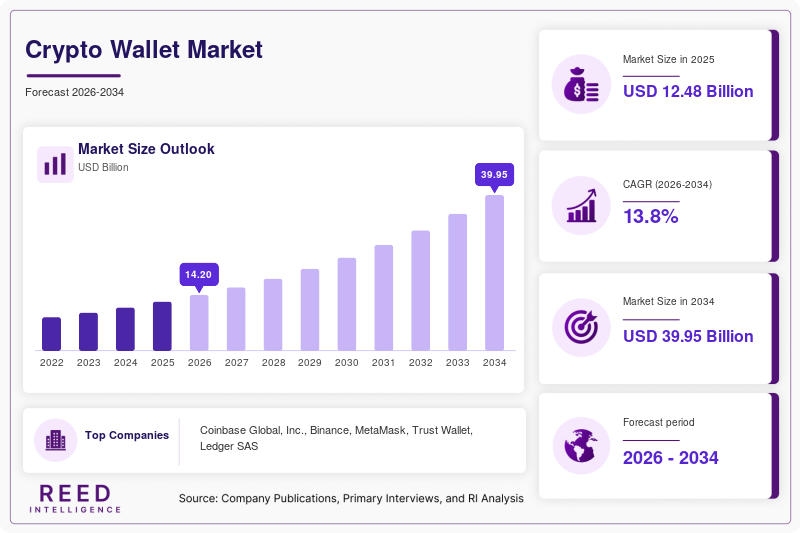
Global crypto wallet market size is projected at USD 14.2 billion in 2026 and is expected to hit USD 39.95 billion by 2034 with a CAGR of 13.8%.” The market is expanding as cryptocurrency ownership, decentralized applications, digital-asset payments, and institutional blockchain adoption increase worldwide. Detailed market data, wallet-type segmentation, application analysis, regional adoption patterns, transaction activity, and competitive positioning are essential for evaluating the rapidly evolving digital-asset ecosystem.
Key takeaways
- North America dominated the global market with approximately 34.6% share in 2026, while Asia Pacific is the fastest-growing region at an estimated 16.1% CAGR through 2034.
- Hot wallets accounted for approximately 52.4% of global revenue in 2026, while hardware wallets represent the fastest-growing wallet type at approximately 15.7% CAGR.
- Individual users represented approximately 61.8% of market revenue in 2026, supported by increasing cryptocurrency ownership, decentralized finance participation, and retail digital-asset trading.
- Financial institutions are projected to be the fastest-growing application segment, expanding at approximately 16.4% CAGR as banks and asset managers increase digital-asset custody and tokenization activities.
- India represents an emerging high-growth country market and is projected to reach approximately USD 2.6 billion by 2034, expanding at a CAGR of around 17.2% during 2026–2034.
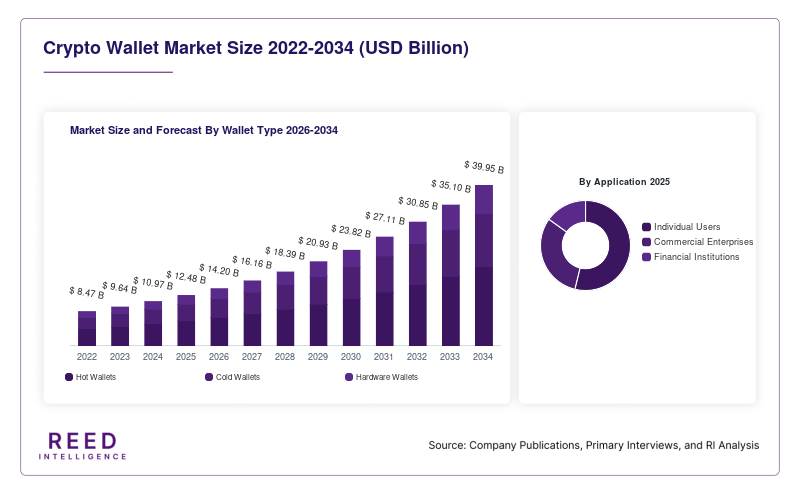
The global crypto wallet market encompasses software and hardware solutions that enable users and organizations to store, manage, send, receive, and interact with blockchain-based digital assets. The global ecosystem is estimated to support approximately 230 million active wallet users and more than 480 million wallet installations across major platforms in 2026, although individual users may operate multiple wallets. Hot wallets contribute approximately 52.4% of revenue, cold wallets 24.1%, and hardware wallets 23.5%. Adoption is being supported by cryptocurrency exchanges, decentralized finance, non-fungible tokens, blockchain gaming, stablecoins, and increasing institutional digital-asset infrastructure.
Crypto Wallet Market Trends
Multichain Architecture and Embedded Security Reshape Wallet Technology
Crypto wallet technology is shifting from single-network applications toward multichain platforms supporting numerous blockchain networks, stablecoins, tokenized assets, and decentralized applications through a single interface. Developers are increasingly incorporating biometric authentication, passkeys, multi-party computation, smart-account functionality, transaction simulation, fraud detection, and hardware-backed key storage. Wallet providers are also integrating decentralized identity and account-abstraction capabilities to reduce the complexity of blockchain transactions for mainstream users.
Sector-specific demand is expanding across retail payments, decentralized finance, gaming, creator economies, remittances, and institutional asset management. Businesses increasingly require wallets capable of managing corporate treasury assets and stablecoin transactions, while financial institutions prioritize regulated custody, policy controls, transaction monitoring, and multi-user authorization. Embedded wallets are also gaining momentum as exchanges, fintech platforms, gaming applications, and Web3 services seek to integrate digital-asset functionality without requiring users to manage complex private-key infrastructure independently.
Crypto Wallet Market Drivers
Rising Digital-Asset Ownership and Blockchain Adoption
Growth in cryptocurrency ownership and blockchain-based applications is increasing demand for secure and accessible wallet infrastructure. Stablecoins, decentralized finance, tokenized assets, blockchain gaming, and cross-border transactions are expanding wallet use cases beyond speculative trading. Greater availability of mobile wallets, simplified onboarding, biometric authentication, and integrated exchange functionality is also reducing barriers for retail users, while institutional adoption is increasing demand for enterprise-grade custody and transaction-management solutions.
Crypto Wallet Market Restraints
Security Risks and Complex Regulatory Requirements
Cyberattacks, phishing, malware, compromised private keys, fraudulent applications, and social-engineering attacks remain significant barriers to wallet adoption. Users can permanently lose access to assets if recovery credentials are compromised or incorrectly stored. Regulatory requirements concerning custody, anti-money-laundering controls, consumer protection, and digital-asset reporting also vary substantially across jurisdictions. These factors increase compliance costs for providers and can slow the rollout of wallet services in regulated financial markets.
Crypto Wallet Market Opportunities
Institutional Custody and Embedded Wallet Expansion
Institutional digital-asset custody, tokenized financial instruments, stablecoin payments, and embedded wallet infrastructure represent significant growth opportunities. Wallet providers can expand through partnerships with banks, fintech companies, exchanges, payment processors, gaming platforms, and Web3 applications. Multi-party computation, smart accounts, policy-based transaction controls, and automated compliance monitoring can further improve institutional adoption. Emerging markets also provide opportunities as mobile-first consumers increasingly use blockchain technology for payments, savings, and international transfers.
Challenges in Crypto Wallet Market
Balancing Usability, Security, and Decentralization
Wallet providers face the challenge of delivering simple user experiences without weakening security or compromising decentralized ownership principles. Self-custody requires users to understand private keys, recovery phrases, and transaction approvals, while custodial products introduce counterparty and regulatory risks. Fragmentation across blockchain networks also increases development complexity. Providers must continuously upgrade security systems against new attack methods while supporting interoperability, faster transactions, lower fees, and increasingly sophisticated decentralized applications.
Crypto Wallet Market Segmentation Analysis
By wallet type, hot wallets dominated the market with approximately 52.4% of global revenue in 2026 because of their accessibility, low entry barriers, and integration with trading platforms. Cold wallets represented approximately 24.1%, while hardware wallets contributed 23.5%. By application, individual users accounted for nearly 61.8% of revenue, followed by commercial enterprises at 23.4% and financial institutions at 14.8%.
By Type
Hot Wallets: Hot wallets represented approximately 52.4% of market revenue in 2026, supported by an estimated 250 million active installations globally. These internet-connected wallets include mobile, desktop, browser, and exchange-integrated applications. Leading systems increasingly support multiple blockchain networks, biometric authentication, encrypted private keys, token swaps, decentralized application connectivity, and transaction simulation. Their rapid accessibility makes them particularly popular among retail traders and frequent digital-asset users.
Cold Wallets: Cold wallets accounted for approximately 24.1% of global revenue, with around 75 million active devices and storage solutions in 2026. These products keep private keys offline and commonly include air-gapped or disconnected storage mechanisms. Advanced solutions incorporate encrypted backup systems, secure recovery procedures, offline transaction signing, and tamper-resistant designs. Cold storage is particularly attractive to long-term cryptocurrency holders and users managing larger digital-asset balances.
Hardware Wallets: Hardware wallets generated approximately 23.5% of global revenue in 2026, with estimated production of 18 million dedicated devices. Typical products use secure elements, PIN protection, encrypted key storage, physical confirmation buttons or touchscreens, and USB or wireless connectivity. Newer devices increasingly support passkeys, multiple blockchain networks, NFT management, staking, and decentralized application authentication, strengthening their position in the premium self-custody segment.
By Application
Individual Users: Individual users generated approximately 61.8% of global market revenue in 2026 and represented more than 190 million active wallet users. Retail applications include cryptocurrency storage, trading, decentralized finance, NFT ownership, blockchain gaming, remittances, and digital payments. Mobile wallets account for a substantial portion of consumer usage because they combine convenience with biometric authentication and integrated token-management features.
Commercial Enterprises: Commercial enterprises contributed approximately 23.4% of global revenue in 2026, representing around 55 million enterprise-linked wallet accounts and managed addresses. Businesses use wallets for cryptocurrency treasury management, supplier payments, customer rewards, digital commerce, tokenized assets, and cross-border settlements. Enterprise products increasingly provide multi-user approvals, spending policies, accounting integrations, transaction monitoring, and role-based access controls to reduce operational and security risks.
Financial Institutions: Financial institutions represented approximately 14.8% of global revenue in 2026, with more than 12 million institutional wallet and custody accounts across banks, asset managers, payment companies, and regulated digital-asset providers. Institutional systems emphasize multi-party authorization, secure custody, transaction monitoring, compliance controls, policy engines, and integration with existing financial infrastructure. Demand is increasing as institutions explore tokenized securities, stablecoins, digital-asset funds, and blockchain-based settlement.
Crypto Wallet Market Regional Analysis
North America Crypto Wallet Market
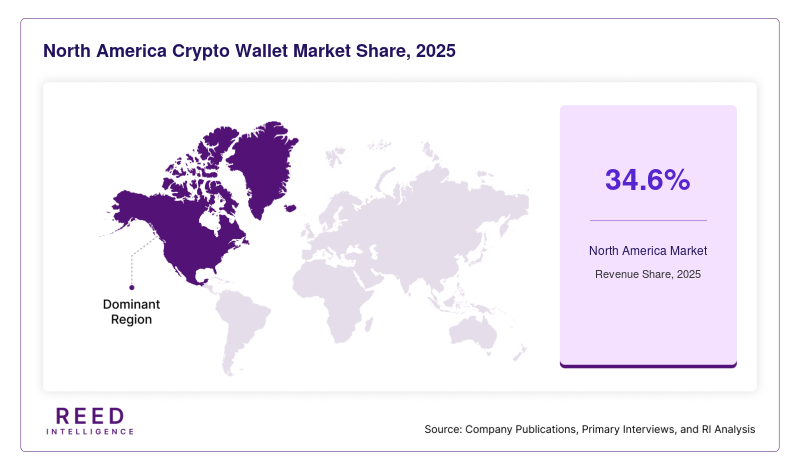
North America held the leading regional share at approximately 34.6% in 2026, with the United States contributing the majority of regional revenue, followed by Canada. The region benefits from strong cryptocurrency ownership, established blockchain companies, sophisticated fintech infrastructure, and institutional digital-asset activity. Individual users contribute approximately 57% of regional revenue, while enterprises account for 25% and financial institutions approximately 18%. Growing institutional custody and stablecoin adoption are strengthening demand.
Europe Crypto Wallet Market
Europe accounted for approximately 26.8% of global revenue in 2026, with the United Kingdom, Germany, France, Switzerland, and Italy representing significant contributors. Regulatory development and increasing integration of digital assets into financial services are supporting enterprise and institutional wallet demand. Individual users account for approximately 59% of regional revenue, commercial enterprises 24%, and financial institutions 17%. Demand is increasingly centered on compliant custody, transaction monitoring, and regulated digital-asset services.
Asia Pacific Crypto Wallet Market
Asia Pacific represented approximately 25.7% of the global market in 2026 and is the fastest-growing major region, expanding at approximately 16.1% CAGR. China, India, Japan, South Korea, Singapore, and Australia contribute substantially to regional activity. India and Southeast Asian markets are experiencing particularly strong mobile-first adoption. Individual users account for nearly 66% of regional revenue, enterprises 22%, and financial institutions 12%, with remittances, Web3 applications, and digital payments supporting expansion.
Latin America Crypto Wallet Market
Latin America contributed approximately 7.5% of global revenue in 2026, led by Brazil, Mexico, Argentina, and Colombia. Cryptocurrency wallets are increasingly used for cross-border transfers, savings, payments, and protection against local currency volatility. Individual users represent approximately 71% of regional revenue, while commercial enterprises contribute 20% and financial institutions 9%. Mobile wallet adoption and stablecoin usage provide significant opportunities across the region.
Middle East & Africa Crypto Wallet Market
The Middle East & Africa region represented approximately 5.4% of global revenue in 2026, with the United Arab Emirates, Saudi Arabia, South Africa, and Nigeria among the major contributors. Digital-asset hubs, fintech development, remittances, and blockchain investment are supporting adoption. Individual users account for approximately 68% of regional revenue, commercial enterprises 22%, and financial institutions 10%. Expanding digital-finance infrastructure is expected to accelerate wallet adoption through 2034.
Top players in Crypto Wallet Market
- Coinbase Global, Inc.
- Binance
- MetaMask
- Trust Wallet
- Ledger SAS
- Trezor
- Exodus Movement, Inc.
- Blockchain.com
- Crypto.com
- BitGo, Inc.
- Safe
- Phantom Technologies, Inc.
Recent Developments in Crypto Wallet Market
- January 2026: Major wallet providers expanded multichain support, enabling users to manage additional blockchain networks and digital assets through unified interfaces.
- March 2026: Wallet developers increased integration of passkeys, biometric authentication, smart accounts, and account-abstraction features to improve security and simplify onboarding.
- May 2026: Institutional wallet providers expanded custody and treasury-management capabilities for enterprises managing cryptocurrencies, stablecoins, and tokenized assets.
- July 2026: Hardware-wallet manufacturers introduced updated devices emphasizing secure elements, improved displays, wireless connectivity, and broader blockchain compatibility.
- August 2026: Crypto wallet platforms strengthened embedded-wallet partnerships with fintech, gaming, decentralized application, and payment ecosystems to expand mainstream digital-asset adoption.
Crypto Wallet Market Segments
By Wallet Type
- Hot Wallets
- Cold Wallets
- Hardware Wallets
By Application
- Individual Users
- Commercial Enterprises
- Financial Institutions
By Region
- North America
- Europe
- APAC
- Middle East and Africa
- LATAM